Global Trade Nuclear Blast: How Trump's "Tariff Tsunami" Shattered Wall Street Consensus in 72 Hours
TechFlow Selected TechFlow Selected
Global Trade Nuclear Blast: How Trump's "Tariff Tsunami" Shattered Wall Street Consensus in 72 Hours
The Trump administration escalated the trade war between the United States and other countries to a nuclear deterrence stage of "mutual assured destruction" with a single official document.
 Navigating Web3 tides with focused insights
When the S&P index confidently posted gains during Friday's early trading session, traders hadn't yet realized that a midnight fax machine in Washington was spitting out a historic document rewriting the script of globalization—Trump's administration had just escalated the U.S. trade war with other nations into a "mutually assured destruction" phase akin to nuclear deterrence.
Following up on my previous article, the relatively mild tariff scenario I anticipated did not materialize. Instead, broad-based tariffs were imposed, with only energy products exempted. Canada did not back down but immediately retaliated by imposing 25% tariffs on $155 billion worth of U.S. goods.
This triggered the U.S. cross-retaliation clause, signaling an escalation in tensions, and significantly diminished expectations that Canada would quickly capitulate. China and Mexico have also threatened retaliation but have not yet announced specific measures, leaving some room (though unlikely) for de-escalation between these countries and the U.S.
As previously stated, markets had underestimated the tariff impact because Trump’s promised inauguration-day tariffs showed no movement for nearly two weeks, followed by the initiation of a Section 301 investigation—a process expected to take several months or even a year. Most analysts therefore believed that imposing tariffs on allies was merely a “maximum pressure” negotiation tactic, with actual implementation months away.
CNN’s summary below illustrates well how policies were communicated verbally, creating ambiguity in expectations, explaining why most people didn’t believe “comprehensive” tariffs would be implemented, and why markets failed to price them in:
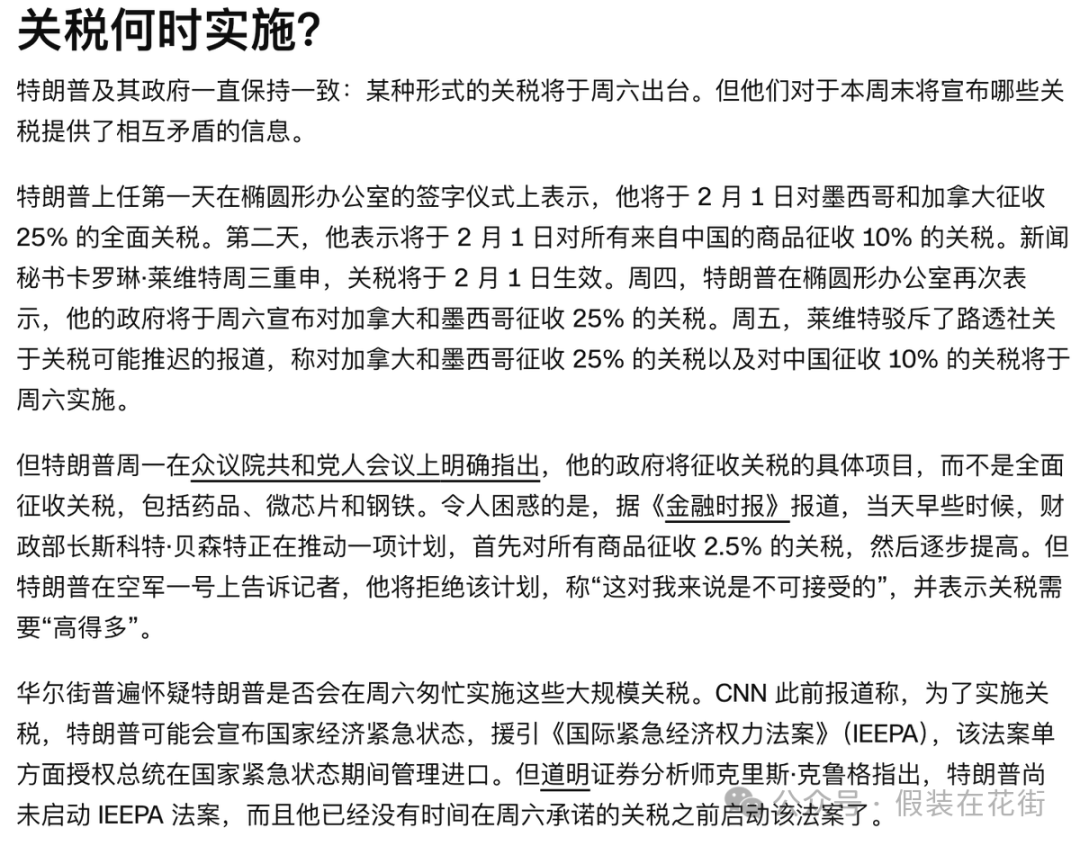
Last week’s violent rebound in U.S. stocks, pushing indices back to high levels, confirms that this impact was not priced in. If the market had fallen last week and failed to recover, the situation might have been less severe.
The real recognition of this possibility only began in the second half of Friday—too late for proper pricing. The cryptocurrency plunge over the weekend clearly reflects both growing market awareness and significant lag.
A Monday gap-down open in U.S. stocks along with simultaneous stock-bond sell-offs is inevitable. If gold falls too, it signals a liquidity crisis, leading to oversold conditions and presenting a good buying opportunity.
China faces smaller marginal impacts compared to allied nations, as it already faces average tariffs of 20–30%; an additional 10% is relatively manageable. In contrast, Mexico and Canada face single-digit average tariffs, so the marginal change is far greater. Thus, Chinese equities may see limited downside.
Additionally, Trump posted a message urging Americans to “tighten their belts,” further reinforcing market expectations that high tariffs could persist longer:
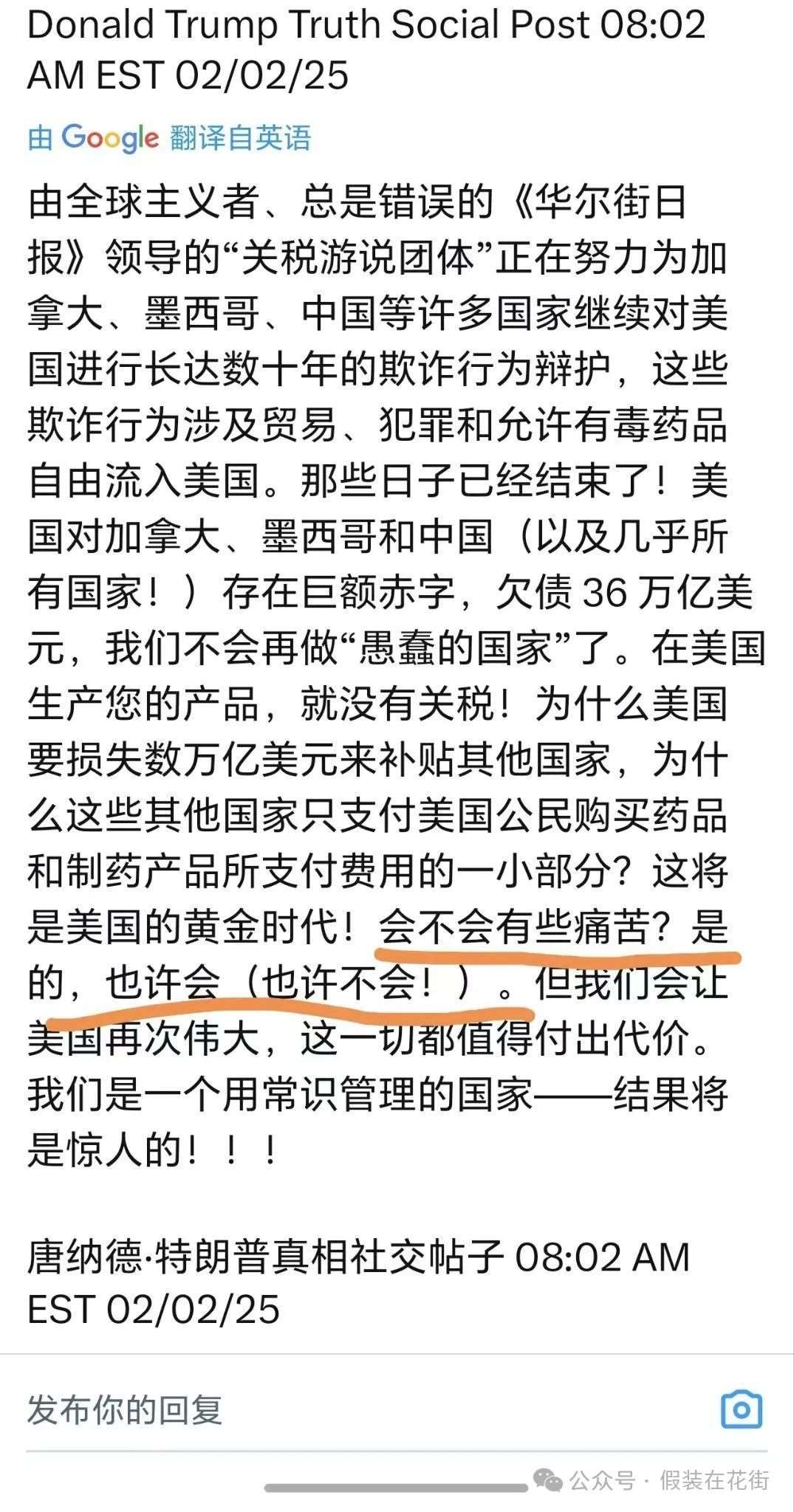
Therefore, underpriced to begin with, each additional day of high tariffs accumulates more negative effects over time: the longer other countries show no signs of constructive engagement or retaliation, the more likely these tariffs will be perceived as permanent—and the more negative the market reaction becomes.
For optimists looking ahead, three developments are worth watching: first, whether there are any negotiation breakthroughs with China, Mexico, and Canada; second, whether U.S. courts issue injunctions; third, whether Trump, having seen market concerns about the economy, introduces supportive policies such as deregulation, liquidity support, or tax cuts (e.g., personal income tax). Any positive moves in these areas could potentially halt the decline.
Further elaborating on the second point: Trump’s Saturday tariff hike invoked the “International Economic Emergency Power Act” (IEEPA). In theory, invoking IEEPA allows the president not only to unilaterally adjust tariffs but also to freeze assets of any foreign individual or government—not just domestically, but internationally (with foreign cooperation). This effectively places the economic fate of all nations in Trump’s hands. (Arbitrarily activating such legal provisions legitimizes unconventional measures and will only accelerate global decoupling from the U.S., undermining the dollar’s long-term credibility.)
However, since IEEPA has historically been used primarily for economic and financial sanctions, this is the first time it’s being applied to import tariffs. Affected parties (e.g., U.S. importers claiming damages) may seek temporary injunctions. Courts will likely uphold the president’s authority, making the coming days a critical test of Trump’s power and potentially triggering additional market volatility.
Some believe this case differs from Trump’s first-day executive order on birthright citizenship—which was temporarily blocked due to domestic controversy—as this involves external conflict, where “the judiciary cannot possibly tie its own hands.” I agree, but we must also acknowledge that judicial intervention is not impossible. There’s even a chance it could be orchestrated—Trump might instruct U.S. importers to file lawsuits, prompting courts to pause enforcement temporarily. This would minimize economic damage while maintaining maximum pressure on adversaries, though such a scenario remains speculative.
In any case, watch this closely—any related news could trigger a violent rebound.
Personally, I’m increasingly convinced that Trump genuinely intends to use tariff revenues to subsidize personal income tax cuts. After all, the U.S. did function without income tax a century ago, and Trump believes the economy can thrive just as well today.
Join TechFlow official community to stay tuned
Telegram:https://t.me/TechFlowDaily
X (Twitter):https://x.com/TechFlowPost
X (Twitter) EN:https://x.com/BlockFlow_News