Using Taiko to explain the concept of preconfirmation: How to make Ethereum transactions more efficient?
2024.11.21
Share Share to X (Twitter) Navigating Web3 tides with focused insights
Share to WeChat
Share to WeiboShare to WeChat
Share by Link
Share by Image
TechFlow Selected TechFlow Selected
Using Taiko to explain the concept of preconfirmation: How to make Ethereum transactions more efficient?
This article will take Taiko as an example to deeply analyze the concept of preconfirmation.
2024.11.21 - 00:20:33
Taiko
Navigating Web3 tides with focused insightsThis article will take Taiko as an example to deeply analyze the concept of preconfirmation.
Author: Ingeun Kim :: FP

Key Overview
- Taiko is a Layer 2 network based on Based Rollup, aiming for full interoperability with Ethereum while advancing sequencer decentralization. To address the delay in transaction finality inherent in Rollup mechanisms, Taiko introduces the concept of "preconfirmation." By providing users with early guarantees on transaction inclusion and ordering, preconfirmation effectively mitigates inefficiencies in Rollup confirmation processes, significantly enhancing user experience.
- In the Based Preconfirmation model, L1 validators offer users assurance on transaction outcomes. Preconfirmers must stake collateral and adhere to slashing mechanisms to ensure system reliability. Projects like Taiko leverage preconfirmation to establish reliable transaction finality, creating a more seamless operational environment for real-time services such as DeFi.
- Multiple projects are now actively contributing to the development of the preconfirmation ecosystem. This technological advancement has the potential to improve efficiency across the Ethereum L2 landscape, strengthen interoperability with Ethereum, and drive further expansion of the broader ecosystem.
Current L2 Efficiency Challenges
As the L2 ecosystem expands, numerous new projects have emerged, introducing novel concepts and technical stacks. Nevertheless, despite these advancements, L2s continue to face pressing efficiency issues—particularly in areas that directly impact user experience, where improvements are most needed.Inherent Limitations of Rollups: Inefficient Transaction Finality Process
 L2s achieve scalability via Rollups, relying on Ethereum or other L1 platforms for data availability and transaction processing. However, Rollups have an inherent limitation: although they can independently perform transaction ordering and execution, all subsequent steps must wait for final confirmation on L1.
This architecture ensures security and data immutability by leveraging L1 block production and data availability. Yet, dependence on L1 for finality results in slower transaction processing and limited real-time confirmability, making it difficult to meet user demands for immediacy.
Moreover, many L2 sequencers and validator nodes remain centralized today. This centralization leads to inefficiencies such as prolonged confirmation times and potential service disruptions, negatively affecting transaction processing efficiency and causing confirmation delays in some Rollups.
L2s achieve scalability via Rollups, relying on Ethereum or other L1 platforms for data availability and transaction processing. However, Rollups have an inherent limitation: although they can independently perform transaction ordering and execution, all subsequent steps must wait for final confirmation on L1.
This architecture ensures security and data immutability by leveraging L1 block production and data availability. Yet, dependence on L1 for finality results in slower transaction processing and limited real-time confirmability, making it difficult to meet user demands for immediacy.
Moreover, many L2 sequencers and validator nodes remain centralized today. This centralization leads to inefficiencies such as prolonged confirmation times and potential service disruptions, negatively affecting transaction processing efficiency and causing confirmation delays in some Rollups.
The Emergence of Preconfirmation
The concept of preconfirmation was introduced to resolve the inefficiency of transaction finality in L2 networks. Preconfirmation enables users to receive faster transaction confirmation, alleviating common delays and bottlenecks in Rollup systems.What Problems Does Preconfirmation Aim to Solve?
In Rollup systems, the process of confirming transactions after submission to L2 suffers from persistent inefficiencies. Because centralized L2 sequencers cannot reliably guarantee when a transaction will be confirmed on L1, users often lack certainty about transaction order and outcome. For example, users may endure long waits for their transactions to be included on L1; if the order is incorrect or the result unfavorable, it could lead to financial losses from executed trades. These issues become even more pronounced in highly volatile market conditions, where users rely heavily on arbitrage and DeFi services. In such cases, delayed or reordered transactions directly result in missed opportunities. Even ordinary users may lose confidence in the timing and sequence of final L1 confirmations, raising doubts about blockchain's reliability and usability. Therefore, the design objective of preconfirmation is to bridge these gaps—especially improving the experience for users most affected by Rollup inefficiencies, offering them a smoother and more trustworthy transaction process.How Does Preconfirmation Solve These Issues?
Preconfirmation addresses these problems by providing users with guarantees on transaction inclusion, ordering, and execution. It allows centralized L2 sequencers to issue a “soft confirmation” and sign a preconfirmation receipt, assuring users that their transaction will eventually be included on L1. The main advantage of soft confirmation lies in improved user experience. After submitting a transaction, users immediately receive confirmation, ensuring their transaction will be included on L1 in the expected order—reducing uncertainty, especially in time-sensitive operations like arbitrage. Furthermore, preconfirmation strengthens user trust in the L2 system. As confidence in secure transaction handling grows, overall usage of the L2 ecosystem increases. Thus, preconfirmation plays a key role in enhancing both the efficiency and convenience of Rollup processing.Is Preconfirmation the Ultimate Solution?
Although soft confirmations from centralized sequencers enhance user experience by promising specific ordering and outcomes, they rely fundamentally on trust in the sequencer. Without legal or technical enforcement, users must depend solely on the sequencer’s integrity. This dependency creates risks: transactions might not be included in the correct order—or at all—on L1, failing to deliver the stability users expect.Understanding Based Preconfirmation Through Taiko
Taiko has invested significant effort into implementing Based Preconfirmation, as this approach aligns closely with the core characteristics of Based Rollup. If Based Preconfirmation is successfully integrated into Taiko’s framework, it could drastically reduce transaction finality latency and greatly improve user experience. Additionally, this enhancement would unlock previously constrained services, enabling them to operate efficiently on the Taiko network. Before diving deeper into Based Preconfirmation, it’s essential to review some of Taiko’s key features to fully appreciate the applicability and benefits of this method.Taiko Case Study
Taiko exemplifies the core traits of Based Rollup. It achieves full interoperability with Ethereum infrastructure and strives to align completely with Ethereum’s security model. Using a Based Rollup architecture, Taiko does not rely on centralized sequencers. Instead, it leverages Ethereum validators themselves as sequencers responsible for transaction and block ordering. In other words, Taiko’s sequencers are the same entities as Ethereum block proposers. This design grants them unique responsibilities and incentives—such as earning maximum extractable value (MEV) rewards and other benefits tied to their sequencer role. Consequently, if issues arise during Taiko’s L2 sequencing process, these sequencers naturally bear responsibility due to their vested interests within the Ethereum ecosystem. This mechanism sets Taiko apart operationally from other Ethereum L2 projects. Additionally, Taiko’s Based Rollup model is designed as a “Based Contestable Rollup (BCR),” structured to encourage healthy competition. With an open, permissionless design, Taiko ensures decentralization, allows anyone to participate, and promotes fairness and transparency.Preconfirmation Built for Based Rollup
So what does a preconfirmation model specifically designed for Based Rollup look like? The answer is “Based Preconfirmation.” This model replaces traditional soft confirmation by offering verifiable confirmation directly on L1. Based Preconfirmation establishes a system where certain L1 validators voluntarily participate and provide preconfirmation services. Acting as sequencers, these validators give users provable predictions of Rollup transaction outcomes. This provides users with credible assurances on transaction inclusion and ordering—assurances rooted directly in L1, thereby increasing the trustworthiness and reliability of the Rollup process. Justin Drake first proposed the concept of Based Preconfirmation and introduced a specialized role called the “Preconfer,” who offers signed guarantees to users regarding transaction order and execution status. To ensure commitment reliability, each Preconfer must stake collateral. Failure to uphold promises on transaction order or execution triggers a slashing penalty—resulting in partial or total loss of their stake.
The slashing mechanism, widely used in Ethereum’s PoS staking, effectively deters malicious behavior. It reinforces accountability among Preconfers and builds a foundational level of trust between them and users.
Two scenarios trigger slashing penalties for Preconfers:
Justin Drake first proposed the concept of Based Preconfirmation and introduced a specialized role called the “Preconfer,” who offers signed guarantees to users regarding transaction order and execution status. To ensure commitment reliability, each Preconfer must stake collateral. Failure to uphold promises on transaction order or execution triggers a slashing penalty—resulting in partial or total loss of their stake.
The slashing mechanism, widely used in Ethereum’s PoS staking, effectively deters malicious behavior. It reinforces accountability among Preconfers and builds a foundational level of trust between them and users.
Two scenarios trigger slashing penalties for Preconfers:
- Liveness Faults: A liveness fault occurs if a Preconfer fails to include a user’s preconfirmed transaction on-chain for any reason. Since liveness faults aren’t always intentional—possibly caused by network issues or disruptions in L1/L2 chains—the penalties are relatively mild. To protect honest Preconfers from unfair punishment, the penalty amount is typically negotiated between the user and the Preconfer.
- Safety Faults: A safety fault happens when a preconfirmed transaction is included on-chain but produces a result inconsistent with the user’s original request. Such discrepancies are entirely the Preconfer’s responsibility, so safety fault penalties are much stricter. The Preconfer’s entire stake is forfeited, regardless of intent.
Why Are Users Willing to Pay for Preconfirmation?
This question ties directly to the core purpose of preconfirmation. Users are willing to pay because it directly addresses the inefficiency of transaction finality in Rollups, delivering tangible convenience. For example, when a user submits a preconfirmed transaction on an L2 chain via their personal wallet, standard transactions may require waiting for final confirmation. In contrast, a user requesting preconfirmation receives immediate assurance from the Preconfer—completing the transaction without delay. At this point, the user might even see a green checkmark in their wallet interface, clearly indicating successful transaction completion. Take DeFi services as another example: when users swap tokens on an L2 DeFi platform, preconfirmation adds an extra layer of protection. Normally, exchange rates or fees might differ between quote time and actual execution due to delays. But with preconfirmation, users enjoy fast and efficient final confirmation, minimizing discrepancies between expected and actual outcomes—delivering a more reliable service experience. These use cases enable developers to offer more precise services and give users a smoother, more convenient experience. This dynamic further supports the growth of the L2 ecosystem and contributes to the broader expansion of the L1 ecosystem. Moreover, for Based Rollup sequencers, the additional income from preconfirmation creates a compelling business model. This design effectively addresses some traditional weaknesses of Based Rollups, making it an ideal and attractive choice for sequencers.Challenges Facing Based Preconfirmation
Based Preconfirmation remains a prominent area of research for Rollup-driven Layer 2 projects like Taiko. While this mechanism offers a clear path to improving L2 performance and scalability without sacrificing decentralization, several challenges remain before widespread adoption can be achieved. First, when a Preconfer submits a transaction to a block, users still cannot receive absolute guarantees of inclusion. Although Preconfers back their commitments with staked collateral, this mechanism cannot fully eliminate risks arising from external disruptions that prevent transaction inclusion. Especially when the transaction value exceeds the Preconfer’s stake, there’s a risk the Preconfer might abuse their power—selectively including or excluding transactions—posing potential threats. Another major challenge lies in the economic sustainability of the preconfirmation model. Preconfers primarily earn income from user-paid preconfirmation fees. However, if too few Preconfers exist or participation is low, the market may become centralized, leading to monopolistic tendencies. In such cases, preconfirmation fees could be artificially inflated, increasing the cost for users seeking fast, efficient transactions—and threatening the healthy development of the preconfirmation ecosystem. It’s important to note that Based Preconfirmation is a relatively new concept, introduced only about a year ago. To become the “key tool” that maximizes speed and efficiency for Rollup-driven L2 solutions, it will require further practical testing and refinement. Nonetheless, given that Rollups have firmly established themselves as core components of Ethereum’s scalability roadmap, continued exploration of preconfirmation marks a significant step forward in L2 technology. Notably, Taiko has already made substantial progress in advancing Based Preconfirmation. Additionally, Taiko is collaborating with partners including Taiko Gwyneth, Nethermind, Chainbound, Limechain, Primev, and Espresso to jointly explore and develop applications for Based Preconfirmation. These collaborations aim to drive the next stage of L2 ecosystem evolution, with further details to be discussed in upcoming sections.Preconfirmation Ecosystem Landscape: Flowchart Analysis and Project Exploration
In this section, we examine which projects are actively researching and advancing preconfirmation technologies within Rollup-driven L2 ecosystems. Given that this ecosystem is still in its early stages, we’ll use a flowchart to visually illustrate the preconfirmation process.Preconfirmation Flowchart
Preconfirmation is a complex process requiring close coordination between L1 and L2, involving multiple roles, each with distinct responsibilities. To make the process easier to grasp, I’ve created a simplified flowchart. Note that this diagram focuses on explaining the overall logic and does not strictly differentiate between Rollup and Based Rollup characteristics, instead presenting a generalized base-level workflow. Before walking through the flowchart steps, let’s identify the key participants and their functions:
- User: An individual using the L1 or L2 network who creates and submits transactions. If they desire preconfirmation, they send their transaction to a Preconfer.
- Preconfer: Responsible for reviewing and validating transactions, then issuing a preconfirmation guarantee to the user. This allows users to quickly obtain assurance on transaction status before final settlement. Nodes without preconfirmation privileges act as Non-Preconf Actors, handling regular transactions similar to standard validators.
- L1 Validator: Responsible for final verification of transactions and blocks on the L1 network. Once a Preconfer submits transaction data, L1 validators verify it and record the final data onto the L1 chain, ensuring compliance with consensus rules.
- Preconfirmation Challenge Manager: Handles disputes or issues that arise during preconfirmation, investigating and taking appropriate actions. This role is crucial for maintaining fairness and reliability in the process.
- A user sends a transaction request to a Preconfer to initiate the preconfirmation process.
- The Preconfer reviews the transaction and issues a preconfirmation receipt, committing to include the transaction in an L1 block—providing the user with preliminary finality assurance.
- The Preconfer submits the transaction data (either individual or aggregated by an L2 sequencer) to L1 validators.
- L1 validators verify the submitted data and record it into an L1 block, ensuring it complies with consensus rules.
- After some time, the L1 block containing the data reaches finality, and the transaction is officially confirmed.
- Users can check the final transaction result via an L1 node and, if necessary, file a dispute or challenge based on relevant information.
- If a transaction is not correctly included on L1 as promised, the Preconfer faces penalties from the Preconfirmation Challenge Manager—such as having their stake slashed or assets frozen.
Exploring Key Projects
Below is a detailed analysis of major projects actively involved in the preconfirmation ecosystem and their respective roles in the process. While these projects occupy specific positions in the flowchart, their actual responsibilities may vary slightly. This overview serves as a foundational guide. Projects within each category are listed alphabetically for clarity.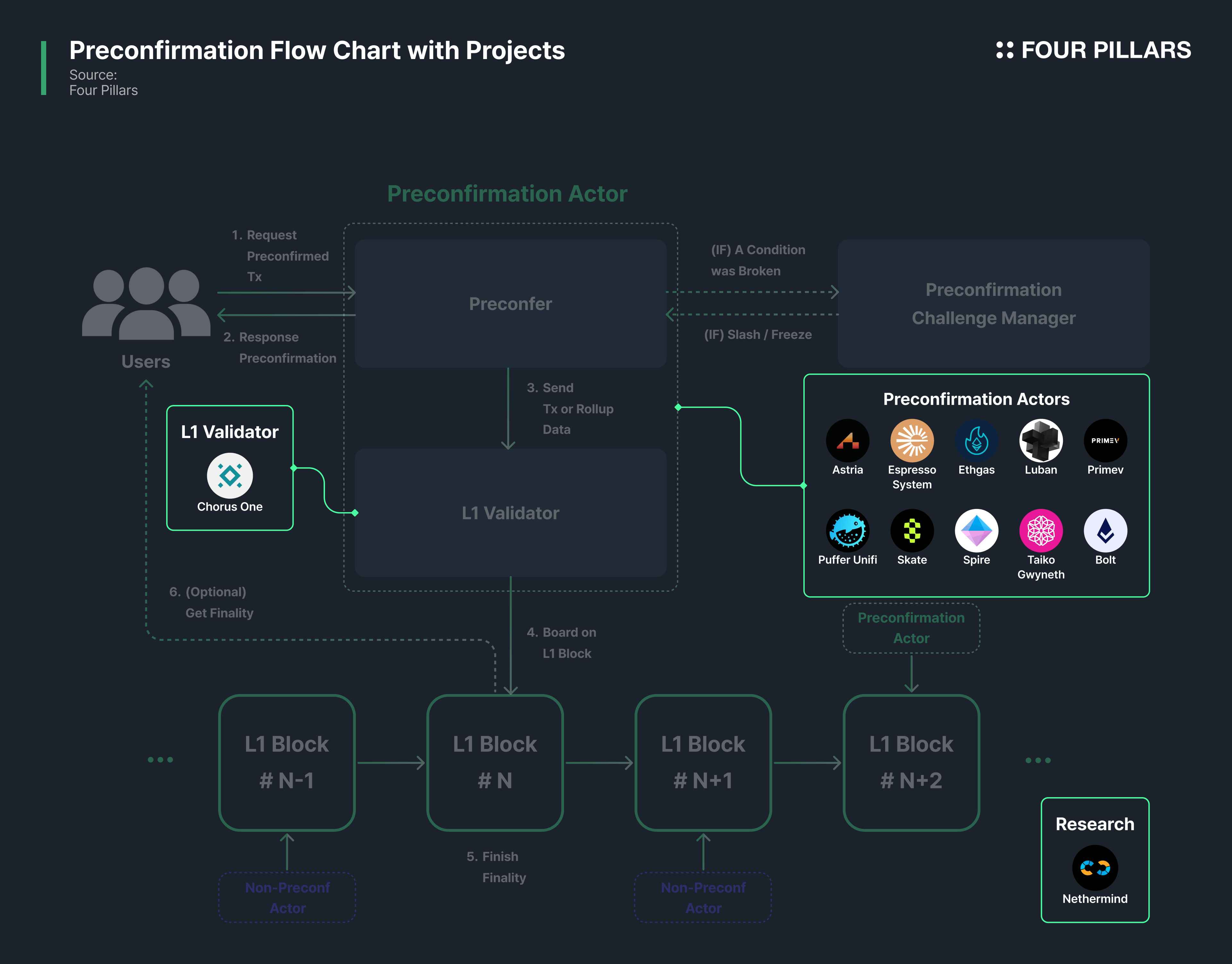
Preconfer Validators
- Astria: Astria aims to replace centralized sequencers with a decentralized sequencer network supporting multiple Rollups. This design offers stronger censorship resistance, faster block finality, and seamless cross-Rollup interactions. To achieve rapid finality, Astria integrates preconfirmation, enabling Rollups to provide instant transaction confirmation and enhanced censorship resistance—greatly improving user experience.
- Bolt by Chainbound: Bolt is a preconfirmation protocol developed by Chainbound, offering near-instant transaction confirmation for Ethereum users. Operating on a trustless participation model with economic staking, Bolt integrates with existing MEV-Boost PBS pipelines, creating new revenue streams for proposers. Its core function is L1 preconfirmation, delivering immediate finality for basic transactions (e.g., transfers and approvals), thereby enhancing user experience. By shifting inclusion responsibility from centralized block builders to proposers, Bolt improves censorship resistance. Its staked proposer registration mechanism ensures a trustless environment and supports various smart contract types.
- Espresso System: Espresso System is a protocol focused on enhancing blockchain interoperability. It employs the HotShot Byzantine Fault Tolerant (BFT) consensus to achieve fast transaction ordering and data finality across chains. Comprising Espresso Network and Espresso Marketplace, it works synergistically to deliver rapid finality and efficient interoperability, aiming to boost scalability and security across blockchain ecosystems.
- Ethgas: Ethgas is a marketplace for transaction block space, with matching managed centrally and on-chain execution via smart contracts. Ethgas offers two main features: inclusion preconfirmation (guaranteeing transaction inclusion within a specified gas limit) and execution preconfirmation (ensuring transactions reach a specific state or outcome). Ethgas emphasizes privacy protection in block space trading and operates with a neutral stance.
- Luban: Luban focuses on building a decentralized sequencing layer connecting Ethereum and Rollups. Designed as a decentralized system, it separates proposal and execution roles. Luban’s preconfirmation functionality enhances transaction reliability by verifying executability before inclusion on Ethereum, while also optimizing key factors like fees, gas prices, and MEV.
- Primev: Primev is developing a proposer network integrated with MEV, combining preconfirmation with MEV capabilities to build an efficient, reliable peer-to-peer network. The network records commitments to Ethereum transaction execution and uses reward/punishment mechanisms to incentivize proposers. Primev allows MEV participants to set specific execution conditions, which block builders and validators commit to fulfill—ensuring preconfirmation. Based on EIP-4337, it supports flexible preconfirmation and gas fee options, boosting transaction efficiency and user experience.
- Puffer Unifi: Puffer Unifi’s Actively Validated Services (AVS) is built on EigenLayer, targeting preconfirmation challenges in the Ethereum ecosystem—especially within Based Rollup architectures. Leveraging EigenLayer’s restaking functionality, Puffer Unifi AVS supports participation in preconfirmation mechanisms to improve finality efficiency. As demand for reliable preconfirmers grows with Based Rollup adoption, Puffer Unifi AVS aims to meet this need. Its vision is to enable high-efficiency preconfirmation without modifying core protocols, fostering sustainable growth in the Ethereum ecosystem.
- Skate: Skate’s preconfirmation AVS leverages restaked assets on EigenLayer to provide economic security for all cross-chain operations. The AVS verifies bundled data required for cross-chain transactions, which are then signed and prepared for execution by Skate’s relayers. This process enables data preconfirmation, significantly improving the reliability and efficiency of cross-chain transactions.
- Spire: Spire’s Based Stack is a Rollup framework for Based Ethereum, designed to empower developers building app chains. It enables direct interaction with Ethereum, customizable sequencing methods, and features like cross-chain swaps—all optimized with preconfirmation for better UX. Supporting multiple execution environments, Based Stack secures sequencer revenue for app chains and maintains compatibility with traditional shared sequencers. As an open-source project, it provides developers with comprehensive tools and resources to build and manage app chains, promoting app chain development and Ethereum ecosystem interoperability.
- Taiko Gwyneth: Taiko Gwyneth is a Rollup design under development by Taiko, classified under the based Rollup architecture. It aims for full interoperability with Ethereum and manages transaction sequencing directly on Ethereum. This design fully leverages Ethereum’s security and decentralization while delivering high throughput and fast finality. Currently, Taiko operates a proposer mechanism to assist block creation and is exploring preconfirmation to promote profitable block production within the community. The mechanism targets optimization of block timing and data publication efficiency. To achieve this, Taiko is collaborating deeply with projects like Nethermind and Gattaca.
L1 Validators
- Chorus One: Chorus One provides validation services and infrastructure for blockchain networks, focusing on staking across multiple protocols to enhance network stability and security. As an L1 validator, Chorus One verifies transactions and generates blocks, improving network reliability and efficiency. Recently, Chorus One has shown strong interest in preconfirmation technology, even hosting dedicated sessions on the topic during Devcon 2024.
Research
- Nethermind: Nethermind is dedicated to developing Ethereum clients and tools, aiming to improve blockchain performance and stability. Through advanced optimization techniques, it actively boosts Ethereum’s transaction throughput. Regarding preconfirmation, Nethermind conducts in-depth research and has submitted a proposal to Taiko’s grant program to accelerate preconfirmation deployment on the Taiko mainnet. Based on Nethermind’s RFP-001 project, the plan unfolds in two phases: Phase 1 tests preconfirmation with a limited set of authorized participants; Phase 2 gradually expands its application scope.
Looking Ahead
Taiko and other Based Rollup Layer 2 projects—regardless of whether they adopt Based Rollup—are striving to optimize the inefficient transaction finality processes of traditional Rollups. By introducing the concept of preconfirmation, these projects are building transaction confirmation systems that allow users to verify transactions faster and more reliably. Through this approach, they continuously explore ways to enhance user experience and build trust. Taiko, in particular, leverages its position as a Based Rollup L2 project to actively advance the implementation of Based Preconfirmation—achieving full interoperability with Ethereum and decentralization. By offering users fast and reliable transaction finality guarantees, Taiko dramatically improves transaction speed and reliability, significantly enhancing user experience. However, industry experts—including Arbitrum’s Ed Felten—have pointed out that mature middleware capable of fully supporting preconfirmation is still lacking. This indicates that preconfirmation technology maturity and Preconfer monetization models still face unresolved challenges. As discussed in this article, an increasing number of projects and participants are entering the preconfirmation space, bringing unique innovations aimed at improving Ethereum L2 performance and efficiency. This trend follows the general pattern of iterative optimization after initial implementation. I believe this phase marks a pivotal moment in L2 system evolution—an exciting and positive development within today’s L2 ecosystem. Enhancing user convenience through preconfirmation could profoundly impact speed- and efficiency-sensitive domains like DeFi and gaming. It may also reconnect Ethereum with previously fragmented ecosystem segments by boosting L2 performance. These improvements could enable more Type-1 Ethereum L2 projects to deeply integrate with Ethereum, unlocking potential previously constrained by speed limitations. These developments are bound to have far-reaching impacts across the entire Ethereum ecosystem. Preconfirmation remains a challenging and winding road. Yet pioneers like Taiko are pushing forward, relentlessly focused on delivering greater convenience to users. Innovation is never easy—but as a supporter of Ethereum and its Layer 2 ecosystem, I extend my sincere respect and encouragement to their efforts.Join TechFlow official community to stay tuned
Telegram:https://t.me/TechFlowDaily
X (Twitter):https://x.com/TechFlowPost
X (Twitter) EN:https://x.com/BlockFlow_News
Add to Favorites
Share to Social Media
 Four Pillars