Amid Frequent CEO Changes, Starknet Plunges into a Crisis of Trust
TechFlow Selected TechFlow Selected
Amid Frequent CEO Changes, Starknet Plunges into a Crisis of Trust
Is the Foundation's new CEO a fresh start or a new low?
 Navigating Web3 tides with focused insights
Author: flowie, ChainCatcher
Editor: Marco, ChainCatcher
Last week, the Starknet Foundation announced a CEO change, with Diego Oliva stepping down from his role as CEO of the Starknet Foundation—a position he had held since March 2023. James Strudwick, previously responsible for ecosystem growth at Starknet, has taken over.
This is not the first major leadership change within the Starknet team this year. In January, Uri Kolodny, CEO of StarkWare—the developer behind Starknet—announced on X that he had stepped down as CEO due to family health reasons. The CEO role was then assumed by Eli Ben-Sasson, another co-founder and president of StarkWare.
Since facing community backlash earlier this year over airdrop distribution issues, Starknet has continued to face controversy. Recently, ZKX, a leading derivatives protocol in Starknet's ecosystem, announced its shutdown less than two months after its token generation event (TGE). Amid investor outrage, defense of ZKX by members of the Starknet Foundation further fueled dissatisfaction.
Frequent CEO changes, coupled with Starknet’s perceived inaction following multiple public relations crises, have inevitably led community members to question the operational health of the organization behind it.
After Controversy, Has CEO Rotation Become Habit?
Quickly replacing the CEO appears to have become a habitual response for Starknet when facing community backlash.
On December 1 last year, shortly after Starknet officially announced its airdrop, community dissatisfaction emerged. Many regular users criticized Starknet’s airdrop rules for favoring developers while neglecting the interests of ordinary users.
About a month into the ongoing airdrop controversy, Uri Kolodny, CEO of StarkWare, abruptly announced his resignation citing family health reasons.
StarkWare has four core founders: Uri Kolodny, Eli Ben-Sasson, Alessandro Chiesa, and Michael Riabzev.
Uri Kolodny, the outgoing CEO, comes primarily from a business and capital background, whereas the others are technically oriented. Kolodny is a serial entrepreneur who previously co-founded and served as CEO of companies such as Mondria Technologies Ltd and Timna.
In contrast, incoming CEO Eli Ben-Sasson is a cryptographer and one of the creators of zk-STARK, a key technological standard. Alongside fellow core StarkWare member Alessandro Chiesa, he was formerly a founding scientist at Electric Coin Company (also known as Zcash Co).
With the airdrop controversy still unresolved, the CEO resignation sparked speculation among the community about internal conflicts. Some users found Kolodny’s explanation regarding family health unconvincing. Moreover, the lack of any public expression of sympathy or comment from Eli Ben-Sasson upon taking over further fueled suspicions of internal discord.
Just six months after changing the StarkWare CEO, Starknet repeated the same pattern amid renewed controversy triggered by the shutdown of ZKX, a flagship ecosystem project. Diego Oliva stepped down as CEO of the Starknet Foundation, succeeded by James Strudwick, previously head of ecosystem growth.
Oliva served as CEO of the Starknet Foundation for just over a year. Prior to joining Starknet, he was Facebook’s Director for Europe, Middle East, and Africa, overseeing growth across those regions.
Starknet provided no explanation for Oliva’s departure, merely stating that the foundation’s team structure had been sufficiently established and was ready for leadership transition.
According to Starknet’s official blog, during Oliva’s tenure, the foundation grew from a team of two part-time staff to over thirty people. It launched several ecosystem initiatives including DeFi Spring, Seed Grants, Catalyst, and Propulsion programs, and collaborated with more than 100 infrastructure teams.
James, the new CEO, has only been with the Starknet Foundation for about six months and has mainly driven work on DeFi, L1, and L2 expansion projects.
While some community members expressed cautious optimism about the new leadership, skepticism prevailed. Twitter user @Timmy_Turnes commented, “I feel like we’re heading toward a new low…”
@TheJinKang suggested Starknet is currently facing a trust crisis. He noted that neither the Starknet Foundation nor its CEO formally responded after ZKX shut down. The timing of the CEO change, he argued, indicates poor organizational operations.
@wholisticguy questioned the new foundation CEO’s social media presence, pointing out that as a former ecosystem lead, his X account had only around 400 followers before the appointment (later growing to over 900).
“For one of the most technically capable L2 teams,” @wholisticguy said, “building a Twitter following should be like fishing in a barrel. I’m not asking for 100k followers, but only hundreds shows a lack of engagement.”
Starknet’s Self-Made Public Relations Crises
CEO rotation may be Starknet’s attempt at self-rescue amid stagnating development and recurring PR crises.
Despite its strengths in technical expertise and backing from Vitalik Buterin, Starknet has long maintained a notably laid-back approach to marketing and public relations.
Whether it was the airdrop dispute or the collapse of ecosystem project ZKX, Starknet has often remained passive in the face of mounting community frustration. Team members have repeatedly made ill-timed remarks that sparked fresh waves of controversy and eroded trust.
In January, amid persistent rumors and delays around the airdrop, already-frustrated community members were further alienated by what they perceived as mockery from Starknet itself.
Abdelhamid Bakhta, a core Starknet member, publicly referred to users inquiring about the airdrop status as “e-beggars” on social media. Starknet even created a dedicated “e-beggar” sub-channel on its official Discord server, provoking widespread anger.
Although both Abdelhamid and the official Starknet channels quickly deleted the posts and issued apologies, Abdelhamid and Starknet CEO Eli Ben-Sasson faced prolonged online harassment as a result.
To this day, comments sections on Starknet’s official social media accounts are frequently filled with sarcastic references to the “e-beggar chain.”
The widely circulated claim in April that “Starknet has only 8 daily active users” was later debunked as misinformation. Nevertheless, many in the crypto community still believe this reflects Starknet’s actual state.
Recently, a similar PR disaster unfolded when ZKX, a top-tier derivatives protocol on Starknet, announced its shutdown just six weeks after TGE. Investors launched fierce criticism, accusing ZKX of being a scam and demanding transparency from StarkNet and the exchanges that listed its token.
In response, Starknet’s official team remained silent. However, Henri, a member of the Starknet Foundation, stepped in to defend ZKX, stating: “ZKX has been diligently contributing to the ecosystem for years… Calling them fraudsters because of some wrong decisions (which I don’t defend) is completely unwarranted. This reflects poorly on you and your judgment.”
This seemingly tone-deaf statement reignited user frustration, with Starknet once again mocked for having single-digit daily active users.
Criticism of ZKX escalated into broader doubts about the health of Starknet’s ecosystem. Several community members argued that the lack of ecosystem vitality was the fundamental reason why the ZKX team couldn’t sustain operations despite securing funding.
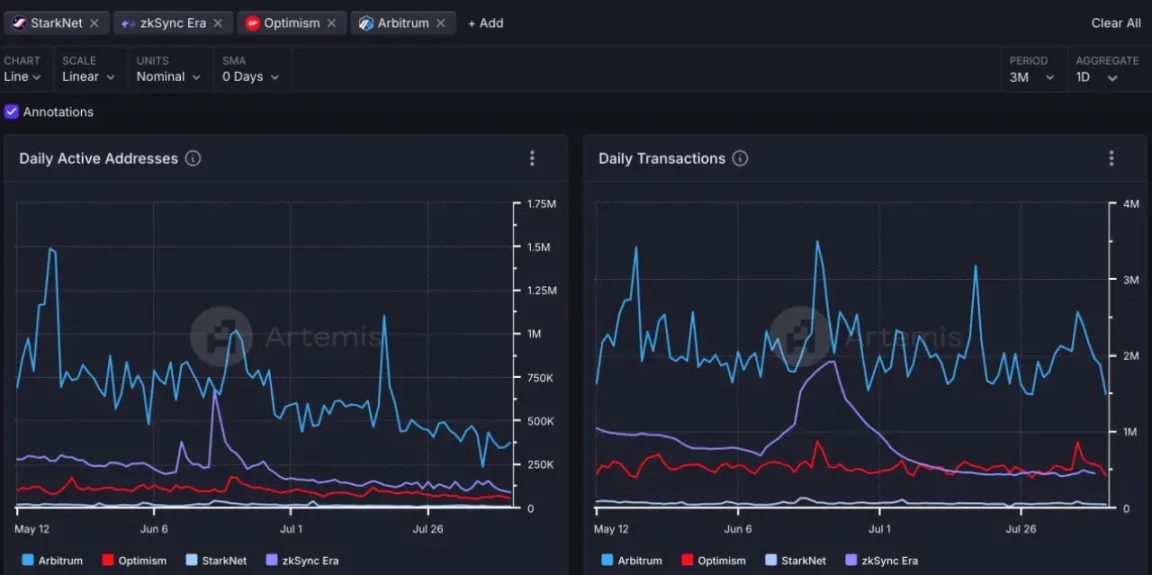
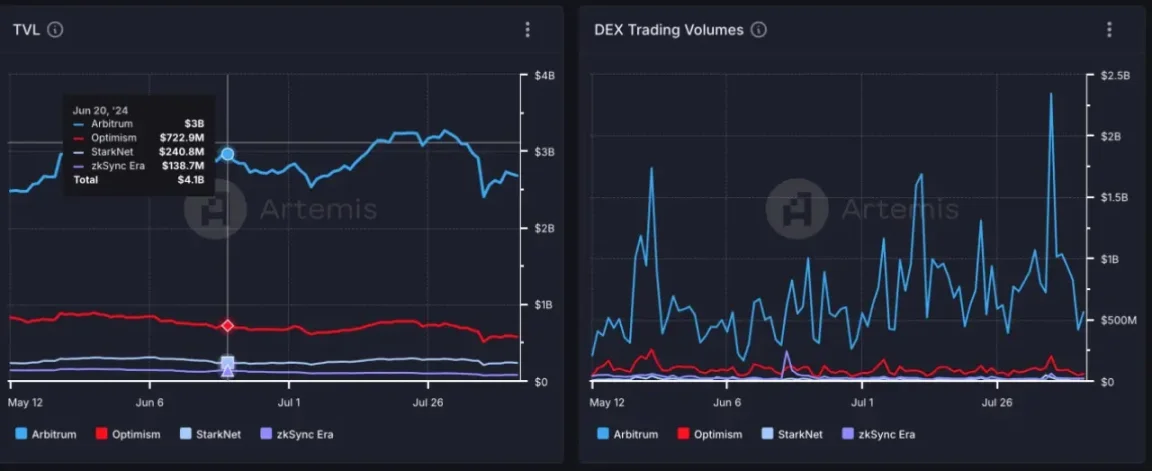
According to Artemis data, compared to other Layer2s such as Arbitrum, Optimism, and zkSync, Starknet currently ranks last in daily active users, daily transaction volume, DEX daily trading volume, and daily transaction fee revenue. While many other Layer2 networks are generating positive profits, Starknet remains unprofitable.
Expanding into the BTC Ecosystem Narrative—Is Starknet Still Worth Watching?
After being mired in PR crises, declining network activity, and a plummeting token price, @cryptonerdcn, a developer within the Starknet ecosystem, has lowered his expectations for Starknet.
However, @cryptonerdcn emphasized that it’s not all doom and gloom. Judging from participation in Starknet’s hackathon in June, developer activity within the ecosystem wasn’t as bleak as imagined.
He noted that despite the steep decline in token price, which he assumed would deter attendance, an estimated 75 teams ultimately participated. “Keep in mind,” he added, “Cairo, Starknet’s programming language, is far less known than Solidity—I recall there are only a fraction of developers familiar with it. Unlike EVM-based chains where participants can bring various rebranded projects, many of these hackathon projects were built entirely from scratch.”
In @cryptonerdcn’s view, if Starknet can work to improve its weaknesses in marketing and outreach, it won’t simply fade into oblivion.
Judging from Starknet’s recent developments, continuous technical upgrades remain the top priority. According to the community-released v0.13.2 update and summer roadmap, the upcoming v0.13.2 version in August will reduce block production time without increasing L1 costs, aiming to shorten transaction confirmation times to an average of around 2 seconds.
The v0.13.3 version, expected between October and November, will include Cairo-native execution, enabling faster processing and further reducing confirmation times.
But Ethereum Layer2 is extremely competitive. Merely competing on TPS and low fees no longer generates meaningful growth expectations.
If the broader Ethereum Layer2 narrative continues to underperform, @cryptonerdcn hopes Starknet can carve out a compelling narrative space within the Bitcoin ecosystem.
In June, Starknet announced plans to become the first network to settle transactions on both Bitcoin and Ethereum while scaling Bitcoin to thousands of transactions per second. This would be achieved within six months of a potential Bitcoin upgrade enabling OP_CAT.
Crypto analyst Haotian acknowledged that Starknet’s move into the Bitcoin ecosystem faces significant technical challenges and uncertainties. “But once it breaks free from the constraints of the (Ethereum) Layer2 narrative,” he said, “Starknet’s potential could look vastly different.”
In Haotian’s view, if Starknet extends into Bitcoin-based application scenarios, its underlying ZK technology, parallel transaction processing, and the Cairo language—originally designed for high performance—could become core differentiators setting it apart from other Layer2 solutions.
Join TechFlow official community to stay tuned
Telegram:https://t.me/TechFlowDaily
X (Twitter):https://x.com/TechFlowPost
X (Twitter) EN:https://x.com/BlockFlow_News
 ChainCatcher 链捕手