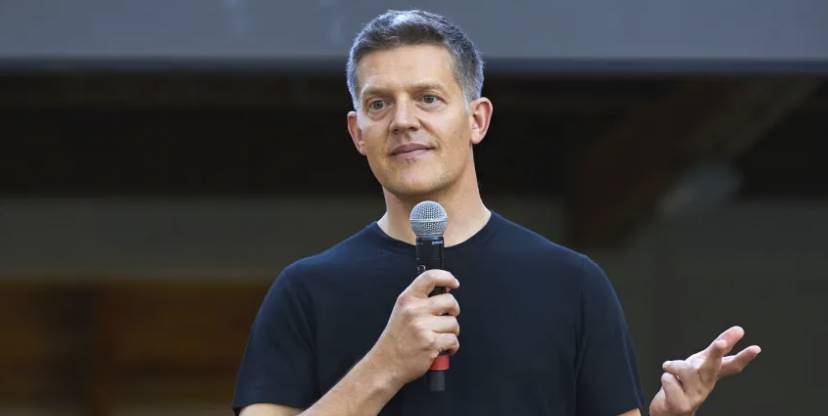
Interview with Roelof Botha, Managing Partner at Sequoia U.S.: The Neutral Era of Silicon Valley is Over, and AI is the New Space Race
TechFlow Selected TechFlow Selected
Interview with Roelof Botha, Managing Partner at Sequoia U.S.: The Neutral Era of Silicon Valley is Over, and AI is the New Space Race
AI is our generation's space race, and we need to get it right—harnessing the promise of this technology instead of wasting it.
 Navigating Web3 tides with focused insights
Written by: Youxin Newin
Recently, Roelof Botha, Managing Partner at Sequoia Capital U.S., and Jacob Helberg, advisor at Palantir and founder of the Hill and Valley Conference, sat down for a discussion delving into critical topics such as technology regulation, the importance of open-source software, and U.S.-China tech decoupling.
Botha likened AI to "this generation’s space race," emphasizing its pivotal impact on national futures. To win this race, the United States must adopt the right strategies across technology, policy, and international cooperation.
He also highlighted that open-source software not only accelerates innovation but enhances technological transparency and fosters international collaboration. Therefore, the U.S. should continue supporting and developing open-source projects in AI to prevent adversarial nations from dominating this field.
Below is the full transcript of their conversation—enjoy.
Erik Torenberg:
The Hill and Valley Conference has achieved tremendous success. First, I’d like to ask you, Roelof, what made you decide to join this conference this year?
Roelof Botha:
Before answering, I want to express my appreciation to Jacob for his significant role in bridging Silicon Valley and Washington, D.C. There's a decades-long history between Silicon Valley and the U.S. government.
I think people don’t always realize that much of Silicon Valley’s success stems from massive government investments in foundational research and development—like semiconductors and the internet. This relationship began fading about a decade ago, so it’s truly encouraging to see individuals like Jacob reigniting these dialogues and bringing together leaders from both Washington and Silicon Valley.
As reflected in the conference name—Hill and Valley—for the first time, we’re gathering in one room and discovering that we actually share far more common ground than it might appear.
Our reason for attending is this: when I joined Sequoia shortly after PayPal’s exit, around 200 million people were online globally. Today, that number is clearly in the billions. Technology is now deeply embedded in our lives in ways we couldn’t have imagined two decades ago.
Thus, the idea that Silicon Valley can remain detached from broader societal roles feels outdated. It’s essential for those in Silicon Valley to step forward and participate in Washington’s debates, because technology profoundly shapes our lives.
If we don’t engage, there won’t be adequate information exchange, and we won’t develop policies that allow America to thrive and remain competitive globally.
Erik Torenberg:
Well said. Jacob, now I’d like to bring you in. You’ve hosted several of these summits, and this one was a huge success. Both sides contributed significantly, many key figures delivered speeches, and even former President Trump submitted some encouraging notes. Can you talk about how attitudes on Capitol Hill and in Silicon Valley have shifted over recent years? After all, you’ve been building bridges between them.
Jacob Helberg:
Eric, if I may, I’d like to expand slightly on your initial question about Sequoia’s involvement in Hill and Valley and add a few points.
The core mission of the Hill and Valley Forum is to foster collaboration between Silicon Valley and Capitol Hill, ensuring the U.S. maintains the world’s leading technological capabilities. In my view, we cannot fulfill this mission effectively without involving the best representatives from both sides.
My boss at Palantir, Alex Karp, once said, “If you want to heal a patient, you need the best surgeons.” I take the same approach.
Therefore, for the Hill and Valley Forum to succeed, we need top innovators and top venture investors collaborating with the most thoughtful and committed policymakers.
When Roelof expressed interest in participating, I was thrilled—Sequoia plays a pivotal role in Silicon Valley and has long stood at the forefront of innovation. Having him at this year’s forum was truly a privilege.
Erik Torenberg:
That’s fantastic. Let’s move to the second question—how do you think attitudes have changed since you began this bridge-building work?
Jacob Helberg:
When I first started documenting the intellectual dynamics between Washington and Silicon Valley, part of my work began while I was on Google’s policy team. I noticed two things.
First, the relationship between Silicon Valley and Washington had grown tense over the years, marked by deep mistrust and a clear cultural disconnect. This mistrust stemmed partly from a series of unfortunate events—such as the Snowden leaks—which triggered strong international backlash against major Silicon Valley companies.
Second, incidents like Project Maven and Project Dragonfly attracted significant attention and controversy, further eroding trust among Washington policymakers toward Silicon Valley.
Additionally, I observed that in Washington, the loudest voices and most visibility went to executives from the largest tech firms. Yet, living in the Bay Area, I saw a vibrant tech ecosystem that received almost no attention or recognition from Washington.
One consequence was that many in Washington grew pessimistic, believing our top engineers were merely optimizing ad tech while China focused on hypersonic and hard technologies. But I knew that wasn’t true—I saw founders every day taking enormous risks to solve difficult engineering challenges.
Eventually, in 2021, I published a book with an entire chapter dedicated to the Hill and Valley divide. As a byproduct of that work, we launched a conference that evolved into a community aimed at uniting these two worlds and closing the cultural gap—a gap that is very real.
In Washington, lawmakers typically come from legal backgrounds and are mostly over 60; in Silicon Valley, people are on average about 20 years younger and come from engineering backgrounds.
So they approach the same facts from vastly different worldviews and life experiences. But fundamentally, they're both invested in building the future. I’m deeply passionate about helping bridge these two crucial communities.
Erik Torenberg:
Excellent point. Roelof, I’d like to ask about your perspective at Sequoia on defense and frontier technologies. Which areas excite you? Can you share any insights?
Roelof Botha:
My job is fascinating because I simply listen to the smartest entrepreneurs—that’s our focus. Fortunately, founders often see the future before the rest of us, which is their special gift. Our goal at Sequoia is to help them turn that vision into reality.
We’re seeing more and more entrepreneurs wanting to make an impact in defense technology—not just for sound business reasons, but sometimes out of patriotism.
We’re investors in SpaceX, which clearly has massive implications for U.S. defense. SpaceX now accounts for 80% of all mass entering orbit globally—more than all other countries combined. Without Elon Musk’s work at SpaceX, the U.S. would be far behind.
Given control over space access, this is a major factor for national defense. I have a long history with Elon—he recruited me at PayPal many years ago.
We also work with a company called Mark. Jacob mentioned hypersonics earlier. It’s somewhat tragic that although the U.S. developed hypersonic technology with DARPA funding, we failed to fully capitalize on it. The Air Force didn’t seize the opportunity, the IP was stolen and adopted elsewhere. Today, our adversaries surpass us in hypersonic capability.
Ethan, Mark’s founder, spoke at the Hill and Valley Forum. They’re developing hydrogen-powered hypersonic missile and defense systems for the U.S. government. We’re proud to support them. We also have a long history in cybersecurity—a major domain where many battles are fought.
We began investing in Palantir in 2005 and now collaborate with companies like Wiz and Oasis on cybersecurity and machine security solutions. We continue to see opportunities in this space. We’ve already completed two new investments, though they’re still under wraps.
In fact, just earlier today, we approved another investment in the defense sector. It’s great to see founders stepping up, and we’re eager to help them build transformative companies.
Erik Torenberg:
You’ve been very vocal about whether we should act on TikTok and influential in pushing for steps in that direction. Do you believe we’re in a new arms race with China?
Jacob Helberg:
I do believe we’re in a new arms race with China. For a long time, I worried that many in Silicon Valley tried to stay neutral, like Switzerland. Geopolitics isn’t usually central to most founders’ day-to-day operations.
I understand why many entrepreneurs prefer to stay out of the center of geopolitical conflict. But I think that in the mid-2010s, many companies attempting neutrality during intensifying geopolitical tensions were really trying to balance priorities between Beijing and Washington.
In 2020, I wrote an article arguing that Silicon Valley cannot remain neutral in a U.S.-China cold war—and that this approach is unworkable. I’m glad to see that we’ve shifted course. Overall, I believe Silicon Valley today recognizes that U.S.-China relations require companies to take clearer stances. So I’m pleased to say that the era of neutrality in Silicon Valley appears to be over.
As Roelof said, we’re seeing an encouraging and growing ecosystem of tech founders voluntarily answering the government’s call to tackle some of the hardest engineering problems—from hypersonics to biosciences and AI.
These hard and frontier technologies are inherently dual-use, so it’s vital that our best founders focus on solving the toughest challenges.
Ultimately, I believe the U.S. government has a responsibility to better engage Silicon Valley and help translate our best private-sector innovations into hard power.
Erik Torenberg:
Roelof, I’ve given Jacob due credit for his advocacy, but you deserve praise too—even within your own firm, your efforts to separate from China and focus on the U.S. and Europe are commendable. Can you explain the current state of that separation? How connected are you still to that entity? And why do you see this as necessary for both the U.S. and Sequoia’s investment risk?
Roelof Botha:
Absolutely. We began an expansion phase around 2005, shortly after China joined the WTO. At the time, the prevailing Western belief was that economic integration would lead to normalization and acceptance of Western democratic values. The U.S. government explicitly encouraged investment in China to strengthen economic ties. And indeed, this lifted hundreds of millions out of poverty.
So we established offices in India, Southeast Asia, and China. These were set up as independent entities—with independent teams, decision-making, and fundraising. What we shared was branding and back-office functions like finance, compliance, and IT. But clearly, the world has changed. Recent data shows global goods trade as a share of global GDP peaked in 2008 and has been declining for over 15 years.
We’re now in a more economically nationalist era—very different from the post-WWII golden age we enjoyed for 70 years. We need to recognize this new reality.
We obviously can’t ignore geopolitical pressures. Honestly, operating such a distributed global organization presents challenges, even with independent structures. So last year, we decided it was more appropriate to go our separate ways.
We announced this in June 2023, and by the end of last year, the separation was complete. Now, we’re entirely independent brands.
Erik Torenberg:
Does the TikTok situation signal deeper tech decoupling between the U.S. and China?
Jacob Helberg:
I believe so, and I’d like to echo some of Roelof’s points. The process he described—where in the early to mid-2000s, there was broad consensus that deeper integration with China benefited both the world and the U.S.—was shared across both private and public sectors. As Roelof noted, this was official U.S. policy: promoting deeper regional and international integration.
Now, many companies are reassessing and choosing markets outside China, adopting a “build where you sell” model. Whatever form this realignment takes, the same reevaluation is happening in policy circles.
The TikTok legislation reflects this shift. TikTok was allowed to operate in the U.S. for years; Huawei issues surfaced only in the mid-2010s, ZTE similarly, and DJI remains under scrutiny. Looking around, you see policymakers undergoing the same reevaluation, recognizing that public policy must adapt to a changed world—and updating approaches is justified.
I see the TikTok legislation as a significant and urgent recalibration of our tech trade relationship with China—one that sets an important precedent for how we handle other tech issues.
You see this process unfolding broadly—whether in debates over ZTE, Huawei, TikTok, DJI, or the Trump campaign considering EV tariffs. We’re reevaluating our entire tech trade relationship. Given the world in 2024, I believe this is a healthy trend.
Erik Torenberg:
Roelof, anything to add?
Roelof Botha:
During my undergraduate studies, I focused on economics, statistics, and math. I’ve long been a proponent of comparative advantage theory—the benefits of trade seem obvious. But the theory makes simplifying assumptions about trading partners: that everyone serves mutual interests and shares certain values, such as respect for intellectual property and human rights.
This reminds me of a joke: If in a game like soccer, one side keeps scoring by repeatedly offside, eventually you have to say, “We need to rethink the rules—this isn’t how we agreed to play.” So I believe these discussions we’re having are very healthy.
Jacob Helberg:
Eric, I’d like to add to what Roelof just said. One key reason maintaining open communication between Congress and Silicon Valley is so important is that everyone in Washington understands it’s unrealistic to bring all manufacturing back to the U.S.
Thus, policymakers need feedback from tech executives in Silicon Valley to better achieve reduced reliance on China—especially in supply chains and data security. Technical insights from executives who understand supply chains and complex platform architectures are extremely valuable to policymakers.
With such feedback, policymakers can better implement trade agendas—whether with Vietnam, India, or other markets—balancing security concerns while enabling companies to achieve the scale needed to build great products and breakthrough technologies.
Roelof Botha:
Beyond security, there are fundamental legal issues around intellectual property. Personally, I’ve been involved with at least three software companies whose software was blatantly stolen, making it impossible to operate in China because we couldn’t protect their IP.
These companies spent billions in R&D over the past decade developing world-class software, yet we can’t enter markets where competitors—who did no R&D—use our software to build businesses.
It’s like someone taking your factory without paying capital costs and claiming they’re low-cost producers. That’s unfair trade, and beyond national security, we shouldn’t tolerate such behavior.
Jacob Helberg:
Yes, absolutely. Peter Thiel once made an interesting observation: the U.S. and China are playing different games. With China’s population roughly four times larger, if tech parity is reached, its economy could be four times ours—simply due to scale. So staying ahead is far more critical for us.
As Roelof said, we must be careful—these practices cost the U.S. economy hundreds of billions. A former head of U.S. Cyber Command called it the largest wealth transfer in human history—an exaggeration, perhaps, but it highlights the scale is significant.
Erik Torenberg:
That’s a fascinating point. It feels like you’ve been sounding alarms for years, and now people are finally listening and taking the threat seriously. If you could go back to around 2010—when hopes and expectations for China were high, not just for liberalization and fair competition, but also based on agreements they ultimately didn’t honor or actions we didn’t anticipate—what would you do differently knowing what you know now? What alternative steps could we have taken to put ourselves in a stronger position?
Jacob Helberg:
I think the debate over strategic tech decoupling could have started earlier. The evidence of China’s theft patterns was visible. I don’t claim foresight—I just paid close attention to behaviors that weren’t widely noticed at the time.
In recent years, my basic approach has been to talk with anyone willing to listen. One strength of our democracy is that we can have these open dialogues—letting the best arguments win based on merit. If an argument is compelling, people become receptive and responsive. I think this evolution of consensus is a good thing.
Erik Torenberg:
Well said. Now let’s zoom out and discuss the AI supply chain. What impact do export controls have on technology?
Jacob Helberg:
Do you have thoughts on this? I’m curious whether export controls are a topic in the Bay Area—does it come up in the startup ecosystem?
Roelof Botha:
Export controls themselves aren’t a hot topic. In Silicon Valley, the more active discussion revolves around CFIUS (Committee on Foreign Investment in the United States). The ability of foreign states or individuals—particularly China—to invest in the U.S. has long-standing rules.
The question is whether those rules are sufficient given changing circumstances, and whether existing ownership should be reevaluated. If an investment was deemed sensitive three years ago, should it be revisited rather than forgotten? That’s a current debate.
Moreover, I think more and more Silicon Valley investors are reluctant to invest in China. I’ve heard concerns shifting from return on investment to return of investment.
You see many Chinese investors now putting money into Europe and the U.S., as opportunities shrink in China and government involvement in leading private and public tech firms reduces their options. This remains an ongoing discussion.
On export controls, I think especially in the context of AI, we need something akin to energy independence. Looking back at the past decade, if we hadn’t cracked fracking and achieved energy independence, the U.S. would be in real danger.
People here are deeply concerned about a future without AI independence—meaning the semiconductors, data centers for training foundation models and running inference, and the software models built on top.
Right now, we can’t claim full independence—especially in semiconductor manufacturing. Taiwan is clearly a major vulnerability, and there’s strong desire here to rebuild domestic manufacturing capability at key nodes. This is a very hot topic in Silicon Valley.
Jacob Helberg:
I think in Washington, these observations from Silicon Valley are actually quite interesting. In D.C., much attention is focused on chip production—but less on other parts of the AI supply chain and tech ecosystem.
I think you rightly highlight that Chinese capital’s growing presence in the U.S. tech ecosystem is underestimated in policy circles, as is the concept of AI independence.
I find this very interesting and consistent with trends we’re seeing—like KV investing in an India-based version of OpenAI, based on the premise that major powers will want their own “sovereign AI capabilities.”
So I think the idea of AI independence is a genuinely compelling issue that policymakers need to better understand—especially given the UAE’s current moves. The UAE, a highly energy-rich nation, has pledged billions to build large-scale compute clusters.
They clearly have the right to do so, and our companies should be free to partner with them and build infrastructure—because if we don’t, China will fill the void.
But I think we need to thoughtfully decide whether we want our companies to start relying on foreign computing power from partners like the UAE—or instead invest domestically to build local compute capacity capable of creating the world’s best AI models.
Because I worry that if we don’t upgrade our power grid and make necessary investments in energy and computing infrastructure, in five, six, seven years, our biggest AI companies will heavily depend on foreign compute infrastructure. Then we’ll be discussing AI supply chains the way we now talk about manufacturing supply chains—be it appliances, toys, or electric vehicles. So I believe the industry is still early enough that we can be intentional—and it’s great that we can help drive these conversations.
Roelof Botha:
By the way, today, U.S. data centers consume about 2% of electricity. Based on current projections of energy needs for training models and running inference, that could rise from 2% to 6%. A 4% increase in U.S. power capacity is substantial.
Currently, just completing an environmental impact study for a new plant takes about four and a half years, regardless of type. I know several small modular nuclear reactors have been approved, but I strongly urge us to move faster to ensure adequate power capacity. Electricity production capacity is one of the best indicators of GDP growth.
We have the ability to produce clean energy—solar is now cheap enough, nuclear technology exists—we just need to get out of our own way and avoid over-regulation.
Jacob Helberg:
Yes, I completely agree. This is a topic I hope gets more attention in Washington, because I believe it’s critically important.
Erik Torenberg:
To continue this thread, let’s discuss regulation. Maybe start with you, Roelof. What are your views on AI regulation? What approach should we take? How do we get it right? What mistakes should we avoid?
Roelof Botha:
One of the beautiful aspects of the U.S. system is actually regulation. When I was in business school, Professor Paul Romer gave a lecture explaining how foundational U.S. regulatory frameworks enable capitalism to flourish.
As a freshman, I was confused—what did he mean? He explained how efficient Chapter 7 bankruptcy procedures in the U.S. are compared to other countries, allowing labor, capital, and buildings to be reallocated to new ventures.
So I think overall, while half of Silicon Valley might instinctively react with disdain toward regulation, assuming it’s inherently bad, that’s not true. Thoughtful regulation has enabled our nation to thrive. With AI, we face both opportunities and risks. The risk is getting it wrong and wasting one of the best chances we’ve ever had to grow the national economy—an opportunity right before us.
So we must be very careful to seize this moment and ensure policy focuses on applications, not foundational technologies. Regulating core AI capabilities would be like regulating electricity or the internal combustion engine as abstract innovations, without regard to actual use cases. That’s where our focus should be.
Let me give examples. I sit on the board of a financial services company providing loans to small businesses and consumers. The U.S. has robust fair lending laws. Whether using traditional statistics, early ML models, or modern generative AI, you must test to ensure lending practices comply with U.S. regulations. This has nothing to do with regulating base models—whether ML or generative AI.
So I believe that’s where we should focus. I’m somewhat concerned Europe may be going too far too fast, potentially missing a huge opportunity. Frankly, the Hill and Valley Forum is a great example—when I visited Washington in February.
When I spoke with folks on Capitol Hill, they were very open to listening. They want to engage not just with leading companies but also, as Jacob said, with smaller ones. Academia was represented too—several professors attended last week’s forum because they want to contribute to these policy discussions. It’s also bipartisan.
Seeing so many people from diverse political backgrounds engaging, wrestling with these issues, and striving for the right answers—it’s truly impressive. So I’m very optimistic we’re having these discussions the right way and moving in the right direction.
Jacob Helberg:
I completely agree with Roelof. His emphasis on focusing on end-use applications rather than the technology itself is spot-on. His electricity analogy is excellent.
I often use steel as an analogy—you can use steel to build machine guns or hospitals, but clearly, machine guns and hospitals shouldn’t be regulated the same way.
So when I hear certain discussions in Washington, I worry there’s too much focus on creating a new agency to license and audit AI technology itself.
I’d much prefer a sectoral and end-use approach—AI in transportation shouldn’t be regulated the same as in healthcare or biomedical research. I strongly support governing AI by sector and application. A benefit of this approach is that it’s grounded in legal precedent.
For example, in transportation AI, classic policy questions include: if a self-driving car hits someone, who’s liable—the AI company or the car manufacturer? We can draw on vast legal precedents and our tort system to answer these in ways consistent with how we’ve handled similar issues in the auto industry.
So I believe this is the right path. The same applies to military AI—we have laws on export controls for sensitive technologies and a whole policy agenda to maintain superior military tech. Approaching this through end-use and sectoral lenses makes policy discussions more rational, rather than creating a new agency to serve as an unfair arbiter or whatever else it might be defined as.
Erik Torenberg:
Let’s dive into the open vs. closed debate. We have Mark, Jason, and Vinod Khosla on opposite sides of this. Very smart people disagree on whether open source should be encouraged. What are your thoughts?
Roelof Botha:
I’m a big fan of open-source software. Many of the software products we enjoy today wouldn’t exist without open-source technologies. When I was at PayPal, we had to spend heavily on Sun servers because we used Oracle as our database. We had to build our own data center capabilities, rack our own servers—it was a completely different business model.
When I worked with the YouTube founders in 2005, they used open-source tools like MySQL and MemCache, and cloud computing was emerging. This allowed them to easily build a highly attractive business serving massive global user traffic daily.
So to me, open-source software is admirable because it’s inherently transparent—others can inspect the code. Sunlight is the best disinfectant. Vulnerabilities can be exposed, tested by academia. I’m a strong advocate for continuing to nurture open-source ecosystems in AI.
There’s also the fact that Alibaba owns one of the world’s top 15 open-source models. So if the U.S. doesn’t provide or support open-source AI tech, others will fill the gap.
You might end up with developers in Southeast Asia, Latin America, Eastern Europe, or Africa building apps on models developed in adversarial markets—models that give different answers than what we consider correct.
We must consider this future—because if we don’t provide these open-source tools, others will. I don’t think that’s a future we want. So I’m a strong supporter of open source, and I also support companies building proprietary models.
Looking at other software categories we’ve invested in—like infrastructure software—both proprietary and open-source companies have thrived. I believe we should foster the same ecosystem in AI.
Jacob Helberg:
Join TechFlow official community to stay tuned
Telegram:https://t.me/TechFlowDaily
X (Twitter):https://x.com/TechFlowPost
X (Twitter) EN:https://x.com/BlockFlow_News