ZKsync Officially Responds to Community Concerns: Why Were Some Addresses with Zero Transactions Still Allocated Tokens?
TechFlow Selected TechFlow Selected
ZKsync Officially Responds to Community Concerns: Why Were Some Addresses with Zero Transactions Still Allocated Tokens?
True users are often unafraid of risks, especially when they feel they are part of a community.
 Navigating Web3 tides with focused insights
Author: ZKsync
1. How to qualify for this airdrop?
There are two ways an address can qualify for the 17.5% airdrop:
1. Users (89%): ZKsync users who bridged crypto assets to ZKsync Era and met at least one of the seven eligibility criteria.
2. Contributors (11%): Individuals, developers, researchers, communities, and companies who contributed to the ZKsync protocol and ecosystem through development, promotion, education, or participation—regardless of whether they used the ZKsync network.
For wallets in the 11% contributor category, activity on ZKsync Era is optional. The contributor allocation primarily targets those who built early projects on ZKsync, contributed to relevant GitHub repositories, conducted security research, served as Discord moderators, or participated in communities such as Degen, Bonsai, Crypto the Game, Pudgy, and Milady.
2. What does it mean when this is referred to as a usage-based airdrop?
The user-based allocation (89% of total airdrop) aims primarily to identify and reward a diverse group of users on ZKsync Era who will help govern and grow ZKsync long-term. The goal is to find people who connected crypto assets to ZKsync Era and provide multiplier rewards for actions that demonstrate organic user behavior. Such individuals are likely to become valuable members of the ZKsync community.
A wallet's history across chains can reveal significant information about its owner. Genuine users tend to be less risk-averse, especially when they feel part of a community. They take time to explore, try new protocols, and hold speculative assets. In contrast, bots and speculators act cautiously, putting in minimal effort while attempting to blend into the community and extract value.
3. I met some eligibility criteria but didn't receive an allocation—why?
ZKsync user airdrop allocations (89% of total airdrop) are based on a combination of the following:
1. How many of the seven eligibility criteria were satisfied.
2. The amount bridged to and held on ZKsync Era (whether in your wallet or within DeFi protocols), measured by time-weighted average balance (TWAB) over the 12 months leading up to the snapshot date. This is known as value scaling (see detailed explanation in Question 5).
3. Bonus multipliers: If a wallet belongs to a predefined group—such as early ETH adopters, top holders of ZKsync-native NFTs/tokens, or recipients of ARB, OP, ENS airdrops—it receives an allocation multiplier.
Important: Trading volume itself has no impact on allocation size.
Allocations for users are calculated according to the above criteria. To receive any airdrop allocation, the result must exceed 450 ZK.
This means that even if you met all seven criteria, if you held very little value on average over time or did not qualify for any bonus multipliers, you may not have received an allocation.
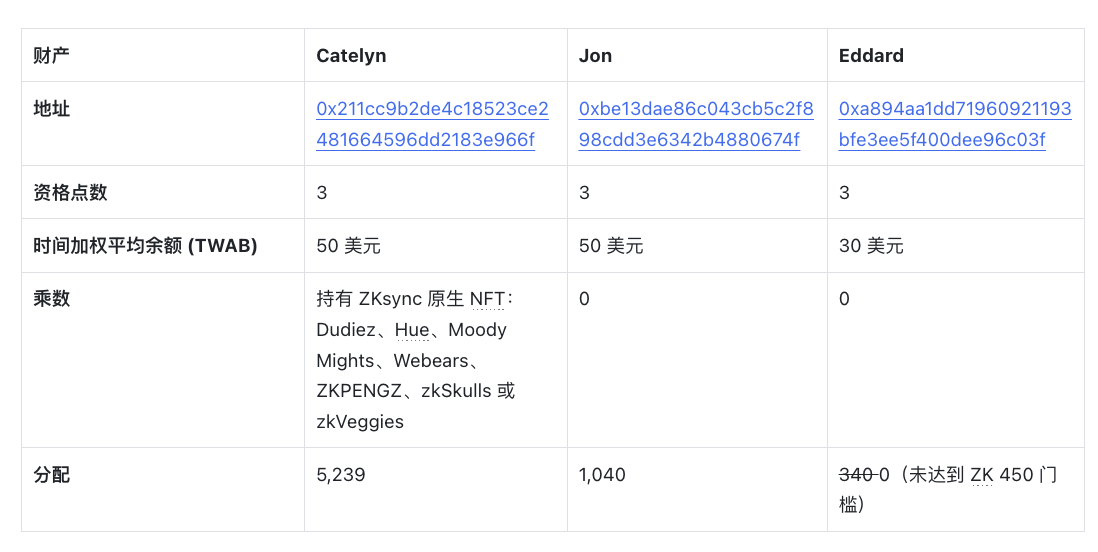
4. I met four eligibility criteria, yet received less than someone I saw on X who only met two. Why?
The number of eligibility criteria met is just one of three factors determining allocation size. ZKsync airdrop allocations combine eligibility criteria, time-weighted average balance (TWAB) on ZKsync Era, and bonus multipliers.
In this case, the other person likely transferred a large amount of crypto assets to ZKsync Era and/or held them for a longer duration. Alternatively, they may have qualified for one of the bonus multipliers or were included in the contributor-based airdrop, whereas you were not.
5. How does "value scaling" work?
To identify and reward users who placed crypto assets onto the ZKsync Era platform, allocations are partially based on a value scaling formula. This formula adjusts an address’s allocation based on both the amount sent to ZKsync Era and how long those crypto assets remained in the wallet.
For example, an address that sent $100 to ZKsync Era at mainnet launch (March 2023) and held it since then carries more weight than an address that deposited $100 only one month before the snapshot.
Value scaling = Time-weighted average balance (TWAB) = Scales allocations based on the value of crypto assets someone bridged and how long they held them.
Reminder: Trading volume itself has no effect on value scaling.
For more details, see these examples.
6. What if I only used ZKsync Lite? Why was I excluded?
To qualify for the airdrop, an address must meet one eligibility criterion and bridge crypto assets to ZKsync Era. The airdrop focuses on ZKsync Era—the first ZK chain—as it is expected to serve as the decentralized hub for the entire ZKsync ecosystem.
ZKsync Lite users, as OG members of the ZKsync ecosystem, can earn up to two eligibility points for using ZKsync Lite. However, they must also have held crypto assets on ZKsync Era at some point.
For the usage-based airdrop: If a user only used ZKsync Lite and never used ZKsync Era, unfortunately, they are not eligible for any user airdrop allocation.
7. Why did some addresses with zero transactions still receive allocations?
The airdrop consists of user-based allocations (89% of airdrop) and contributor-based allocations (11% of airdrop). Wallets in the contributor category do not need to show activity on ZKsync Era. For instance, contributor allocations focus on individuals and communities who built early projects on ZKsync, contributed to relevant GitHub repositories, performed security research, managed communities on Discord, or participated in groups like Degen, Bonsai, Crypto the Game, Pudgy, and Milady.
There are 184 addresses that met ZKsync Lite eligibility conditions and had bridged assets on ZKsync Era but no other transactions; these wallets qualified for the airdrop.
Additionally, 10 test addresses were added for internal quality assurance and testing. These addresses were allocated a minimum of 917 tokens. Once claimed, these tokens will be sent to a burn address.
0x6adb27812220f1ff5df618e3273d83c430705eec
0xb1ded8ff2f7a45f436951f082dda770e1dcee84d
0x07528fba97b02bba1aaa03a8ffe51d3fda86b585
0xc527a57ebcc7af699055bb8a3aca917a00a235ed
0x358291b1ea089437a9b16fb8c23d8a035ea7c358
0x023e3e6d98d7a5c7209910ab4ab9f91713dbdc1d
0x65f8dfc419b418ae82f289059d038428d038cd9a
0x6cc3a7f20f0f2f3d3fb5e07f89f7449e6a2537d6
0xae757f4c8aad55712018e6fef0612a091279517a
0x5f66edefd2d3d228244d5801911cdccb87df92bc
0x0e602a94192f9da3db92f159a724ea8442916987
8. Why reward external groups like Degen and Bonsai instead of ZKsync users?
A small portion of the total airdrop (2.8%) has been reserved for experimental on-chain communities: recipients from Degen and Bonsai, Crypto The Game, Pudgy, and Milady. These communities are known for being passionate advocates and defenders of their ecosystems, sharing the same cypherpunk values as ZK Nation, while also experimenting with innovative forms of self-organization. These positive, forward-thinking communities are valuable additions to any network and are expected to become long-term members and guardians of ZKsync.
9. Why did some people receive over 100,000 tokens?
100K is the maximum reward in the user-based airdrop allocation (again, 89% of the total airdrop). A total of 155 addresses (0.022%) received allocations exceeding 100K tokens because they qualified for the highest-tier user rewards and also met eligibility for the contributor category (11% of total airdrop).
Examples of groups in the contributor category: native ZKsync projects, GitHub developers, security researchers, Discord community moderators, ZK Credo translators, etc.
Disclaimer: Address disclosures follow this privacy policy.
Join TechFlow official community to stay tuned
Telegram:https://t.me/TechFlowDaily
X (Twitter):https://x.com/TechFlowPost
X (Twitter) EN:https://x.com/BlockFlow_News
 @zksync