








Exclusive Interview with the Co-Founder of Story Protocol: A Blockchain Renaissance Around Programmable IP Assetization
TechFlow Selected TechFlow Selected
Exclusive Interview with the Co-Founder of Story Protocol: A Blockchain Renaissance Around Programmable IP Assetization
"IP is not just media; it includes media plus rights."
 Navigating Web3 tides with focused insights
Reporters: Sunny and Min, TechFlow
Guest: Jason Zhao, Co-founder of Story Protocol
The crypto world is a game about issuing and trading assets—everything from AI models to memes seems capable of being tokenized and traded. But what about intellectual property (IP)?
Pioneering this space is Story Protocol, building a programmable IP layer that allows creators to combine, remix, and monetize their work through on-chain rules—aiming to spark a true renaissance of creativity on the blockchain.
In September 2023, Story Protocol announced a $25 million Series A round led by a16z crypto. Combined with its earlier $29.3 million raise, the total funding exceeds $54 million. Other key investors include Hashed—the largest blockchain fund in South Korea, Endeavor (the agency behind Eileen Gu), Samsung Next (Samsung’s investment arm), and Alliance—the world’s largest crypto accelerator...
Story Protocol has three co-founders hailing from Korea, the United States, and a Chinese-American background, forming a unique "China-U.S.-Korea" mix.
-
S.Y. Lee graduated from Oxford University and previously founded Radish, a serialized fiction platform, and served as a VC partner at Hashed, South Korea's largest crypto fund;
-
Jason Levy graduated from Stanford University and previously led content and IP at Episode, a top mobile storytelling platform;
-
Jason Zhao also graduated from Stanford and worked as a product manager at Google DeepMind, focusing on commercializing cutting-edge AI research.
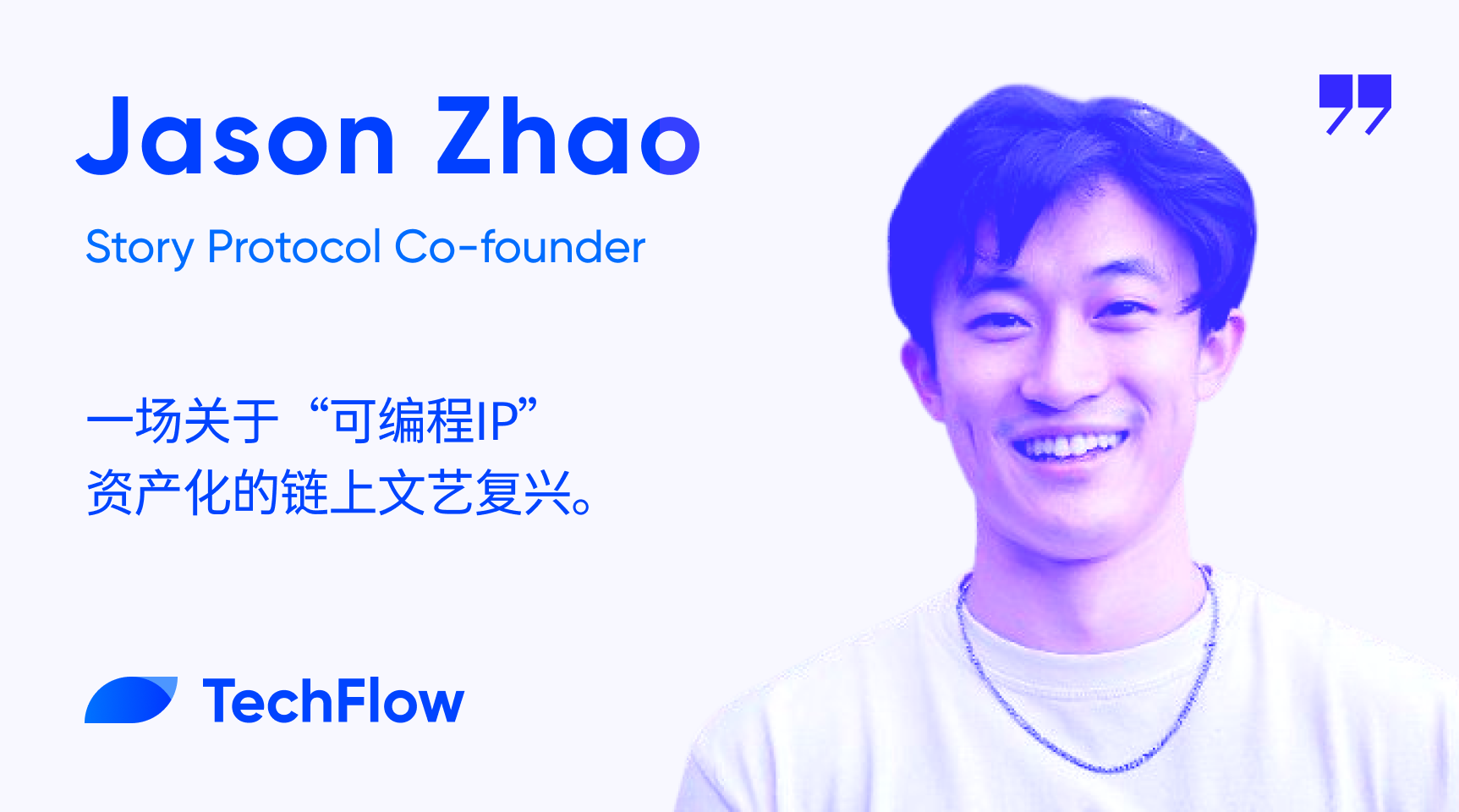
Driven by curiosity around “How will Story Protocol lead an on-chain renaissance?”, TechFlow sat down with co-founder Jason Zhao for an exclusive interview.
The Founding Story and Background of Story Protocol
TechFlow
Could you first introduce the founding background and original vision behind Story Protocol?
Jason
Story Protocol has three co-founders: S.Y. Lee, myself, and Jason Levy.
The creation of Story Protocol was driven by two main factors. First, both S.Y. and Jason are seasoned entrepreneurs in the media industry, with extensive experience in both cryptocurrency and entertainment. For years, they've been exploring systemic issues within the creative industries' intellectual property systems. Recently, these problems became especially evident during Hollywood strikes, where actors and writers protested against unfair creative economies.
Intellectual Property (IP) as an asset is often controlled by large studios like Disney or Paramount, making it difficult for smaller entities to access or use IP without substantial legal resources. The process is not only expensive but also opaque.
As for me, I spent many years at Google’s AI lab DeepMind as a product lead, turning AI research into consumer-facing innovations. I’ve always been passionate about using frontier technologies to improve accessibility and utility for users. In contrast, the dynamics of the crypto space—with its permissionless environment—fascinate me even more, accelerating the path from research to real-world implementation. Individuals can propose ideas via whitepapers and rapidly build them into functional protocols involving massive transactions and user interactions—all within weeks. This open and organic product development model stands in stark contrast to the AI field, where high computational and data requirements typically limit access to only a few large corporations.
Additionally, my university major was philosophy, focusing on political theory, which sparked my deep interest in the foundational principles of Bitcoin and Ethereum. Discussions around decentralized autonomous organizations (DAOs) and their potential governance models also intrigued me—models resembling cooperatives that reflect diverse political beliefs and allow users to participate in ownership and governance.
Overall, Story Protocol presents a significant opportunity for innovation in the IP space. While IP plays a critical role in decentralized finance and financial infrastructure, its application in creative and cultural industries remains underexplored. We aim to leverage the latest blockchain research to revolutionize how IP is developed, managed, and monetized—ushering in a true on-chain renaissance.
Traditional IP vs. Programmable IP
TechFlow
What is programmable IP, and how does it differ from traditional IP?
Jason
Let me explain through an analogy.
DeFi (decentralized finance) made money programmable. Our goal is to do the same for intellectual property (IP). Imagine if a physical dollar bill in your wallet could only be used to buy a lollipop at a corner store—it would have very limited utility, be nearly untraceable, and hard to integrate into broader financial systems.
In contrast, stablecoins like USDC or USDT in DeFi still represent one dollar—but now you hold an on-chain asset usable across platforms like Uniswap. You can swap USDC, stake ETH via Lido to get stETH, then lend stETH on Compound to earn c-stETH. This creates a vast financial ecosystem limited only by developers’ imagination and software capabilities—all fully permissionless.
Now apply this concept to IP. Our mission is to make IP programmable—doing for IP what DeFi did for money.
Currently, IP management relies heavily on traditional paper-based methods. Take iconic characters like Mickey Mouse or Pokémon—their IP protection involves mountains of legal documents. Entire legal teams are dedicated to safeguarding these rights, and licensing usually requires costly, complex negotiations between lawyers. This is not scalable. It results in countless potential IP interactions never happening due to high cost and friction.
At Story Protocol, we envision moving IP onto the blockchain and making it programmable—not just putting media files on-chain as NFTs, but creating a rights layer for each media file—a kind of Rights API. IP isn't just media; it's media plus rights.
Our goal is to empower creators to upload their IP to Story Protocol and define how others can build upon, remix, and reuse their creations.
This approach unlocks full composability—extending DeFi’s paradigm into the creative realm.
TechFlow
Can you describe Story Protocol’s technical architecture and how it uses blockchain technology to manage IP?
Jason
Story Protocol’s architecture consists of two core components: “nouns” and “verbs.”
“Nouns” represent the core elements or states of IP. For example, you can bring any existing or newly created NFT—like a Bored Ape—or if migrating from Web2, upload a character you created. After uploading, Story Protocol automatically mints an NFT for you and assigns an account with designated pointers to it. This resembles traditional NFTs but with enhancements: We attach a bound-token account to each NFT—similar to a smart contract wallet—that serves as a gateway to various functionalities including permissionless remixing, licensing, royalties, and attribute management.
“Verbs” refer to the set of actions or modules defining how users can interact with and benefit from your IP. These function sets enable dynamically flexible usage of IPs registered on our platform.
Together, these “nouns” and “verbs” form the foundational structure of Story Protocol—providing a powerful and intuitive environment for managing and innovating IP on the blockchain.
IP Onboarding Falls Under RWA: A Legal Layer Must Be Established Before Interoperability With DeFi
TechFlow
How does Story Protocol achieve consensus between its programmable IP system and off-chain legal systems?
Jason
Regarding integration with off-chain legal systems, Story Protocol does not aim to replace existing legal frameworks—but rather to enhance their efficiency.
We recognize copyright as a legitimate authority and aim to bridge the gap between traditional paper-based legal systems and more autonomous blockchain infrastructures. To this end, we’ve partnered with leading legal experts to develop Programmable IP Licenses, which are legally binding and designed to cover a broad range of use cases, though certain edge cases may fall outside their scope.
These licenses include legal clauses—such as derivative rights, upfront payments, and royalty splits—that directly map to on-chain logic, ensuring contractual terms are programmatically enforced on the blockchain. This creates a crucial link between the legal and digital worlds.
Our go-to-market strategy involves two primary directions.
First, we aim to attract established Web2 creators, dedicating about 20–25% of our efforts toward bringing well-known creators from Hollywood and beyond to build new IP on Story Protocol. This strategy is vital because it demonstrates the benefits of our platform to mainstream audiences—highlighting how it enhances creator control and fan engagement, allowing fans to legally participate in the creative process, much like officially sanctioned fan fiction.
The remaining 75% of our focus is on the crypto-native ecosystem—those who already deeply understand and align with our vision. This includes integrating with existing Web3 applications and encouraging crypto developers to build new apps and novel types of IP native to blockchain environments. Given that new media technologies often differ significantly from their predecessors—just as TikTok videos differ from traditional films—we believe there’s immense potential in empowering a new generation of crypto-native creators to innovate and produce content previously impossible.
Overall, our approach balances introducing blockchain advantages to traditional creators while nurturing a robust ecosystem of crypto-native innovation.
TechFlow
Compared to putting other digital assets on-chain (e.g., internet domains), how is Story Protocol’s work on IP different?
Jason
At Story Protocol, our approach is highly open—we remain neutral regarding the types of IP that can be registered. This flexibility stems from our core assumption: any NFT brought into the protocol represents a media file. That file can come in many formats—music, audio, video, MP3, images, or written works. Essentially, any form of intellectual property can be integrated into the protocol.
Our primary focus is introducing a legal layer on-chain to enable genuine, permissionless composability. We aim to encapsulate rights typically found in legal contracts into a format that can be represented and automatically executed on-chain.
This goes beyond simply transferring licenses or images onto the blockchain—which NFTs already do. The transformative aspect of Story Protocol lies in transferring not just the license, but also the logic enabling self-execution and autonomy. That’s where the real innovation lies—creating a legal agreement that is not only digitized, but dynamic and capable of autonomous execution.
The real challenge—and our innovation—is going beyond mere digitization of legal text.
TechFlow
What was the first real-world IP registered on Story Protocol?
Jason
Currently, Story Protocol operates on testnet and has become a hub for experimental IP. Creators are actively exploring and registering various forms of artwork—from structured projects to more spontaneous creations. Given the breadth of activity and the decentralized nature of our platform, it’s difficult to pinpoint a single “first” IP. The content spans multiple media types, quality levels, and creative intents.
This vibrant testing ground resembles early stages of other blockchain innovations, where numerous experiments eventually shaped standard use cases. Just as it’s hard to recall the first ERC-20 token associated with media, identifying the first IP on Story Protocol is equally complex, as creators worldwide continuously contribute diverse works.
How Story Protocol Integrates With Traditional Social Media and On-Chain Social Platforms
TechFlow
Compared to uploading content on traditional social media, what makes the user experience on Story Protocol different?
Jason
Our vision isn’t just about launching a standalone app—we’re actively integrating with existing Web3 social media platforms.
For instance, posting a drawing—unlike on platforms like Instagram, where uploaded images lack inherent IP protection—we offer a transformative approach.
During upload, users can permissionlessly attach specific rights directly on these platforms. For example, if a creator wants others to commercialize their character design, they can set conditions such as requiring a certain amount of ETH and revenue sharing—terms that are then stored and tracked on-chain via Story Protocol.
From a user perspective, the interface remains familiar, but with significant upgrades. While browsing feeds, in addition to standard interaction buttons, there’s an extra button displaying the rights associated with each asset. This feature increases transparency and user control over IP.
The true innovation of our approach lies in scalability and interoperability. Registering a character on Story Protocol doesn’t just protect it on one platform—it makes the IP universally accessible. Just as on-chain data can be used across multiple apps, IP managed via Story Protocol can too. This universal IP layer enables any application—whether a licensing marketplace, creator tool, or social media platform—to leverage the same IP, ensuring seamless integration and broad accessibility.
TechFlow
How does Story Protocol integrate with Web2 social platforms for IP creation and management?
Jason
Magma’s platform allows multiple team members to log in and collaboratively create artwork, making it popular among game and film studios. They currently have over 2.5 million users.
We’ve already integrated with Magma and recently launched a demo in Denver—you can view it on Twitter. Through this integration, artists who finish a piece on Magma can simply click a button to register it on Story Protocol. During registration, they can directly set rights—an experience we’ve streamlined in collaboration with Magma. This integration leverages our SDKs and APIs, but more importantly, we simplify the UX by abstracting away complex operations like wallet creation and gas fees. This ensures Magma’s creators enjoy a seamless experience without needing to understand underlying blockchain mechanics.
This partnership exemplifies our strategy in the blockchain space—not just promoting the technology itself, but emphasizing the tangible benefits it brings. For Magma, the focus isn’t on blockchain per se, but on how our features enhance their platform and user experience.
TechFlow
Why did you choose Magma?
Jason
Magma approached us proactively, seeking solutions to several key challenges. First, their writers needed a way to protect their IP and ensure provenance and transparency—something blockchain naturally enables. That was their primary concern.
Second, Magma introduced generative AI tools into their platform, allowing creators to incorporate AI-generated elements into their art. They wanted to use Story Protocol to track AI involvement in the creative process. This capability is increasingly important, helping verify whether a work contains AI-generated content and addressing creators’ concerns about authenticity and originality.
Third, and most excitingly, once an IP—say, a stunning landscape created on Magma—is registered on Story Protocol, it becomes accessible to other applications. This means platforms like Lens, Forecaster, and various AI tools can connect and utilize that IP. We call this building a universal IP database or IP liquidity, where network effects emerge: every app that registers an IP makes it available for all others to use. This interconnectedness greatly enhances the utility and reach of registered IP.
Centralization Factors in Real-World Assets
TechFlow
What are the potential major risk factors facing Story Protocol?
Jason
Companies like Story Protocol, aiming to reimagine the IP system in creative industries, naturally face numerous challenges. One major obstacle is the complexity associated with the word “licensing.” Typically, when people hear “IP” or “licensing,” they tune out due to its perceived complexity. We’re investing heavily to ensure users of Story Protocol can benefit from our platform without needing to understand licensing intricacies.
A good analogy is Stripe. Stripe brilliantly simplified the complexities of global banking systems, making them easy for developers to use. They didn’t need to educate users about how financial systems or credit card processing work—they provided one line of code that lets websites accept payments instantly.
Likewise, at Story Protocol, our goal is effective communication—not just with creators, but also with developers. We want them to know they can use Story Protocol to remix or monetize IP without becoming licensing experts. We handle the complexity so they can focus on creation and innovation. However, this simplification introduces new challenges, particularly overcoming deeply ingrained cultural resistance to licensing due to its historical complexity. Our task is to break down these barriers and prove that managing IP can be as simple as adding one line of code to an app.
How Do You Maintain Competitiveness?
TechFlow
Can you share some innovative ideas or applications Story Protocol is currently exploring or has already implemented?
Jason
We’re exploring concepts similar to Getty Images or Shutterstock—but tailored for Web3, with a special focus on addressing monetization challenges for AI-generated images. This area holds great innovation potential, as current solutions for monetizing such content are limited.
Additionally, we’ve made progress developing a Web3-native social remixing platform and have already integrated with platforms like Lens and Forecast. Another area gaining attention but still largely unexplored is what I call “IP Finance” or “IPFi.” Intellectual property is a valuable real-world asset class, frequently leveraged but rarely fully utilized due to the lack of mechanisms for trading or creating liquidity.
We’re exploring possibilities such as using IP as collateral in lending protocols or fractionalizing and tokenizing IP to unlock its value. These initiatives could transform IP into a more liquid asset class, enabling new forms of financial interaction and investment. The growing interest in building such tools is significant and encouraging, highlighting the potential for innovative blockchain-based IP management solutions.
TechFlow
Given the various business models we’ve discussed, how does Story Protocol plan to generate revenue from these protocol projects?
Jason
Let’s take Uniswap as a comparison. For a long time, Uniswap operated without any protocol fees. Only recently did their DAO vote to introduce fees at the protocol level. We see a similar path for Story Protocol. Just as Uniswap built financial rails for fungible token trading in the DeFi ecosystem, we’re building creative content or IP rails that enable programmable IP to flow efficiently across platforms.
In terms of adoption, a protocol’s value is directly tied to its usage; a standard only matters when widely adopted. Currently, we operate as public infrastructure, primarily focused on driving broad usage and integration.
Looking ahead, introducing protocol fees is an option we keep open—but it will be a community-driven decision. If the community chooses to activate fees, they’ll be designed to support the protocol’s ongoing decentralization and sustainability. This approach ensures we prioritize widespread adoption and utility over immediate revenue, laying the foundation for long-term value creation within the ecosystem.
TechFlow
Other protocols similar to Story Protocol may emerge in the future. How do you view competition in this space?
Jason
Moats are a key question. For Story Protocol, our moat lies in the quality and quantity of IP hosted on our platform. While our smart contracts are publicly available on GitHub—and I encourage everyone to check them out—our true strength lies in the IP itself.
Just as Uniswap retained its liquidity despite forks like SushiSwap, our strength comes from the unique, high-quality content we host. Even if other entities replicate our protocol logic and infrastructure, they cannot reproduce the unique cultural assets and creative content we possess—from top-tier characters to compelling videos and stories.
This creates “IP liquidity,” analogous to token liquidity. Just as liquidity is crucial to the success of decentralized exchanges, Story Protocol’s rich repository of IP makes it invaluable. Technology can be copied, but the content ecosystem and the community that values and contributes to it—this cannot be replicated.
Join TechFlow official community to stay tuned
Telegram:https://t.me/TechFlowDaily
X (Twitter):https://x.com/TechFlowPost
X (Twitter) EN:https://x.com/BlockFlow_News
 深潮TechFlow


