Another graduation season has arrived—take a quick look at the 12 crypto startups incubated by Alliance this year
TechFlow Selected TechFlow Selected
Another graduation season has arrived—take a quick look at the 12 crypto startups incubated by Alliance this year
12 early-stage crypto startups have successfully graduated from Alliance, with most of them operating in popular sectors such as RWA, AI, and DePIN.
 Navigating Web3 tides with focused insights
Written by: TechFlow
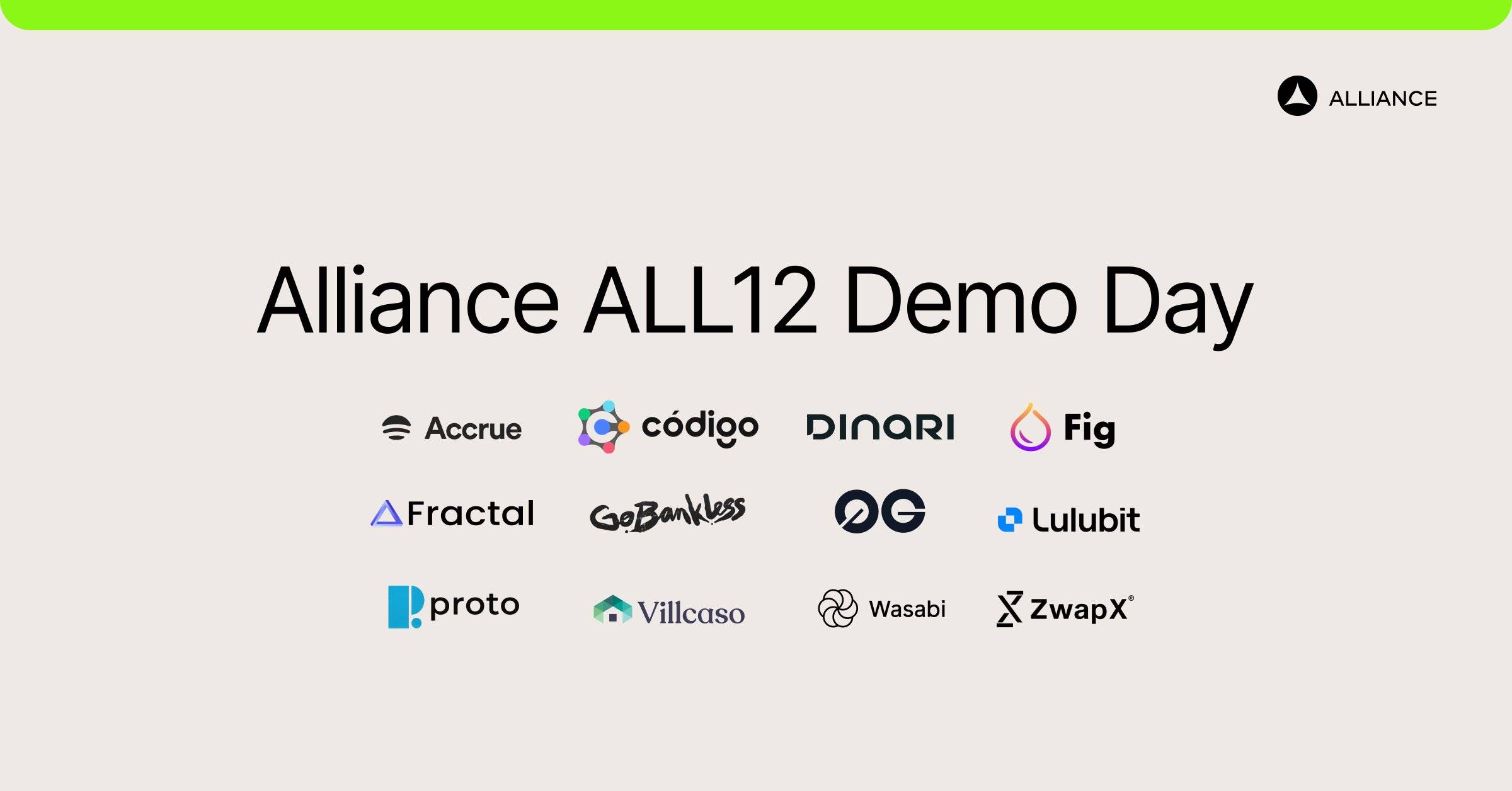
At a time when the market is wavering and sentiment appears slightly fatigued, Alliance has launched its latest cohort of incubated projects into the market.
As the largest accelerator in the crypto space, Alliance has previously incubated well-known projects such as Tensor, Pendle, and Synthetix. Recently popular crypto consumer applications Fantasy.top and Pump.fun were also孵化 by Alliance. Both Fantasy.top and Pump.fun now rank among the top ten cryptocurrency protocols by fees and revenue generated, surpassing many established Layer 1 blockchains.
Last week, 12 early-stage crypto startups successfully "graduated" from Alliance. Most of these projects are focused on trending sectors such as RWA (Real World Assets), AI, and DePIN, reflecting Alliance’s deep understanding of current market narratives and industry trends.
Beyond capitalizing on prevailing narratives, several projects in this cohort focus specifically on expanding into crypto markets across Africa, Latin America, and Asia, highlighting the growing trend of blockchain adoption in developing regions.
Below are introductions to these 12 startups:
1. Villcaso
Product Focus: Tokenization of U.S. Real Estate
Project Twitter: https://twitter.com/Villcaso
Overview:
Villcaso tokenizes U.S. real estate assets in a compliant manner, enabling global users to participate in American property investment through holding $USH (U.S. Housing) tokens on-chain. This approach solves key challenges non-U.S. residents face when investing in U.S. real estate, including regulatory compliance and high entry barriers.
2. GoBankless
Product Focus: Cross-border Crypto Payments in Africa
Project Twitter: https://twitter.com/gobanklessapp
Overview:
GoBankless builds a compliant stablecoin-based cross-border payment system for small and medium-sized enterprises (SMEs) in Africa, helping them convert cash into stablecoins. By leveraging on-chain payments, GoBankless eliminates SWIFT's high transaction fees—up to 20%—and long settlement times, addressing major pain points for African SMEs. Currently, GoBankless serves over 400 courier companies and 49 bank branches across Africa.
3. Wasabi Protocol
Product Focus: Derivatives Trading for NFTs and MEME Coins
Project Twitter: https://twitter.com/wasabi_protocol
Overview:
Wasabi Protocol is a Web3 long-tail asset derivatives exchange built on Blast Chain, offering leveraged trading for high-volatility assets such as NFTs and memecoins. It also provides services including NFT options, asset staking, and fractionalized NFT trading. Wasabi is the first project to offer derivatives for both ERC721 and ERC404 standard assets and actively improves liquidity for culturally significant memecoins. Within months of launch, Wasabi attracted over 30,000 users and achieved more than $200 million in trading volume.
4. Lulubit
Product Focus: Fiat-to-Crypto Exchange for Central America
Project Twitter: https://twitter.com/lulubitapp
Overview:
The Central American crypto market, valued at $70 billion, remains dominated by P2P networks with high fees and poor user experience. To address this, Lulubit offers a fiat-to-crypto exchange service allowing users to directly buy or sell cryptocurrencies using their bank accounts and spend crypto via debit cards. In under a year, Lulubit has attracted over 18,000 users. The service is currently available to residents of Panama and Guatemala, with plans to expand across Central America soon.
5. ZwapX
Product Focus: Tokenization of Luxury Watch Trading
Project Twitter: https://twitter.com/zwapxofficial
Overview:
Traditional luxury watch trading platforms like Chrono24 and Montro suffer from inadequate authentication technology, leading to frequent fraud. To combat this, traditional platforms rely on escrow systems.
ZwapX addresses this issue by holding the physical watches in custody instead of user funds. After registering a watch, users send it to ZwapX’s warehouse in Geneva, where professionals verify authenticity and condition. Once confirmed, the watch is converted into an on-chain token. Users can then hold or freely trade these tokens. Upon successful sale, funds are immediately released to the seller, while buyers can redeem tokens for physical watches or use them as collateral in DeFi applications.
6. Fractal Payments
Product Focus: Stablecoin Cross-border Payments
Project Twitter: https://twitter.com/FractalPayments
Overview:
Fractal Payments is a global cross-border payment platform supporting stablecoin settlements, offering transaction fees three times cheaper and settlement speeds six times faster than SWIFT. Traditional cross-border solutions often face issues such as high costs, slow processing, and complex usability.
Fully licensed in the European Union, Fractal Payments currently supports transactions in over 60 countries. This allows businesses to price transactions in fiat while settling quickly and cheaply using on-chain stablecoins.
Fractal Payments is already integrated into applications such as Zerion and widely adopted.
7. Codigo
Product Focus: AI-Powered Code Generation Platform
Project Twitter: https://twitter.com/CodigoPlatform
Overview:
The usability of AI models heavily depends on the quality of training data. However, acquiring high-quality training data is difficult due to poor data categorization in relevant fields and inconsistent model quality. Codigo aims to help users easily access high-quality datasets. Through token incentives, crowdsourced data collection, and centralized validation, the platform delivers curated datasets and offers specialized model training for high-risk domains like AI-driven finance. Notably, Codigo initially focuses on open-source crypto code—a domain rich in high-quality data. Its beta tool has already generated over 4 million lines of code within just six months.
8. Accrue
Product Focus: Cross-border Payments in Underserved African Regions
Project Twitter: https://twitter.com/useaccrue
Overview:
Accrue enables African users to create virtual payment cards. On the Accrue platform, users can recharge these cards with USD-pegged stablecoins via multiple channels—including banks—and use them for transaction settlements. This reduces cross-border payment costs in Africa by nearly tenfold and cuts settlement time from two weeks to under five minutes. Accrue is now live in seven countries and integrated into Opera, Africa’s largest payment wallet app. Since launch, Accrue has processed over $5 million in transaction volume.
9. Fig
Product Focus: Tokenization of CeFi Options
Project Twitter: https://twitter.com/FigPlatform
Overview:
Fig targets the CeFi options market, which is significantly larger than the CeFi perpetual futures market. By tokenizing complex financial options, Fig simplifies their usage, enabling users to build on-chain investment portfolios and generate returns through sophisticated hedging strategies.
Since launching four months ago, Fig has achieved over $50 million in options trading volume and an ecosystem TVL exceeding $10.2 million.
10. 0G
Product Focus: On-chain Data Availability Solution for AI
Project Twitter: https://twitter.com/0G_labs
Overview:
0G Labs is building the first modular AI chain, developing a programmable data availability solution designed to handle the massive storage and throughput demands of on-chain AI operations. The architecture separates data handling into publishing and storage phases. According to official claims, this design performs up to 50,000 times faster than leading data availability solutions like Celestia, while reducing costs by 100x.
11. Proto
Product Focus: Building a Decentralized Google Maps Using DePIN Devices
Project Twitter: https://twitter.com/dp_proto
Overview:
Proto’s DePIN network uses token incentives to crowdsource geographic data uploaded from users’ smartphones, providing updated mapping services for emerging economic regions. By collecting real-time location data, Proto addresses the problem of outdated information on large-scale map providers like Google Maps—especially in rapidly developing cities such as Mumbai and Bangalore, where dense urban development and fast-changing landscapes make timely updates difficult.
Within months of launch, Proto has achieved 75% coverage of Bangalore compared to Google Maps and expanded into areas previously unmapped by traditional services.
12. Dinari
Product Focus: Tokenization of U.S. Equities
Project Twitter: https://twitter.com/DinariGlobal
Overview:
Dinari is a Web3 securities trading platform that tokenizes traditional financial assets such as stocks, bonds, and ETFs into digital shares called dShares via smart contracts, enabling on-chain trading. Currently operating on Arbitrum, Dinari supports gas payments using stablecoins like USDC, USDC.e, and USDT, eliminating the need to hold native ETH for transactions.
Join TechFlow official community to stay tuned
Telegram:https://t.me/TechFlowDaily
X (Twitter):https://x.com/TechFlowPost
X (Twitter) EN:https://x.com/BlockFlow_News
 深潮TechFlow