Sequoia US: 3 PMF Frameworks Every Founder Should Know – OpenAI Is One of the Most Compelling Vision Stories of This Era
TechFlow Selected TechFlow Selected
Sequoia US: 3 PMF Frameworks Every Founder Should Know – OpenAI Is One of the Most Compelling Vision Stories of This Era
For every early-stage startup, finding product-market fit is the core mission.
 Navigating Web3 tides with focused insights
Author: Youxin
This is a PMF thinking framework recently shared by the Sequoia US team with founders. For every early-stage startup, achieving product-market fit (PMF) is their core mission. Drawing from years of working with companies that have not yet reached PMF, Sequoia US believes there are multiple ways to think about and pursue this fit.
In its immersive company-building experience Arc for seed and pre-seed stage companies, Sequoia guides founders through the following framework—not to diagnose whether PMF has already been achieved, but to outline three distinct PMF frameworks that help understand a product’s position in the market and determine how the company should operate.
Three PMF Frameworks
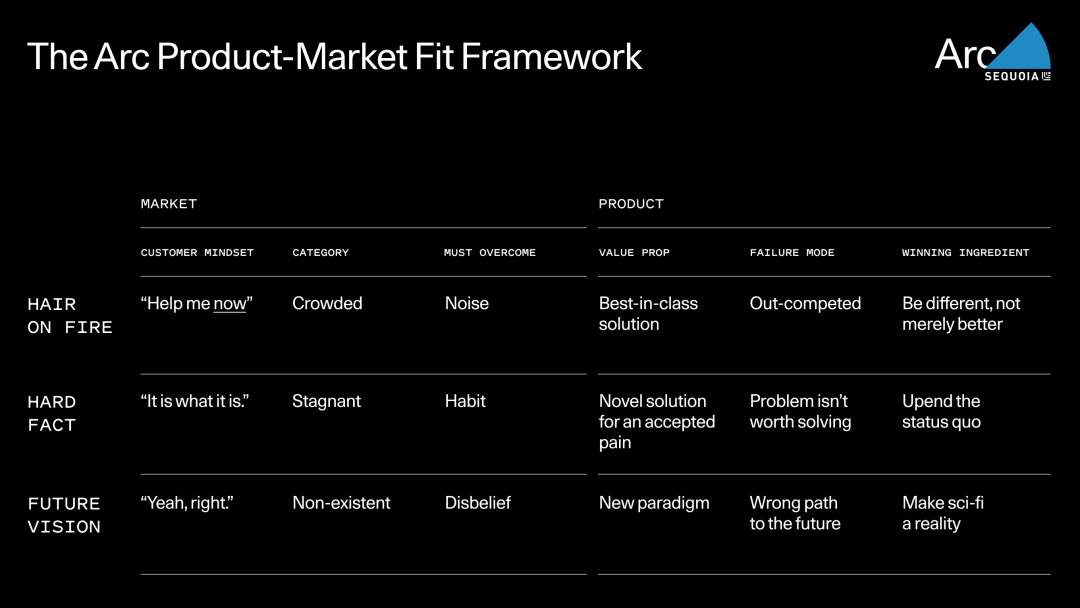
At its core, PMF is about where a product fits in the world. There are many angles from which to consider how a product fits—competitive landscape, technical superiority, etc. But Sequoia believes the best starting point is focusing on how customers perceive the problem your product solves.
Different problems and customer relationships to those problems vary. Sequoia has identified three fundamental frameworks, each with its own unique customer-product relationship dynamic.
Hair on Fire
Solving a clear, urgent need for customers. The need is obvious. As a result, your category may be crowded with competitors. Customers are actively struggling with the problem and likely comparing existing solutions. To succeed in this dynamic, you must stand out. The only way is to offer the best solution. And the best products stand out not just by being better, but by being different. You can’t just be faster or cheaper—you need a truly differentiated customer experience to gain lasting advantage.
Hard Fact
You take a pain point widely accepted as an immutable fact of life and reveal it as merely a problem your product can solve. Your customers have resigned themselves to living with the issue. They aren't actively seeking a solution. The status quo feels fixed; change doesn't seem like an option. You disrupt convention with an unexpected approach: facts can't change—but the problem can be solved. The challenge to overcome is the power of habit. Customers will have to change their current behavior, and inertia is strong. You need a method novel enough, targeting a problem important enough, to make change worthwhile.
Future Vision
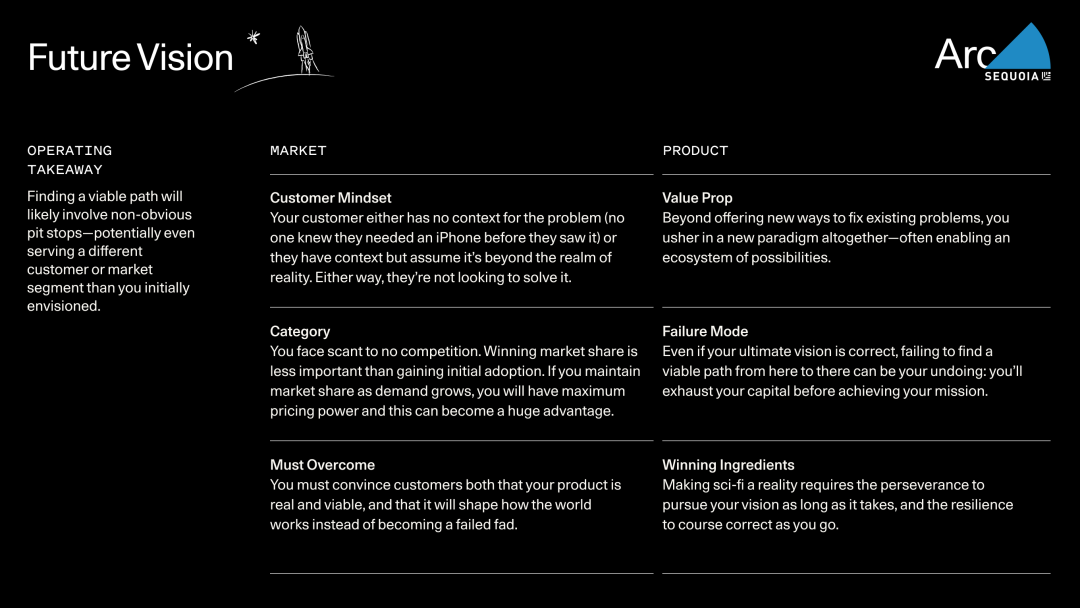
Creating new realities through forward-looking innovation. To customers, this sounds like science fiction—either because the concept is familiar but seems impossible (like abundant cheap energy via nuclear fusion), or because no one has ever imagined it before (like the iPhone). Customers aren’t just not trying to solve the problem—they’re either unaware of it or dismiss it as a daydream. In either case, the barrier is disbelief: customers must believe your product represents a completely new paradigm—often accompanied by its own ecosystem. (The iPhone wasn’t just a device; its App Store was a new way to interact with the internet. Tesla isn’t just a car; it’s a network of cameras and autonomous software, a new driving experience.) Customers must find this paradigm and its possibilities irresistible. As discussed below, this path is often long, and identifying the right commercial opportunities along the way is usually critical.
How to Operate on Each Path
Once these frameworks are understood, companies can self-identify which path they’re on. Many founders in Sequoia US’s Arc program assume they should be on the “Hair on Fire” path. They’ve internalized the mantra of listening to customer needs. That’s good advice. But they’re often surprised to learn that “Hard Fact” or “Future Vision” dynamics are also viable paths to PMF.
Ideally, a company is already working on a problem where it has a unique edge. However, the path the company is on will be defined by how customers view the problem (and their feelings about potential solutions). Success is possible on any path—but each comes with a distinct set of operational priorities that must be understood.
Path 1 – Hair on Fire
The “Hair on Fire” path requires both an exceptional product and an exceptional go-to-market effort—delivered rapidly in succession. It’s this combination of solution, sales, and speed that overcomes competition.
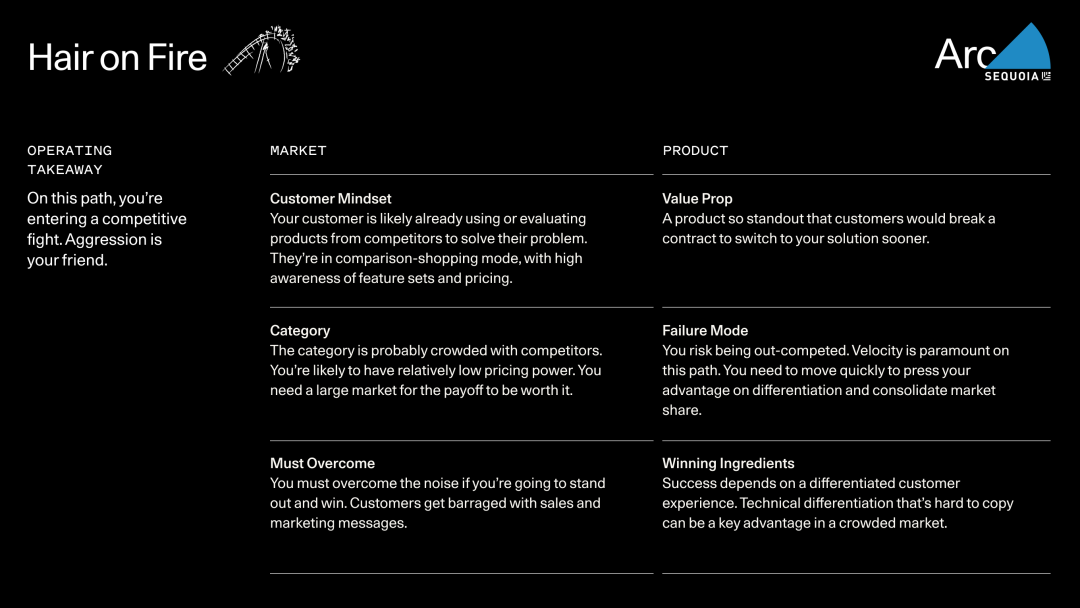
Matching product velocity with the ability to aggressively outpace competitors is a hallmark of success on the “Hair on Fire” path. Assaf Rappaport and his Wiz co-founders had previously built Adallom together. For their new venture, they were intrigued by the problem of cloud infrastructure security—but this was already a crowded space, with established players like Palo Alto Networks and startups like Orca Security already offering products.
Yet when they interviewed chief information security officers (CISOs), the topic consistently topped everyone’s wish list. A clear need in a large market—but differentiation required digging deeper. Most cloud security products relied on agents, software that needed to be installed on every server to enable monitoring. Wiz envisioned an agentless solution that not only reduced friction and headaches but also detected vulnerabilities more effectively.
Even better, once connected, it could uncover these vulnerabilities within a 15-minute customer demo. Assaf and his team seized their advantage and aggressively outmaneuvered competitors: engineers in Israel built the product during local work hours and worked nights as sales reps—during business hours in the U.S. They grew from $0 to $2.8 million in one quarter and hit a $100 million annual run rate (ARR) within 18 months, setting a record for the fastest-growing software company ever.
When Parker Conrad founded Rippling, he entered a large “Hair on Fire” market. Every company needs HR software, and that urgency is reflected in fierce competition: at least half a dozen established players were already fighting for share.
In fact, one of them was Parker’s own former company, Zenefits. Why bother? Because his deep expertise meant he knew it had to be done differently: other vendors stitched together disparate datasets to offer a unified HR and benefits platform, while Rippling’s approach was to build a single, unified database. This foundational employee data layer could then “ripple” across all aspects of the employee experience—from benefits to expenses to device management.
Their technical advantage created a distinct experience for HR, finance, and IT administrators, enabling Rippling to stand out among incumbents and rapidly grow market share. Their strategy of bundling the broadest range of employee experiences—even in a “Hair on Fire” dynamic where new entrants often struggle to command pricing power—gave them strong pricing leverage.
Path 2 – Hard Fact
The “Hard Fact” path requires customers to re-evaluate and change their current behaviors. This begins with educating the market, then seizing the opportunity.
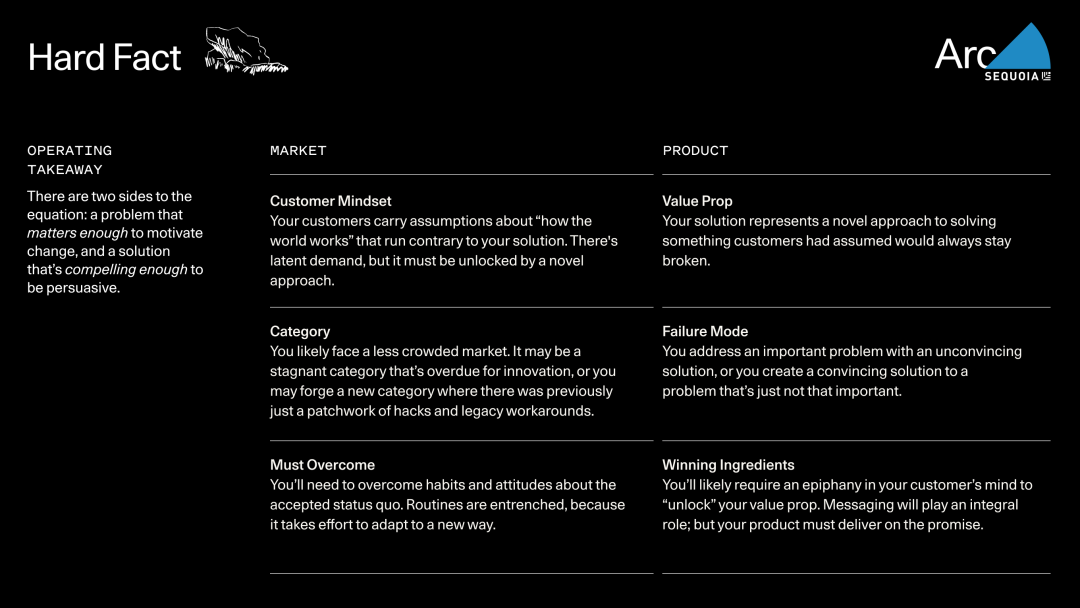
Your novel approach might replace an existing market (like Salesforce moving CRM to the cloud) or create a new one (like Uber reimagining taxi service as ride-sharing). Either way, you may face less competition on the “Hard Fact” path because the difficulty of changing the status quo has deterred others from tackling the problem.
To succeed, Uber had to not only convince large numbers of ordinary people to drive strangers around but also navigate taxi unions, local regulations, and labor laws. Others’ natural avoidance of such complexity means you may gain a wider blank canvas.
When Block (then Square) first launched, they addressed a well-known and accepted “Hard Fact”: “Cash Only.” For many small businesses—or anyone at a farmers market—there was no way to accept credit card payments. Consumers would trek to ATMs, and merchants frequently lost sales. Jack Dorsey and Jim McKelvey’s key insight was that smartphones—becoming ubiquitous—could effectively become mobile credit card terminals.
Square recognized that what was seen as a hard truth of life was actually a solvable problem. But success meant convincing the world it no longer had to endure this pain—and that Square’s solution was trustworthy enough to adopt their new method. To spark this realization and win early adopters who would spread the word, Square made the early decision to give away its hardware and software for free to merchants, figuring out the business model later. Eventually, Square became the new standard.
In 2006, marketing was dominated by advertising, direct mail, and telemarketing—high-cost channels that disadvantaged small businesses. Brian Halligan and Dharmesh Shah realized there was a new way: small companies could leverage rapidly maturing internet properties—blogs, social media, SEO, email newsletters—to reach audiences at a fraction of traditional costs.
HubSpot’s suite of content, SEO, and email management tools solved this problem for customers. But to get clients to believe in their approach and start using their product, HubSpot needed to concretize this new method in customers’ minds—helping them realize the old way was broken and replaceable. They did so by naming the new approach “inbound marketing” and even writing a book about it. Their effectiveness in educating the market made the idea catch on, sparking a marketing revolution in the small business world that propelled HubSpot to PMF and beyond.
Path 3 – Future Vision
The “Future Vision” path has the most ways to fail and the fewest paths to success—but the highest potential rewards. Walking this path requires endurance and the ability to attract and retain top talent.
The philosopher Søren Kierkegaard once said: “Life can only be understood backwards, but it must be lived forwards.” Founders with a “Future Vision” mindset, like Jensen Huang of Nvidia—who walked a long 30-year journey to fulfill the ambition set at founding—might resonate with this.
Nvidia’s original vision was to enhance personal computers with a 3D graphics chip that would transform the computing experience. When Nvidia released its first chip, it was so far ahead of its time that no one knew how to use it. It took six years and three product lines before finding PMF in an industry where GPUs unlocked irresistible new possibilities in video games.
While Nvidia’s original ambition extended far beyond gaming, it became synonymous with gaming innovation, powering PCs and Xboxes. Without that highly productive pit stop—which drove profitability and enabled an IPO—the company might never have survived long enough to power today’s AI revolution. Indeed, before finding PMF in gaming, they nearly went bankrupt. Thirty years after founding, Nvidia is now enabling a new computing paradigm, as GPUs transform everything from data centers to cloud computing.
Products with a “Future Vision” are often dismissed as “too early” and fail to find PMF. For example, 11 years after Google Glass launched, augmented reality still hasn’t gone mainstream. That’s precisely why finding commercially attractive intermediate milestones along the way is so crucial. Assuming your vision is correct and you can find a viable path, time will favor those with a “Future Vision” framework: you can accumulate an insurmountable lead as the world gradually adopts your paradigm. But identifying the right pit stops can be difficult.
You must act on imperfect information—as Kierkegaard said, “living life forwards”—and the bumps in the road are usually clearer in hindsight. Often, finding the right path means embracing unexpected turns in both the technology you’re building and the market you’re serving.
OpenAI is one of the most fascinating “Future Vision” stories of our time. Its vision is to achieve AGI—long considered a pipe dream in tech circles—and do so for the benefit of humanity. To accomplish this, it began as a nonprofit, as the founders believed corporate profit motives would undermine their mission.
However, several years into the journey, they realized the computing costs required to innovate their large language models exceeded even the fundraising capacity of the most resourceful nonprofits. Their path needed to shift toward the for-profit sector. Adopting a more traditional startup structure brought capital and expectations around product launches—leading to ChatGPT. It immediately found PMF in the “I didn’t know I wanted it until I saw it” iPhone paradigm. In 2022, consumer demand for generative AI was just beginning.
By 2023, OpenAI generated $1.6 billion in revenue. While ChatGPT achieved the fastest adoption rate of any consumer tech product ever, for OpenAI, it remains just a strategic pit stop on their true, much grander journey.
Summary
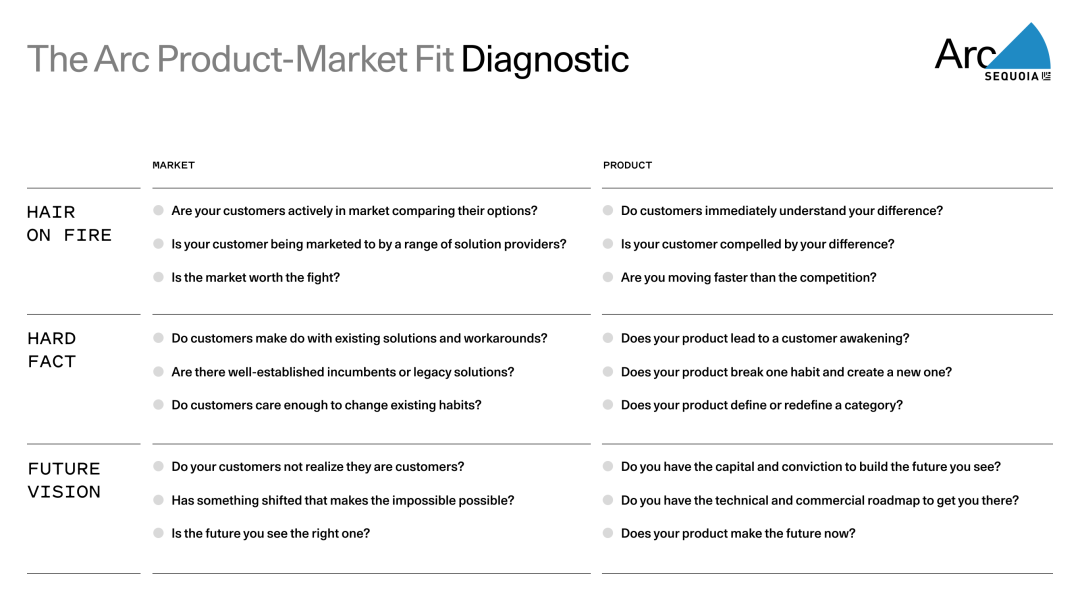
Sequoia emphasizes the importance of these three developmental path frameworks and stresses that none is inherently superior. Founders and companies are encouraged to reflect on their product’s global positioning:
-
Which of these paths is your product on?
-
How do your customers view the problem you're trying to solve? Are you considering the right market category dynamics?
-
What are your operational priorities?
-
Do you need to optimize for speed and scale, demonstrate breakthrough insights to early adopters, or strategically plan necessary pit stops along your journey?
Answers to these questions can help companies better position themselves, understand customer needs, and clarify operational focus and development strategy.
Keep Exploring
Sequoia US emphasizes that applying theory to practice is always messy, and several important nuances should be kept in mind when using this framework in the real world:
The dynamics between product and market are fluid. Over time, many companies shift from one path to another when launching new products or as customer attitudes toward existing products and underlying problems evolve. Some companies operate on two paths simultaneously. The point of this framework is not to rigidly lock yourself into one path; doing so too narrowly is a mistake.
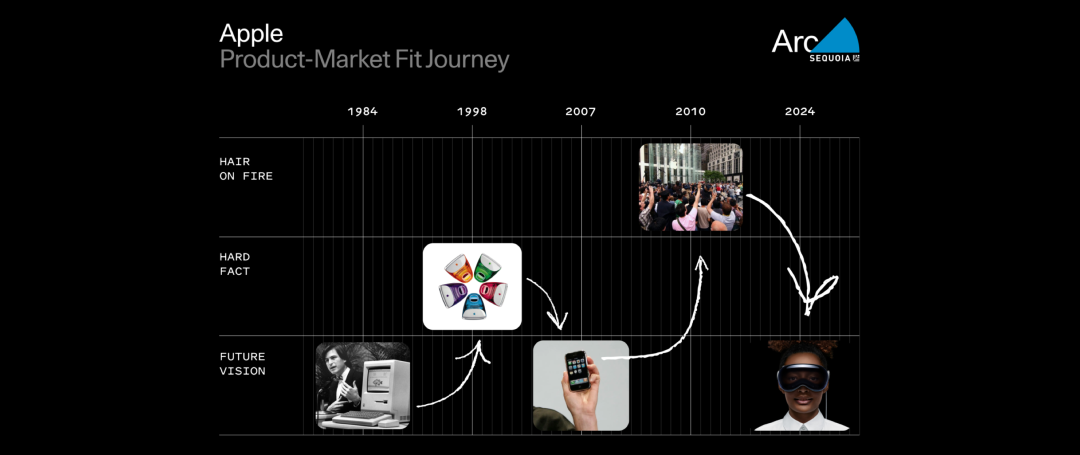
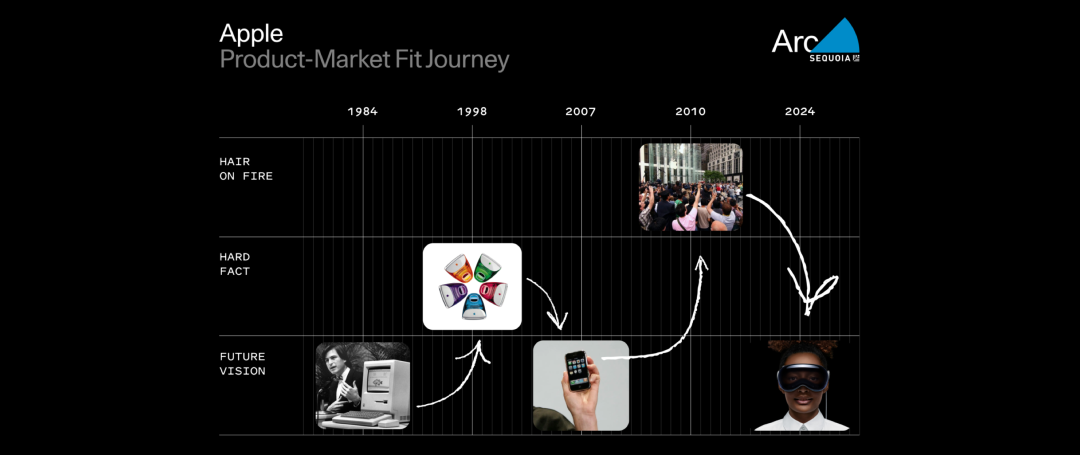
Take Apple, for example, initially seen as a “Future Vision” company. In 1978, the company’s initial memo to Sequoia acknowledged zero demand for home computers. It stated: “Apple management believes that the majority of prospective customers in 1980 have no interest today in buying a home computer.” Yet as they captured imaginations in the 1980s and gained popularity, the personal computer category ceased to be a “Future Vision.”
By 1998, with the launch of the iMac, Apple addressed a “Hard Fact”: despite increasing ubiquity, computers lacked personality. In 2007, when Steve Jobs unveiled the iPhone, it immediately found PMF as a “Future Vision.” Soon after, the smartphone category rapidly shifted into a “Hair on Fire” dynamic, with numerous new smartphones flooding the market. Through category definition, sound judgment, and continuous innovation, Apple managed to maintain its dominance.
Today, Apple is launching another “Future Vision”: the Apple Vision Pro. The device leverages sensors ten times more advanced than those developed for the iPhone: the PMF journey of one product can seed the next. Will Apple Vision Pro unlock entirely new experiences we haven’t yet imagined and clearly enter the “Hair on Fire” path in a few years? Time will tell.
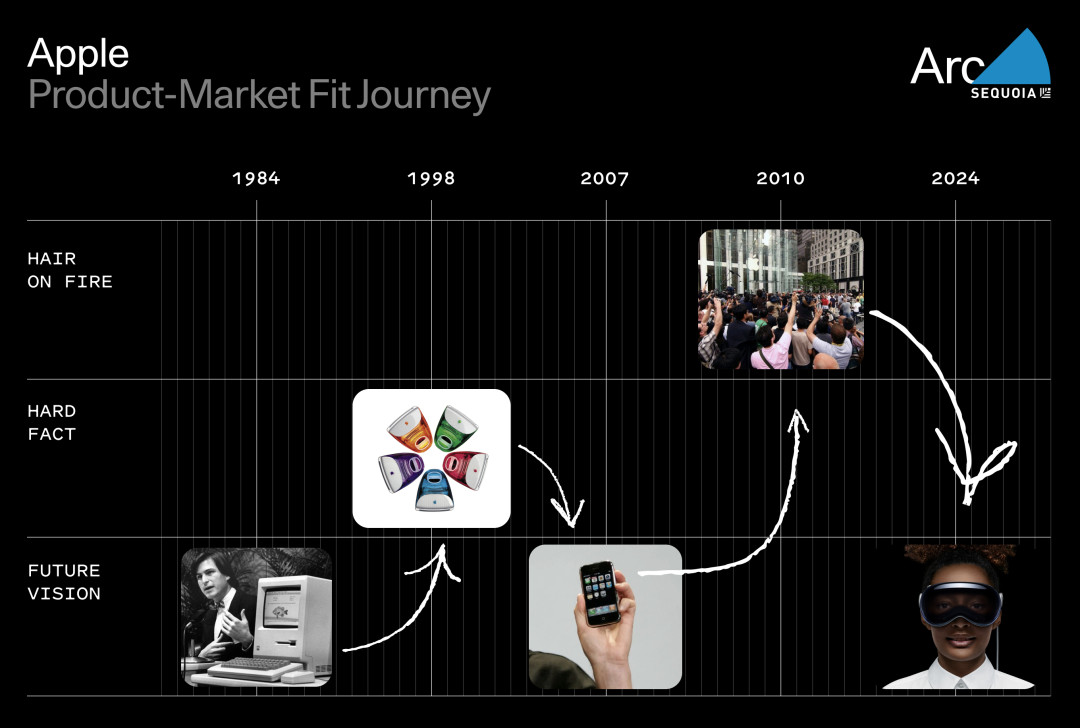
Legendary companies thrive by chaining together multiple product lines, each progressing through its own PMF journey. While one product may peak, the next begins its ascent.
No matter where you are in this cycle, you can use this framework to orient yourself. PMF may feel like a destination you’re striving to reach—but once achieved, maintaining and expanding it is an ongoing exploration that will last the lifetime of your company.
PS: Looking back from 2023 to today, most AI hype has focused on the horizontal capabilities of foundational models, but the real opportunity lies in how AI and Agents reconfigure and create B2B value chains.
Join TechFlow official community to stay tuned
Telegram:https://t.me/TechFlowDaily
X (Twitter):https://x.com/TechFlowPost
X (Twitter) EN:https://x.com/BlockFlow_News