Google is still bogged down by internal struggles, while OpenAI continues poaching talent
TechFlow Selected TechFlow Selected
Google is still bogged down by internal struggles, while OpenAI continues poaching talent
The merger did not suddenly create peace within Google's AI team. The merged teams still sometimes clash over resources.
 Navigating Web3 tides with focused insights
By Youxin
The enthusiastic response to ChatGPT's release in November 2022 shocked Google, which for years had operated two of the world’s most advanced machine learning teams. Google Brain pioneered language models and invented the Transformer technology that OpenAI used to create ChatGPT.
Meanwhile, DeepMind built AI capable of mastering games like chess and Go, but the two teams frequently clashed over everything from shared code to computing resources, and neither managed to launch a product that created an internet sensation like ChatGPT.
Within weeks of OpenAI’s ChatGPT release, Google CEO Sundar Pichai directed executives from Google Brain and DeepMind to collaborate on developing a single AI model called Gemini instead of pursuing separate efforts. At the same time, Pichai began preparing a bigger move: merging the AI units.
DeepMind CEO Demis Hassabis didn’t initially seem enthusiastic about such a merger. He expressed uncertainty about wanting to lead the combined unit and even considered leaving Google to raise billions of dollars to start a new research lab. Such a move would allow him to restart free from the growing organizational politics consuming his time.
But when the merger finally took place in April 2023, Hassabis became the leader of the new unit. In a meeting that month, he presented employees with the benefits of the merger—such as greater access to servers and opportunities for researchers from both teams to collaborate.
The merger did not instantly bring peace to Google’s AI ranks. The combined teams still sometimes clash over resources. Google shifted staff from exploratory AGI research—an AI system capable of human-like thinking and reasoning—to the roughly 1,000-person Gemini project, shutting down some AI initiatives and creating disappointment within the restructured organization.
Meanwhile, OpenAI continued poaching key AI talent from Google, a dynamic that frustrated Hassabis. According to someone who recently spoke with him, he complained that Google’s compensation policies made it difficult to stop researchers from leaving for the startup, which offered generous pay packages.
Since then, DeepMind has increased researcher compensation, partly by using a special stock pool. Hassabis has also expressed disappointment at the extensive media coverage given to several high-profile departures.
According to The Information, in early March, Google DeepMind CEO Demis Hassabis told employees in his DeepMind division that they were responsible for building foundational AI technologies at Google, but others in the company were tasked with delivering them to billions of users—a moment signaling that Google still hadn’t fully overcome the disharmony that previously hindered its AI efforts.
Hassabis’s DeepMind division has long clashed with the other AI lab, Google Brain. A year earlier, Google hastily merged the two labs into one under Hassabis’s leadership as Google DeepMind, yet tensions between them persist.
Meanwhile, Hassabis has struggled to adapt to his new reality within the 182,000-employee Google. DeepMind had operated with unusual independence inside Google, allowing it to focus purely on AI research without worrying about commercializing its creations.
Now, Hassabis faces pressure to work more closely with other leaders to turn DeepMind’s technologies into products—a dynamic that has frustrated him enough to implement organizational changes aimed at restoring influence to pure AI research within Google.
In March, Hassabis restructured his executive team so that more research executives now report directly to him. Pushmeet Kohli, Raia Hadsell, and Zoubin Ghahramani—all Google executives overseeing different areas of AI research—now report directly to him rather than to Koray Kavukcuoglu, who leads the 1,000-person Gemini project and has taken on a new title as Chief Technology Officer of Google DeepMind.
Google DeepMind spokesperson Amanda Carl said the integration between Google Brain and DeepMind has gone smoothly, and the latest restructuring is intended to improve efficiency.
On the surface, Hassabis possesses all the ingredients needed to beat OpenAI. Despite attempts by OpenAI and others to lure away his team, he leads many of the world’s top machine learning researchers and oversees a team integrating DeepMind’s scientific advances into Gemini.
The chart below shows the 36 people directly supervising Gemini’s development, reflecting numerous departures since The Information published its list of project leads in August last year. Many top employees, including Ioannis Antongiulou and Amelia Glaese, have recently left to join OpenAI or launch startups.
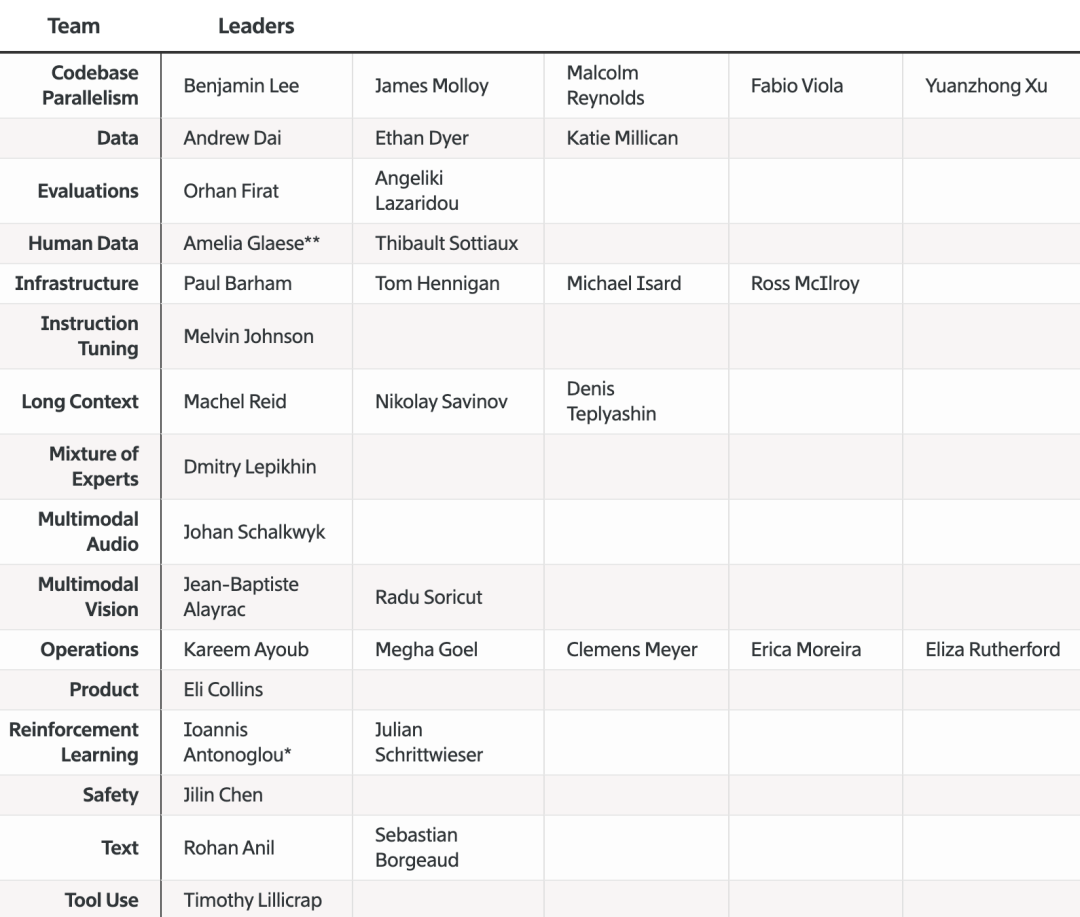
Source: The Information
Google is also planning its next wave of AI products. The Gemini project now includes a dedicated team working on agent software—programs capable of automatically completing computer tasks. This includes Anmol Gulati, co-founder of Adept, a well-known startup developing AI agents, according to one participant. But DeepMind has already lost several key employees in this field.
Daan Wierstra, a senior computer scientist who joined DeepMind before Google acquired it, left earlier this year to join Holistic, an agent-focused startup founded by former DeepMind researchers. Wierstra’s departure had not been previously reported; he said he will begin as Holistic’s chief scientist in August.
DeepMind also controls Google’s vast network of data centers and has access to billions of users across Google products to whom it can roll out new AI offerings. If negotiations between Google and Apple succeed, Hassabis could reach even broader audiences by powering iPhone features like Siri, according to reports.
DeepMind has narrowed the technological gap with OpenAI—but hasn't closed it. While Gemini outperforms OpenAI’s GPT-4 in certain areas, OpenAI’s earlier release allowed it to gather valuable data to help build better models.
OpenAI’s AI-generated video service Sora amazed the industry so much that Hassabis believes it will be especially difficult for Google to catch up in this domain. Last week, Google stated that if OpenAI used YouTube—the video platform owned by Google—to train Sora, it would violate YouTube’s terms.
Additionally, in a January blog post, DeepMind claimed its AI system could solve “complex geometry problems at nearly the level of a human gold medalist at the Olympics.” However, the post omitted notable limitations, said New York University professor Ernest Davis, who studies automated reasoning. For example, DeepMind’s AI can only handle two-dimensional geometry problems and does not understand area, he said.
Such controversies distract Hassabis from AGI research and may represent “a persistent source of frustration,” said Frank Meehan, one of DeepMind’s earliest investors. “OpenAI is generating incredible videos from text prompts, while Google is stuck spinning its wheels on some image problems.”
Hassabis continues to insist that AGI might be just around the corner. To better measure progress toward his long-term goal, DeepMind researchers are developing new benchmarks specifically designed for AGI. The team also hopes Gemini will serve another purpose beyond supporting Google products: suggesting new methods and algorithms to advance their own research.
PS: Looking back from 2023 to today, most AI hype has focused on the horizontal capabilities of foundation models. But the real opportunity lies in how AI and Agents will reconfigure and create B2B value chains.
Join TechFlow official community to stay tuned
Telegram:https://t.me/TechFlowDaily
X (Twitter):https://x.com/TechFlowPost
X (Twitter) EN:https://x.com/BlockFlow_News