2023 Crypto Funding Report: Total Funding Declines, DeFi, Gaming, and Infrastructure Favored by Capital
TechFlow Selected TechFlow Selected
2023 Crypto Funding Report: Total Funding Declines, DeFi, Gaming, and Infrastructure Favored by Capital
How has the funding landscape in the crypto market evolved? Which categories have received the most funding? Who are the top investors?
 Navigating Web3 tides with focused insights
Author: Thor Hartvigsen
Translation: TechFlow

How has the funding landscape in the crypto market evolved over time? Which categories have received the most capital? Who are the top investors? This report will answer these questions and more.
Report Overview
-
Introduction
-
Funding Landscape
-
Funding in 2023
-
Selected Funding Highlights
Introduction
Funding plays a crucial role in both the cryptocurrency and traditional markets, as it enables projects to raise early-stage capital by selling equity to private investors and funds. While such opportunities are typically inaccessible to retail investors, understanding general funding trends is valuable for several reasons. For instance, when analyzing tokenomics and distribution, it’s essential to know whether a project has sold tokens privately to investors.
Over the past few years, the funding landscape has shifted significantly, as new crypto sectors and protocols attracted substantial investments. Today’s report covers funding activity over recent years, with a detailed look at developments in 2023.
Venture capital and angel investor funding can be divided into different stages:
-
Pre-Seed
-
Seed
-
Series (A-E)
-
Strategic Round

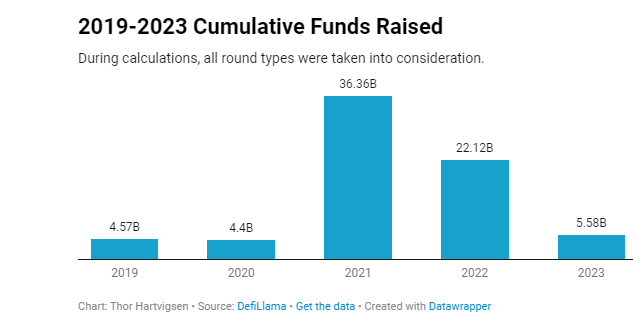
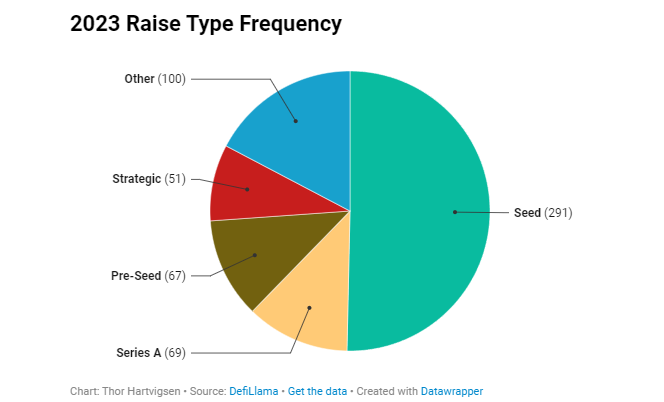
In 2023 alone, approximately 641 funding rounds were conducted by 1,957 unique investors across 617 projects, raising a total of $5.58 billion. The most popular round type was the seed round.
Funding Landscape
In the years preceding the 2021 bull run, funding was relatively concentrated in terms of the number of unique investors participating. As the industry matured, an increasing number of investors sought exposure to the space. During 2021 and early 2022, fueled by relentless price appreciation and low interest rates, unprecedented amounts of capital were funneled into projects seeking investment. Clearly, that era of crypto has ended—total funding in 2023 was only slightly above the levels seen in 2019 and 2020.
When it comes to capital deployment, firms like a16z, Paradigm, and Jump Crypto are known for actively leading high-profile rounds and distributing large sums from their seemingly endless war chests. Most of the largest funding rounds occurred during more optimistic times, although activity hasn't completely ceased. Even relics from the recent crypto wreckage—such as 3AC—appear on the list, with Su Zhu and other members leading seven funding rounds.
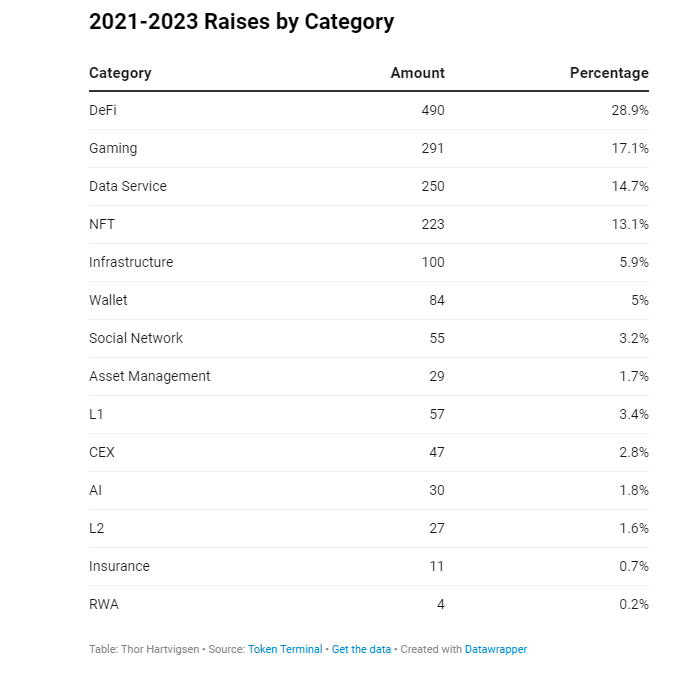
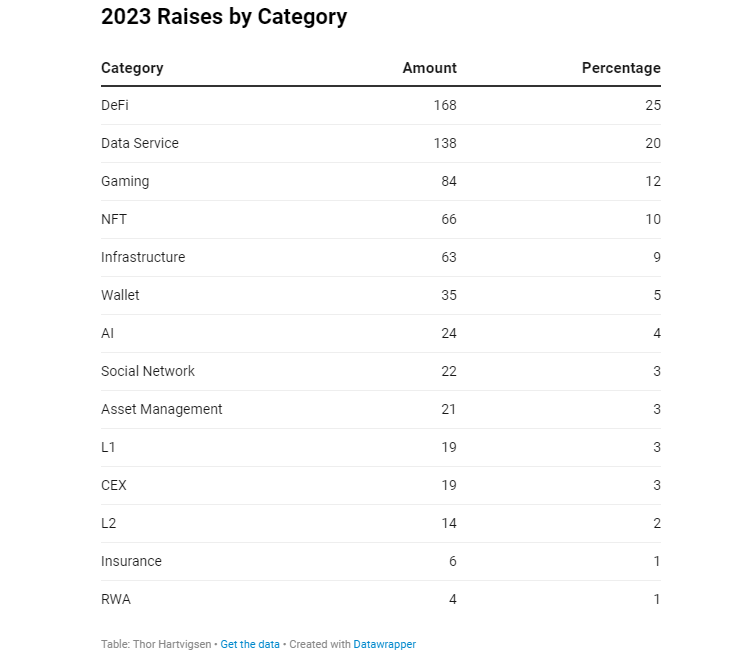
Beyond individual investors, it's worth examining which categories attracted the most capital during this period. As shown below, DeFi accounted for 29% of total funding during this timeframe. Notable DeFi investments include Li.Fi, M^ZERO, and Radiant. Additionally, gaming remains a favorite among venture capitalists, with much of the investment occurring in 2021 and 2022. However, it remains one of the best-funded crypto verticals to this day.
Another category favored by dollar-denominated investors is Layer 1 blockchains. Their corresponding tokens led the 2021 bull market, with some achieving 100x returns post-launch. The chart below shows the eight largest L1 blockchain fundraisings from 2021 to 2023, with Near, Aptos, and Solana leading the pack. More recently funded projects include Celestia and Sei, which also appear on the list but raised significantly less compared to those launched during the 2021 bull market.
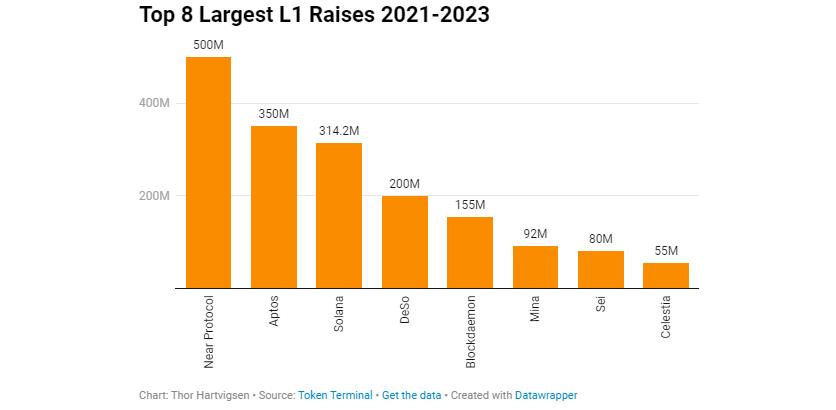
Note: These figures represent the dollar amounts raised from investors, not the valuations of these L1s.
Funding in 2023
As mentioned in the previous section, the most popular funding round among investors is the Seed round. Its popularity stems from its historically high return potential—projects with strong product-market fit have repeatedly demonstrated astronomical valuation growth, convincing investors that this remains a viable strategy.
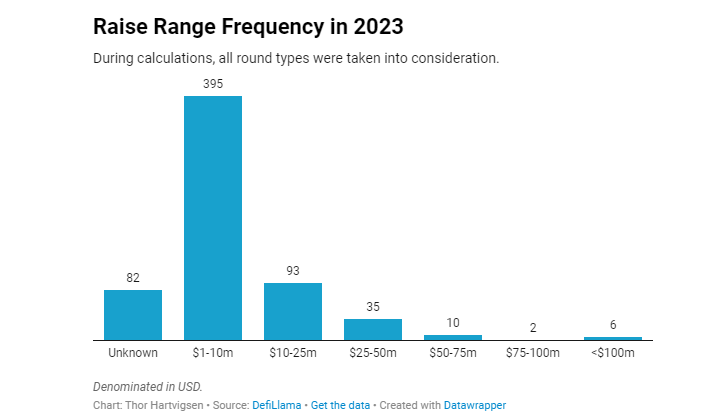
Conditions remain tough, as 2023’s market environment has been less favorable than previous years, liquidity is harder to secure, and investors are more risk-averse. Most projects receive between $1 million and $10 million, with only a few established ones raising $50 million or more.
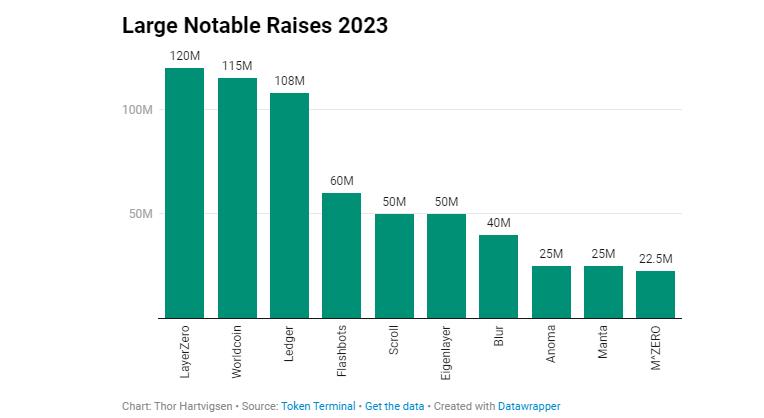
Which established players successfully raised significant capital this year? As illustrated below, notable examples include LayerZero, Worldcoin, Scroll, and Eigenlayer. Importantly, most of these products are some form of blockchain infrastructure—be it a cross-chain bridge, a blockchain, or a privacy protocol.
Although absent from the list of largest financings this year, DeFi projects continue to be among the most sought-after areas in crypto for VCs and private investors. Binance Labs exemplifies heavy VC involvement in DeFi, having invested in Pendle, Radiant, Helio, and others in 2023.
With all this in mind, let’s now examine some notable investments made in the second half of this year.
Selected L1 Fundings in H2 2023
Sei
Sei is a Cosmos-based Layer 1 blockchain optimized for trading applications through its “Twin Turbo” consensus mechanism. Sei claims to process up to 20,000 transactions within 0.5 seconds and focuses specifically on enhancing the decentralized exchange (DEX) ecosystem.
Roughly a week ago, the Cosmos SDK-based L1 secured a strategic investment from Circle Ventures—the amount undisclosed—to further expand USDC’s presence across blockchains. Sei’s fast transaction processing and promising scalability features justified this investment.
Noble
Noble is a new application-specific blockchain within the Cosmos ecosystem, built for native asset issuance. It aims to improve efficiency and interoperability for native assets across the Cosmos network, starting with the USDC stablecoin. Noble’s vision is to become the premier global digital asset issuance hub, enabling seamless connectivity with other blockchains.
In a seed round led by Polychain Capital and joined by Circle Ventures, Wintermute, and many others, Noble raised $3.3 million.
Linera
Linera is a Layer 1 blockchain using “microchains” to enhance scalability, allowing lightweight blockchains to run in parallel under a single validator set. This multi-chain infrastructure is designed for scalable Web3 applications, aiming to solve blockspace scarcity while delivering predictable performance, security, and responsiveness at scale.
With Borderless Capital leading the effort and support from investors including DFG, a16z, and GSR, Linera raised another $6 million in seed funding to build the first low-latency blockchain capable of scaling as easily as web2 applications.
Selected L2 Fundings in H2 2023
Blast
Blast attracted over $500 million in deposits within seven days of launch. With backing from major investors including eGirl Capital, Manifold, Standard Crypto, Paradigm, and Santiago R. Santos, Blast successfully raised $20 million. Blast aims to introduce native yields for various assets such as ETH and stablecoins, enabling automatic compounding while earning additional Blast rewards. Furthermore, Blast plans to distribute all revenue back to protocol developers via sequencer fee sharing.
Fhenix
An L2 leveraging fully homomorphic encryption, focused on creating a confidential environment for Ethereum-compatible smart contract development.
Fhenix secured $7 million in seed funding led by Multicoin Capital and Collider Ventures, with participation from Node Capital, Robot Ventures, Tane, Hack VC, Metaplanet, and Bankless Ventures. The funds will be used to deploy rollups emphasizing encryption.
Layer N
In a collaborative seed round led by dao5 and Founders Fund, Layer N received $5 million to develop a high-performance L2 tailored for financial applications requiring speed and scalability. The goal is to replicate the efficiency of traditional financial markets while offering decentralized, non-custodial products comparable to centralized exchanges (CEX).
Selected DeFi Fundings in H2 2023
Ekubo Protocol
Ekubo Protocol was solely funded by the Uniswap DAO, receiving 3M UNI tokens (worth $18 million) in exchange for 20% of its upcoming governance token supply. Ekubo is an AMM DEX designed specifically for the Starknet architecture, placing strong emphasis on capital efficiency and third-party developer support.
Definitive
Definitive, a non-custodial execution platform and API, raised $4.1 million in a seed round led by BlockTower Capital earlier this month, with participation from Coinbase Ventures, Nascent, and Robot Ventures. The ultimate goal is to enhance the DeFi trading experience by providing optimal slippage and price impact execution, along with advanced yield strategies.
Flashwire
Gate.io Labs, VeChain, CyberX, Legend Trading, Cobo, and SuperChain Capital collectively invested $10 million in Flashwire during an October Series A round. Flashwire is a Singapore-based digital bank committed to increasing financial inclusion by making financial services more accessible and user-friendly.
Conclusion
Key takeaways from this study:
-
Total funding in 2023 dropped significantly compared to 2021 and 2022. However, given recent market rallies and expectations around BTC ETFs, an increase in 2024 is unsurprising.
-
DeFi is the most funded category overall, but the largest individual raises belong to L1 and L2 blockchains.
-
Gaming remains one of the biggest bets for crypto funds.
-
Seed rounds are more common than any other type of funding round.
-
Only a few funding rounds this year were related to RWA. We expect this number to grow significantly in 2024.
Join TechFlow official community to stay tuned
Telegram:https://t.me/TechFlowDaily
X (Twitter):https://x.com/TechFlowPost
X (Twitter) EN:https://x.com/BlockFlow_News
 Thor Hartvigsen