Exploring the Meaning of Web3 Social: Background, Motivation, and Categories
TechFlow Selected TechFlow Selected
Exploring the Meaning of Web3 Social: Background, Motivation, and Categories
Are the early promises of decentralization, ownership, and trustlessness on track?
 Navigating Web3 tides with focused insights
What is Web3 Social?
How do Web3 social applications differ from Web2?
Are the early promises of decentralization, ownership, and trustlessness on track—or faltering under the countless trade-offs that come with building complex technologies? What will change for users, creators, and their communities?
These are some of the questions we’ll dive into throughout this Web3 Social series. I’m not a developer, nor an expert in web3 social, so I’ll be learning as I write! The first few articles will focus on quickly outlining what defines “web3 social,” including types of projects, key players, dominant narratives, and more—just to ensure we have a shared understanding of what we’re exploring.
First, I’ll share a WIP mapping I’ve been developing alongside a web3 social project database. With your help, I’ll continue refining this map! But first, here’s some background on why this series exists.
Background and Intent Behind This Series
After spending all of 2022 working on mental health initiatives, I’ve now fully returned my focus to Web3, aiming to collaborate as a consultant and creator with various projects and their communities. While looking for new clients, a close friend introduced me to Hadrien, founder and CEO of Sismo—a Paris-based company applying zero-knowledge (ZK) proofs for privacy and user data aggregation.
While I initially expected to assist Sismo with growth and marketing, the conversation led to something even more exciting: Hadrien proposed funding me to write an educational series on web3 social. As someone who loves investigating, learning, and sharing what I discover, this was an opportunity I couldn’t pass up—even if I tried.
So here I am, diving deep into web3 social—trying to understand the concepts and break down the work of many brilliant builders into digestible insights.
I’ve already learned from—and will continue learning from—many builders and thinkers, including Nir from Yup, Dan and Varun from Farcaster, Bradley from Lens, Jacob from Zora, Raz and Reka from Guild, Jakub from SGV, Peter and Nich from 1kx, Diana from Rehash, Pol from Converse, Matt from XMTP, Adam Belo from Guild, and others.
State of Web3 Social v0, July 2023
I think a good old-fashioned map is interesting right off the bat. We plan to upgrade and refine this mapping—and its corresponding database—in the coming months as we explore the space in greater detail.

Let’s briefly describe each category in the current state of web3 social (v0).
Protocol Layer

Protocols provide developers with fundamental building blocks (or primitives) for Web3 social applications: posting, commenting, following, messaging, etc. Thus, protocols treat developers as their end users.
Several attributes make web3 social more attractive to developers than web2 social:
-
Web3 protocols aim to be decentralized and "trust-minimized," meaning no central entity can block developers from using Web3 tools. This contrasts with recent events at Reddit, where API access costs were significantly increased, forcing most third-party developers to shut down their apps.
-
The web3 social graph (transaction history and user data) is publicly accessible and available for developers to use without having to bootstrap their own social graphs—a notoriously difficult task.
-
Web3 builders can leverage a growing body of existing building blocks and open-source code, dramatically lowering the barrier from idea to MVP.
The degree of decentralization for protocols may fluctuate over time, as teams must make short- to medium-term trade-offs. Some projects are adopting different approaches, including progressive decentralization or “sufficient decentralization.” The latter is based on the idea that a protocol only needs to be decentralized to the extent required to deliver its core value proposition—non-essential functions don’t need to be decentralized.
Web3 social is still in its early stages, with key protocols in initial development phases. Some projects like Farcaster and Lens have partly focused on building web3 versions of web2 functionalities such as posting, commenting, and following. Now, newer web3 primitives—such as minting, collecting, and granting access to NFT-based services—are being added to the mix. Collectively, these elements will enable novel use cases at the application layer.
XMTP is an example of a web3 protocol solving the messaging primitive, allowing users to receive messages across different apps directly on their blockchain accounts via clients like Luster and Converse.
Identity Layer

The identity layer enables richer experiences for web3 social applications by allowing users to create and aggregate data directly under decentralized identifiers. This includes creating decentralized identities, names and avatars, profiles, transaction histories, data privacy, selective information sharing, and access to various digital social spaces.
Some projects in this layer are also protocols, but given the breadth of projects handling identity and social data, I believe they warrant their own distinct layer in the stack. I expect innovations in the identity layer to profoundly impact the experiences created at the application and client layers.
One expectation around web3 social is that users will control their own data and should be able to enjoy personalized experiences—even on first use across apps. To achieve this, builders will rely on identity-layer projects to supply rich and diverse data sets.
POAP is an example of an identity-layer project used to enrich user experience in the chat app Salsa.
Client and Application Layer
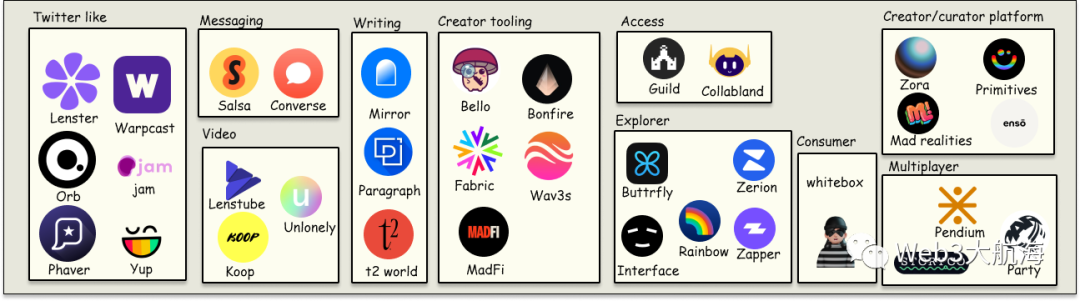
Clients and applications are user-facing interfaces and products built atop web3 social protocols. They leverage the breadth of available protocols and identity solutions to craft valuable and novel use cases for end users such as collectors, creators, and everyday consumers.
My initial thought was to segment applications based on how much they cater to different web3 social roles—like collectors, curators, and creators. Ultimately, I opted for a simpler classification based on the primary function of each application. That said, it can still be challenging to categorize truly out-of-the-box experiences like Stealcam.
An example of a web3 social application is PartyBid, which allows people to easily purchase items with cryptocurrency through genuinely novel experiences. The PartyBid app leverages the Party protocol.
Key Enablers
These are foundational technologies without which protocols, tools, and applications could not exist. Examples include standards like ERC-721/1155/6551, around which many projects are designed.
In this category, I also want to include critical enablers such as the ability to build multiple clients on top of a single web3 social protocol.
Where Do We Go From Here?
I expect this mapping to evolve significantly as my understanding of the space deepens.
Here are some topics I’d like to research and write about next:
-
1. How projects across different layers of the stack approach decentralization
-
2. Who are the main social roles in web3?
-
3. What are the dominant web3 social narratives?
Join TechFlow official community to stay tuned
Telegram:https://t.me/TechFlowDaily
X (Twitter):https://x.com/TechFlowPost
X (Twitter) EN:https://x.com/BlockFlow_News