TechFlow Logo
Login/ Sign up
ETH Gas
Gwei
Fear
gas
How to Capture Price Surge Opportunities from the Korean Market? Practical Tools and Strategies Shared

How to Capture Price Surge Opportunities from the Korean Market? Practical Tools and Strategies Shared

2023.04.18
Share

TechFlow Selected TechFlow Selected

techFlow

How to Capture Price Surge Opportunities from the Korean Market? Practical Tools and Strategies Shared

The South Korean market has always played a key role in the cryptocurrency market.

2023.04.18 - 05:52:54
韩国工具Upbit
The South Korean market has always played a key role in the cryptocurrency market.

Written by: Miles Deutscher

Compiled by: TechFlow

The South Korean market has long played a pivotal role in the cryptocurrency space, known for its distinctive trait—nationwide retail participation in crypto trading—which has driven remarkable price surges for numerous tokens. Therefore, monitoring South Korea's crypto trading activity is crucial.

In this article, crypto researcher Miles Deutscher outlines several methods to help capture emerging trends in South Korea’s crypto market. Below is the original piece:

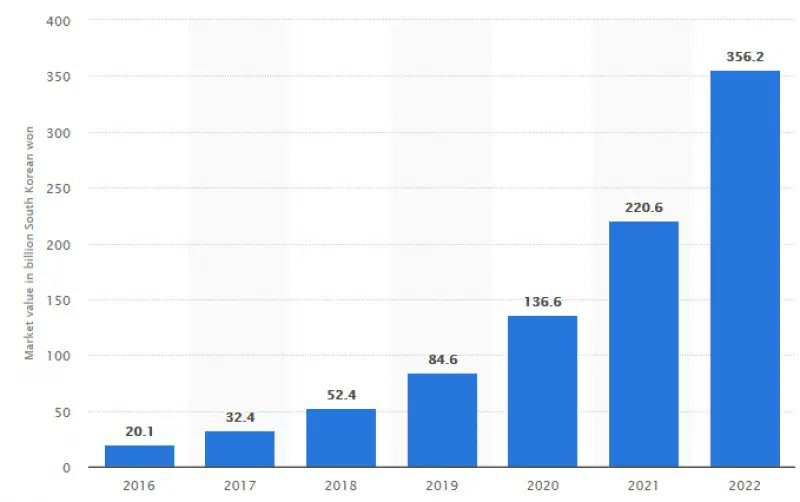
The value of South Korea’s crypto market is growing rapidly, with some of this year’s biggest rallies fueled by Korean retail investors—APT and ARB being recent examples. Support from authorities for Web3 development, a strong economy, and a cultural emphasis on technology and innovation are all contributing factors behind this trend.

As a result, South Korea has become one of the world’s major crypto hubs and currently ranks among the top four countries by trading volume.
Upbit is currently South Korea’s largest cryptocurrency exchange, dominating the domestic market with a 76.6% share.
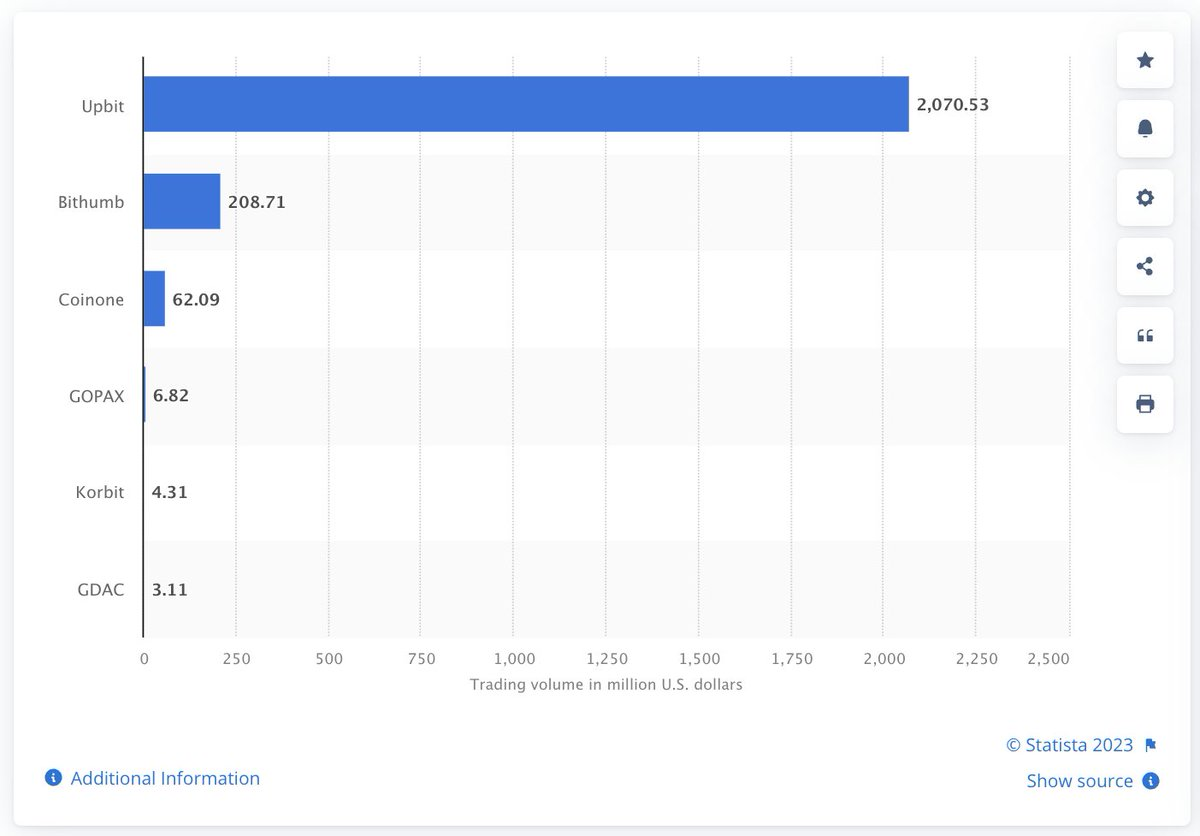
Due to its dominance, monitoring Upbit has become a fundamental method for tracking Korean trading movements.

Below are four steps that can help you catch the next surge in South Korea’s crypto market:

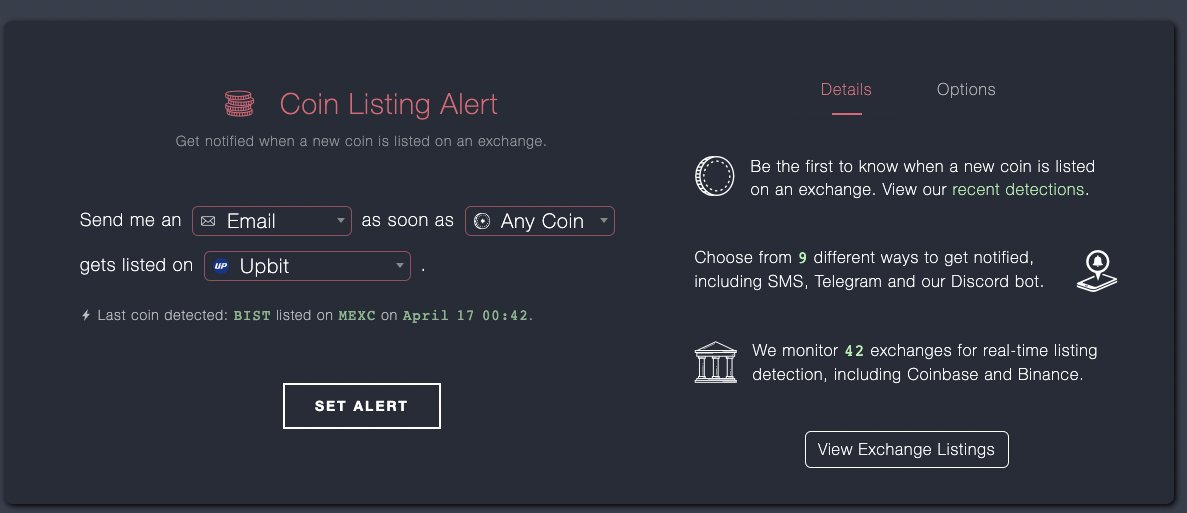
1. Monitor newly listed cryptocurrencies.

You can use websites like Crypto Exchange Listing Bot to send you alerts whenever a new cryptocurrency is listed on Upbit. This may help you catch "listing pumps."

Project Twitter: https://twitter.com/crypto_alerting
2. Use CoinMarketCap to monitor trading pair volumes.

This dashboard allows you to view the top cryptocurrencies by trading volume, along with other relevant metrics. It's useful for identifying which trading pairs are currently "hot."

Project Twitter: https://twitter.com/CoinMarketCap
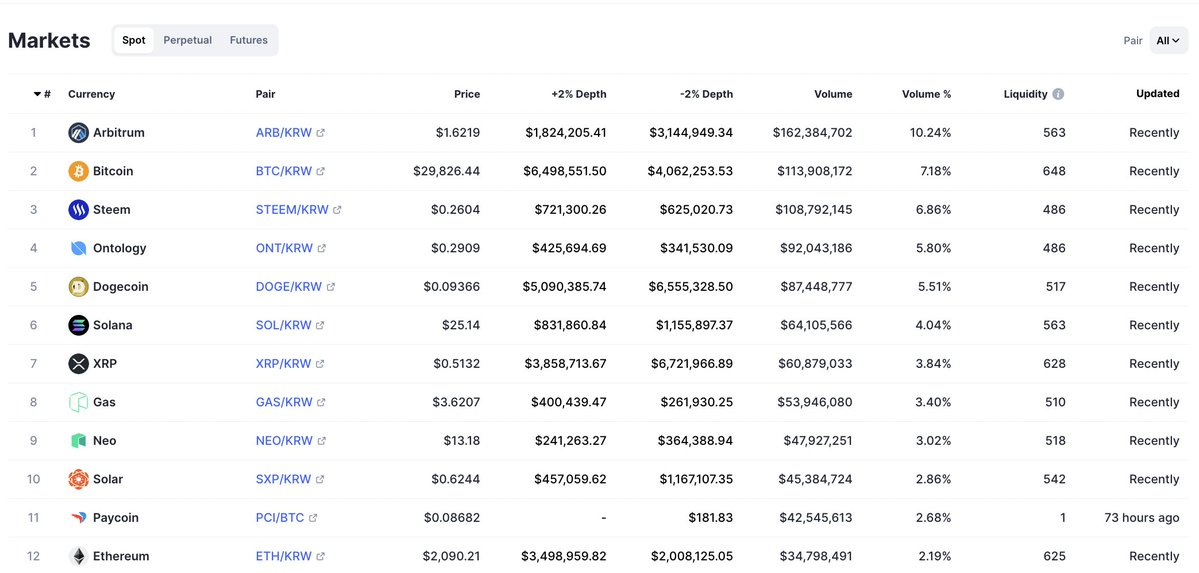
3. Go further by using bots to automatically detect abnormal volume spikes.

These can serve as signals for deeper research. I use the Unusual Upbit Volume Bot, which compares Upbit data with corresponding Binance data.

On April 13, the bot detected a 102.9% increase in $ARB volume on Upbit. Later that day, $ARB began rising by 40%.

Project Twitter: https://twitter.com/UnusualUpbitVol
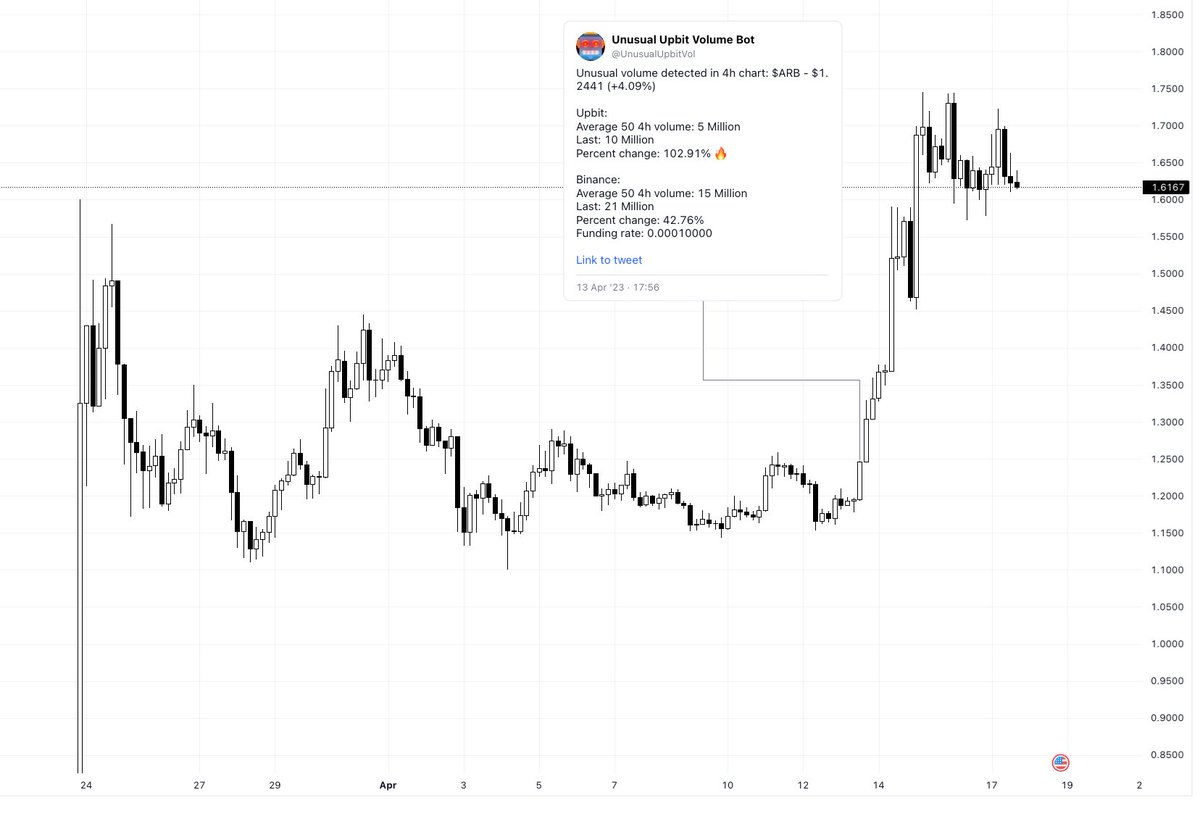
However, I don’t immediately go long just because volume spikes. I treat increased volume as a signal to conduct further research into the token and determine the drivers behind the price movement. I ask myself:

• Is this token being driven by the Korean community?

• Has the volume increase been sustained over a significant period?

• Are there other factors influencing the price move?

• What does the price chart look like? (Very important)

4. Look for cryptocurrencies with low circulating supply and high FDV.

A low circulating supply means that increases in trading volume can have a larger impact on price. Both $APT and $ARB were examples of this scenario, which partly explains their explosive rallies (especially the former).

As the South Korean market grows rapidly, keeping an eye on its developments makes sense. Of course, I also closely monitor other Asian markets such as Hong Kong and Japan. With regulatory uncertainty in the U.S. and increasing crypto adoption across Asia, we may be witnessing an interesting shift in market dynamics.

Join TechFlow official community to stay tuned

Add to Favorites
Share to Social Media

Related Articles

2026.07.22

South Korean Exchange Long-Tail Anomaly: Why Is the Listing Effect So Prominent?

85% of funds are crowding into altcoins, structural barriers create a unique KRW new listing bonus.

South Korean Exchange Long-Tail Anomaly: Why Is the Listing Effect So Prominent?
2026.07.15

South Korean Stock Market Crash Triggers $286 Million in Forced Liquidations, But Upbit Trading Volume Surges 1426%

Capital is flowing from traditional markets to the crypto market.

South Korean Stock Market Crash Triggers $286 Million in Forced Liquidations, But Upbit Trading Volume Surges 1426%
2026.07.13

15 Days After World Cup Elimination, South Korea's National Fate Stock Crashed

The real national team of Koreans this summer collapsed faster than the football team.

15 Days After World Cup Elimination, South Korea's National Fate Stock Crashed
2026.06.23

South Korean Crypto Retail Investor Survey: Nearly Half Increased Stock Holdings; 95% Say They’ll Return Once the Market Recovers

Money has temporarily paused in the stock market and has not exited.

South Korean Crypto Retail Investor Survey: Nearly Half Increased Stock Holdings; 95% Say They’ll Return Once the Market Recovers
2026.06.12

South Korean Young People Make a “Final Bet” Amid an Epic Bull Market

South Koreans, averaging two stock accounts each, are wildly betting on the chip bull market; behind the nationwide frenzy of stock trading and wealth creation lies young people’s survival anxiety and harsh reality as they attempt to break through class barriers.

South Korean Young People Make a “Final Bet” Amid an Epic Bull Market
2026.06.08

South Korea’s KOSPI Plunged 8.37% at Open, Triggering Circuit Breaker: The “Two Stocks” That Propelled the Bull Market Turned Against It in a Single Day

Broadcom’s guidance served as the trigger, sparking an overnight cross-market sell-off that reached Seoul.

South Korea’s KOSPI Plunged 8.37% at Open, Triggering Circuit Breaker: The “Two Stocks” That Propelled the Bull Market Turned Against It in a Single Day
2026.06.02

South Korea’s cryptocurrency “kimchi premium” turns negative—The nation that once traded crypto now trades stocks.

South Korean retail investors are exiting the crypto market, and the net outflow of funds has already left a clear imprint on the price structure.

South Korea’s cryptocurrency “kimchi premium” turns negative—The nation that once traded crypto now trades stocks.
2026.05.29

South Korean retail crypto investors exit the market; banks spend ₩1 trillion in 10 days to seize control of crypto infrastructure

A Single Chart to Understand South Korea’s Institutional Crypto Landscape in 2026

South Korean retail crypto investors exit the market; banks spend ₩1 trillion in 10 days to seize control of crypto infrastructure
2026.05.21

“Cancel Insurance to Buy Stocks”: South Korea’s Seniors Aged 60+ Are Borrowing Money to Bet on Samsung

Time may be the most precious thing for elderly people who borrow money to trade stocks.

“Cancel Insurance to Buy Stocks”: South Korea’s Seniors Aged 60+ Are Borrowing Money to Bet on Samsung
2026.04.13

Bank of Korea’s Interpretation of the AI Semiconductor Cycle: The Most Dangerous Signal Lies in the Financing Side

The Bank of Korea judges that both the magnitude and duration of supply-demand imbalance in this memory cycle significantly exceed those of the previous three cycles, with expansion confirmed to continue at least through the first half of 2026.

Bank of Korea’s Interpretation of the AI Semiconductor Cycle: The Most Dangerous Signal Lies in the Financing Side
TechFlow Logo

Navigating Web3 tides with focused insights

Contribute An Articleemail
Media Requestsmsg

Risk Disclosure: This website's content is not investment advice and offers no trading guidance or related services. Per regulations from the PBOC and other authorities, users must be aware of virtual currency risks. Contact us / [email protected] ICP License: 琼ICP备2022009338号