How can Web3 protocols and NFTs promote the future development of the music industry?
TechFlow Selected TechFlow Selected
How can Web3 protocols and NFTs promote the future development of the music industry?
What problems in the music industry can be solved by Web3 technology?
 Navigating Web3 tides with focused insights
Written by: Genesis Block
Compiled by: TechFlow
Previously, we discussed several challenges facing the Web3 music industry and explored how Web3 technologies might address them. As the industry begins experimenting, we’ve seen it branch into distinct focus areas.
In this article, we’ll dive deeper into these use cases, examine specific protocols helping shape the future of Web3 music, and explore how users can interact with this emerging ecosystem.
Finally, we’ll offer some predictions about where things are headed.
1A: Digital Audio Workstations – The Future of Music Production
The first protocol we’ll examine is Arpeggi, which is currently developing a Web3-native digital audio workstation (DAW). A DAW is essentially the modern version of music production software. With the rise of DAWs like Logic, Pro Tools, and Ableton, music production became democratized—what once required professional studio hardware could now be done on a personal computer for under $500.
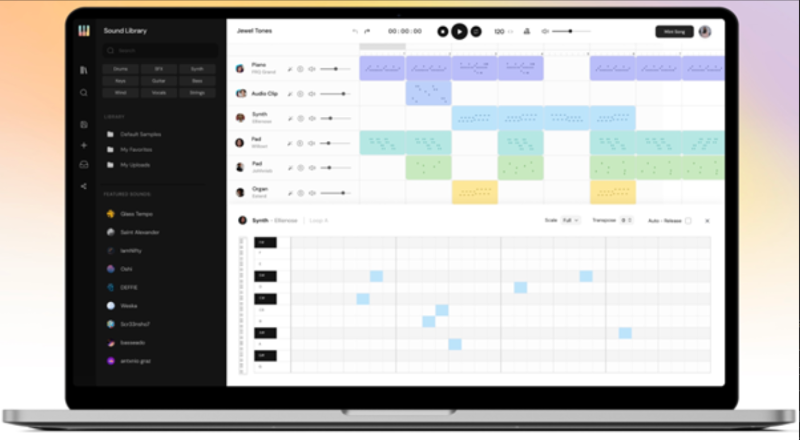
Arpeggi takes this further. By leveraging an online workflow, it makes music creation more collaborative, providing real-time updates for all team members. Particularly interesting—and relevant—is its ability to let artists mint NFTs directly from the DAW. This allows not only full tracks but also individual musical elements (melodies, basslines, etc.) to be tokenized seamlessly. Such tools accelerate NFT adoption in music, enabling a world where remixing and sampling can happen without depriving original artists of fair compensation.
1B: Web3 Digital Service Providers – The Future of Streaming
On another front, projects like Audius and Emanate are redefining how we consume music.
Digital service providers (DSPs) such as Spotify and Apple Music have dominated personal music listening, and frankly, the user experience has never been better.
However, DSPs are essentially just another form of social media platform, and their monopolistic behaviors—from platform control to data exploitation—are increasingly under scrutiny.
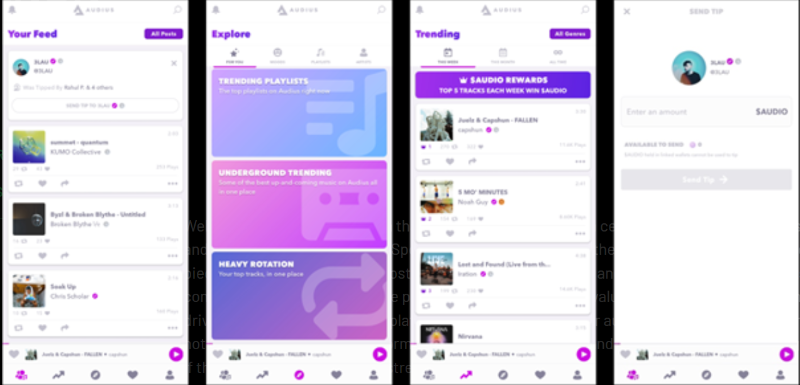
Web3 DSPs, if we may call them that, aim to build censorship-resistant, permissionless, and transparent versions of Spotify and Apple Music.
By decentralizing core components—hosting, indexing, and delivery—they provide on-chain insights into consumer behavior, offering artists significantly better value propositions: more data-driven strategies and reliable platforms to grow their audience.
That said, whether users will adopt these platforms remains to be seen—and will ultimately determine their mainstream viability.
1C: Distribution, Artist Management, and More
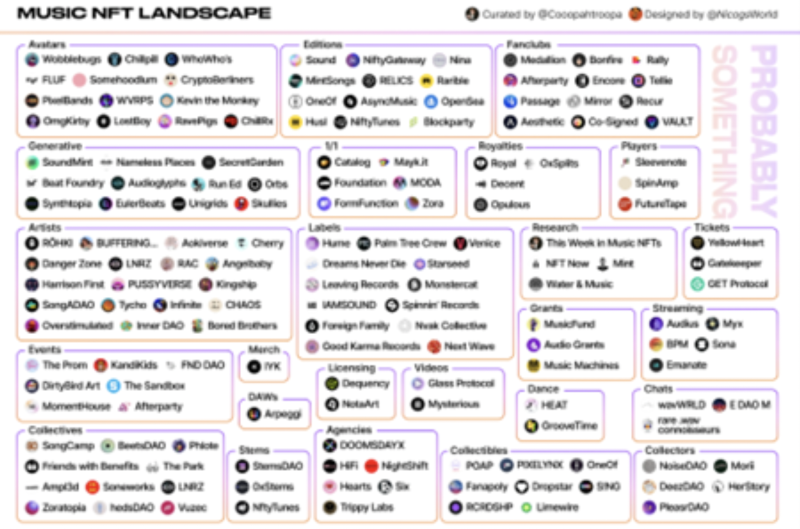
As you can see in the image below, experimentation is happening across other areas of the industry as well.
From music distribution efforts by platforms like Sound.xyz, Catalogue, and Royal, to artist/IP management via Web3-native labels and entities such as DOOMSDAY X and Hume.
Of course, many of these experiments will fade away—but a few may endure and shape the entire industry’s trajectory.
2: Music NFTs and How to Use Them?
If you're an artist or fan new to Web3, there are several basic steps you can take.
First: research, research, and research again. Reading this article is a great starting point.
Once you understand the tools and projects being built, you might want to get hands-on.
Here are a few ways to engage:
Mint or Buy Music NFT Collectibles
These may be part of one or more NFT collections (e.g., limited edition song releases in NFT format). Platforms like Sound.xyz and Catalogue facilitate such NFT drops. These platforms provide artists with foundational tools—not only to monetize their work but also to gain deep data insights into their fans.
Monetization here is straightforward: artists launch NFT series to early supporters, funding future creative work. On the data side, the on-chain nature of NFTs lets artists see who bought their NFTs, when they bought them, whether current holders are the same as initial buyers, where purchases occurred, and more. These insights allow artists to segment and target their audience. For example, knowing who minted your Genesis NFT helps identify your earliest supporters, whom you can then reward accordingly.
Mint or Buy Music NFTs Offering Partial Ownership
For artists, this is a solid way to generate immediate cash flow from future royalty streams. For fans who believe in an artist or track, it offers potential upside if the song or artist succeeds. Currently, a notable platform enabling this is Royal, which allows artists to mint NFTs with embedded ownership rights.
If traditional DSPs like Spotify or Apple Music—or Web3-native ones like Audius—choose to integrate with such NFTs after gaining traction, we could easily live in a world where a significant portion of royalties (especially for independent artists) goes directly to fans. In this future, being a music fan would carry certain characteristics of being an investor.
Utility-Enabled NFTs
These are NFTs with added benefits—such as direct access to the artist, exclusive gated content, rights to NFT artwork, or anything else imaginable. While platforms like Sound.xyz and Catalogue also support such utility features, utility-enabled NFTs belong to a broader subset beyond just music. As such, these tokens can be acquired through horizontal marketplaces like OpenSea, Magic Eden, or Rarible.

Imagine a future where holders of utility NFTs minted by musicians gain backstage access to concerts, receive limited-edition merchandise, or even enjoy a 30-minute session with the artist.
3. Predictions and Outlook
As we've seen across nearly every industry, over time integration tends to occur due to efficiency gains. From the 19th-century oil and gas sector to today's e-commerce landscape, consolidation follows innovation. Similarly, we expect the same pattern to unfold among various Web3 music projects. Take distribution channels, for example: multiple platforms (Catalogue, Sound, Royal, etc.) offer largely the same service—minting music NFTs—with only slight differences in positioning.
We envision two possible outcomes:
- Given that music is a sufficiently large vertical market, there may be room for dedicated marketplaces, leading to a consolidated liquidity hub for music; or
- All these platforms maintain differentiated user experiences but are built atop shared protocols like Zora, effectively bypassing fragmented liquidity while still serving niche audiences.
Intermediaries Will Still Exist
While we can expect much of the industry’s activity to move on-chain, intermediaries similar to those today will still be needed. If a song is played on the other side of the world, where technological maturity and copyright laws differ, we’ll likely still require jurisdiction-specific entities to properly identify and transfer royalties to rightful owners.
Web2 x Web3
As previously discussed, Web3 isn’t here to replace Web2—it exists as a complement. Given that DSPs like Spotify and Apple Music deliver exceptional user experiences, we’re unlikely to see declining adoption rates. Their flywheel of attracting the broadest and largest user base continues spinning smoothly, and such network effects are hard to disrupt.
Instead, hybrid systems are more likely. We foresee Web2 playing a major role in music discovery and consumption, while Web3 becomes central to artist monetization. For discovery, getting your song featured on popular Spotify playlists or the homepage will remain mainstream. For monetization, the more streams you earn on DSPs, the more valuable your artist NFTs become.
Music VC DAOs
As mentioned earlier, a new class of financially coordinated curators is likely to emerge. Taking it a step further, these individuals could band together to form a DAO, scaling their activities significantly. Multicoin Capital, in particular, sees strong potential here.
Copyright
Returning to the comparison between gaming and music, one key reason gaming has thrived compared to music is its approach to copyright law.
With the rise of platforms like Twitch, YouTube, and other social media giants, it’s clear that user-generated content (UGC) is the next frontier shaping these industries.
The difference? While major music stakeholders (primarily record labels) have taken aggressive stances against UGC, the gaming industry has embraced it. This adversarial posture toward smaller creators building atop established works—rooted in the Napster and LimeWire era—ultimately contributed to SoundCloud’s decline and sparked ongoing friction between artists, fans, and labels.
Web3 represents a second chance. It’s imperative that copyright laws aren’t weaponized to the point of stifling Web3 music innovation.
4. Conclusion
With that, our overview of the current Web3 music landscape comes to a close. The industry is clearly in its earliest stages, and there will be many exciting developments in the years ahead—we’re eager to see what surprises lie in store.
Join TechFlow official community to stay tuned
Telegram:https://t.me/TechFlowDaily
X (Twitter):https://x.com/TechFlowPost
X (Twitter) EN:https://x.com/BlockFlow_News
 Frogs Anon