

How do cryptocurrency and tokenomics shape consumer behavior?
TechFlow Selected TechFlow Selected
How do cryptocurrency and tokenomics shape consumer behavior?
Consumer behavior may shift in an instant, or it may take decades of effort to change direction.
 Navigating Web3 tides with focused insights
Written by: Mason Nystrom
Compiled by: TechFlow
Consumer behavior can shift in an instant—or take decades of effort to turn around.
For instance, the perception of remote work shifted almost overnight from being “a nice perk” to a necessity for normal business operations.
In contrast, the relatively obscure vegetarian movement at the beginning of this century took nearly two decades to influence thousands of Americans. Large-scale shifts in consumer behavior are often catalyzed by new technologies, macro trends, or global events.
Throughout the 21st century, the primary catalysts for new consumer behaviors have been social experiences enabled by new technologies: the internet, mobile phones, social networks, and blockchain.
Among these, blockchain is both a technological innovation and a social revolution, and today Web3 has already cultivated fertile ground.
On this fertile ground, blockchain technology will continue to nurture new consumer behaviors.
Tokens provide a mechanism to shape how users behave within networks, offering exciting methods for predicting and designing new consumption patterns. Entrepreneurs, developers, and creators will leverage tokens to extend existing behaviors and intentionally or unintentionally create new consumption norms.
Skeuomorphism vs. Emerging Consumer Behavior
In product design, skeuomorphic design refers to the process of making digital objects resemble their real-world counterparts—for example, selecting a camera icon on your phone to take a photo.
Likewise, skeuomorphic behavior refers to user activities that mirror existing consumption patterns—it only changes the form or perception of consumption, but not both simultaneously.
In contrast, "emerging behavior" comes closest to representing entirely new consumer behaviors, combining changes in both consumption forms and consumer cognition. While any change in consumer behavior may have various catalysts, shifts in both consumption form and perception are often driven by new technologies.
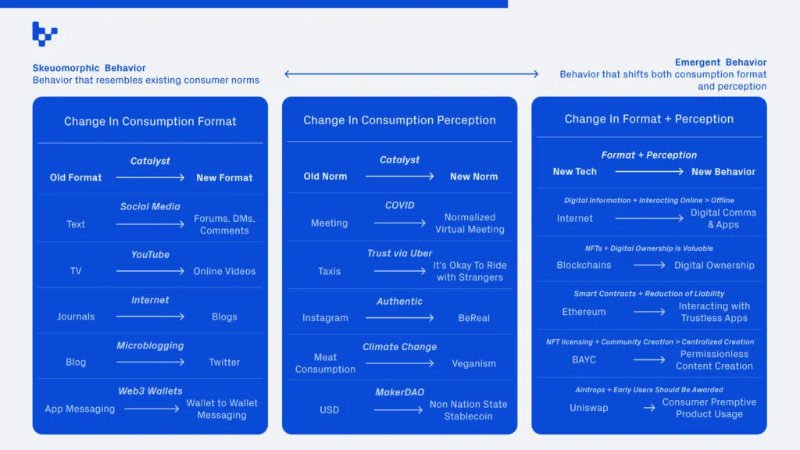
The emergence of social media platforms like Facebook or Reddit simply evolved existing behaviors—such as texting on flip phones—into private messaging, comments, and public forums. Consumer behavior did shift, but retained its fundamental consumption format.
Conversely, new technologies, macro trends, or events alter consumers’ perceptions or the way people interact with one another. Uber and Airbnb created markets that commodified trust through economic and social incentives (e.g., if you lie or misbehave, we’ll remove you from our platform).
However, the most transformative technologies often change both the underlying consumption format and consumer perception.
For example, the aviation industry fundamentally disrupted previous transportation formats—from cars and trains to airplanes—but also required convincing people that flying was at least as safe as driving.
The internet shifted consumption from physical to digital formats and demanded a larger cognitive leap—convincing consumers that online communities and relationships hold value. The most dramatic transformations give rise to entirely new behaviors.
Changes in Consumption Format
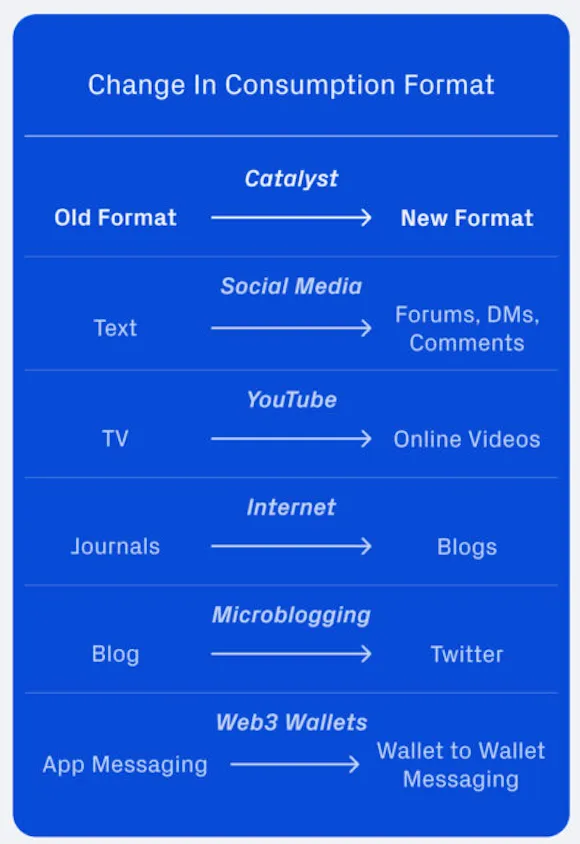
The most skeuomorphic consumer behaviors involve changes in consumption format. Written communication has long been an established behavior, evolving in form with technological progress. The internet gave birth to blogs, which eventually evolved into microblogging via social networks like Twitter.
Changes in Consumer Perception
Consumer perception can shift gradually or suddenly. Beyond remote meetings, the global pandemic accelerated by technological advancement changed views on telemedicine and many other services previously considered inherently face-to-face.
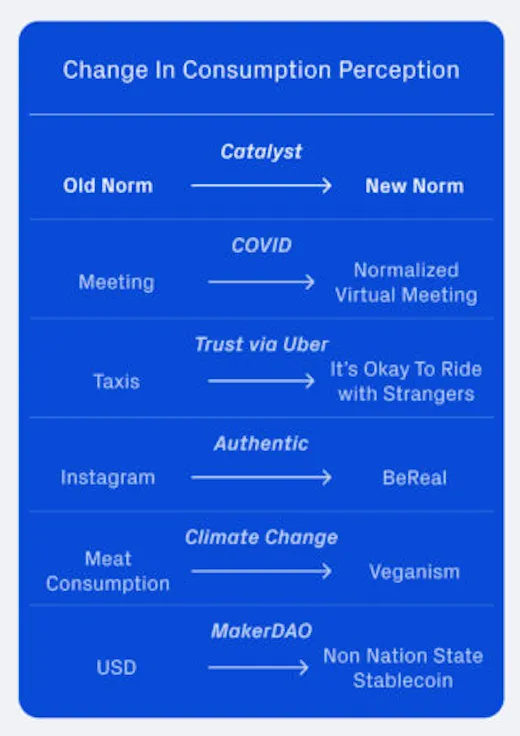
Often, consumer perceptions first shift among smaller audiences before gradually becoming mainstream.
Each social network begins with a unique element of authenticity as a growth catalyst. BeReal is the latest example. Facebook was once uniquely authentic among college peers, while Snapchat offered less filtering than Instagram. However, authenticity tends to fade with mass adoption and large-scale advertising.
Emerging Consumer Behavior (Changes in Both Form and Perception)
Emerging consumer behaviors require shifts in both consumption format and mindset.

Blockchain catalyzed the emergence of NFTs, which shifted both consumption formats (from digital images to blockchain-based assets) and consumer perception—that digital objects can be owned and possess value.
Similar to Airbnb, Ethereum changed consumer perception by commodifying trust and shifting financial transaction formats from Web2 applications to Web3 protocols. This combined shift in format and mindset led to broader adoption of DeFi—trustless financial applications and protocols.
Leveraging Tokens and New Cryptocurrency-Driven Consumer Behaviors
While not all new consumer behaviors are predictable, tokens represent a new consumption format that enables companies or protocols to design human behavior.
By analyzing consumer behavior through the lens of skeuomorphism and emerging consumption, we can envision how consumers might behave in the future. Let’s examine three potential cryptocurrency-driven behaviors:
Communication and Social Interaction
-
Skeuomorphic behavior: W2W (wallet-to-wallet) messaging—individuals connect via their wallets on platforms like OpenSea or Magic Eden.
-
Emerging behavior: Web3 social—open social graphs mean followers can be bonded to those they follow (how does this change our interaction with creators?), and content can be published as NFTs (will consumers perceive it as valuable?).
Physical Infrastructure
-
Skeuomorphic behavior: Nova Labs—physical infrastructure built and designed by private companies (e.g., building Helium blockchain and miners).
-
Emerging behavior: Helium—blockchain unlocks the ability to coordinate socioeconomic activity. Helium pioneered a business model where consumers are rewarded for allocating capital (buying hotspots) and performing work (setting up and running hotspots). This spawned numerous projects iterating on Helium’s model with new use cases: DIMO (vehicle data), Hivemapper (location data), Pollen (5G), Helium (5G), and more.
Token Distribution
-
Skeuomorphic behavior: Token incentives—rewards distributed in tokens instead of referrals, discounts, or cashback.
-
Emerging behavior: Retroactive airdrops—Uniswap’s airdrop introduced a new model where protocols feel obligated to reward early users, and consumers now actively seek out and use new products anticipating future rewards.
Airdrops are a fascinating example of how token distribution experiments can gradually generate new consumer behaviors. This model has since been iterated upon by Hop Protocol (anti-Sybil measures) and Optimism Airdrop (refined reward criteria).
Clearly, tokens offer a design space far beyond distribution and growth marketing. When we reframe tokens as products themselves, we open doors to latent consumer behaviors. That is, “How do new types of tokens—distribution, utility, and incentives—shape consumer behavior?”
While it’s impossible to fully predict new social behaviors, they are typically driven by new business models, technologies, or macro events and trends. Crypto networks and tokens give us a glimpse into the future of skeuomorphic and emerging human behaviors.
Join TechFlow official community to stay tuned
Telegram:https://t.me/TechFlowDaily
X (Twitter):https://x.com/TechFlowPost
X (Twitter) EN:https://x.com/BlockFlow_News















