From lending protocols to on-chain credit infrastructure, exactly how much profit flows to AAVE?
Author: OAK Research (@OAK_Res)
Compiled by: TechFlow
TechFlow: After nine years of evolution, Aave has long ceased to be a single on-chain lending application. Over the past two years, the team has built a three-tier architecture centered around collateralized yield generation: an infrastructure layer, a product layer, and an institutional layer, rolling out comprehensively from the V4 liquidity hub and native stablecoin GHO to mobile savings apps and tokenized U.S. equity markets.
But behind billions in TVL and a vast commercial footprint, investors consistently ask one question: how much of the actual revenue generated by these new businesses flows back to the DAO and the $AAVE token? Based on the latest on-chain data as of November 2026, this article breaks down Aave's cash flow routing, protocol net retention, and token buyback mechanisms layer by layer.
Aave is no longer just a simple lending market. Over the past two years, it has grown into a massive system operating through a synchronized three-tier architecture: foundational lending infrastructure at the bottom, consumer and B2B product matrices built upon it, and an institutional business line targeting traditional finance.
This article takes you on a comprehensive tour of the products the team has actually delivered across these three tiers, consistently tied to the single core question that connects everything: what portion of the value from this business expansion truly flows back to the $AAVE token itself?
Introduction
No one in the crypto world hasn't heard of Aave. Born in 2017 as ETHLend, and launched under its current name since 2020, it has now become the largest lending infrastructure in on-chain finance. But from an external perspective, it's often hard to piece together how its recent flurry of new products interlock: a native stablecoin, a mass-market savings app, an institutional real-world asset (RWA) market, a backend engine powering third-party crypto credit cards, vault infrastructure, fiat on/off-ramps, and even developer servers for AI agents to autonomously construct lending trades.
The simplest way to understand this is to view it as a three-tier architecture revolving around the same core, where the foundational core has never changed: Aave converts user collateral into borrowing purchasing power. You deposit tokens, use them as collateral to borrow other assets, and pay interest to liquidity-providing depositors. All other operations are automatically managed by smart contracts in the background, with governance mechanisms deciding which assets go live and how much risk the system can absorb.
At the very bottom is the infrastructure layer, namely the well-known lending engines V3 and V4. Above it sits the product layer, covering the GHO stablecoin, the Aave App, vault infrastructure that allows other apps to seamlessly embed into Aave, and ecosystem partners responsible for driving lending demand.
Running parallel to these two is the institutional layer: Aave Horizon for tokenized securities and institutional funds, a dedicated V4 deployment instance specifically serving Coinbase's tokenized U.S. equities, and a customized V4 instance specializing in RWA set to launch on Avalanche. Each layer feeds into and amplifies the others.
Thus, the core argument of this article is clear: Aave is no longer just a lending website requiring users to visit directly, but is transforming into the underlying credit infrastructure supporting various retail and institutional, front-end and back-end financial products. We will track a core question from start to finish: of the dividends brought by this massive expansion, how much truly reaches the DAO treasury and the $AAVE token?
A brief note before we begin: This article stems from a long-term content partnership between OAK Research and Aave, researched and written independently by the OAK Research team, without any commission, editing, or intervention from the Aave team.
Seeing Aave's Real Business Through Data
Before diving into each tier, let's anchor this business with a few sets of hard data. At its core, Aave is lending infrastructure: users deposit assets to collateralize borrowing of other assets, or simply earn yield by providing liquidity.
In the industry, three metrics are often conflated, which is why the Aave TVL figures you see across different sources often vary drastically, making it necessary to clarify the boundaries first.
Total Deposits represent all assets deposited by users into the protocol, including portions later borrowed and moved elsewhere; subtracting the already-borrowed portion from total deposits leaves the True Total Value Locked (TVL) genuinely locked within the protocol; and Loan Volume measures the total credit actually used in the market at a given moment. Three numbers, pointing to three completely different things.
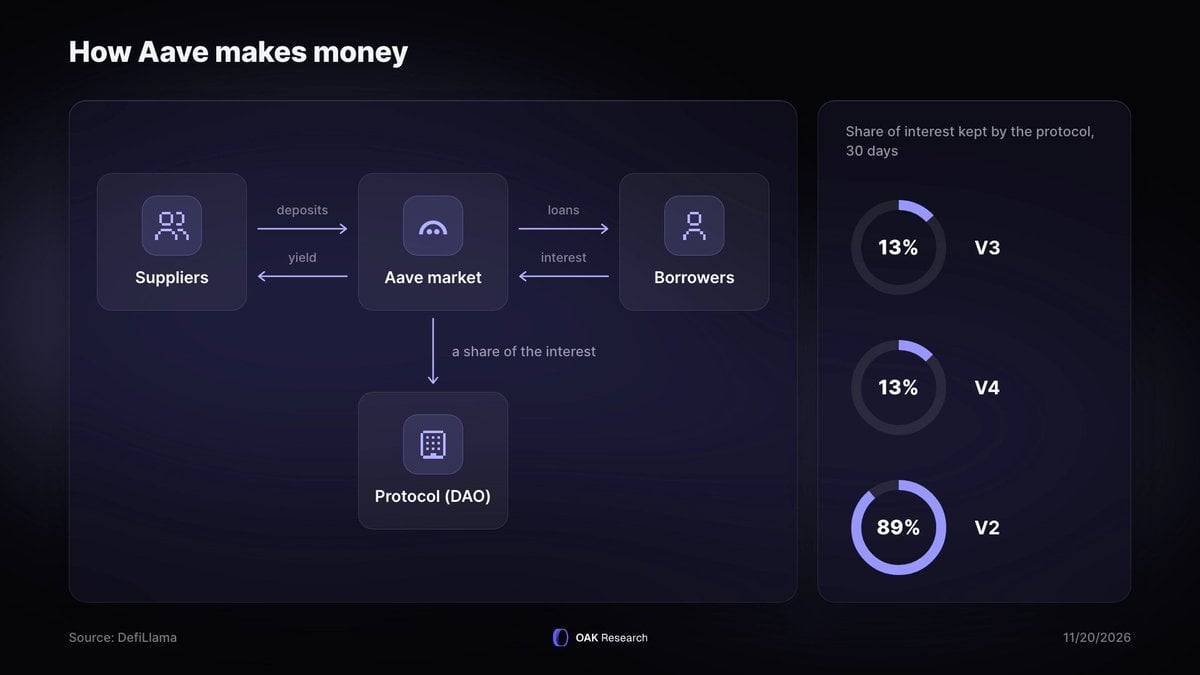
The next unavoidable question when examining any business model is: how much money does the protocol actually keep? Here, we must distinguish between the total fees (Fees) created by Aave and the net retained revenue (Revenue) of the protocol. When borrowers pay interest, this is collectively called protocol fees, but the vast majority goes to the funding depositors, with the protocol only taking a small cut based on the "Reserve Factor." Since reserve factors are configured asset-by-asset, the retention ratios below for each version are weighted averages, not a single fixed rate:
Aave V2: Relatively high fee retention ratio, but belongs to legacy ledgers gradually being phased out, with little liquidity remaining today.
Aave V3: The absolute economic core today, with a comprehensive fee retention rate of roughly 13%.
Aave V4: The newly launched next-generation engine, currently operating at a similar comprehensive retention range.
Below is an overview of Aave's core operational data as of early November 2026.
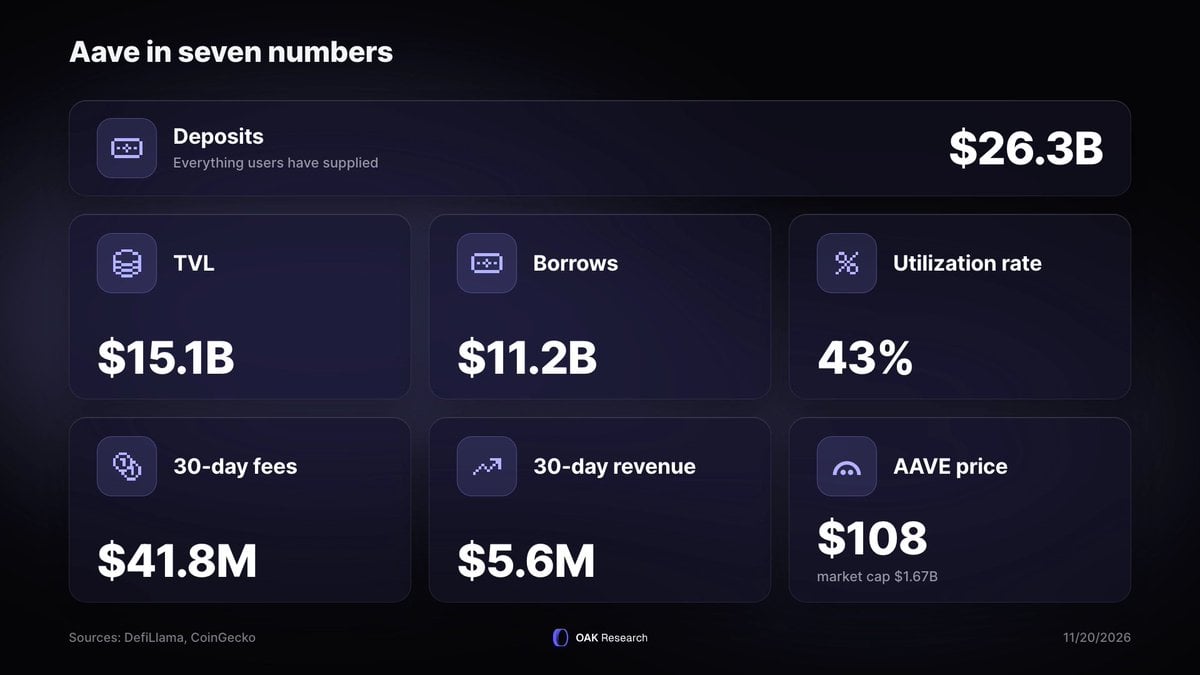
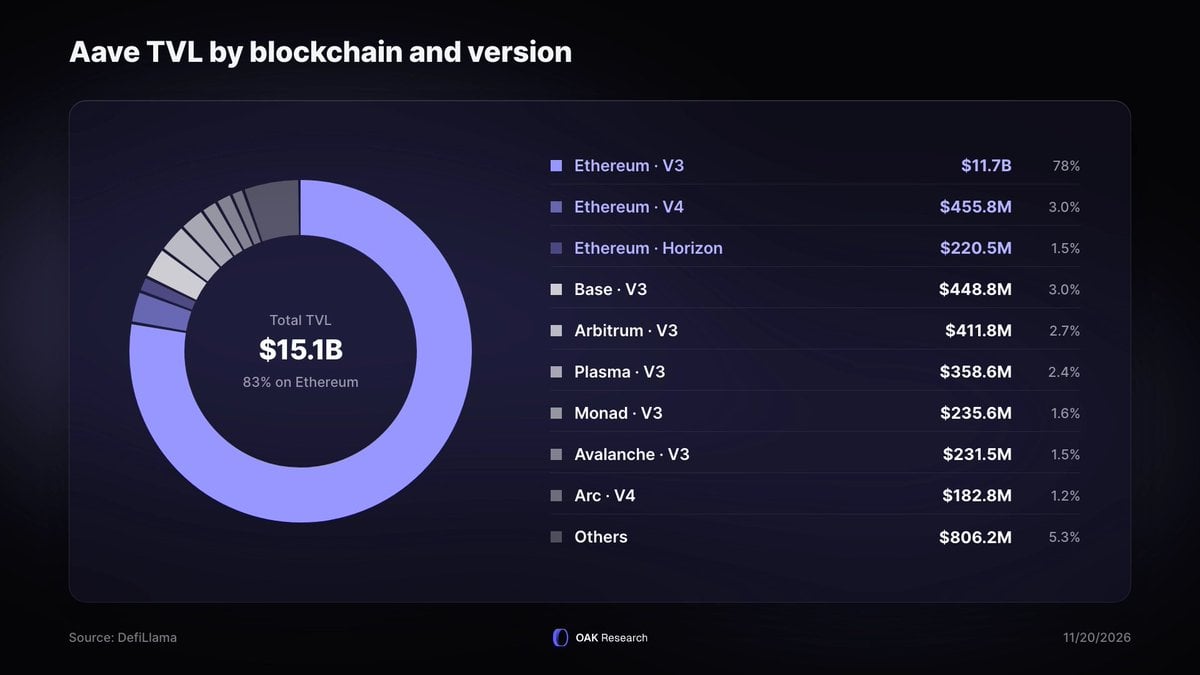
The key to interpreting the numbers behind these figures is "concentration." V3 remains the absolute mainstay, with just the Ethereum mainnet accounting for roughly 83% of the protocol's total TVL, and the vast majority of revenue stemming from this foundation.
This is less of a weakness and more the starting point for the entire transition. The many strategic moves Aave is advancing right now are, in essence, simultaneously broadening revenue streams and reducing single-market dependency on Ethereum: expanding to emerging L1s like Base, Plasma, Monad, and Arc, while opening up externally curator-driven customized V4 markets, extending upward to a rich product layer.
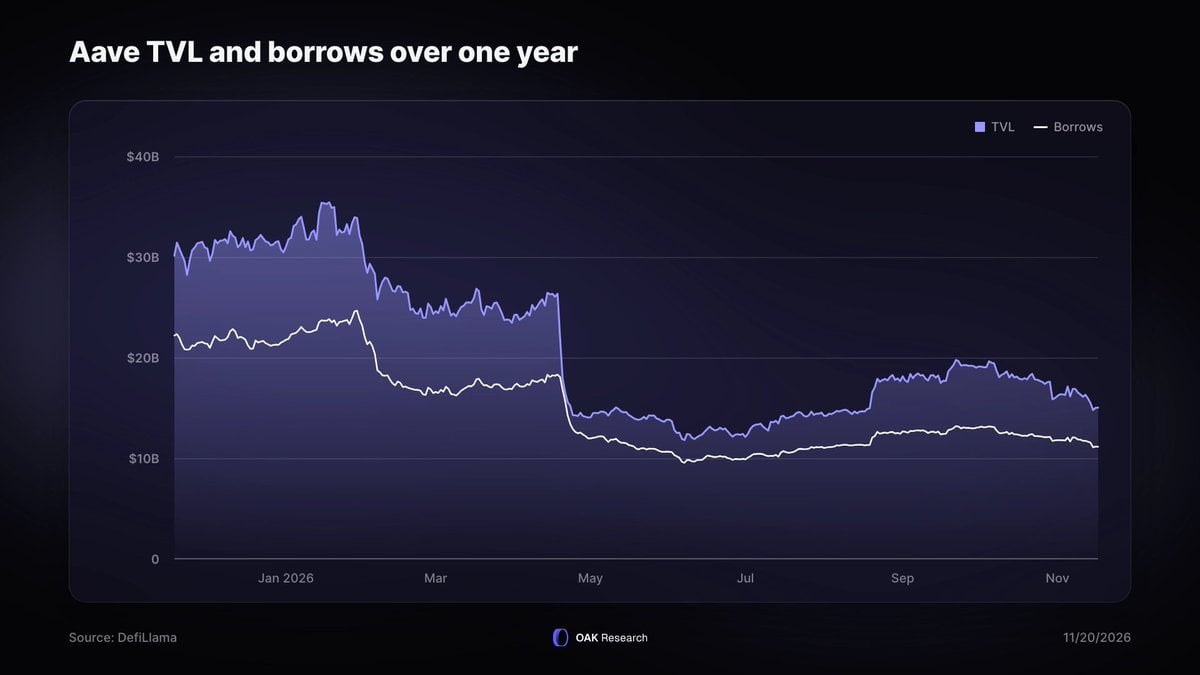
Over the past year, Aave's TVL has declined from roughly $32 billion to around $17 billion, with loan volume shrinking accordingly to approximately $12 billion. This shift mainly follows broader crypto market fluctuations: since most collateral within the protocol consists of ETH and highly correlated assets, a year-long bear market and systemic deleveraging mechanically compress deposit and loan volumes in USD terms. However, the underlying business landscape remains unchanged, still arrayed with V3 as the core engine and peripheral markets continuously expanding.
Infrastructure Layer: Aave V3 and Aave V4
The Aave protocol itself serves as the foundational infrastructure base upon which all other products connect. Released in 2022 and launching on Ethereum in early 2023, Aave V3 now spans multiple mainstream public chains and is rightly considered the primary economic engine. It holds the vast majority of Aave's TVL and outstanding loans, stably contributing approximately $4.8 million in net income to the DAO monthly. When people discuss Aave's fundamentals today, they are primarily talking about V3.
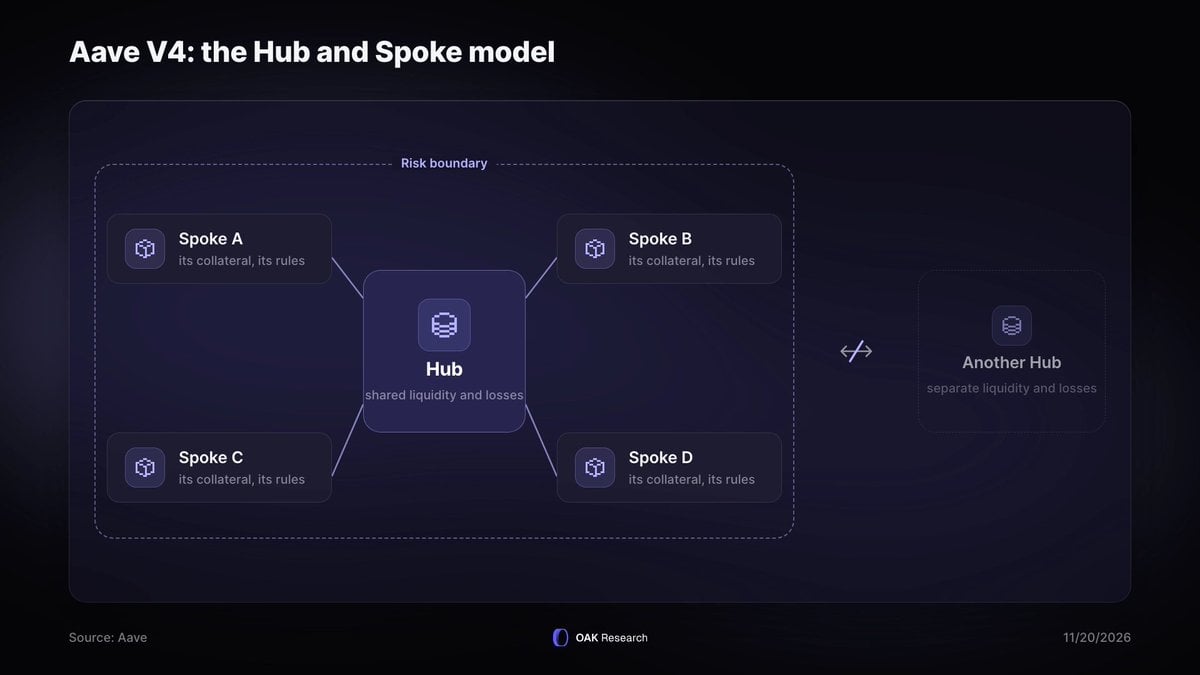
Aave V4, officially launched on the Ethereum mainnet on March 30, 2026, represents the protocol's next-generation architecture. Its design completely decouples "liquidity and markets": a unified Hub aggregates liquidity, while individual Spoke markets connect to the Hub on demand and independently set collateral whitelists and risk caps tailored to specific scenarios.
Under this architecture, partners can launch dedicated markets directly atop the Hub's existing liquidity without cold-starting capital from scratch; alternatively, they can operate fully independent dedicated Hubs like Ether.fi, completely isolating risk. Consequently, Aave's moat is no longer just open-source code, but rather the massive capital pools directly linked behind its infrastructure and its mature risk control systems.
Looking solely at direct revenue, V4 remains in a very early stage. Over the past 30 days, V4 generated approximately $1.03 million in protocol fees on a base of roughly $1.8 billion in total deposits, translating to about $140k in protocol net income—far short of V3's ~$4.8 million monthly revenue scale. This gap isn't surprising: operating as the flagship for years, V3 has accumulated a massive user base and capital inertia, giving large incumbent capital inherently high migration stickiness.
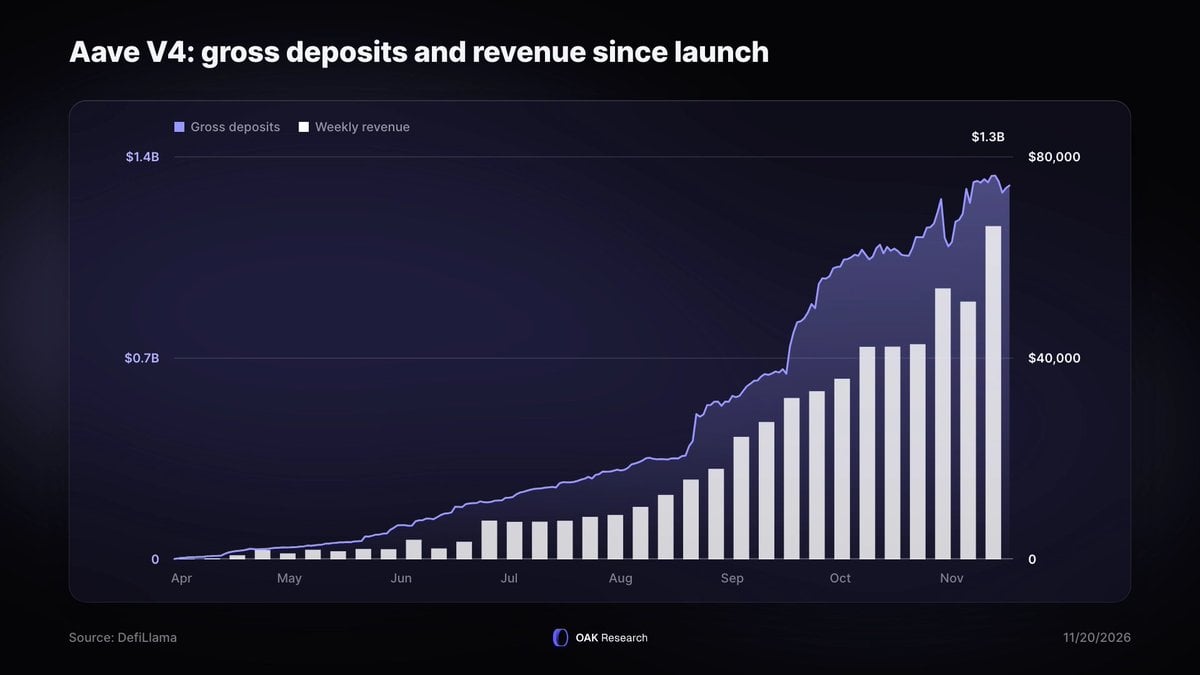
The key takeaway is that if you only evaluate V4 by staring at fee reports, you miss the structural leap it has already completed—the latter being what truly matters at this stage:
Full Migration of Ether.fi Cash Credit Cards: Ether.fi has migrated its entire crypto cash card credit backend to a dedicated Aave V4 instance on Optimism, with agreed-upon revenue sharing terms to the DAO.
First External Curator Hub Deployment: In October, Sentora launched the first externally curated and operated Hub and spoke markets on V4, independently configuring collateral, risk parameters, interest rate curves, and oracles; meanwhile, the DAO retains smart contract ownership, all risk parameter increases require a 48-hour timelock, and the protocol directly takes 50% of the Hub's net income. Its market deposits have already exceeded $100 million.
Strategy Products Leveraging Liquidity: Also in October, Steakhouse began managing the underlying yield strategies for Ethena Pay's Earn+ product on Avalanche's Aave V4, a typical example of curators building end-user products directly on top of Aave liquidity rather than operating independent markets.
Whether curators build their own markets or external teams develop products leveraging Aave's liquidity, they are essentially two variants of the same business logic: regardless of which growth path, both ultimately channel deposits, loan volumes, and protocol revenue continuously into Aave.
This also marks the first time in Aave's history that customized markets are opened to third parties at this scale, tangibly bringing in pure incremental users: Ether.fi Cash users previously resided on Ether.fi's self-built backend, while Sentora and its clients historically were mainly active in other lending venues.
Therefore, today's V4 is less of a near-term revenue story and more of a platformization story: it transforms Aave into an open base allowing external teams to build markets and route revenue back to the DAO. The metric most worth watching over the next year is whether this structural demand can convert into sustained, battle-tested recurring revenue.
From the current demand distribution, early-stage high concentration is a very natural phenomenon: Ether.fi Spoke alone accounts for over 96% of the WETH borrowing within its Hub, while the Maple Spoke in the Global Dollar Hub recorded approximately $36 million in USDG borrowing. As more spoke markets and curators join, whether lending demand diversifies and spreads will be the core observation point.
Where Lending Demand Comes From: Ethena and Pendle
The value of a lending engine depends entirely on how many people in the market are willing to borrow from it, making ecosystem partners capable of consistently generating lending demand naturally critical puzzle pieces for the infrastructure layer.
Robust liquidity and time-tested brand credibility are barriers that many protocols struggle to build over years, yet Aave possesses both. The real task now is providing users with ample motivation to borrow, with top-tier partners acting as the core engines.
Ethena is the most intuitive case study. Its synthetic dollar USDe and yield-bearing sUSDe carry inherently higher yields. Once accepted as qualified collateral on Aave, users can deposit yield-bearing assets, borrow stablecoins, and cyclically leverage to amplify return exposure, with Aave acting as the underlying "bank" providing financing. Aave's 2025 annual review shows that this deep binding once generated roughly $8.5 billion in Ethena-related deposits, peaking by absorbing over half of Ethena's total stablecoin supply.
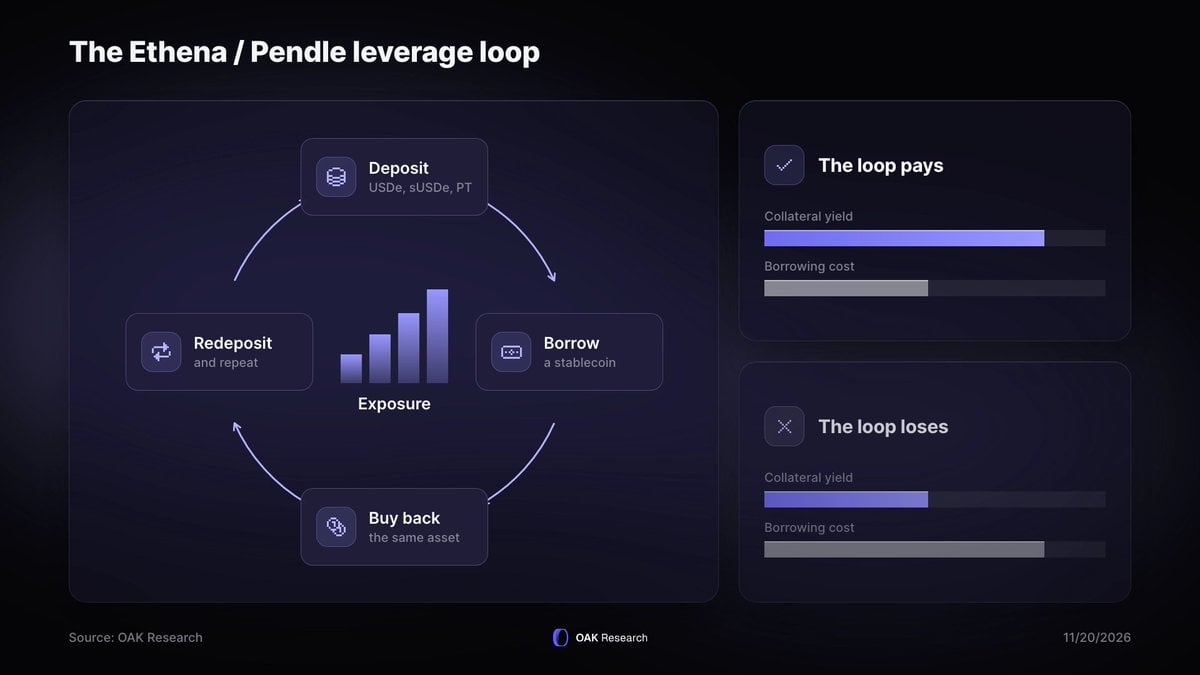
Pendle opens up another category of lending demand around a similar financial logic. Pendle's principal tokens (PT) represent the principal of yield-bearing assets bought at a discount that matures at par value. Once listed as collateral, holders can finance positions through Aave to hold them until maturity.
Today, Aave has become the preferred venue for PT collateral lending, having smoothly navigated multiple rounds of PT maturities over the past year—a phase where risk management is notoriously difficult. Since borrowing rates are floating while PT yields are fixed, these arbitrage positions indeed require tight monitoring, but Aave's flawless track record stands as the best endorsement. Together, Ethena and Pendle reveal Aave's true logic for adding new collateral: it values not merely adding another token code, but finding asset engines capable of nurturing enduring lending demand.
Product Layer
Solidifying the foundation only completes half the work. The other half lies in proactively reaching wider borrower-lender pairs and enabling external applications to directly embed Aave, rather than passively waiting for users to find it themselves.
Native Stablecoin GHO
For $AAVE token holders, the native stablecoin $GHO is one of the most compelling business lines in the entire blueprint. While Aave captures value across the Pro interface and various lending markets, GHO's uniqueness lies here: 100% of the interest paid by borrowers who take out GHO loans goes entirely to the DAO, without needing to share the vast majority with external depositors as in standard markets.
Since GHO is minted and issued by Aave itself, requiring no external capital for principal, every dollar minted and lent out funnels its entire interest revenue directly into the DAO's coffers. Commercially, this closely resembles a central bank seigniorage model earning profits from its own currency issuance.
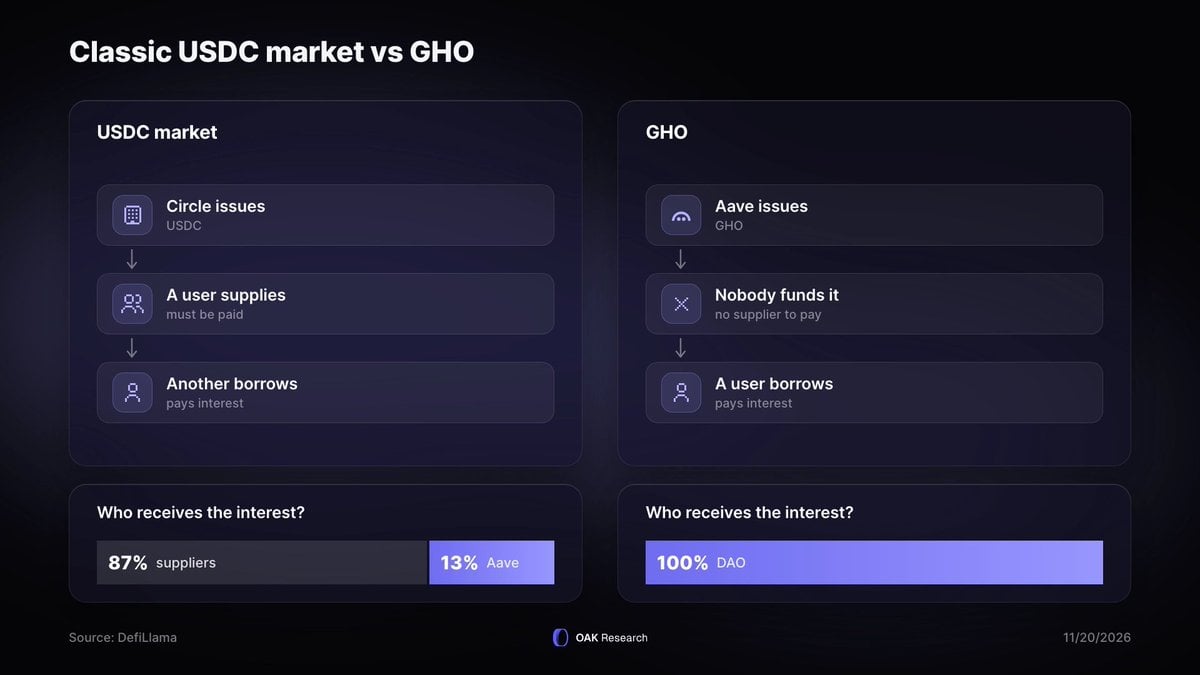
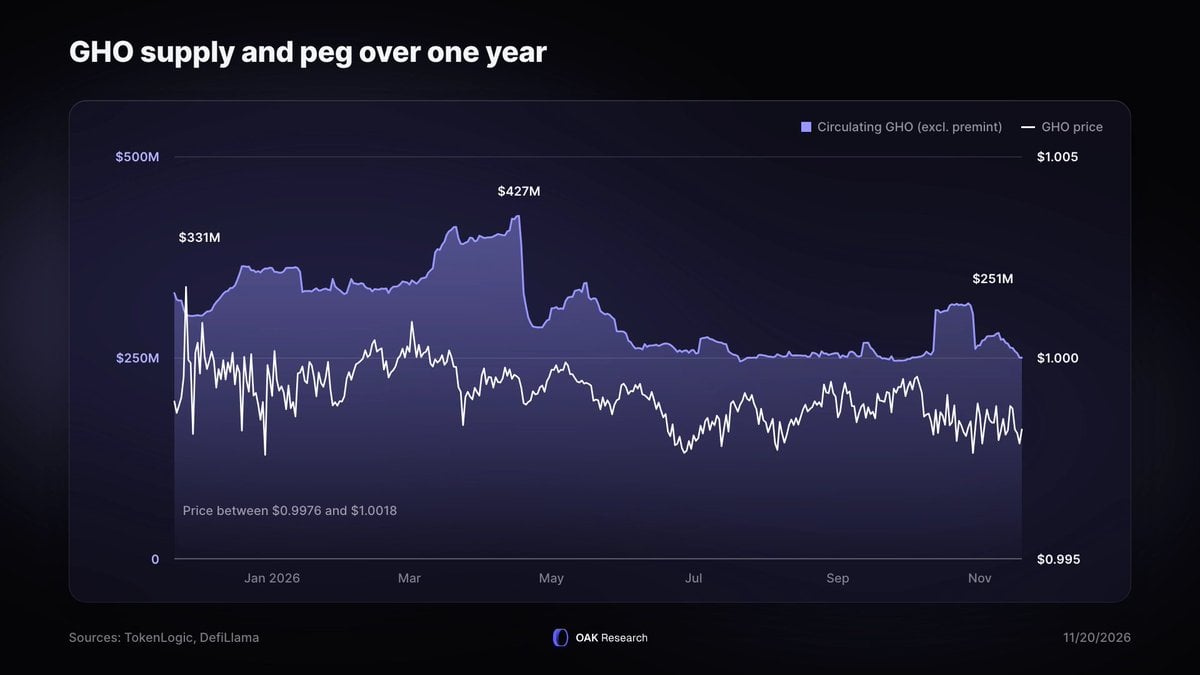
For a long time, GHO's nominal supply included a massive prefabricated buffer pool that had not truly entered circulation. In November 2026, DefiLlama revised its statistical methodology to exclude it, adjusting GHO's circulating supply from ~$698 million to ~$252 million, representing the actual scale minted and deployed by the market, with roughly 95% concentrated on the Ethereum mainnet.
Throughout the year, GHO's peg has remained rock-solid, fluctuating between $0.9976 and $1.0018, meaning this data adjustment was purely a methodological correction, not indicative of business shrinkage. Additionally, since July this year, GHO has expanded to the Monad network, currently remaining in a small-scale bootstrapping phase.
According to Aave's publicly available TokenLogic financial dashboard, GHO has achieved net profitability on an annualized basis. Profit stems from the borrow interest fully retained by the DAO, minus incentives and growth subsidies distributed to sGHO savers, forming the net interest margin. However, it's crucial to understand that this margin is dynamically adjusted rather than auto-generated: for instance, in early October, the DAO temporarily lowered GHO borrow rates to levels approaching or even below sGHO yields to stimulate demand. Therefore, assessing GHO's profitability should focus on the comprehensive annual returns rather than the instantaneous daily spread per dollar.
Its companion product, sGHO, allows holders to deposit GHO for yield, offering an APY of approximately 4.5% at the time of writing. Essentially functioning as a foundational demand reservoir for a young stablecoin, its yield is directly backed by the DAO's balance sheet, demonstrating the protocol's financial strength rather than representing a hidden cost burden.
Reaching End Users: App, Kit, and Pro
The Aave App is a mobile savings product aimed at mass consumers. Fully powered by Aave's proprietary stack (Aave Protocol and Stable Vaults), it provides users with smooth on-chain savings yields akin to fixed rates, helping everyday users completely avoid the experience pain points of volatile floating rates in traditional DeFi.
Currently in an early invite-only beta for iOS (with Android opening since November 17, 2026), the app has rapidly scaled deposits past $45 million, ranking among the fastest-growing on-chain savings applications today.
Aave Kit takes it further, allowing wallets, exchanges, or fintechs to directly embed Aave's lending engine into their own products. The most representative component is the Stable Vaults launched in July 2026, enabling any fintech to reuse the identical vault stack driving the Aave App to package Aave's floating rates into predictable, steady yields for end customers.
This is precisely the essence of this business model: when a fintech with millions of users integrates Aave, customer acquisition and channel distribution are handled by the partner, while the underlying credit and yield provisioning are wholly absorbed by Aave.
Aave Pro is a professional V4 position management interface designed for advanced users. It consolidates asset swaps, collateral substitution, and debt conversion in one place. Its built-in swap fees have become a tangible incremental revenue stream for the DAO, accumulating over $2 million in the past 12 months. Of course, funds deposited via Pro remain pooled in V4 and do not generate duplicate counted TVL.
Powered by Aave: Consumer Product Matrix Running in the Background
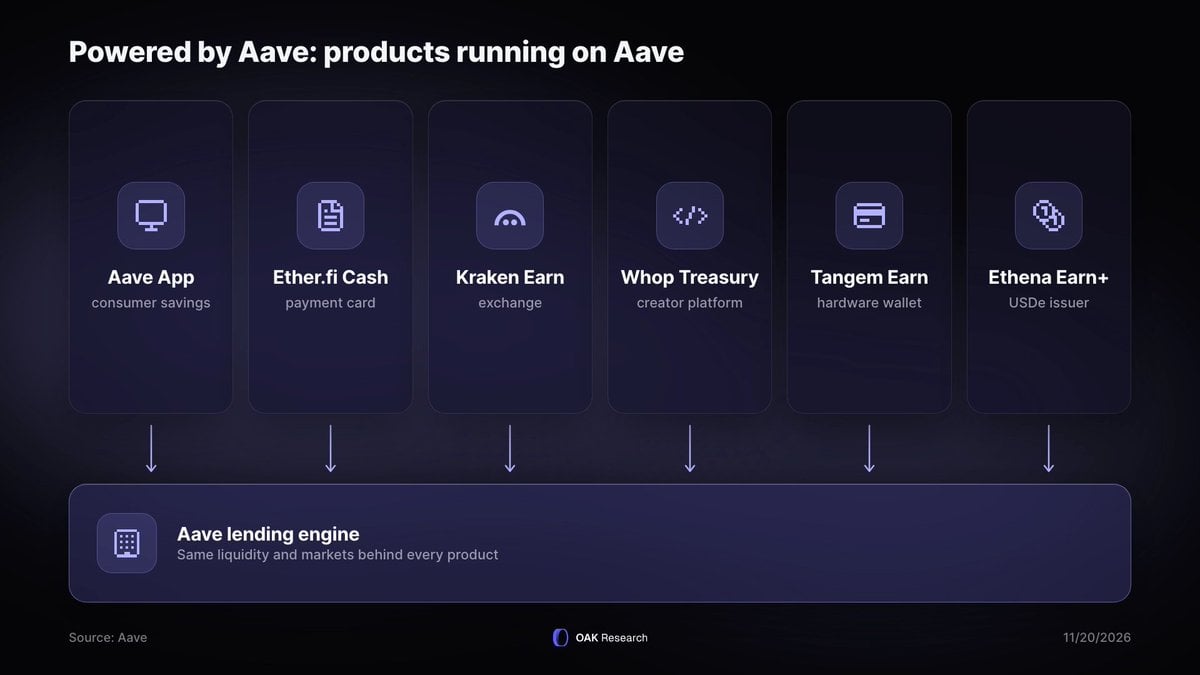
The strongest evidence validating the "infrastructure thesis" is that an increasing number of mass-market consumer products are silently running Aave underneath, without ever needing to display Aave's name to users upfront. The playbook is consistent: partners control branding, frontend UX, and user relationships, while Aave operates behind the scenes providing the credit and yield engines.
Although most integrations haven't signed custom revenue-sharing agreements, every deposit and loan flowing through external channels enters the Aave liquidity pool, still contributing real dollars to the protocol via reserve factors.
The benchmark case for this model is undoubtedly Ether.fi's Cash crypto card. Boasting over 100,000 active cards and nearly $1 billion in annualized spending volume, its backend is driven by a dedicated authorized Aave V4 instance deployed on Optimism. Ether.fi handles branding, acquisition, and card UX, while Aave supplies the underlying credit engine and takes 20% of the instance's revenue. Estimating full-capacity instance revenue at $5–6 million annually, this contributes roughly $1–1.2 million in net income to the DAO yearly.
Ether.fi Cash will certainly not be a standalone anomaly, but rather the beginning of a series of similar partnerships, with even the Aave App itself expected to launch a dedicated payment card. "Powered by Aave" doesn't mean every cent of interest accrues to $AAVE holders, but it does mean a clear, executable, and replicable profit-sharing pipeline is now fully established.
Kraken DeFi Earn, launched in January 2026, brings the same logic to a top global regulated exchange. Upon user deposit of cash or stablecoins, funds are automatically routed to yield vaults connected to Aave, advertised externally with APYs up to ~8%, fully covering Kraken's main app and Krak wallet, allowing Aave to remain invisible behind the exchange's wealth management products.
Whop Treasury reaches a completely different incremental demographic. Serving creators and side-hustle economies, Whop boasts over 21 million users and ~$3 billion in annualized payment processing volume. Its Treasury feature automatically generates yield on idle balances within creator accounts. Under the hood, these funds are allocated via Veda Vaults into Aave's Plasma market, positioning Aave as the foundational yield source several tiers down.
Hardware wallet provider Tangem has baked yield capabilities directly into the wallet itself. Its "Yield Mode" allows hardware wallet owners to deposit stablecoins directly into Aave via dedicated smart contracts deployed across chains by Tangem within the app, without ever needing to redirect to external websites or use WalletConnect.
Capping it off is Ethena Earn+. From a product perspective, the strategy mentioned earlier in the infrastructure section—operated by Steakhouse on Avalanche Aave V4—acts as the hidden engine enabling Ethena Pay's Earn+ to deliver stable yields to users.
Institutional Layer
Today, this time-tested lending logic is crossing the boundaries of the crypto world. Aave isn't reinventing the wheel to pursue unfamiliar business, but logically grafting its signature expertise—"providing financing against collateral"—onto entirely new traditional balance sheets.
Aave Horizon
Launched in August 2025, Aave Horizon is a niche market crafted specifically for compliant investors: qualified institutions can deposit tokenized real-world assets such as those from Superstate, Centrifuge, or VanEck's vBill, and use them as collateral to borrow stablecoins like USDC, RLUSD, or GHO. For institutions holding tokenized U.S. Treasury funds, the appeal mirrors that of ETH holders: unlock liquidity on demand without liquidating underlying asset exposures.
The core of this layout lies in strategic positioning. Due to regulatory restrictions, only compliance-approved institutions can hold and operate these assets on-chain, and Aave Horizon is currently the only lending market specifically tailored for this purpose. Though the sector's current scale is modest, its ceiling is exceptionally high; once the institutional RWA market scales up, Aave's head start will leave competitors struggling to catch up.
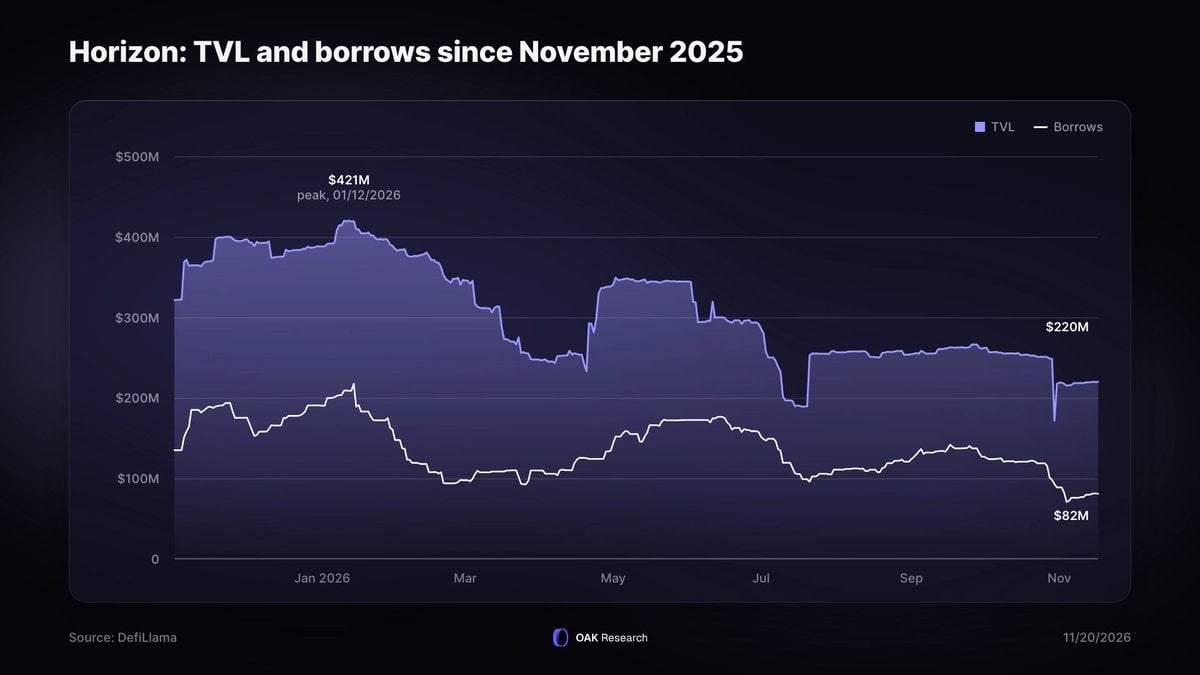
In terms of volume, early-stage characteristics are quite pronounced. DefiLlama data shows Aave Horizon's TVL pulling back from a local peak of ~$421 million in January 2026 to the current ~$253 million, with outstanding loans hovering around $122 million. Since TVL excludes borrowed amounts, total deposits are factually higher. Regardless, Aave Horizon remains in the nascent stage of the institutional RWA market, currently prioritizing paradigm validation over aggressive short-term financial targets.
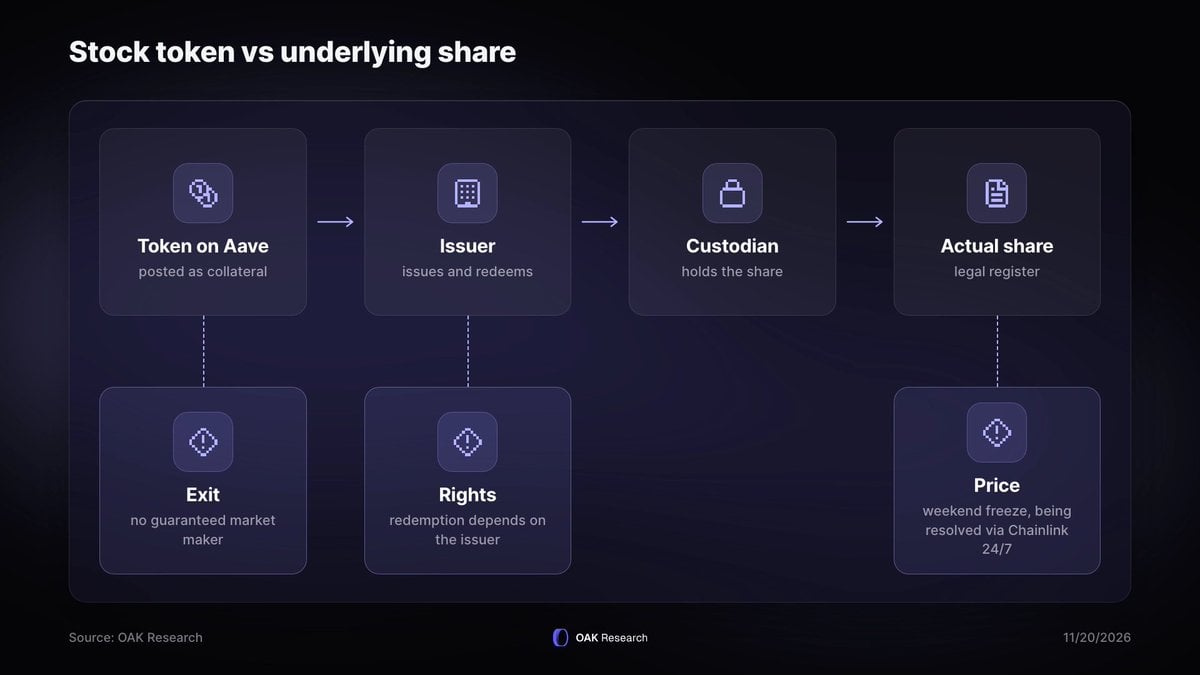
Understanding why RWA lending is exceptionally difficult reveals the value of Aave's investment: tokenized funds settle on-chain in seconds, but their underlying Treasuries or fund shares are constrained by traditional financial redemption windows and weekday settlement cycles. Consequently, a qualified RWA liquidation requires not just accurate real-time pricing, but legal rights to seize underlying assets and the capability to monetize them promptly when crisis strikes.
Tokenized U.S. Equity Lending Market
Beyond Aave Horizon, Aave V4 carved out a completely separate market on the Base chain on September 25, 2026: targeting compliant users outside the U.S., it enables borrowing USDC using seven tokenized U.S. equities issued by Coinbase (underlying shares custodied by Alpaca Securities via the Coinbase Onchain SPV entity), covering Apple, Amazon, Alphabet, Meta, Microsoft, Nvidia, and Tesla.
The innovation here lies not in "stock-backed lending" itself (long commonplace in Wall Street), but in executing it through programmable on-chain infrastructure, and jointly betting on this trillion-dollar new vertical alongside Base and Coinbase. Crucially, this partnership successfully integrated Aave into Coinbase's core ecosystem, breaking the previous pattern of it being sidelined from their preferred lending partners.
The market currently remains in a subsidized cold-launch phase: depositing equity tokens earns incentive rewards, and USDC borrow rates are compressed near zero, sending a clear signal that Aave aims to cultivate incremental markets rather than rush profit extraction.
On risk management design, these equity tokens serve exclusively as collateral (the market only lends USDC, never the stocks themselves), with LTVs set by LlamaRisk ranging from 65% to 79%, capped at ~$29 million for collateral and ~$21 million for loans. As of early October, deposits shortly after launch have already reached ~$9 million.
Rough economic math: even if future loan volume hits $1 billion, applying a 5% borrow rate and 10% protocol take yields roughly $5 million in annualized revenue before incentives. Not groundbreaking during the seeding phase, but it maintains a direct linear positive correlation with the long-term scale of the bet.
Of course, tokenizing equities faces real-world friction, and the most daunting hurdle has recently broken through. Historically, stock oracle price feeds only updated during traditional market hours, exposing on-chain liquidations to lag risks during weekend gap events. On October 29, 2026, Chainlink partnered with launchpad Aave to officially debut 24/7 all-hours price feeds for tokenized assets, accelerating tokenized U.S. equities from a "5-day-a-week, limited-hours" model toward a perpetual global all-caps market.
While shareholder rights and exit liquidity under extreme conditions warrant ongoing monitoring, the global stock market exceeds $150 trillion in market cap. Even if a minuscule fraction migrates on-chain, it represents a colossal upside space for Aave sufficient to redefine its revenue ceiling.
How Much Revenue Actually Flows to the $AAVE Token?
Once these three tiers are stitched together, the ultimate question concerning token holders surfaces: of all the money generated across this business matrix, how much actually makes it back into their pockets?
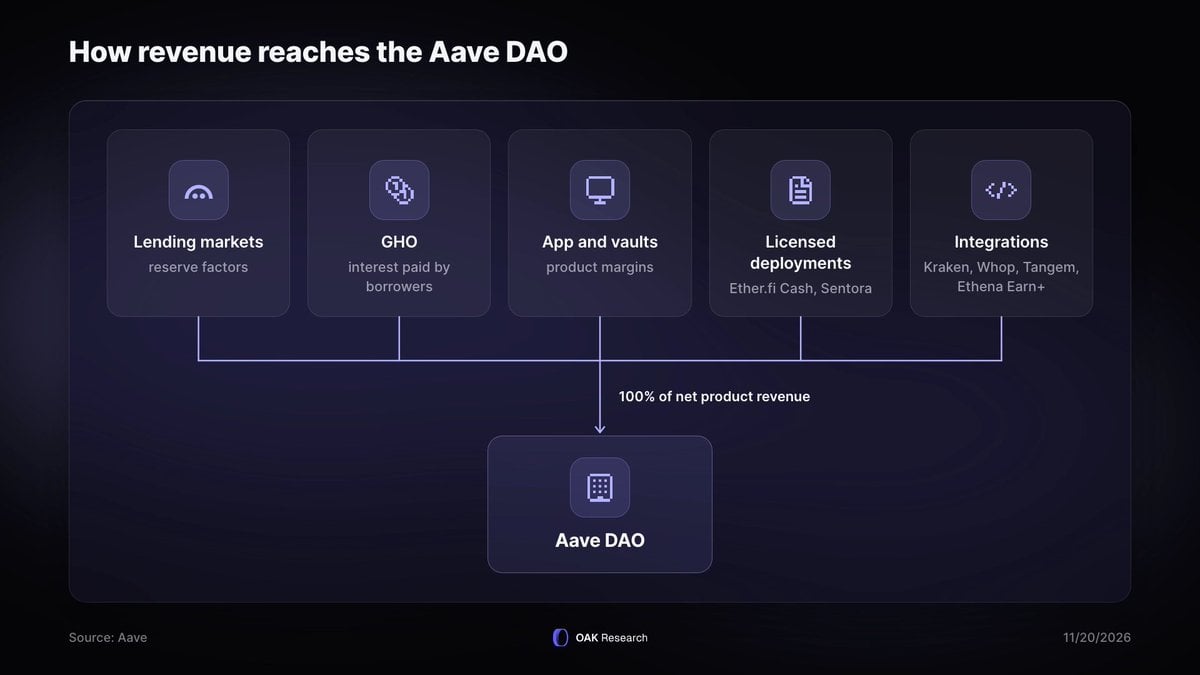
The first half of the answer lies in "revenue routing." Today, income sourced from the foundational protocol, infrastructure, and each product line unifies into the DAO treasury through multiple pipelines: including reserve factor cuts from lending markets, 100% of GHO borrow interest, spread revenues from the Aave App and vault products, and contractual revenue shares from authorized deployments like Ether.fi Cash and the Sentora customized market.
All ecosystem service providers, including Aave Labs, are funded by DAO allocations, tightly aligning core interests across all parties around sustaining healthy DAO revenue growth. Furthermore, the "Aave Will Win" governance framework formally institutionalizes routing 100% of net product revenue falling within defined scopes directly to the DAO.
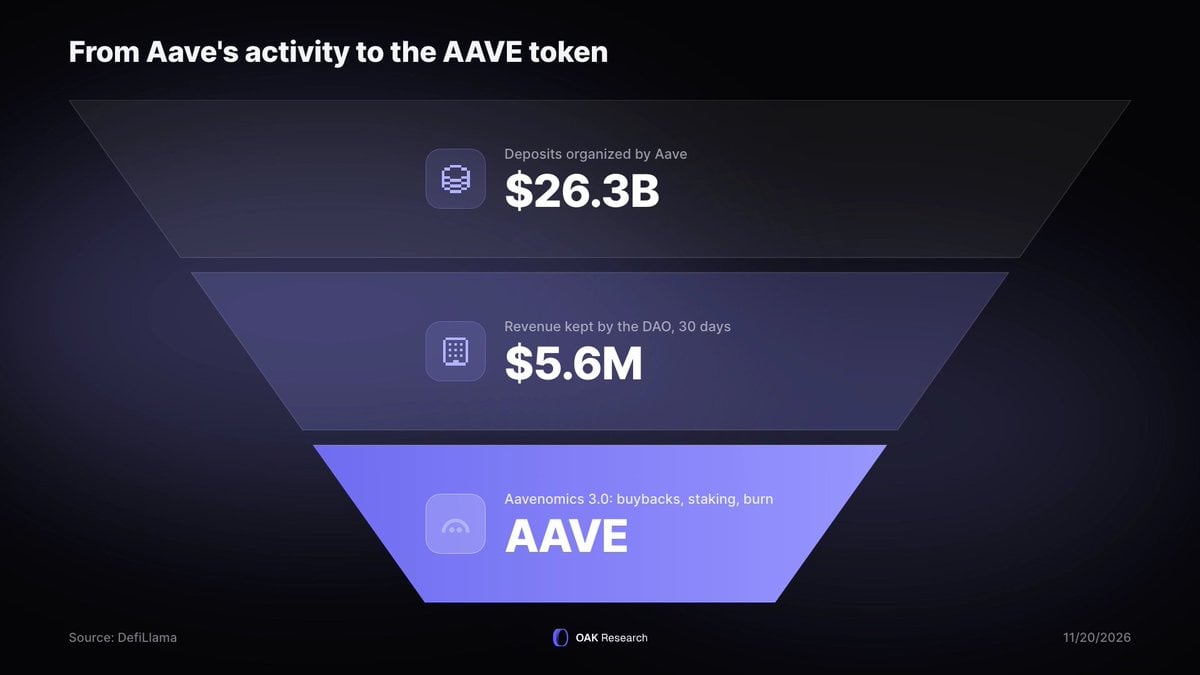
The second half of the answer hinges on "token buybacks." Since April 2025, Aave has initiated an on-chain secondary market buyback plan supported by protocol revenue under the Aavenomics framework, pacing at roughly $1 million weekly, cumulatively repurchasing over 205,000 $AAVE tokens, representing approximately 1.28% of the total supply.
Earlier this year in April, the buyback program paused and entered a comprehensive restructuring phase, set to relaunch in the Aavenomics 3.0 iteration. The upgraded version will significantly boost automation depth, tightly coupling secondary market buybacks with $AAVE staking and burn mechanisms.
In other words, the transmission bridge linking protocol revenue to token value not only genuinely exists but has already been proven functional; the focus now shifts from "whether value capture occurs" to determining exactly how much force the upgraded mechanism can unleash.
To avoid being dazzled by macro numbers, it is best to strictly differentiate three financial tiers: Tier 1 is the total financial activity volume facilitated by Aave, scaling into tens or hundreds of billions, yet the vast majority represents principal capital between depositors and borrowers, not protocol earnings; Tier 2 is the net income genuinely landing on the DAO's books after deducting depositor interest and partner revenue shares, currently hovering around $5–6 million monthly; Tier 3 is precisely how this treasury capital empowers tokens via buybacks and Aavenomics 3.0 distributions.
This is precisely why the article stressed distinguishing "total fees" from "protocol net revenue" right from the outset: the true foundation supporting $AAVE valuation is the net income honestly retained by the DAO, not the glossy nominal gross flows on paper.
Conclusion
Viewed from a holistic perspective across the three-tier architecture, Aave's strategy is not only logically rigorous but has already begun demonstrating compounding effects. On the infrastructure tier, V4 is shaping Aave into an open platform, with Ether.fi and Sentora leading the charge in closing the loop between external markets and DAO revenue sharing; on the product tier, GHO achieves annualized net profitability, the Aave App leads consumer savings frontends, Stable Vaults empower fintech backends, and routing product revenue to the DAO is now institutionalized; on the institutional tier, Aave Horizon and the tokenized U.S. equity market secure highly promising incremental footholds, while 24/7 all-hours feed infrastructure stands ready in sync.
Of course, shortcomings and challenges must also be faced candidly: V4's direct revenue scale remains nascent, the institutional RWA sector housing Aave Horizon is still in its infancy, and certain lending demand heavily relies on arbitrage spreads that fluctuate with market rates. Yet these are growing pains inherent to maturation rather than model failures, each laying out a clear evolutionary roadmap: onboarding more V4 curator markets and external integrations, riding the rising tide of the RWA sector, and efficiently converting hard revenue into token value via Aavenomics 3.0.
The narrative thread weaving through the entire article is unmistakably clear: Aave has successfully transformed from a singular lending venue into a foundational credit infrastructure spanning both retail and institutional domains. Over the next 12 months, the true focal point lies in how this infrastructure accelerates compound growth, and whether the final revenue share flowing to the $AAVE token rises synchronously with it.
Data & Disclosure Notes: This article is a collaborative research output from OAK Research and Aave. OAK Research has also conducted research and reporting partnerships with Maple, and previously held a paid research and content distribution agreement with Ethena (concluded in December 2025). Statistical data herein is current as of early November 2026, sourced predominantly from DefiLlama unless otherwise specified; V4 deposit data originates from Aavescan, GHO financial metrics from the Aave TokenLogic dashboard, and select product indicators drawn from official disclosures by Aave or its service providers. All core arguments and revenue projections within this text were independently finalized by OAK Research.
Join TechFlow official community to stay tuned
Telegram:https://t.me/TechFlowDaily
X (Twitter):https://x.com/TechFlowPost
X (Twitter) EN:https://x.com/BlockFlow_News
 OAK_Res