Coinbase Wins Class Action Lawsuit Over UST Collapse: Court Rules Platform Fully Disclosed Algorithmic Mechanism, Not Liable for Investor Losses
Author: TechFlow
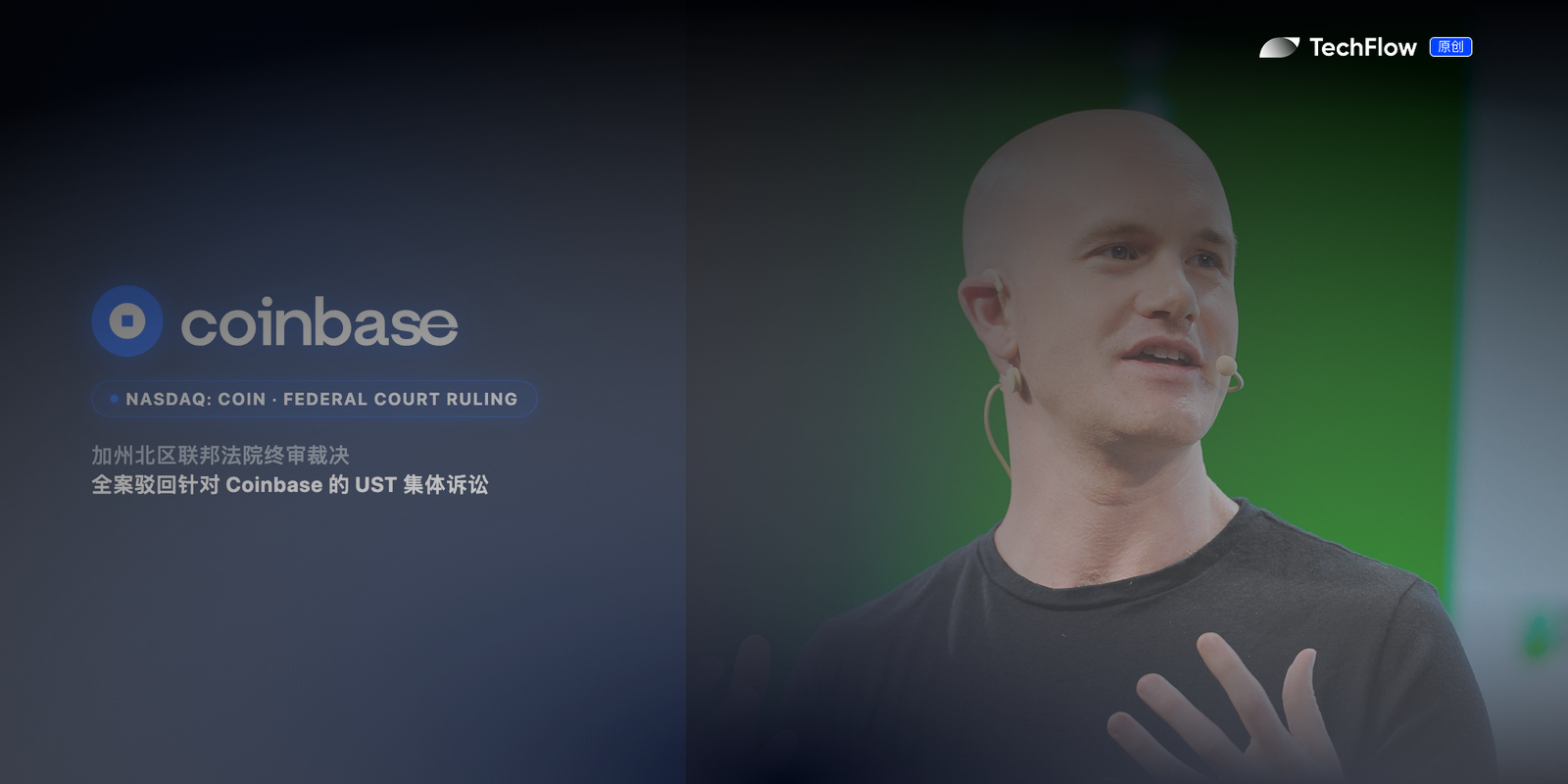
TechFlow Summary: On November 24 Beijing Time, Judge Maxine Chesney of the U.S. District Court for the Northern District of California issued a final ruling, dismissing in its entirety the plaintiff Larry Pearl's fourth amended class action complaint against Coinbase (COIN), and refusing further amendments (Dismissed without leave to amend).
This case stems from the May 2022 TerraUSD (UST) depegging event, in which the plaintiff alleged the platform concealed the algorithmic mechanism. Upon review, the court found that the trading page clearly indicated that the token was not backed by dollars in bank accounts and included a link to the official whitepaper, meaning a reasonable consumer could sufficiently recognize the risks; accordingly, the relevant claims have been formally concluded at the district court level.
Judicial Characterization of Final Dismissal Without Leave to Amend
According to records in the official dockets of the U.S. District Court for the Northern District of California, plaintiff Larry Pearl purchased TerraUSD (UST) on Coinbase in May 2022. Subsequently, the token broke its $1 peg, fell to 35 cents, and ultimately went to zero, causing his invested capital to shrink by over 90%.
Since the case was filed in 2022, the plaintiff has submitted four amended complaints, attempting to claim damages from the platform under California's Unfair Competition Law, False Advertising Law, and Corporation Law. The court held that despite multiple revisions, the plaintiff still failed to provide sufficient facts to establish the essential elements of the statutory claims, and some assertions even exceeded the scope previously permitted for limited amendments.
Judge Maxine Chesney ultimately applied the procedural rule for dismissal without leave to amend, formally terminating the case proceedings. This ruling means that the plaintiff has completely lost the procedural standing to further amend the complaint and pursue civil liability at the same district court level.
Core Disputes Over Trading Page and Algorithm Disclosure
The core allegation put forward by the plaintiff on behalf of the proposed victim class centers on the claim that Coinbase made misleading commercial statements regarding the algorithmic stablecoin TerraUSD (UST) during its listing and frontend display, leading investors to misjudge the asset's risk profile and source of value backing.
In the complaint, the plaintiff asserted that the platform deliberately concealed how TerraUSD (UST) relies on an experimental algorithm pegged to the native LUNA token to maintain its price anchor, and failed to adequately warn that the token is not fully backed by real US dollar fiat currency or other tangible reserve assets.
In response to these allegations, the court verified the original copywriting records of the trading webpage involved. The review revealed that the page explicitly stated that minting 1 TerraUSD (UST) requires burning $1 worth of reserve asset LUNA, directly exposing the underlying dual-token mint-and-burn adjustment mechanism.
More critical evidence lies in the fact that after describing UST as "attempting to maintain a $1 value," the trading page immediately added the disclaimer "UST is not backed by dollars in bank accounts," while prominently providing a clickable link to the official Terra whitepaper, fully presenting the project's technical architecture.
Adequate Risk Warning Constitutes Fulfillment of Reasonable Disclosure Obligation
In her ruling, Judge Maxine Chesney established a reasonable consumer standard for assessing the adequacy of information disclosure by cryptocurrency trading platforms. The court reasoned that determining whether a platform made a misrepresentation should examine the overall objective understanding formed by ordinary consumers after fully reading the disclosed information on the page.
The ruling explicitly points out that since the trading interface clearly and unambiguously indicates that the token lacks backup from bank dollar reserves, and provides a direct path to obtain the issuer's whitepaper, a reasonable consumer reviewing such disclosures would never arrive at the erroneous conclusion that the token is endorsed by physical bank dollars.
Under this judicial logic, the core compliance obligation of secondary market trading platforms is to accurately relay and highlight the basic operational rules set by the asset issuer, rather than act as a credit guarantor for external crypto projects. As long as the platform's frontend disclosures align with the underlying mechanisms, the reasonable disclosure obligation has been fulfilled.
Defining the Liability Exemption Boundary for Information Disclosure by Crypto Platforms
From a litigation timeline perspective, the case was initiated after the UST depegging crash in May 2022, underwent over four years of judicial proceedings and four rounds of complaint amendments, until it was formally closed at the Northern District of California federal court level on November 24, 2026, becoming a significant precedent for allocating civil liability in the secondary crypto market.
This judicial ruling sets a clear defense boundary for compliant crypto trading platforms: as long as the listing page uses explicit text to warn about the non-bank reserve attribute and provides a primary index to the whitepaper, it can effectively block the chain of civil claims flowing from the issuer's tokenomic collapse to the trading channel at the legal level.
For secondary market participants, once the trading platform fulfills its basic risk warning obligations, any flaws in the stability mechanisms of the token's underlying smart contracts and the endogenous economic risks embedded in the on-chain code must be carefully assessed by market participants themselves, who shall bear the corresponding financial consequences.
Join TechFlow official community to stay tuned
Telegram:https://t.me/TechFlowDaily
X (Twitter):https://x.com/TechFlowPost
X (Twitter) EN:https://x.com/BlockFlow_News
 深潮TechFlow