
Jito Uses JTX to Grab User Traffic, Why Is It Still Undervalued by the Market?
TechFlow Selected TechFlow Selected
Jito Uses JTX to Grab User Traffic, Why Is It Still Undervalued by the Market?
Unveiling Jito's New Valuation Logic: How JTX Reshapes the Business, Base Case Upside 57%, Probability-Weighted Target Surges 267%.
 Navigating Web3 tides with focused insights
Written by: ake Koch-Gallup & Sam Schubert
Compiled by: AididiaoJP, Foresight News
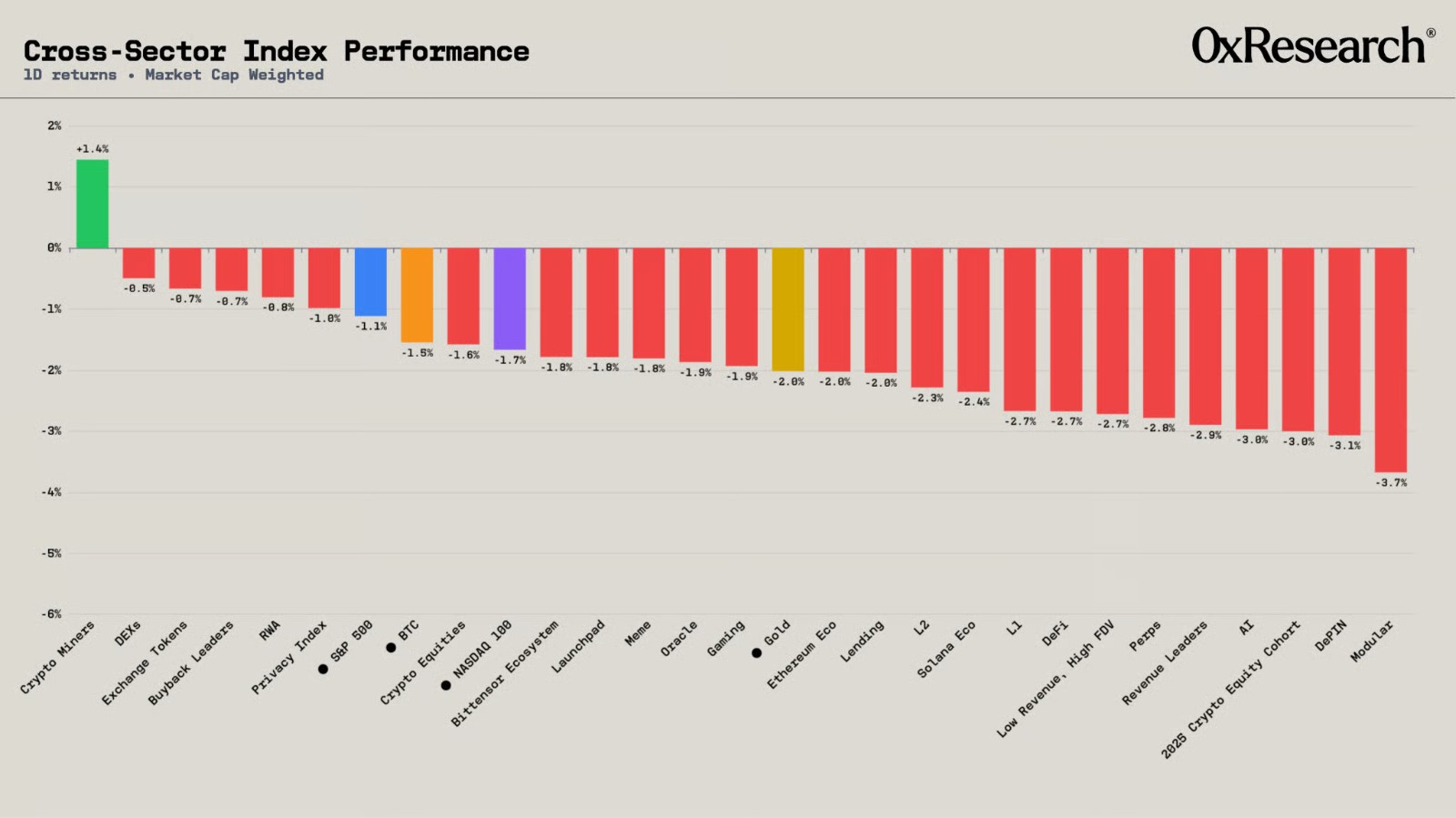
How we price JTO after JTX launched on July 14. This product is reshaping Jito's business model: it is no longer just a price taker on Solana block space, but is beginning to price user traffic. Our base case implies 57% upside, while the probability-weighted target points to a potential gain of 267%. Meanwhile, the crypto market corrected across the board, with only the crypto miner sector closing in the green driven by a wave of AI data center trades.
Taking a longer view, one trend remains prominent: over the past week, the crypto miner sector surged 27.0%, significantly outperforming all other crypto sectors. Following closely were DEX (+4.6%), the Bittensor ecosystem (+4.3%), and the Ethereum ecosystem (+3.9%). The broader stock market was nearly flat over the same period.
This rally was mainly driven by a series of AI infrastructure announcements, as investors' valuation logic for Bitcoin mining companies is changing. On July 20, Hut 8 announced another 15-year, $9.8 billion lease for its Beacon Point campus, covering 352 MW of power. The agreement doubles signed capacity to 704 MW, raising the total base contract value to $19.6 billion. On the same day, IREN signed another $2.8 billion AI cloud contract, raising its year-end run-rate target from $3.7 billion to over $4 billion, with about 85% of capacity signed to clients such as Microsoft, Nvidia, and Perplexity.
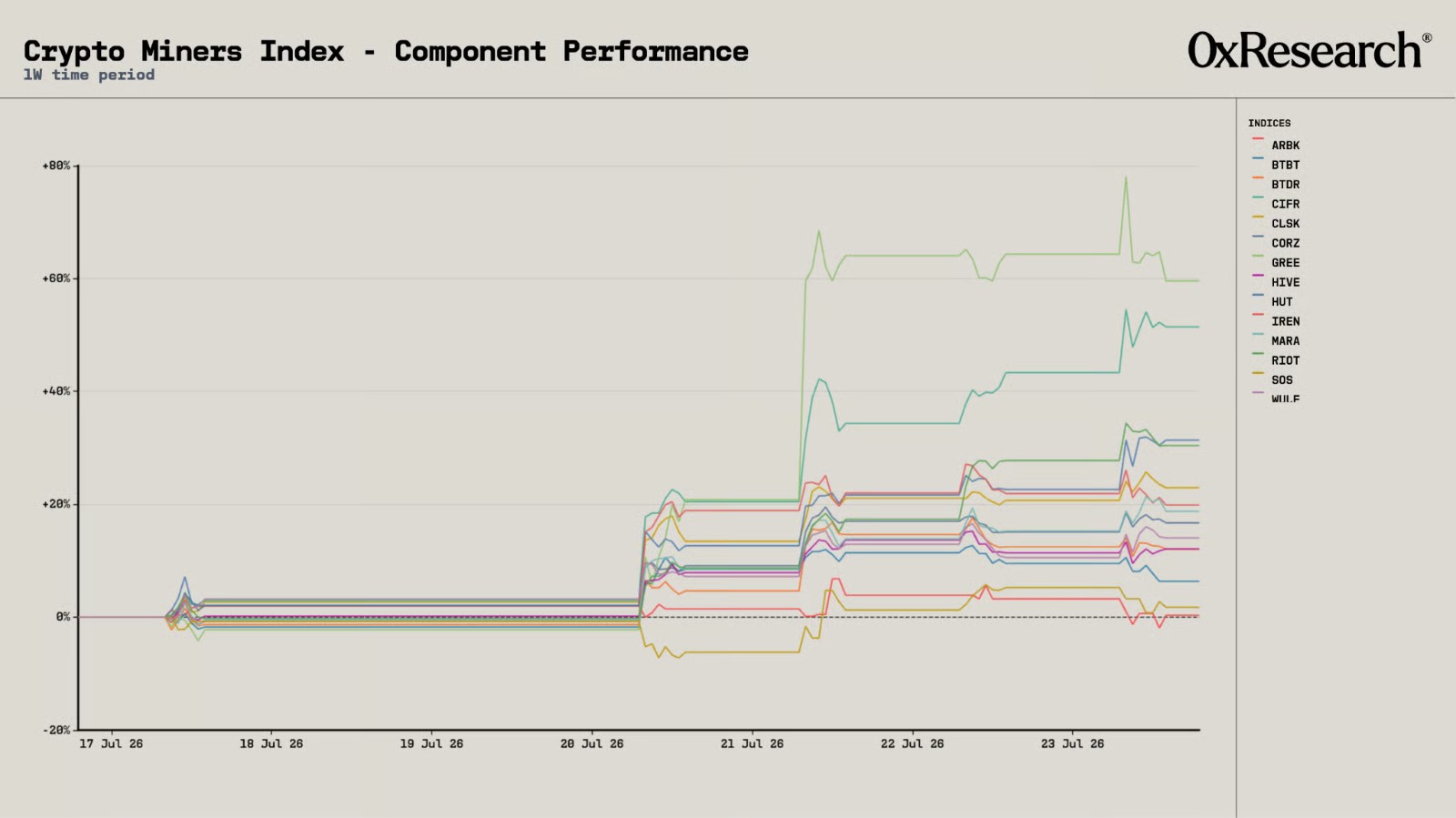
The market reacted quickly. Over the past week, Greenidge rose 59.6%, followed closely by Cipher (+51.4%), with Hut 8 (+31.4%), Riot (+30.4%), and CleanSpark (+22.9%) also performing strongly. The commonality is that investors increasingly view these companies as owners of scarce power and data center infrastructure, not just Bitcoin miners. As long as AI compute demand continues to exceed supply, this narrative is likely to remain a major catalyst for the sector, even if Bitcoin itself remains range-bound.
Jito's JTX Valuation
Today we delve a bit deeper into how to value JTO. The progress of JTX is redefining what this company actually is. The market still prices it as Solana backend infrastructure—a price taker dependent on block space activity—while JTX (launched on July 14) has effectively turned it into a price setter for user traffic. Our buy logic focuses on whether Jito can truly capture this traffic, rather than a rebound in traditional business.
Although execution data for JTX is still early, it has already given positive signals. Among over 77,000 trades since launch, the median execution price deviated from the oracle mid-price by only 5.5 basis points, 77.6% of trades fell within 25 basis points, and 29.1% were even better than the oracle quote. Execution quality is highly correlated with liquidity: SOL median deviation was 3.9 basis points, JitoSOL only 0.5 basis points, while long-tail thin-liquidity assets were wider. The advantage brought by BAM is not yet obvious: 4.6 basis points in BAM-dominated blocks, versus 4.8 basis points in other blocks.
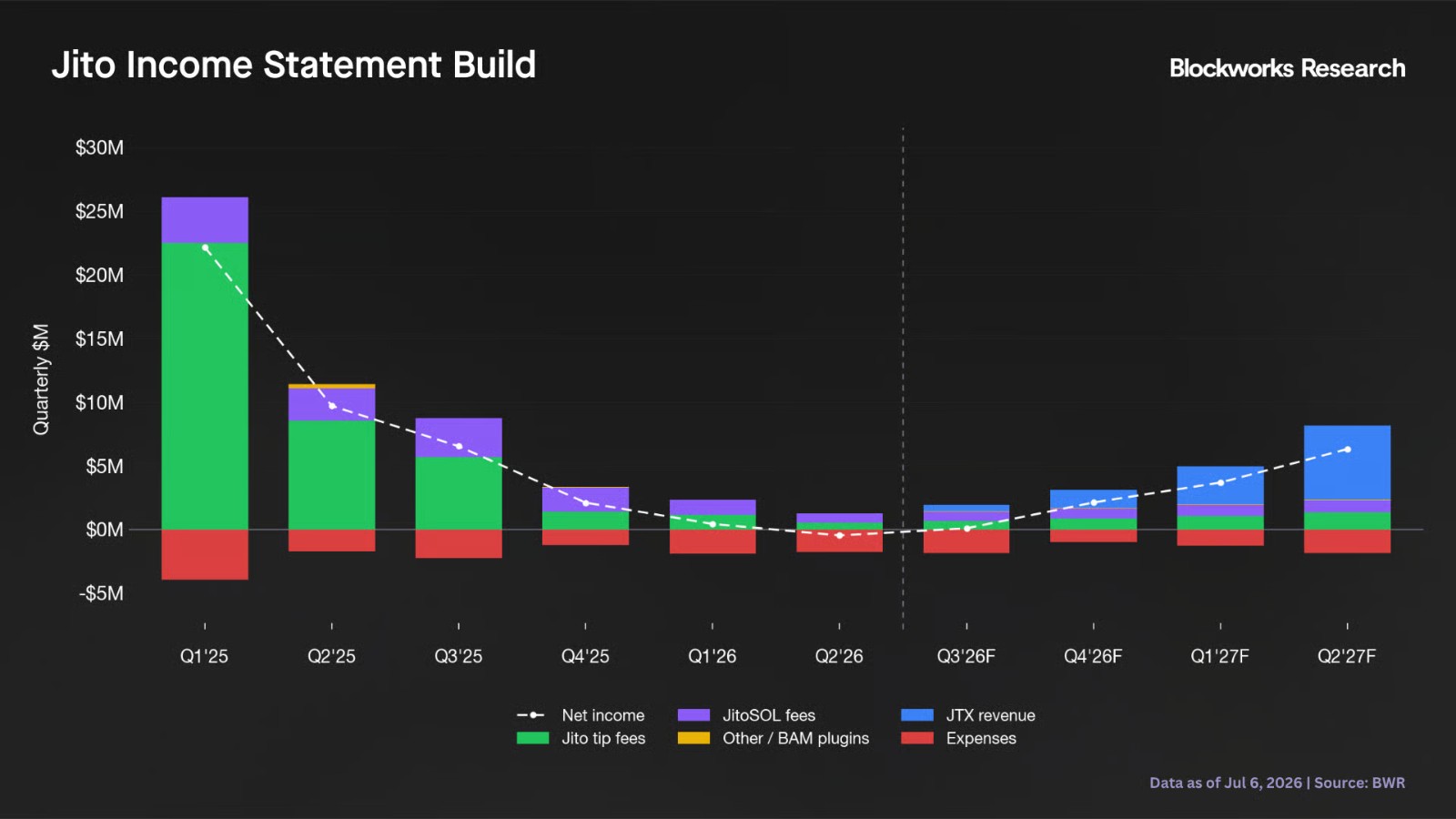
The reason for forming such a trading structure is that Jito deliberately sacrificed short-term revenue in exchange for optimization of Solana's long-term market structure—it shut down predatory MEV traffic and prioritized advancing BAM, which directly cut into Jito tip revenue that once contributed high profits.
The model remains conservative on traditional business: no assumption that tip revenue returns to peaks, no assumption that JitoSOL LST recovers, and no assumption that BAM fully monetizes. The base case instead assumes JTX captures 15% of Solana DEX volume by Q2 2027, bringing single-quarter net revenue of $5.8 million, total revenue of $8.2 million, annualized about $32.7 million, of which JTX accounts for about 72%. This means a treasury-adjusted price-to-sales ratio of less than 15x based on annualized revenue for Q2 2027.
Historical experience shows this is cheap: even while revenue was declining, the average price-to-sales ratio for backend infrastructure business since early 2025 remains about 38x. Assigning a conservative 30x valuation to the base case annualized revenue corresponds to a JTO price of $1.18, about 57% upside. For a growing business with a superior front-end economic model, 30x is not excessive, especially compared to that shrinking business enjoying 38x.
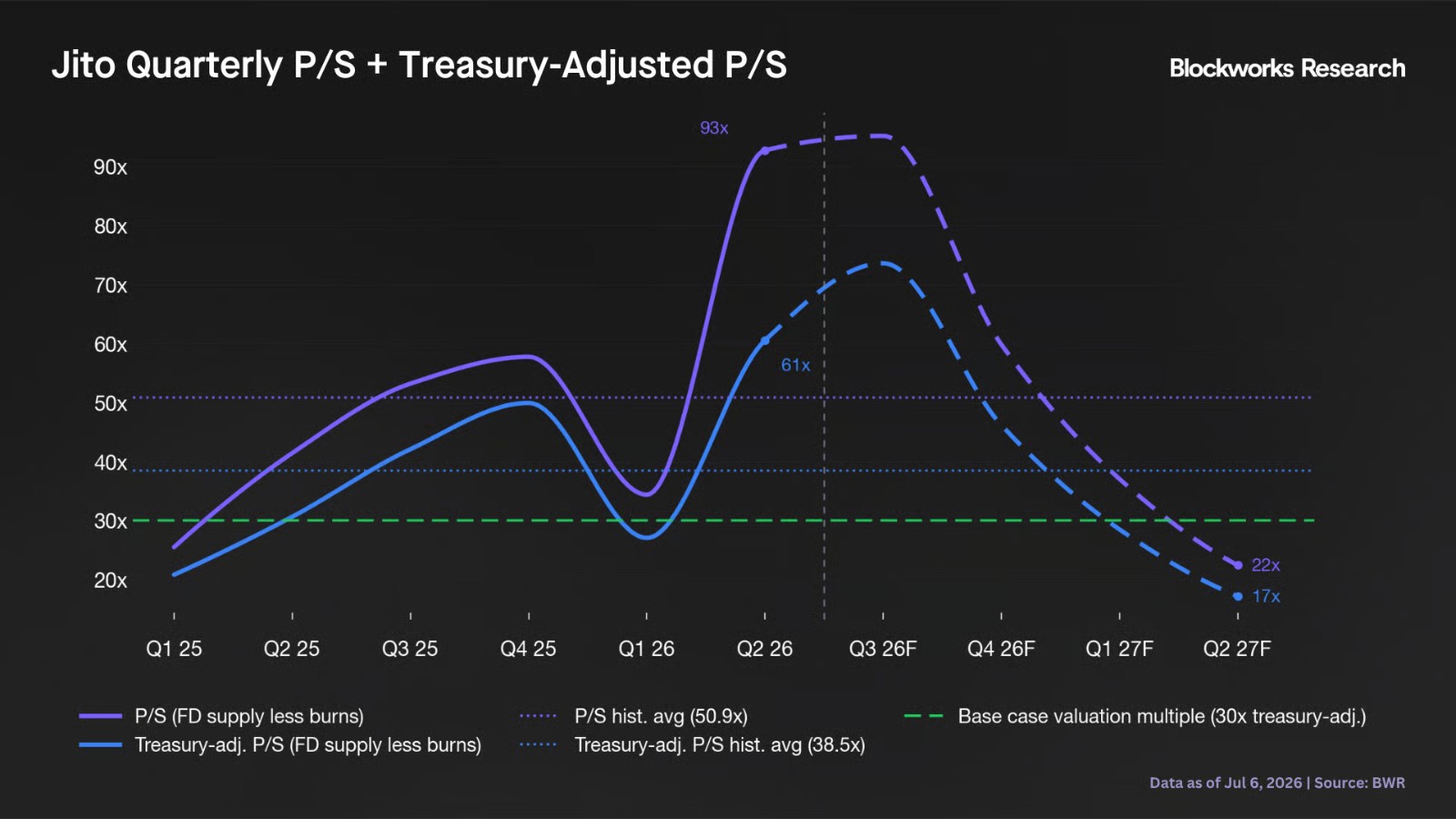
The scenario range is wide. The bullish case (40% probability) assumes JTX share reaches 25%, given a 45x valuation, corresponding to a price of $5.31, a 600% gain; the bearish case (10% probability) assumes share stalls at 5%, price-to-sales ratio drops to a commoditized 15x, corresponding to $0.36, a 52% decline. The three scenarios weighted target price is $2.75, implying about 267% upside relative to the current ~$0.75. Valuation is highly sensitive to Solana DEX volume, and our weighting leans optimistic because we believe tokenized stocks and real-world assets will scale on-chain, simultaneously boosting volume and JTX's share.
JTX also makes JTO's value capture clearer: 80% of its revenue is expected to be used for buybacks. Under the base case, about $8.6 million in buybacks over the next 12 months, canceling about 1.5% of the treasury-adjusted supply (about 5.7% in the bullish case). The flywheel is currently still small in scale, but will amplify directly with JTX's success.
Join TechFlow official community to stay tuned
Telegram:https://t.me/TechFlowDaily
X (Twitter):https://x.com/TechFlowPost
X (Twitter) EN:https://x.com/BlockFlow_News
 Blockworks