








$8.5 Million USDT Fled Overnight—Can You Still Trust High-Yield Stablecoin Vaults?
TechFlow Selected TechFlow Selected
$8.5 Million USDT Fled Overnight—Can You Still Trust High-Yield Stablecoin Vaults?
The Altura run has sounded the alarm on liquidity in stablecoin yield pools.
 Navigating Web3 tides with focused insights
By: Liam Akiba Wright
Translated by: Chopper, Foresight News
TL;DR
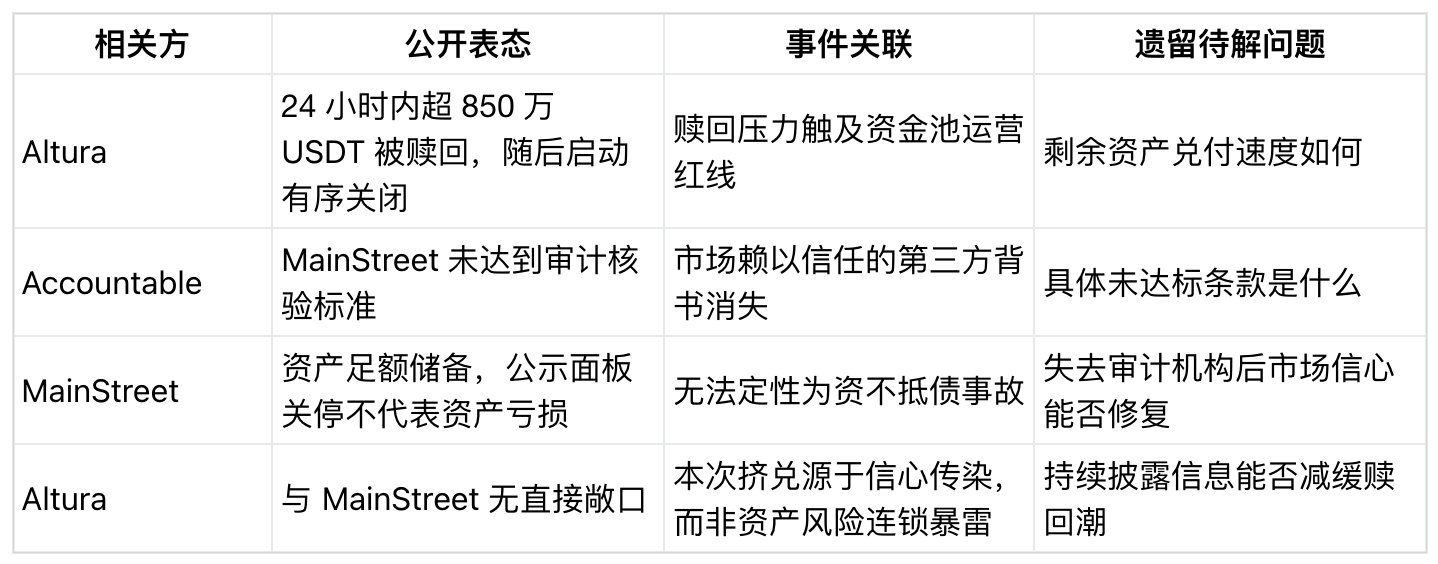
- Altura stated that users withdrew over $8.5 million in USDT within 24 hours before the orderly wind-down of its vault began.
- This bank run illustrates that even yield-bearing stablecoin products with no direct asset linkage to other protocols can still face liquidity pressure amid broad-based confidence erosion.
- An open question remains: Can the platform’s remaining holdings be redeemed on schedule? Clearing timelines vary significantly across investment strategies.
The MainStreet reserve audit controversy triggered a collapse in market confidence across the entire yield-bearing stablecoin sector. Altura experienced over $8.5 million in USDT outflows in a single day, prompting the project to initiate an orderly vault wind-down.
Ranveer Arora, CEO of Altura, confirmed that total redemptions prior to vault closure exceeded $8.5 million. Altura also emphasized it holds no assets linked to MainStreet or its underlying investment strategies. The core driver of this bank run was not asset-risk contagion, but rather a cascading loss of confidence across similar yield products.
The incident was triggered when third-party auditing firm Accountable terminated its engagement with MainStreet, citing the latter’s failure to meet audit verification standards. MainStreet publicly maintained that its assets were fully reserved; however, the absence of third-party audit backing prompted widespread user skepticism: Could the fund pool deliver rapid redemptions if everyone redeemed simultaneously?
This is precisely the operational risk exposed by Altura’s event. From the user’s perspective, redemption appears straightforward—but platform assets are dispersed across exchange holdings, private credit loans, and real-world asset (RWA) settlements, each with vastly different cash recovery timelines.
MainStreet later clarified that shutting down its third-party reserve dashboard does not indicate asset losses or portfolio impairment.
Altura’s own risk disclosures are equally critical: the team explicitly stated it holds no MainStreet-related assets, and its HyperEVM lending pool, USDT/AVLT trading market, and Ethereum-based lending positions remain unaffected by this incident.
Yet once users see an auditor sever ties with a yield-bearing stablecoin product, attention shifts—not to whether neighboring protocols harbor risk exposures—but to whether *all* similar products can withstand a concentrated redemption wave.
Under Concentrated Redemptions, Liquidity Becomes the Central Conflict
Stablecoin users typically focus solely on the token itself. In this case, USDT serves as crypto’s core settlement medium. Its peg to $1 remains rock-solid, with a market cap of approximately $18.6 billion and a 24-hour trading volume exceeding $51 billion.
This scale creates a dual effect: On one hand, USDT’s underlying liquidity is exceptionally deep—making it difficult for any single USDT-denominated pool to destabilize the broader stablecoin market. On the other hand, a pool’s own liquidity depends entirely on where funds are deployed, how assets are held, settlement rules, and whether counterparties can meet users’ expected redemption speed.
Altura’s official announcement underscored this reality: Exchange-held funds are more readily liquidated than private credit or RWA investments—but even exchange withdrawals are subject to platform procedures, transfer channel capacity, and market conditions. Private credit and RWA assets have fixed repayment schedules; loan recoveries, share redemptions, and settlement windows cannot match DeFi users’ expectation of instant withdrawal.
Mismatched asset recovery timelines mean market confidence—not actual asset losses—can determine a product’s survival. Early redeemers receive immediate payouts, while later ones must wait for asset maturities and liquidations. This dynamic incentivizes everyone to redeem first. Even the mere possibility of phased redemptions accelerates the bank-run stampede.
The scale of this redemption wave is significant: Altura’s overall pool size stands in the tens of millions of dollars, making $8.5 million in same-day redemptions an extremely high proportion. Large-scale, concentrated withdrawals force investment portfolios—originally designed for yield enhancement—to pivot abruptly toward liquidity-first asset allocations.
Redemption Timelines: The Next Key Metric to Watch
Across the entire stablecoin sector, this lesson is impossible to ignore. With a combined stablecoin market cap in the hundreds of billions and daily trading volumes in the tens of billions, various yield-bearing stablecoins promise both principal stability and yield—but their underlying investment strategies generally lack instant settlement capability.
Such products are operationally viable in principle, yet their risks concentrate squarely at the operational level. Reserve attestations, third-party audits, exchange holdings, private credit, and RWA investments only expose their liquidity shortcomings when users abandon yield-seeking behavior and simply demand cash back.
For Altura, the key forward-looking metrics center on its wind-down process: Can assets be redeemed in an orderly manner? How frequently does the platform update disclosures? What are the capital inflow amounts at each stage? And crucially, can users be prevented from dumping long-dated assets at steep discounts to exit hastily? Current information confirms only liquidity concerns—not evidence of underlying asset losses at Altura.
For the entire stablecoin yield ecosystem, this incident poses a fundamental test: Can third-party audit endorsements stabilize confidence during market turbulence—or do they instead become panic triggers? Reserve dashboards and third-party verifications were designed to reduce market uncertainty, yet negative news about audit terminations spreads far faster than project teams’ clarifications.
This is the industry-wide insight from Altura’s bank run: In the DeFi pool sector, market confidence is no soft, intangible metric—it directly determines whether users are willing to park funds long-term, thereby granting underlying investment strategies the necessary time to execute orderly liquidations.
Join TechFlow official community to stay tuned
Telegram:https://t.me/TechFlowDaily
X (Twitter):https://x.com/TechFlowPost
X (Twitter) EN:https://x.com/BlockFlow_News
 @CryptoSlate


