Will Powell Bend to Trump? A Deep Dive into the 70-Year Power Struggle Between the President and the Fed
TechFlow Selected TechFlow Selected
Will Powell Bend to Trump? A Deep Dive into the 70-Year Power Struggle Between the President and the Fed
Worth inherited a central bank already showing internal fractures, and Trump’s expectation of him boiled down to just two words: rate cuts.
 Navigating Web3 tides with focused insights
By Zhao Ying
Source: WallStreetCN
President Trump will personally preside over the swearing-in ceremony of new Federal Reserve Chair Jay Powell—a break from recent precedent that once again thrusts the 70-year power struggle between the White House and the Fed into the spotlight. History shows that every Fed chair must balance political pressure against policy independence; Powell is no exception—but his situation is far more complex than outsiders imagine.
According to a report by The Wall Street Journal citing White House officials, Trump will host Powell’s swearing-in ceremony at the White House this Friday—an unusual move, as such ceremonies are typically held internally at the Fed, with sitting presidents rarely in attendance. The last time a Fed chair was sworn in at the White House was in 1987, when Alan Greenspan assumed office—nearly four decades ago.
In its latest research report, Caitong Securities’ fixed-income team (Sun Binbin, Sui Xiuping, Lu Xingchen) notes that although Powell is not a “dovish” chair, it cannot be ruled out that interest rate cuts may occur this year—the relationship between the Fed chair and the U.S. president is not static but evolves with circumstances.
Yet Powell does not inherit a fully unified or battle-ready Fed. At the FOMC meeting in late April, three regional Fed presidents—Hammack of Cleveland, Kashkari of Minneapolis, and Logan of Dallas—cast the most unusual dissenting votes since October 1992: they opposed not rate cuts per se, but even signaling the possibility of future cuts. This means Powell inherits a central bank already fractured internally—while Trump expects precisely those rate cuts.
The White House Swearing-In Ceremony: A Politically Charged Arrangement
The ceremony itself sends a strong political signal. When Powell assumed office in 2018, the event took place inside the Fed—and Trump did not attend. The most recent sitting president to attend a Fed chair’s swearing-in was George W. Bush, who attended Ben Bernanke’s ceremony in 2006. Trump’s personal involvement underscores his intense focus on this Fed appointment.
Procedurally, this transition has also been unusually protracted. Powell received Senate confirmation last week and was granted a four-year term; Powell’s term as chair expired last weekend, yet he has announced he will remain on the Board of Governors as a governor until January 2028. Powell previously agreed to divest certain personal investments before officially assuming office—a step that delayed the handover process. During the interim, Fed Vice Chair Philip Jefferson represented the central bank at Monday’s G7 finance ministers and central bank governors meeting in Paris.
A 70-Year History of Power Struggles: From Martin to Powell
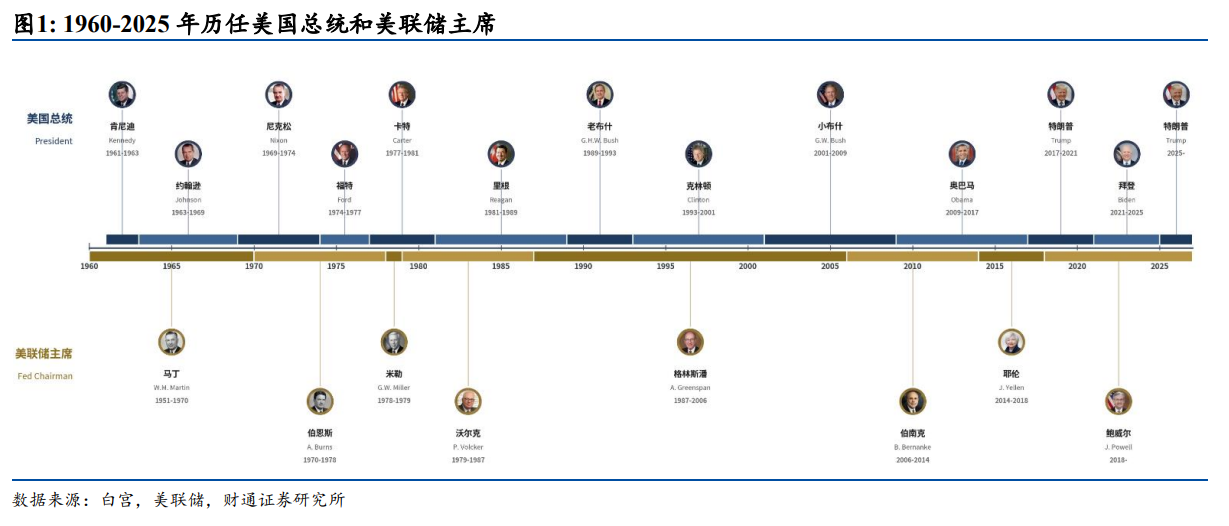
Caitong Securities’ report systematically traces the evolving relationship between U.S. presidents and Fed chairs since 1960, outlining a clear historical trajectory.
William McChesney Martin, operating in an era without formal institutional safeguards, relied solely on personal credibility to preserve Fed independence. Upon taking office, he refused to act as the Treasury’s agent, shifted the Fed’s decision-making center from New York to Washington, and expanded policymaking authority across the entire FOMC. When Truman encountered him on a New York street, he reportedly walked away after muttering only, “Traitor.”
Arthur Burns’ failure stemmed from his own disbelief that monetary policy could tame inflation—opening the door for Nixon’s political pressure. Nixon applied pressure via private letters, intervened in board appointments, and even dispatched senior advisors to directly lecture Fed staff. Though Burns preserved formal institutional independence, he made major substantive concessions on policy direction—ultimately destroying the Fed’s credibility.
William Miller embodied the most direct form of political alignment—he was deliberately selected to align with President Carter’s agenda, only to be undermined by external crises. By summer 1979, inflation had become Carter’s gravest political liability; Miller was moved to Treasury Secretary to clear the way for appointing a true inflation hawk.
Paul Volcker elevated independence from “guardianship by personal credibility” to a “triple moat” comprising personal credibility, institutional framework, and market credibility. Carter knew appointing Volcker would carry political costs, yet proceeded anyway—as his policy advisor Eizenstat observed, this decision “eventually squeezed inflation out at the cost of high unemployment—and squeezed Carter out of a second term.” Though Reagan issued a directive to Volcker not to raise rates ahead of the 1984 election and later orchestrated an “FOMC ambush” in 1986 via newly appointed governors, neither effort materially altered policy direction.
Alan Greenspan used technocratic language to keep tensions beneath the surface—clashing fiercely with George H.W. Bush, achieving a “Washington-style peace” with Clinton, yet crossing a line during George W. Bush’s tenure by openly supporting tax cuts—the first time a Fed chair actively intruded into fiscal policy territory.
Ben Bernanke exemplified natural convergence between the White House and the Fed during crisis—his primary pressures came from Congress and internal Fed dynamics, not the White House. Janet Yellen responded to Trump’s attacks with “non-political language and strict self-restraint,” becoming the first Fed chair since Carter declined to reappoint Burns to be replaced by a new president.
Jerome Powell faces the most severe presidential pressure since Burns. During Trump’s first term, Powell cut rates three times consecutively in 2019 and halted quantitative tightening under combined external political pressure and internal economic judgment. In Trump’s second term, facing investigations launched by Trump over alleged cost overruns in the Fed’s Washington headquarters renovation—and threats of dismissal—Powell’s response hardened significantly, elevating the defense of Fed independence to unprecedented legal, written, and public levels. At his final meeting as chair, the FOMC voted 8–4—a rare split—to hold rates steady.
Powell’s Dilemma: A New Chair Caught Between Internal and External Pressures
Powell inherits a historically rare situation—facing simultaneous pressure from the White House to cut rates and resistance from hawkish voices within the FOMC.
Powell is not a traditional dove. Appointed Fed governor in 2006 at age 35 by George W. Bush, he ranks among the youngest governors in Fed history. After QE2 formally launched in 2010, he became the sole FOMC member to publicly question the expansionary path—and resigned early in 2011, widely interpreted by markets as a silent protest against excessive Fed easing. His background in investment banking at Morgan Stanley, service as Executive Secretary of the White House’s National Economic Council (NEC), and close ties to Republican core circles mean his expected policy independence is no lower than that of past chairs with similar profiles.
Caitong Securities’ report distills four core themes from Powell’s recent speeches and press interviews:
- First, his definition of Fed independence is more nuanced than his predecessors’. He argues that politicians’ commentary on monetary policy does not inherently undermine Fed independence—a form of desensitization to Trump’s pressure, while preserving space to uphold policy independence without open confrontation;
- Second, he holds a negative view of forward guidance, suggesting markets should prepare for a far more “silent” Fed;
- Third, he takes inflation seriously—explicitly rejecting Trump’s claim that rising oil prices represent “fake inflation”;
- Fourth, he believes productivity gains from artificial intelligence could make rate cuts feasible—a logic structure echoing Greenspan’s insight into the productivity boom of the late 1990s.
Rate Cuts and Balance Sheet Reduction: Direction Clear, Pace Cautious
Caitong Securities believes Powell’s monetary policy will likely exhibit “a clear directional bias but cautious pacing.”
On the timing of rate cuts: inflation has exceeded the Fed’s target for five consecutive years, making anchoring inflation expectations the top priority. Powell’s emphasis on inflation—and especially his rejection of the “fake inflation” narrative—signals he will not cut rates prematurely before inflation clearly falls back into the target range. Near-term demand growth driven by data-center investments may further offset room for cuts, causing the pace of easing to be data-dependent and slower. The report notes that if Trump grants Powell greater respect, cuts may arrive earlier; if Trump continues high-intensity pressure, Powell may instead delay cuts to defend Fed independence.
On balance sheet reduction: Powell views the Fed’s expanded balance sheet as having effectively extended monetary policy boundaries into fiscal domains—making balance sheet normalization logically necessary. Yet he acknowledges it took 18 years to build the current balance sheet, so contraction will be gradual and orderly. Moreover, initiating balance sheet reduction before any rate cuts would almost certainly trigger open conflict with the White House—thus ensuring such reduction proceeds at a pace designed to avoid direct confrontation before the easing cycle begins.
Caitong Securities’ core conclusion: Reinstating Greenspan-style management and returning to the scarce-reserves regime requires first winning internal Fed support—rushing the process would backfire. Judging Powell’s future policy path should not hinge solely on his personal stance or current relations with the White House, but rather on macro trends—inflation’s trajectory, growth’s elasticity, oil price dynamics, and financial conditions—to deduce his most likely choices under various scenarios.
Join TechFlow official community to stay tuned
Telegram:https://t.me/TechFlowDaily
X (Twitter):https://x.com/TechFlowPost
X (Twitter) EN:https://x.com/BlockFlow_News