AI and TradFi Singularity Has Arrived: BNB Chain Delivers a +50,048% Performance in Four Months
TechFlow Selected TechFlow Selected
AI and TradFi Singularity Has Arrived: BNB Chain Delivers a +50,048% Performance in Four Months
From embracing the AI ecosystem to transcending the boundaries of crypto and becoming the next-generation open financial infrastructure, BNB Chain is accelerating the translation of its vision into tangible results.
 Navigating Web3 tides with focused insights
Author: TechFlow
On April 20, He Yi, Co-CEO of Binance, appeared at the main venue of the Hong Kong Web3 Festival. When asked what she currently focuses on most, she gave two “singularities” as her answer:
First, the AI wave—AI today is what electricity was to the last era; we cannot remain workers in candle factories.
Second, the accelerating convergence of crypto and traditional finance (TradFi); we must not confine ourselves within the “Crypto” label but instead continuously push boundaries to evolve into global financial infrastructure.
With its sights set on 3 billion users, Binance’s ecosystem has clarified its two key future directions:
AI reshaping interaction paradigms;
Crypto + TradFi integration continuously expanding asset boundaries and driving financial innovation.
At another event, we saw concrete results emerging around these strategic priorities.
On April 19, the BNB Chain HK Super Meetup kicked off.
This event ranked among the most anticipated activities of this year’s Hong Kong Web3 Festival, hosted by BNB Chain—a chain long recognized for its massive user base, high trading activity, and thriving ecosystem.
Over 1,500 attendees showed up that day, and the speaker lineup lived up to community expectations: Richard Teng, Co-CEO of Binance, delivered the opening keynote; He Yi, Co-CEO of Binance, hosted an interactive Q&A session lasting over thirty minutes; and Nina Rong, Head of Growth at BNB Chain, presented a data-driven overview of BNB Chain’s recent progress:
- Total market cap of tokenized assets on-chain reached $16.6 billion, representing over 100% YoY growth;
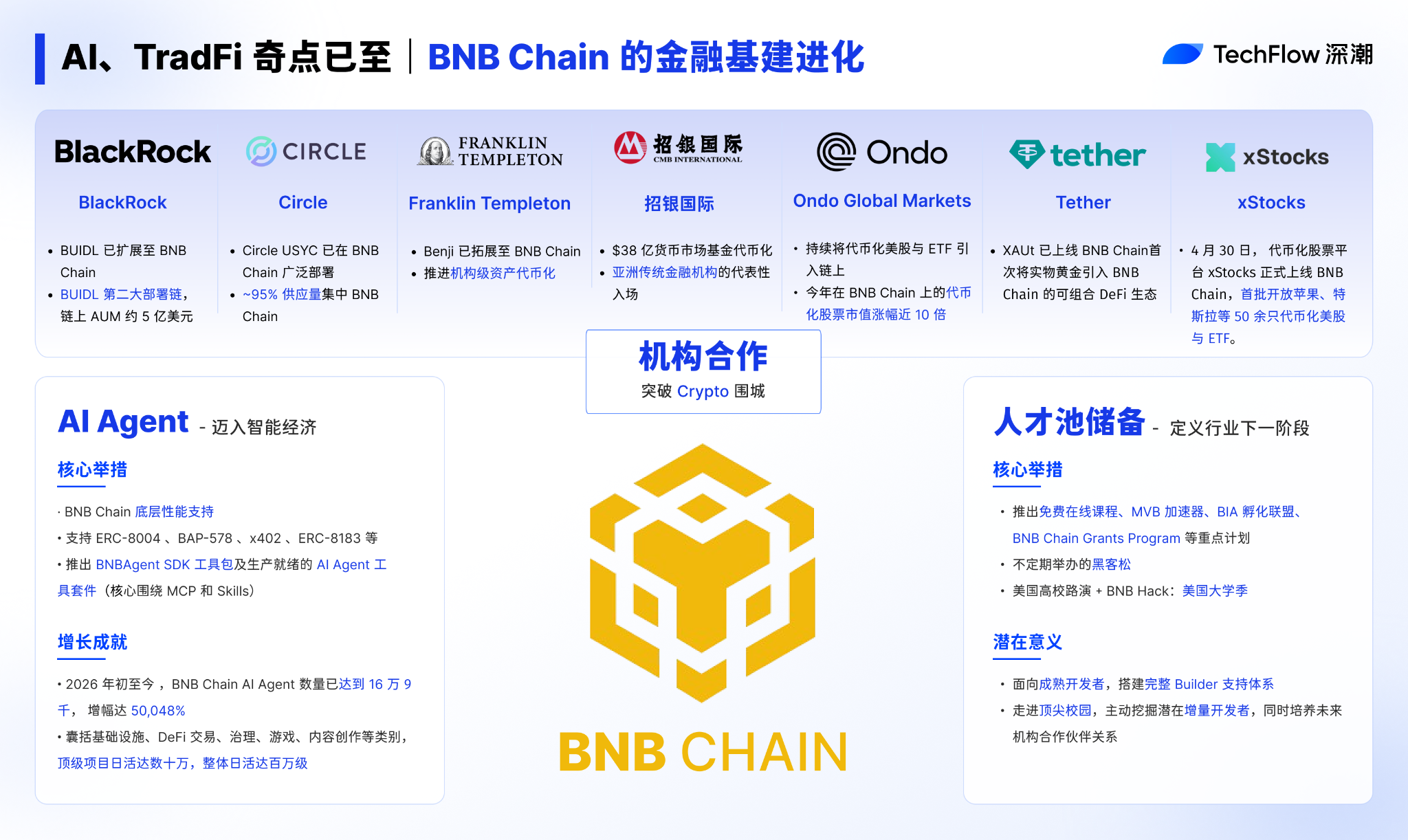
- Its partner network includes top-tier institutions such as BlackRock, Circle, China Merchants Bank International, and Franklin Templeton;
- Since January 1, 2026, the number of AI Agents on-chain surged from 337 to 169,000—an increase of 50,048%.
As its performance metrics grow increasingly impressive, this mature public chain is responding more decisively to industry needs:
From embracing the AI ecosystem to transcending crypto boundaries and becoming the next-generation open financial infrastructure, BNB Chain is rapidly turning vision into tangible outcomes.
From “Chain” to “Infrastructure”: Capable of Onboarding Institutions—and Integrating Into Daily Life
As He Yi shared:
The core value of Web3 should not be limited to cryptocurrencies, but rather viewed as a more efficient, low-cost, and always-on financial infrastructure.
And as financial infrastructure, its target users extend beyond current crypto-native participants to include the broader public—serving everyday payment, wealth management, and asset allocation needs.
Therefore, reviewing BNB Chain’s actions over the past extended period through this lens reveals a remarkably clear strategic logic:
Bring more real-world assets on-chain, then enable those assets to flow efficiently across real-world use cases—achieving genuine activity and sustainable growth.
Institutional collaboration is both a cornerstone initiative and a critical resource for BNB Chain.
BNB Chain’s ecosystem partners list features some exceptionally heavyweight names.
- BlackRock’s tokenized U.S. Treasury fund BUIDL has expanded onto BNB Chain and is accepted by Binance as OTC collateral. As a result, BNB Chain has become BUIDL’s second-largest deployment chain, with ~$500 million in on-chain AUM—second only to Ethereum;
- China Merchants Bank International has tokenized a $3.8 billion USD money market fund on BNB Chain—a landmark entry by an Asian traditional financial institution;
- Franklin Templeton has extended its proprietary Benji technology platform to BNB Chain, leveraging its low-cost, high-throughput infrastructure to advance institutional-grade asset tokenization;
- Meanwhile, through deepening its collaboration with Ondo Global Markets, BNB Chain has also brought tokenized U.S. equities and ETFs on-chain for trading—freeing premium financial assets from institutional silos. According to official data, the market cap of Ondo’s tokenized equities on BNB Chain has risen nearly tenfold YTD.
Entering 2026, BNB Chain has taken another step toward anchoring its on-chain asset structure in the real world.
Tether’s tokenized gold XAUt has officially launched on BNB Chain. As the largest tokenized gold product in crypto markets, XAUt marks the first time physical gold has truly entered the composable on-chain financial ecosystem.
On April 30, BNB Chain officially announced the launch of xStocks—the tokenized stock platform—with over 50 initial listings including Apple, Tesla, NVIDIA, and the S&P 500 ETF. Over 100 additional assets will be added in the coming weeks.
Viewed collectively, these partnerships demonstrate how BNB Chain is increasingly regarded by institutions as a credible on-chain gateway capable of handling real-world assets, real scale, and real liquidity.
Within this narrative, stablecoins serve as the circulatory system that makes RWAs truly “alive.”
They fulfill the pivotal transport-layer role: connecting, on one end, millions of consumer-grade users; and on the other, bridging institutional TradFi assets and DeFi innovation through liquidity conversion.
BNB Chain’s stablecoin strategy reflects both ambition and pragmatism.
First, it deeply integrates stablecoins with institutions and RWAs. Circle’s USYC—widely deployed across the BNB Chain ecosystem—is a prime example: according to Dune data, ~95% of USYC supply resides on BNB Chain. As a yield-bearing money market fund token, USYC can be directly integrated by developers into lending markets, perpetual contract platforms, and yield vaults—making it a composable, collateralizable, and yield-generating on-chain asset module. Meanwhile, institutional-grade tokenized products like BlackRock’s BUIDL further bring institutional assets into on-chain collateralization, yield generation, and liquidity cycles.
Second, BNB Chain has consistently launched—and repeatedly extended—its 0 Fee Carnival, subsidizing gas fees for transfers, withdrawals, and cross-chain bridging of major stablecoins including USDT, USDC, USD1, and $U. Combined with performance optimizations and EIP-3009–enabled gasless transactions, BNB Chain has driven stablecoin transaction costs down further—laying the essential groundwork for high-frequency micro-payments and consumer-grade stablecoin settlement.
Among these, BSC’s native stablecoin $U—launched just four months ago—has already surpassed $1 billion in market cap, achieved a 24-hour peak trading volume exceeding $3 billion, and entered the global top six tokens by trading volume during peak periods. As the first stablecoin on BSC supporting EIP-3009, $U has already integrated with AI projects such as Aeon and Piverse to power autonomous Agent payments.
Naturally, the significance of this coordinated strategy is direct and clear:
First, trust-building: Top-tier institutions choosing BNB Chain as the foundation for deploying core products signals strong validation of BNB Chain’s performance, compliance posture, and user influence.
Second, capability demonstration: Expanding the boundaries of asset classes moves BNB Chain beyond purely crypto-native narratives. Combining traditional yield products with DeFi composability further drives innovation in on-chain financial formats.
Ultimately, when real-world assets, stable yields, and on-chain payments coexist and thrive on a single network, BNB Chain’s narrative as a genuinely demand-driven open financial infrastructure becomes fully credible.
Data serves as the strongest validation of this trajectory.
To date, BNB Chain hosts over 800 million on-chain wallet addresses. Against this massive base, average daily active addresses in Q1 2026 stood at ~4.5 million—ranking among L1 leaders at times—while daily new address creation remains robust, reflecting a user network that is still actively growing and flowing.
In the RWA dimension, BNB Chain’s total market cap has exceeded $3.5 billion, with a 25.93% MoM growth rate; holder addresses have reached 42,958—a 9.37% increase. In Q1 2026 alone, new TVL in BNB Chain’s RWA sector surpassed $1 billion.
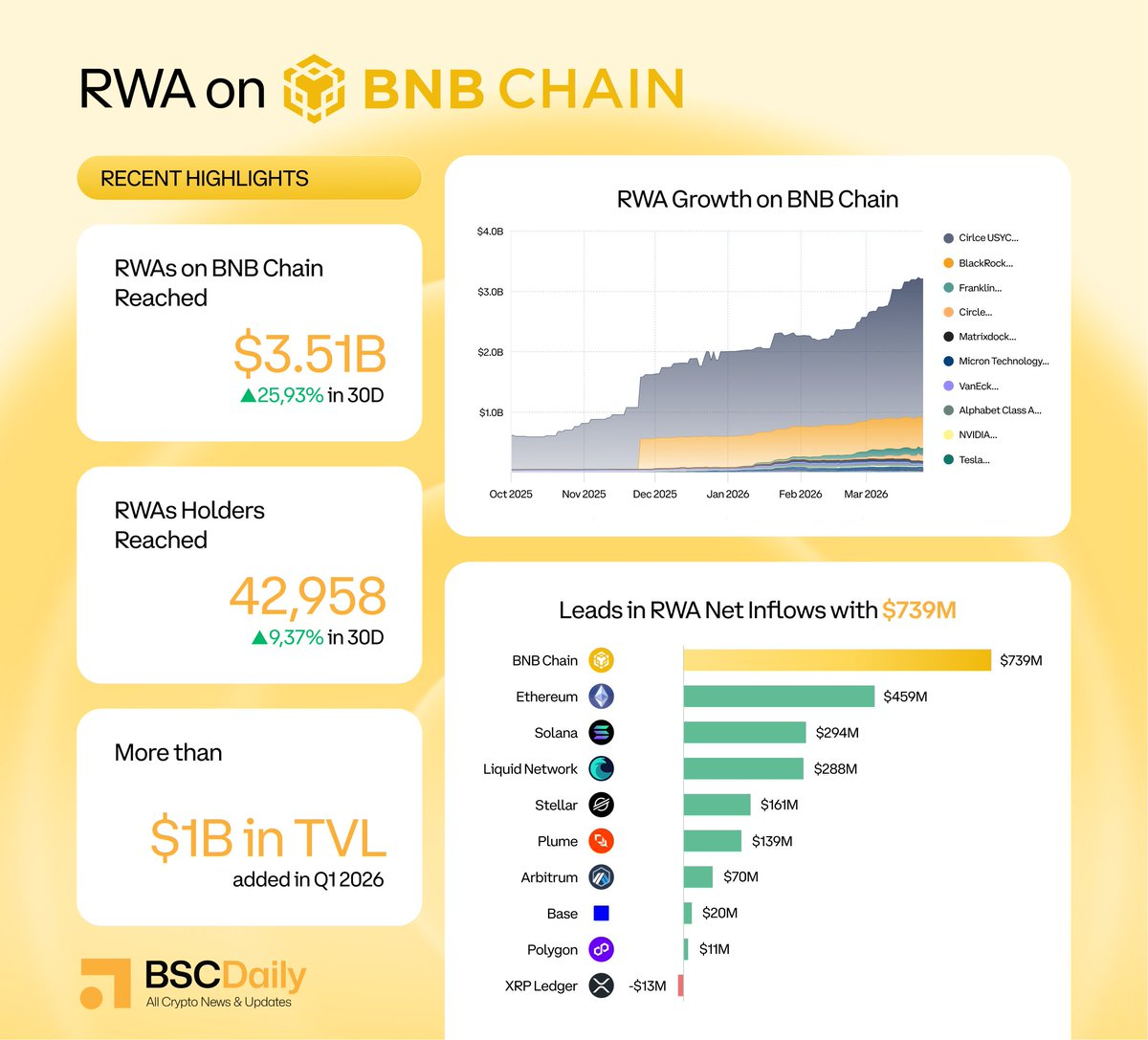
Under a broader definition of tokenized assets, Token Terminal data shows BNB Chain’s total market cap has reached $16.6 billion—over 100% annual growth.
Focusing specifically on stablecoins, the numbers tell an even clearer story: per official data, BNB Chain’s monthly count of unique stablecoin sender addresses stands at 15.1 million—the highest among all public chains.
Meanwhile, although BNB Chain holds only ~5% of global stablecoin supply, it processes nearly 40% of global stablecoin transaction volume—further underscoring stablecoins’ role as high-frequency, real-world payment and settlement tools within the BNB Chain ecosystem.
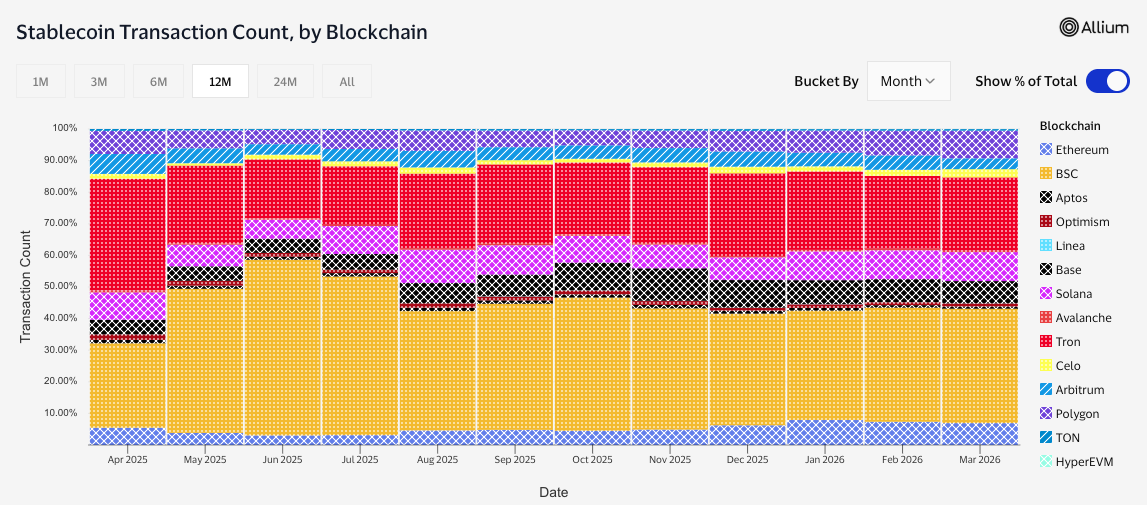
The true significance behind these figures lies not just in scale—but in structural shift:
BNB Chain is no longer driven solely by crypto-native assets; increasing growth now originates from real-world assets, stable-yield products, and payment & allocation use cases.
Through this structural transformation, BNB Chain is gradually taking shape as the “next-generation financial infrastructure” many envision:
It can onboard institutional-grade assets—and seamlessly fit into ordinary people’s daily lives.
But this is only the beginning.
Because the same playbook is now being replayed—on AI, and at an even faster pace.
The AI Agent Strategy Behind a 50,048% Surge
Such explosive growth is impossible to ignore:
On January 1, 2026, there were 337 AI Agents on BNB Chain.
Four months later, that number had climbed to 169,000—a 50,048% increase. BNB Chain now commands over one-third of all ERC-8004 agent deployments, outpacing both Ethereum and Base.
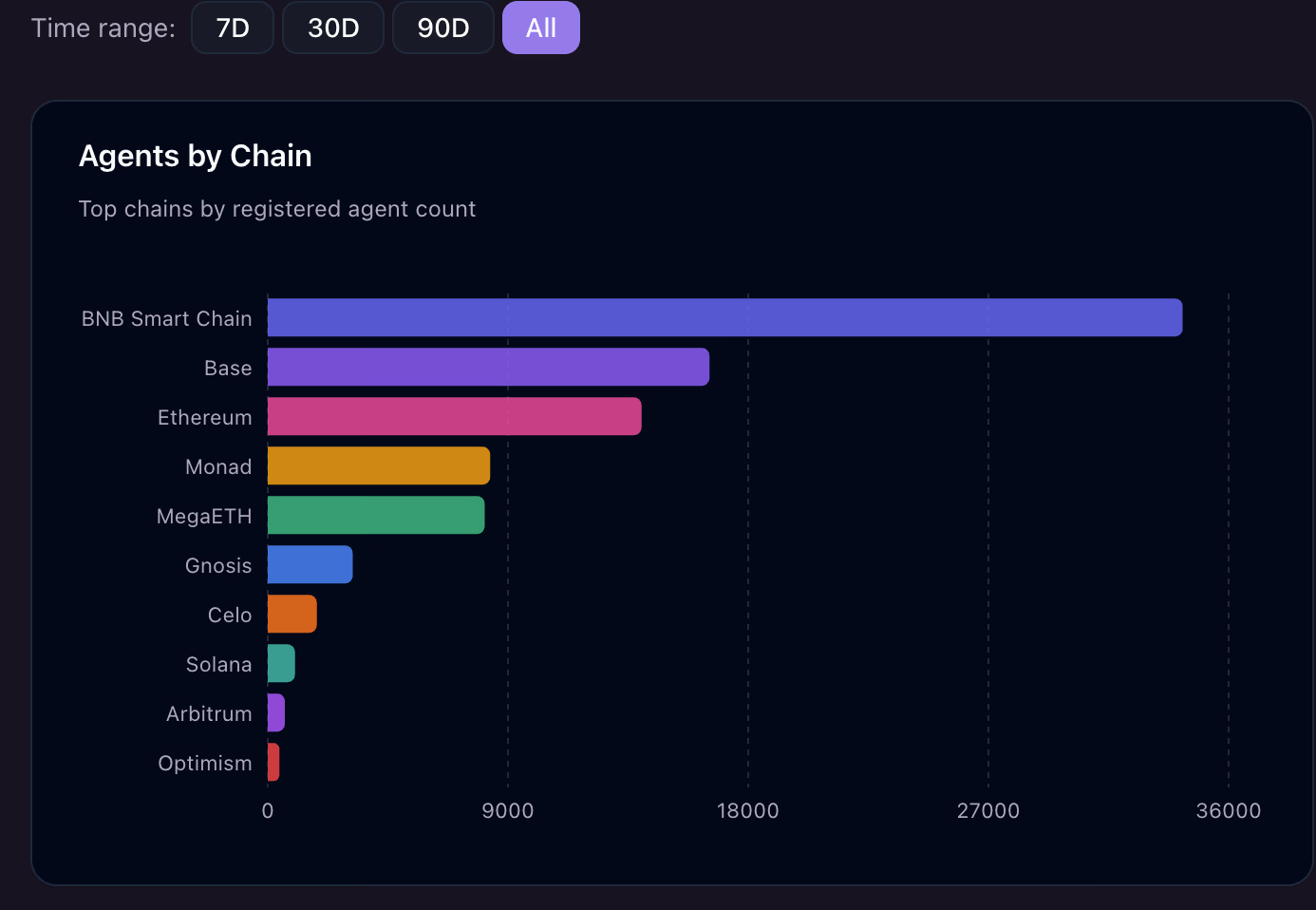
This was near-vertical growth.
Yet this explosion was no accident—it was built on solid foundations.
By design, BNB Chain possesses precisely the native attributes AI Agents require: Agents frequently call external tools, read on-chain data, execute micro-payments, or automate strategies—all highly sensitive to underlying network gas costs, throughput, and confirmation speed. BNB Chain’s low gas fees, high throughput, and sub-second finality provide ideal conditions for Agent proliferation.
But “ideal conditions” weren’t enough—BNB Chain pursued deeper functional and technical alignment.
In February 2026, the ERC-8004 standard officially launched on BNB Chain’s mainnet and testnet. This standard provides AI Agents with verifiable, portable on-chain identities—enabling them to register identities, build reputation scores, autonomously discover each other across platforms, and complete transactions without centralized intermediaries.
Building on this, BNB Chain introduced the BAP-578 standard, making AI Agents themselves ownable, tradable, and upgradable on-chain assets. Agents can hold assets, execute logic, interact with protocols—and even be “hired” or bought/sold.
Complementary developments include:
- x402 payment abstraction layer, enabling autonomous Agent payments and settlements for 24/7, intermediary-free collaboration;
- ERC-8183, designed to solve trust issues in commercial transactions between AI Agents;
- BNBAgent SDK—a full-stack Python toolkit empowering developers to quickly build AI Agents with identity, payment, and business-process capabilities.
Beyond infrastructure, BNB Chain’s multi-chain architecture offers differentiated execution environments for the AI ecosystem.
BSC serves as the primary execution layer for high-frequency Agent interactions; opBNB—optimized for ultra-low cost and high throughput—provides fertile ground for AI content generation, social applications, and consumer-facing use cases; and BNB Greenfield functions as the decentralized data storage layer, supporting secure, private, and monetizable storage of AI training data.
This three-layer architecture ensures clear functional separation—wherever an Agent operates, dedicated infrastructure is ready to support it.
In March 2026, BNB Chain launched production-ready AI Agent tooling, supporting real-time on-chain data access, autonomous trading, independent wallet management, and integration with Skills and MCP frameworks. From infrastructure to developer tooling, the entire stack is now connected—empowering developers to start building immediately.
Looking back, BNB Chain has designed its entire infrastructure from the protocol layer upward—with AI Agents as first-class citizens.
And as infrastructure matures, ecosystem outcomes are now materializing.
Beyond sheer numbers, diversity is flourishing: BNB Chain’s AI ecosystem spans infrastructure, DeFi trading, governance, gaming, and content creation. Top projects include ChainGPT (AI-powered smart contract generation and trading), WhiteBridge (agent coordination network), and GT Protocol (automated trading and asset management). Some projects report daily active users ranging from tens of thousands to hundreds of thousands—with the overall ecosystem reaching over one million DAUs.
Autonomous DeFi strategy execution, contract monitoring, governance participation, data analysis—even “hiring” other Agents to collaborate on tasks. AI is no longer just a question-answering brain; it now has “hands” and “feet.” On-chain interaction is entering a new phase—from “humans operating apps” to “humans expressing intent, Agents executing.”
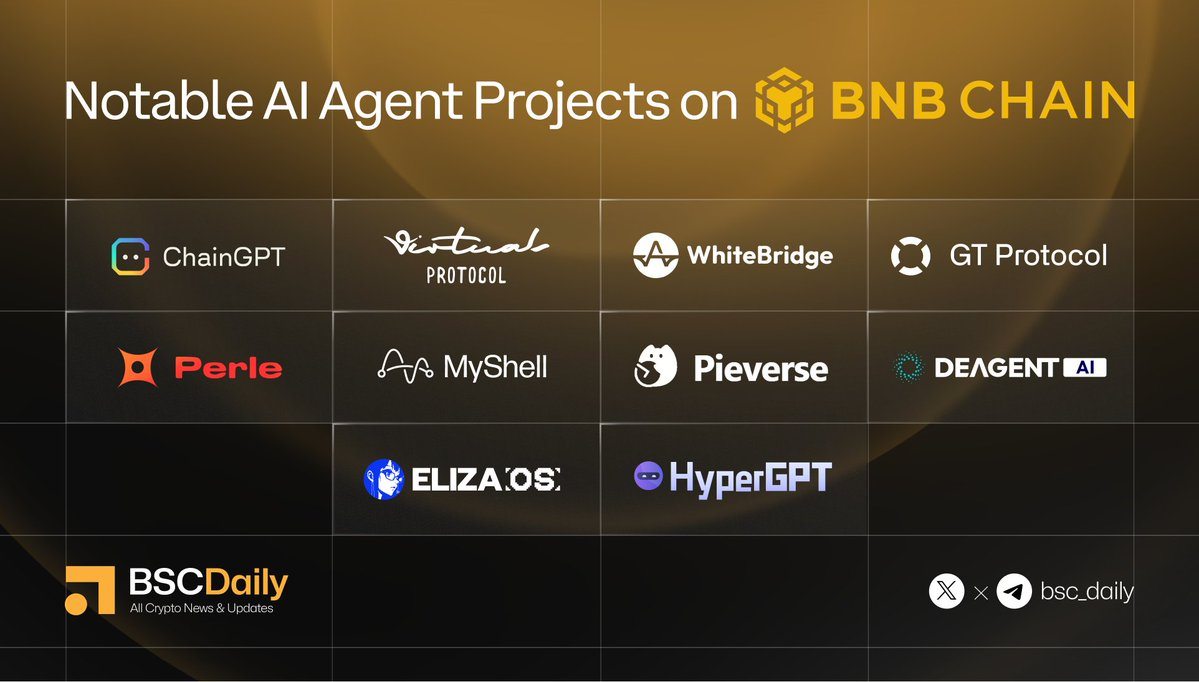
Thus, two distinct scorecards now sit before us:
For RWAs and TradFi: institutional onboarding, real-world assets going on-chain, and high-frequency circulation;
For AI: multi-layer standards, tooling, and architecture now in place—fundamentally reshaping interaction logic.
Yet this isn’t the end. How far an ecosystem advances depends not only on how many Agents run today or how many assets go on-chain—but on how many builders, users, and innovators choose to join tomorrow.
Hence, while continuing to strengthen its capabilities, BNB Chain is proactively planting seeds for the future.
Planting Seeds: Targeting the Highest-Potential Talent Poised to Lead the Next Industry Phase
Infrastructure determines how fast you can run today; talent determines how far you can go tomorrow.
On this front, BNB Chain has already established a comprehensive builder support system.
At the entry level, the free online course BNB Chain Developer Specialization Course is tailored for software developers with no prior blockchain experience—covering core topics including smart contracts, tool usage, and on-chain development. It serves as a key on-ramp into the BNB Chain builder ecosystem.
For project acceleration, BNB Chain offers flagship programs including the MVB Accelerator, BIA Incubation Alliance, and BNB Chain Grants Program—providing high-potential projects with full-cycle incubation support, including marketing assistance, ecosystem connections, expert mentorship, and potential investment.
Beyond these, regularly hosted hackathons serve the function of rapidly transforming ideas into prototypes.
Education, acceleration, funding, competition—BNB Chain walks the full path. But stopping here would merely reflect standard L1 execution—competitiveness measured primarily in operational efficiency.
What truly stands out is what BNB Chain did this spring in the United States.
Rather than competing solely within the pool of already-established developers, BNB Chain proactively sought incremental growth—targeting those not yet fully immersed in the industry but most likely to reshape it in the future.
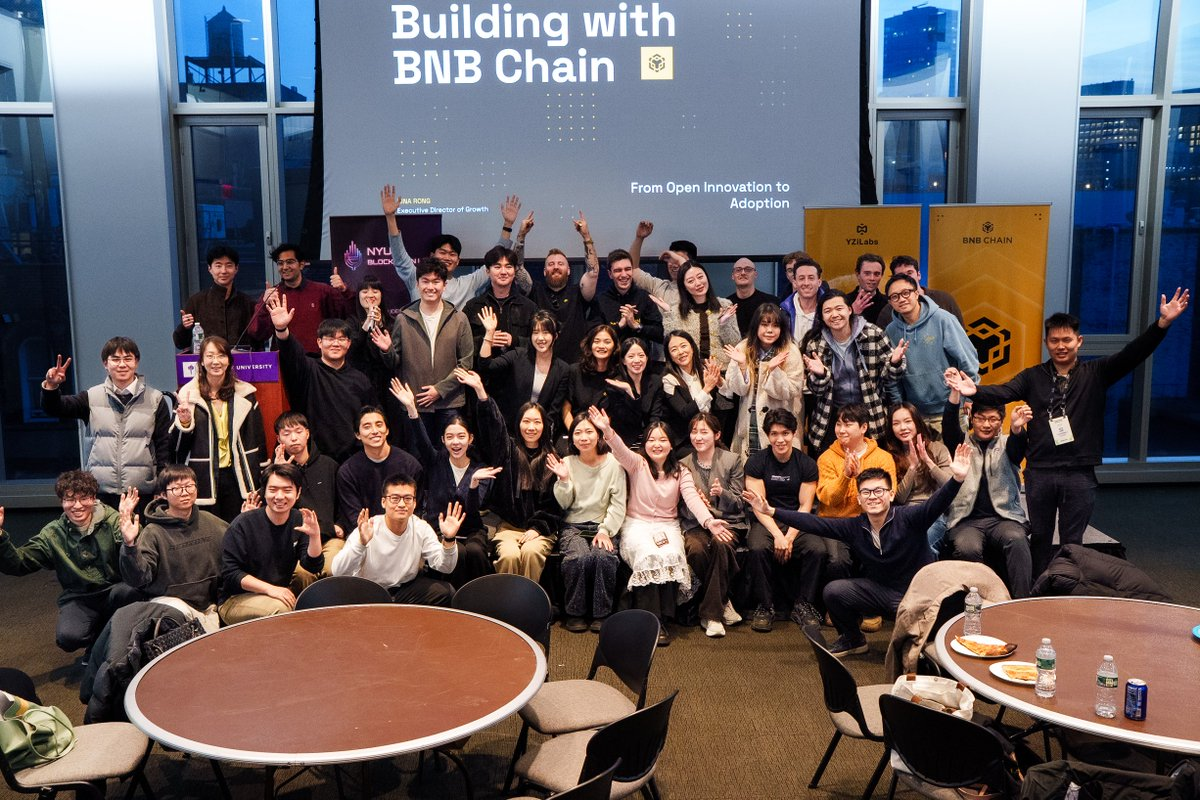
In Spring 2026, BNB Chain partnered with YZi Labs to launch a U.S. university roadshow—visiting top-tier institutions across both U.S. coasts:
- March 24: New York University;
- March 30: Harvard University;
- March 31: Massachusetts Institute of Technology;
- April 8: Stanford University;
- April 9: University of California, Berkeley.
Each stop featured practical, hands-on engagement—not generic brand presentations. Through live demos, developer resource sharing, and open Q&A sessions, leading developers from the BNB Chain ecosystem engaged hundreds of students on real-world opportunities for on-chain building—starting from “what you can build today.”
Immediately following the roadshow came BNB Hack: U.S. University Season, offering students a rapid pathway from idea to implementation: a four-week online hackathon open to invited U.S. university students and blockchain club members, covering themes including AI, DeFi, and infrastructure. Top-performing projects receive $10,000 prizes and live demo opportunities at Consensus Miami’s Demo Day.
From a spark of inspiration on campus to standing on stage at Demo Day—BNB Chain is striving to pave the hardest stretch of that journey in advance.
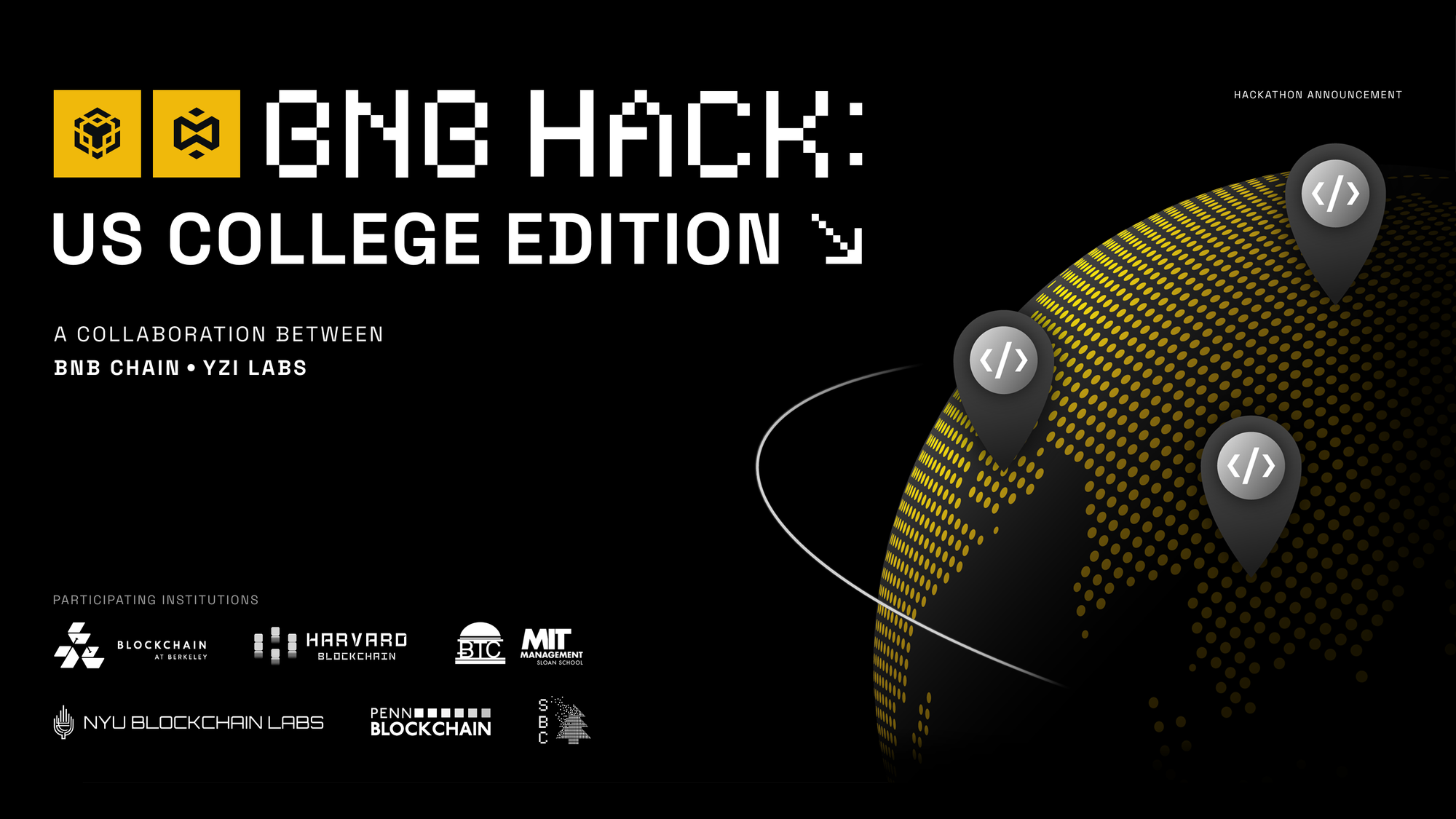
We refer to this university roadshow as “planting seeds” because its forward-looking growth logic merits serious attention.
Universities have always been the deepest talent pools—especially elite institutions, where the most capable learners, most enthusiastic adopters of cutting-edge technologies, and least path-dependent thinkers converge.
Where will today’s students sitting in NYU, Harvard, and Berkeley classrooms be in five years?
Some may be inspired by today’s roadshow to become the next generation of on-chain application builders—and for them, BNB Chain will naturally become their first development environment.
Others may choose careers outside blockchain—joining JPMorgan, BlackRock, or Goldman Sachs—as decision-makers and implementers driving institutional asset tokenization. For BNB Chain, those seeds planted today represent not just developer relationships, but future institutional partnerships, asset onboarding, and financial integration opportunities.
From this perspective, this roadshow may prove more consequential—and worthy of long-term attention—than any feature update or partnership announcement.
Because it bets on a cohort not yet fully embedded in the industry—but most likely to define its next phase.
Attracting experienced developers is about winning today.
Engaging elite campuses is about winning tomorrow.
Clearly, BNB Chain aims to win both.
In today’s market cycle, many claim L1 narratives have “broken down.”
What’s broken down is not the L1 concept itself—but rather those L1s relying on hype to inflate valuations and subsidies to fabricate metrics.
Meanwhile, L1s anchored in real users, real assets, and real-world use cases continue to thrive—even stronger than before.
Perhaps this is precisely why we don’t see “breakdown” at BNB Chain.
Whether it’s institutional assets going on-chain, stablecoins circulating at high frequency, AI Agents operating autonomously, or top-tier talent being cultivated early—BNB Chain is competing not just for growth in this cycle, but for leadership in the next.
From a healthy, vibrant chain—to the default foundational layer for next-generation finance and intelligent collaboration.
True infrastructure isn’t declared on the day it announces its transformation—it’s born on the day enough people quietly begin relying on it.
This is an ongoing evolution. The scorecard for the previous phase is already on display. For the next phase, BNB Chain continues running forward.
Join TechFlow official community to stay tuned
Telegram:https://t.me/TechFlowDaily
X (Twitter):https://x.com/TechFlowPost
X (Twitter) EN:https://x.com/BlockFlow_News
 深潮TechFlow