a16z: Beyond Payments—Stablecoins Reshape the Global Financial Landscape
TechFlow Selected TechFlow Selected
a16z: Beyond Payments—Stablecoins Reshape the Global Financial Landscape
Either embrace and adapt to it, or be left behind by the times.
 Navigating Web3 tides with focused insights
By Noah Levine, Guy Wuollet, and Robert Hackett
Translated by Luffy, Foresight News
The global financial system is being rebuilt atop new infrastructure—and this transformation is advancing far faster than most outside the crypto industry realize.
Stablecoins sit at the heart of this shift. Once niche trading tools, they have evolved into foundational financial infrastructure and are now becoming the bedrock for next-generation global financial products. This article outlines our perspective on this transformation. The competitive landscape among industry players may shift; sector boundaries will continue to blur and evolve. But the deeper change is structural: how the new architecture of global finance is being built, where it is maturing, and where critical gaps remain.
Our central thesis is that stablecoins are catalyzing an entirely new form of Banking-as-a-Service (BaaS). In the previous wave of BaaS, fintech firms primarily operated by leasing bank charters and integrating with legacy core banking systems. This new wave differs fundamentally: businesses build operations atop onchain infrastructure, leverage self-custodial wallets to reduce transaction friction and reliance on intermediaries, and embed core financial functions—including accounts, payments, foreign exchange, and credit—into end-to-end financial products.
A decade ago, launching such full-stack financial services required securing multiple regional banking licenses and forging partnerships with local banks across jurisdictions. Today, any team equipped with this new foundational technical architecture can rapidly deploy comparable services.
Stripe’s acquisition of Bridge and Privy, and Mastercard’s acquisition of BVNK, signal how established incumbents are adopting similar strategies to adapt to a shifting market landscape. Major players are aggressively pursuing consolidation and M&A to secure control over critical foundational layers before the new infrastructure ecosystem fully crystallizes.
All signs point to onchain finance as an irreversible trend. Our choice is stark: embrace and adapt—or be left behind.
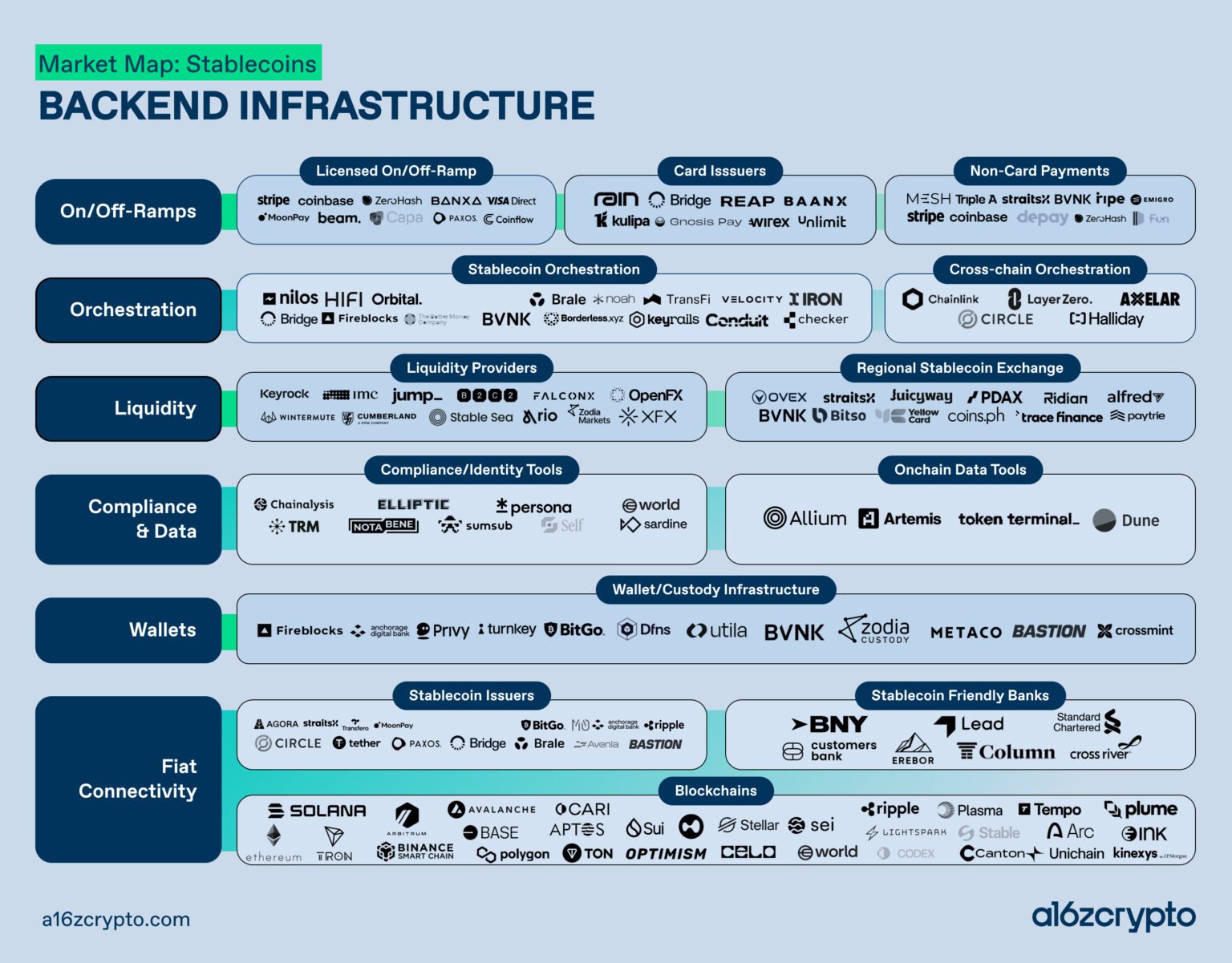
Stablecoin Market Landscape
Three Types of Blockchains
The long-held assumption that all blockchains compete for identical use cases is crumbling. The industry has now diverged into three distinct categories of blockchain networks—each designed for different needs, with performance trade-offs reflecting their specific priorities. Understanding these distinctions is essential to grasping how fintech is truly being deployed worldwide:
General-purpose public blockchains—led by Solana, Ethereum, and its major Layer 2s—remain the core infrastructure for crypto capital markets, supporting trading, lending, and decentralized finance (DeFi). This segment is large and mature, yet it does not capture the full scope of industry evolution.
Payment-specific blockchains represent an emerging category purpose-built for financial services. Networks like Stripe’s Tempo and Circle’s Arc are competing in functional areas never optimized on general-purpose chains: native stablecoin gas fees, privacy guarantees, and—critically—predictable transaction costs. For a fintech firm processing millions of payments, cost modeling is indispensable. Companies in this space bet that payment-optimized blockchains will become the preferred settlement layer for next-generation financial infrastructure.
Institutional networks—such as Canton—are the third category, designed specifically for regulated entities requiring programmability and privacy while remaining compliant with legal and regulatory frameworks. As banks and asset managers accelerate their entry, the pivotal role of these compliant networks will become increasingly pronounced.
Banking Bottlenecks Are Loosening
For the past decade, bank partnerships have been the single greatest bottleneck for native crypto financial services. High barriers to entry and fragile relationships posed the most fundamental survival risk for crypto-native firms.
While this challenge hasn’t vanished entirely, it has improved dramatically. A cohort of crypto-friendly, regulated banks is now bridging onchain infrastructure with traditional fiat systems.
Fiat on-ramps and off-ramps—once universal pain points—have become significantly more viable. Establishing reliable fiat rails is the operational foundation for stablecoin-native fintech companies. Its importance extends beyond payments alone—it underpins the entire technology stack.
Stablecoin Issuers: A High-Stakes Licensing Race
Competition among stablecoin issuers has intensified unprecedentedly, with regulatory compliance now the central battleground. Since the U.S. GENIUS Act took effect, major issuers have rushed to apply for trust charters from the Office of the Comptroller of the Currency (OCC).
In the short term, such licenses confer regulatory credibility and federal-level official recognition—bolstering trust among regulators and institutional partners.
Longer-term stakes are even higher. Should regulators eventually grant access to Federal Reserve clearing channels for nationally chartered institutions, early-mover stablecoin issuers with compliant licenses stand to integrate deeply into the core of the global financial system—becoming central participants in financial digitization.
This race is less about branding and more about securing position within the payments infrastructure—and, more importantly, laying the groundwork for thriving credit and capital markets.
Liquidity Providers: Solving the Last-Mile Problem
Stablecoins have already achieved major breakthroughs in the middle leg of cross-border payments—dramatically simplifying the flow of international funds by accelerating settlement, reducing reliance on pre-funded correspondent accounts, and lowering frictional transfer costs.
What remains is liquidity between stablecoins and local fiat currencies—especially in emerging markets. Most cross-border corridors suffer from insufficient liquidity depth, resulting in slippage, settlement delays, and unstable pricing. If unresolved, this gap could severely constrain stablecoins’ potential in business-to-business (B2B) applications.
This gap is beginning to narrow through three complementary channels:
- Stablecoin-native foreign exchange providers (e.g., OpenFX, XFX);
- Regional exchanges with deep local fiat expertise (e.g., Bitso in Latin America, Yellowcard in Africa, Coins.ph in Southeast Asia);
- Partner banks that will soon directly support stablecoin FX settlement.
All three are indispensable. FX providers deliver technical integration capabilities; regional exchanges deepen local-market liquidity; and banks provide balance-sheet backing and global correspondent banking networks. No single channel can complete the loop alone.
Bank Connectivity: An Indispensable Link
The entire stablecoin infrastructure stack has been built almost exclusively by fintech firms, non-bank payment institutions, and native crypto enterprises—largely independent of the traditional banking system. While this model offers efficiency and openness, it also introduces structural vulnerabilities: stablecoin infrastructure is inherently incompatible with the legacy core systems used by most banks, necessitating specialized middleware to bridge the two.
“Bank connectivity services” serve precisely this critical bridging function. These firms build dedicated infrastructure enabling banks to launch stablecoin-related services quickly—without overhauling their aging core systems.
A cohort of forward-looking service providers is expanding its scope—from crypto capital markets and payments into onchain lending—anticipating banks’ future stablecoin business needs.
Application Layer: Delivering New Financial Functions
Two trends are reshaping the end-user application ecosystem.
The first is the convergence of fintech neobanks and crypto wallets.
Exchanges are adding virtual accounts, payment cards, and rewards programs; internet banks are integrating crypto assets alongside traditional wealth management offerings. Boundaries between these product categories are blurring rapidly—ultimately converging into unified, comprehensive financial platforms that serve both crypto-native users and mainstream consumers through a single interface.
The ultimate winners in this race may not be those with the best individual products today—but those who successfully combine distribution reach, customer trust, and products and services aligned with real user needs.
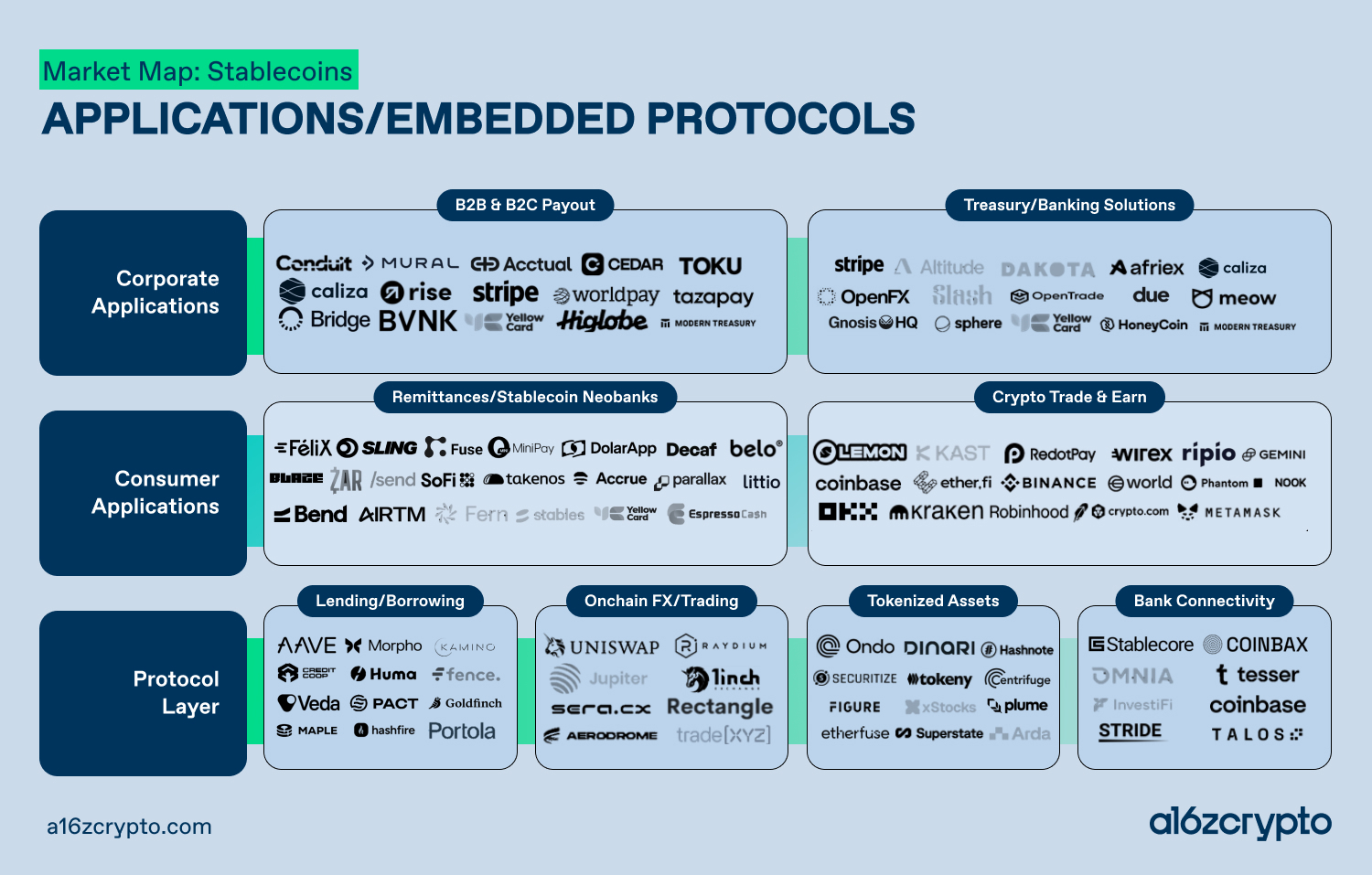
The second trend is stablecoin adoption in corporate banking. In markets where dollar-based banking infrastructure is limited, unreliable, or prohibitively expensive—such as much of Latin America, Sub-Saharan Africa, and Southeast Asia—stablecoins offer enterprises unprecedented access to dollar settlement for critical use cases: supplier payments, global receivables, and treasury management.
At its core, this demand isn’t about crypto concepts—it’s about efficient, accessible dollar assets. Where local financial systems are weak and currencies volatile, businesses adopt stablecoins out of pragmatic operational necessity.
A more consequential long-term shift at the application layer stems from value-added ecosystems built atop foundational account services.
Access to dollar-denominated assets is merely the starting point. Whether a small business owner in Lagos, a freelancer in Buenos Aires, or a saver in Jakarta—anyone holding stable, stablecoin-denominated assets gains access to financial services previously out of reach: credit, investment, wealth management, insurance, and more.
Internet banks and super-apps that first capture users’ account onboarding will leverage their customer base to cross-sell full suites of financial products—reaching massive underserved markets long neglected by traditional finance. Payments are just the onboarding gateway; credit and investment are where commercial value truly resides.
Credit Markets: A Profound Secondary Transformation
If payments are step one, credit is likely step two—and arguably the more important one.
The prevailing narrative around stablecoin growth often focuses narrowly on scaled-up, traditional banking models: tokenized dollars, wallet storage, instant settlement, and on-demand redemption. Yet this view overlooks the most significant implication of mass-scale stablecoin adoption: when trillions of dollars in stablecoins circulate, demand for productive investment of idle capital will explode. Enterprises holding stablecoins will seek yield; protocols will require liquidity; and end users will inevitably generate borrowing demand.
A wholly new onchain credit market is inevitable—not the highly speculative, crypto-asset-collateralized lending of early DeFi cycles, but a return to banking fundamentals: facilitating capital formation, enabling loans backed by real-world assets and receivables, and providing working capital to enterprises in regions lacking robust local banking infrastructure.
The era of unbridled DeFi growth is ending. The industry is entering a more stable, mature phase of onchain finance.
This evolution closely mirrors the trajectory of private credit over the past decade. Under regulatory pressure, traditional banks gradually retreated from certain lending segments—creating openings swiftly filled by private credit funds. What began as a niche alternative asset class has grown into a multi-trillion-dollar sector capable of directly competing with syndicated loans. Onchain credit follows the same logic: capital accumulation and lending outside traditional banking, serving borrowers overlooked by conventional finance. The key difference lies in onchain infrastructure’s inherent advantages: openness, programmability, and global reach—capabilities private credit cannot replicate.
Traditional credit institutions are already watching this space closely. Those that proactively position themselves—through strategic investments, acquisitions, and integrations—will shape the future architecture of onchain capital markets.
Dollar Dominance and Geopolitics
Behind this market map lies a story larger than fintech—one unfolding along two parallel dimensions.
For individuals and enterprises, this new financial system delivers tangible economic empowerment: effective hedging against local currency depreciation, access to globally interoperable payment rails, and the ability to transact, save, and operate using the world’s most liquid currency—the U.S. dollar. Farmers in Sub-Saharan Africa, manufacturers in Southeast Asia, and small importers in Latin America can now hold, trade, and store dollars autonomously—without opening U.S. bank accounts or relying on traditional correspondent banking networks—shattering long-standing, privileged barriers to dollar access.
For the United States, stablecoins further entrench existing financial hegemony. For a century, dollar dominance rested on institutions like the IMF and World Bank, global correspondent banking networks, and bilateral agreements—granting the U.S. Treasury and Federal Reserve decisive influence over global finance. Stablecoins introduce a more direct channel: every wallet holding a U.S. dollar stablecoin becomes a new node in the dollar financial network, enabling low-cost, near-instant value settlement between any two points globally. The broader the stablecoin adoption, the stronger the network effects—and the deeper the dollar’s penetration into financially underserved regions.
This is stablecoins’ most profound strategic value: regulatory milestones like the GENIUS Act are not merely about governing a novel financial product. They represent a deliberate, long-term U.S. strategy—to reinforce the dollar’s centrality amid persistent challenges to its post-Bretton Woods dominance, leveraging stablecoin infrastructure as a foundational pillar.
Beyond Payments: Rebuilding Global Finance’s Foundation
The new foundational architecture of global finance remains under active construction—and its strategic significance extends far beyond payments.
This transformation represents a wholesale upgrade of the global financial system. The new onchain infrastructure is open, programmable, and natively interoperable—capable of reaching geographies, populations, and use cases never served by legacy systems. Its core value propositions include:
- Delivering stable dollar services to regions with underdeveloped financial infrastructure;
- Creating safe, yield-generating avenues for vast pools of idle capital;
- Extending inclusive credit to populations excluded from traditional finance;
- Enabling billions of people to participate in global capital markets for the first time—barrier-free.
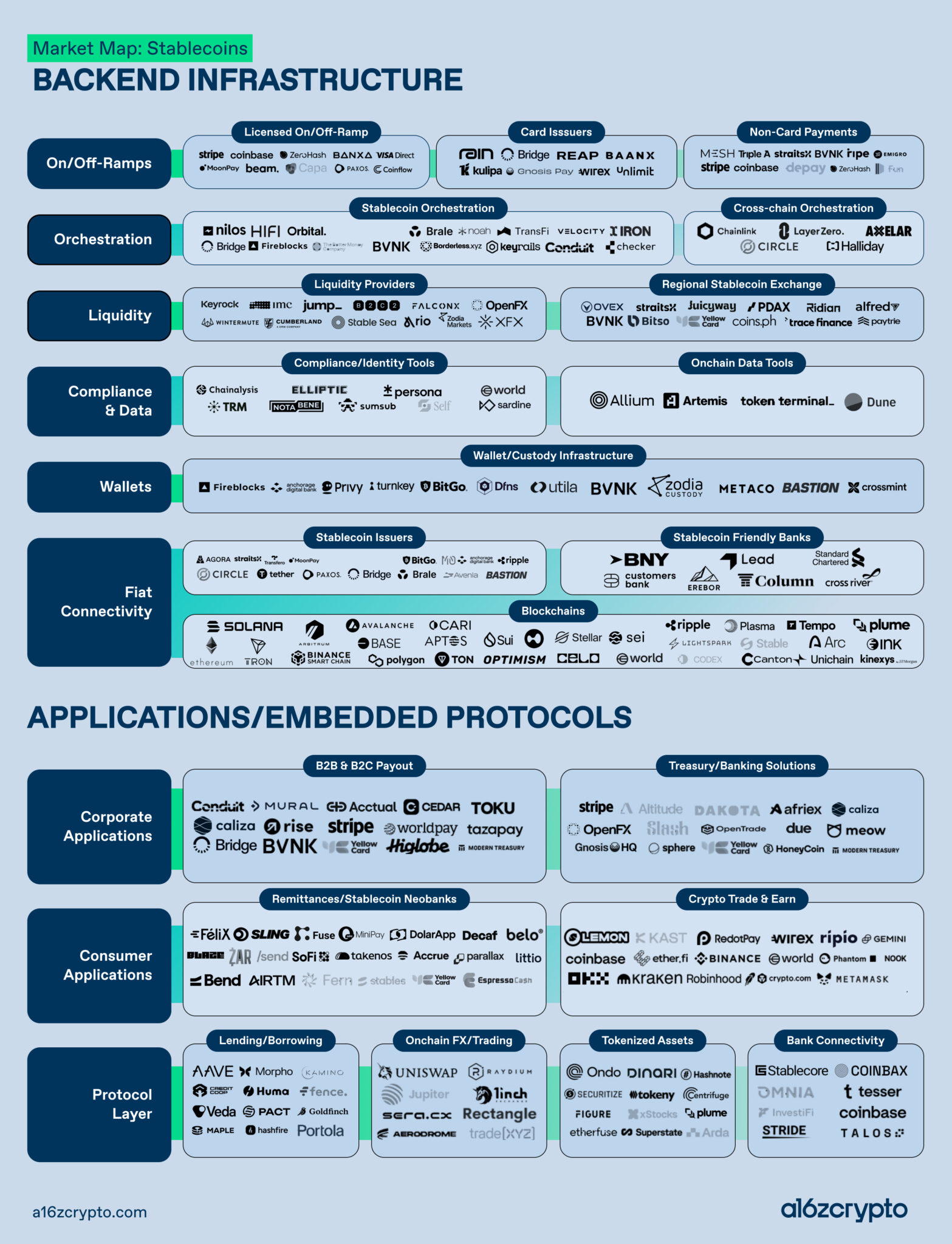
Today, companies building across each layer of this new financial value chain will define the global financial architecture of the next era—and shape the future of the global dollar economy.
Join TechFlow official community to stay tuned
Telegram:https://t.me/TechFlowDaily
X (Twitter):https://x.com/TechFlowPost
X (Twitter) EN:https://x.com/BlockFlow_News
 a16z
a16z