

In-Depth Analysis: Why Are Risk-Averse Funds Migrating En Masse to HTX’s “High-Yield Safe Haven” in 2026 Amid Frequent DeFi Collapses and Hidden Losses?
TechFlow Selected TechFlow Selected
In-Depth Analysis: Why Are Risk-Averse Funds Migrating En Masse to HTX’s “High-Yield Safe Haven” in 2026 Amid Frequent DeFi Collapses and Hidden Losses?
Bid farewell to error-prone, high-risk trial-and-error; instead, leverage reliable infrastructure to capture the certainty of time-based compounding—this may well be the ultimate wealth formula for the next cycle.
 Navigating Web3 tides with focused insights
As a long-term observer tracking cryptocurrency fund flows, in Q1 2026 we noticed an extremely counterintuitive trend: whales and retail investors—once fervently chanting “DeFi Summer”—are quietly withdrawing funds from on-chain protocols and migrating en masse to the wealth management sections of top centralized exchanges.
When we cut through the market’s noise and examine the raw data, a clear logical chain emerges: amid macroeconomic volatility and frequent black swan events, the market’s craving for “certainty” has historically eclipsed its blind pursuit of “high-risk, high-return” gains.

On-Chain Struggles: Black Swan Strikes and the “Silent Bleeding” of Blunt-Force Friction
To understand this massive capital migration, we must first confront the real challenges facing today’s on-chain environment. In 2026, the DeFi ecosystem is under dual pressure—from high-dimensional security crises and underlying frictional costs.
First, systemic risks are erupting en masse. According to Hacken’s Q1 2026 Security & Compliance Report, total Web3 losses reached $482.6 million. The recent Kelp DAO cross-chain bridge vulnerability, for instance, caused nearly $300 million in assets to vanish instantly, rendering multiple target chains simultaneously inoperable.
This cascading collapse across foundational protocols has made markets realize: even the smartest capital can be wiped out overnight within complex, nested smart contracts.
Yet more devastating for ordinary investors than outright hacks is the omnipresent “silent bleeding.” On Ethereum and other mainnets, there exists a harsh reality often overlooked by retail users: gas fees are paid for the computational effort required to *attempt* changing the blockchain state—not as a deposit guaranteeing transaction success. This means that whether your compounding staking, yield farming, or even a failed trade due to insufficient slippage ultimately succeeds or not, once the network executes the computation, the high fee is irreversibly deducted.
When high-friction on-chain operations no longer offer a rational risk-reward ratio, nimble capital has no choice but to seek its next safe harbor—one that balances both security and yield.
Rebuilding Trust: Data-Backed Assurance and Unshakeable Infrastructure
In the asset management space, trust has never been built on marketing slogans—but on historical resilience and cold, hard cryptographic data. In this wave of capital repatriation, HTX has emerged as the most gravitationally compelling destination precisely because it delivers rigorously on the promise of “security.”
Across crypto history, we’ve witnessed countless platforms collapse spectacularly. Yet HTX—managing massive asset volumes—has delivered an exceptionally rare record: thirteen years of stable operations and thirty consecutive months with zero security incidents. This bull-and-bear-tested confidence stems from its institutional-grade, multi-layered security architecture: through meticulously enforced physical and logical segregation of assets, HTX eliminates at the root the systemic risk of commingling platform operational funds with user assets.
Even more compelling is its institutionalized transparency. Under the industry’s “Don’t Trust, Verify” consensus, HTX has pushed asset transparency to its extreme. In 2026, transparency is no longer a competitive advantage—it’s existential. As of April 2026, HTX has published Merkle-tree-based Proof of Reserves (PoR) on a routine, monthly basis for an unprecedented 42 consecutive months.
According to its latest April reserve audit, HTX maintains reserve ratios of 100% or higher across all major assets: BTC at 101%, ETH at 100%, and TRX at 108%. This extreme transparency serves as a powerful stabilizer, calming the risk-averse sentiment of large institutional capital amid current market turbulence.
Yield’s Dimensional Strike: A Wealth Matrix Spanning Retail Inclusion to Whale Defense
Once capital safety is assured, competitiveness inevitably reverts to finance’s core tenet: return on investment. Against a backdrop where most platforms are cutting back on yield subsidies, HTX Earn’s performance stands out dramatically.
1. The “Watershed” Phenomenon in Stablecoin Yields
Let’s compare the market’s most critical safe-haven asset: USDT. While traditional financial USD deposits offer only 2–4.2% APY—and impose early-withdrawal penalties—crypto’s demand deposit products have likewise entered a “conservative phase” of yield.
Recently, prominent crypto KOL Tonys Tucker (@Baby__BTC) published a comprehensive benchmark analysis on X (formerly Twitter), drawing on official April 2026 data from leading exchanges. His chart offers a clear horizontal comparison of demand-deposit yields across top CEXs—visually revealing the industry’s current “watershed” in yield distribution.
Per his calculations, the same USDT deposit yields markedly tiered returns across different platforms:
- Industry Norm: At some mainstream platforms, USDT demand-deposit yields hover around 3.8% for small amounts (e.g., ≤200 USDT), dropping to roughly 1% beyond that threshold. Others maintain a consistently conservative base rate near 1.05%. For retail users, finding a CEX offering both high liquidity and high yield remains exceptionally difficult.
- HTX’s Inclusive Counter-Cycle Move: By contrast, HTX Earn demonstrated exceptional “inclusivity” in this benchmark—emerging as a standout in the stablecoin yield segment. For the broad sub-$500 USDT range, HTX boldly offered a 10% APY demand-deposit yield—defying the broader market trend. Even above $500, it guarantees a flat 2.5% APY with no upper limit. For USDC, HTX offers a generous, flat 5% APY—no tiers, no conditions.
Moreover, for the recently launched, BitGo-backed compliant stablecoin USD1, HTX topped the leaderboard in this benchmark with a tiered subsidy yielding up to 15% APY (for the $0–$500 range), injecting strong liquidity magnetism into the market.
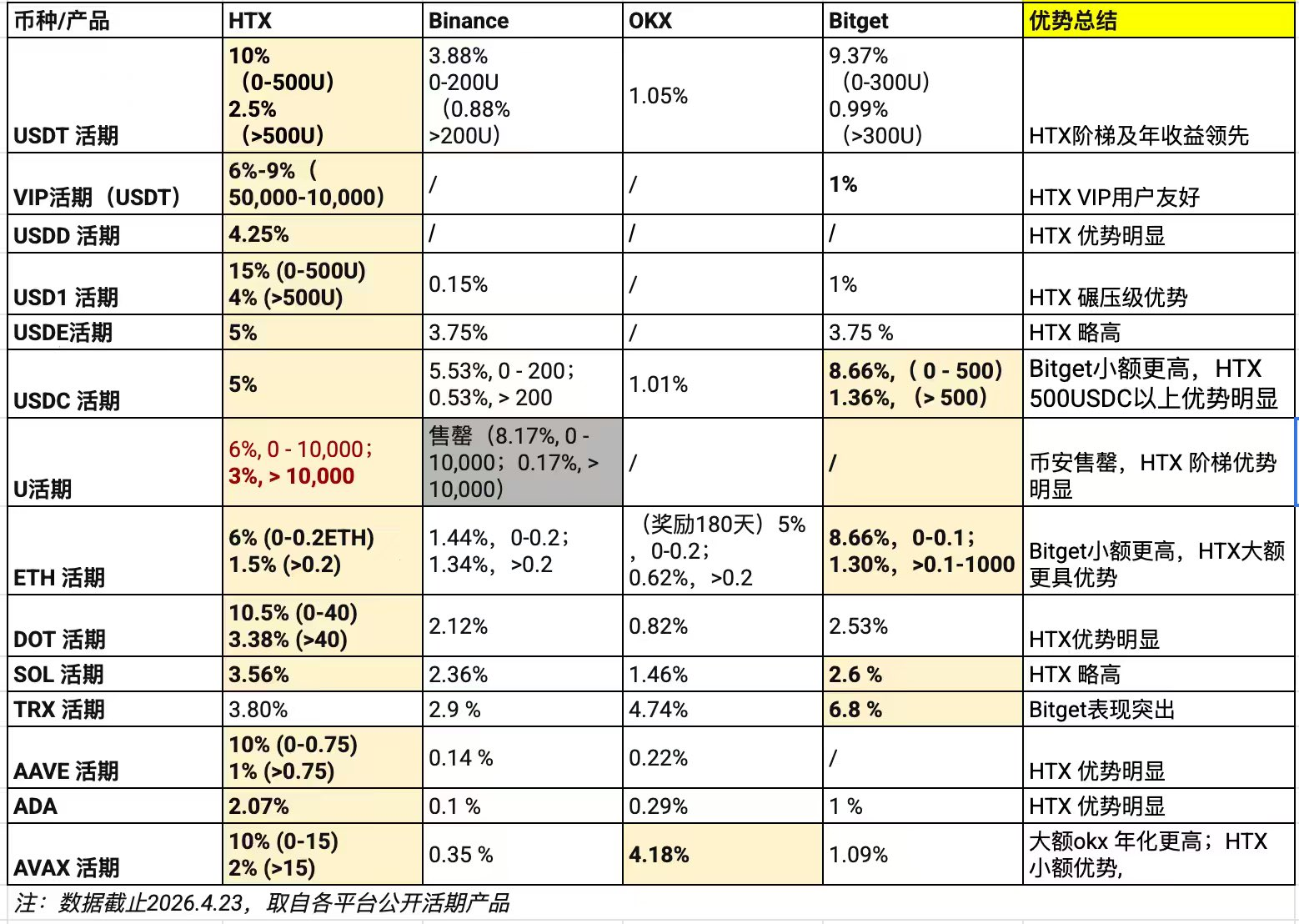
In this widespread “rate-cutting” cycle, HTX chose to deploy real cash subsidies—paired with a “New User Exclusive Bonus up to 100% APY”—to build a wealth haven that combines liquidity, certainty, and high yield for risk-averse capital.
2. “VIP Demand Deposit” Tailored for High-Net-Worth Individuals
For high-net-worth clients withdrawing from DeFi—those managing hundreds of thousands or millions of dollars—tens or hundreds of USDT in subsidies simply won’t suffice. To address this, HTX Earn launched its precision-targeted “VIP Demand Deposit” product.
Users holding Prime 5 status or higher gain access to a single-user subscription cap of up to $100,000 USDT, with yields dynamically scaling alongside their Prime level—reaching a maximum of 9% APY on USDT demand deposits. In an industry where base rates have fallen below 3%, this is a bespoke defensive shield engineered exclusively for whale-tier capital.

3. Ecosystem Asset Empowerment & Value-Chain Compound Yield
Beyond stablecoins, HTX Earn has also built formidable moats around mainstream value-chain assets.
For example, ETH demand deposits yield up to 6% APY (for holdings ≤0.2 ETH); AAVE and AVAX yield up to 10% APY. Most innovatively, HTX introduced a “one-fish, multiple-benefits” mechanism for its native $HTX token: participating in $HTX demand deposits earns a 4% base APY, while automatically granting passive eligibility for airdrops from Launchpool’s hottest new projects—in the background, without manual intervention.
This “yield-generating base position + zero-cost IDO participation” model represents an exceptionally rare low-risk path to outsized returns amid current market volatility.
Experience Redefined: Eliminating Liquidity Anxiety with “Auto-Earn”
If high yield is the hook that attracts capital, what truly makes capital stick is product-level usability.
Traditional CEX wealth management suffers from one persistent pain point: once funds are locked into a yield product, liquidity vanishes. During a sudden overnight market shock, users frantically click “redeem”—only to miss optimal trading windows. Static yield and instantaneous trading opportunities have always seemed like opposing forces.
HTX’s “Auto-Earn” feature delivers an elegant solution to this industry-wide challenge. Once enabled, the system automatically purchases into demand-deposit products every hour—using idle spot-account balances—and calculates interest on an hourly basis, rolling it seamlessly into principal to maximize true compound growth.
But that’s not the most refined part. What gives professional traders genuine peace of mind is that funds held in Auto-Earn are automatically and instantly redeemed to fulfill live spot orders. When a trading opportunity arises, users simply click “buy” or “sell” directly on the order book—the system completes the yield-product redemption and spot settlement in microseconds—zero delay, zero manual withdrawal, zero operational friction.
It genuinely erases the liquidity barrier between yield generation and active trading—so every dollar compounds relentlessly until the very last millisecond before it fires as a bullet into the market.
Conclusion: Aligning With Natural Law, Embracing Sustainable Wealth Growth
Looking back at the crypto market since early 2026, we see a profound cognitive awakening. In the perilous, shadowy forest of on-chain infrastructure, the era of purely gambling for outsized returns is ending. In its place emerges a rational capital return—to “defensive-offensive strategies” and stable compounding.
In this trillion-dollar capital restructuring, HTX—backed by thirteen years of security infrastructure, an aggressively precise high-yield subsidy matrix, and experience innovations that eliminate all operational friction—has transcended its role as a mere trading platform. It is now becoming the world’s most resilient asset management safe harbor for digital asset investors navigating turbulent cycles.
Leaving behind trial-and-error fraught with friction and risk—and instead capturing the certainty of time-compounded returns via reliable infrastructure—may well be the ultimate wealth code for the next cycle.
Join TechFlow official community to stay tuned
Telegram:https://t.me/TechFlowDaily
X (Twitter):https://x.com/TechFlowPost
X (Twitter) EN:https://x.com/BlockFlow_News
















