Prediction markets cannot exist without insider trading, yet insider trading is killing them.
TechFlow Selected TechFlow Selected
Prediction markets cannot exist without insider trading, yet insider trading is killing them.
Prediction markets are stuck in a paradox: the more accurate they are, the more they resemble a scam—an unsolvable bug.
 Navigating Web3 tides with focused insights
Author: Nic Carter
Translated and edited by TechFlow
TechFlow Intro: A U.S. Special Forces soldier earned $400,000 on Polymarket using classified information—the latest in a string of scandals. Nic Carter argues that prediction markets are trapped in a vicious cycle: they rely on insider trading to generate accurate prices, yet this very practice erodes retail traders’ confidence, making them abandon the market. This contradiction determines whether prediction markets can survive long-term.
As I wrote in February this year, prediction markets suffer from severe insider trading problems—and this is no accident. It creates a critical failure mode:
The social value of prediction markets stems precisely from their use of monetary incentives to coax insiders into revealing confidential information—but over time, this undermines retail traders’ confidence in the market.
Two days ago, the largest scandal to date erupted: the U.S. Department of Justice charged Master Sergeant Gannon Ken Van Dyke of the Special Forces with improper trading using classified information. He earned $400,000 on Polymarket ahead of the Maduro raid operation. He was no ordinary soldier but a senior Green Beret responsible for special operations planning and execution.
To put it plainly: although many have called for leniency—citing the widespread (and legal) insider trading among U.S. congressmen—he should still go to prison. His trading activity may have leaked intelligence about the raid to Venezuelans, raising serious ethical and legal concerns. While Venezuelans appear not to have noticed, the government cannot accept a precedent where elite combat personnel disclose operational details via market activity for personal gain. I sympathize with Van Dyke, but he clearly violated both the law and his sworn duty to protect classified information.
This is merely the latest in a series of real or alleged insider trading scandals plaguing prediction markets. Earlier, Israel arrested two reservists for trading on Polymarket using military intelligence. Markets concerning the start of war with Iran, ceasefire agreements, the assassination of Ayatollah Khamenei, and Biden’s pardon order have also drawn suspicion—though no arrests have yet been made. Kalshi and Polymarket have likewise flagged and suspended accounts trading on markets where users held a personal stake—for example, three congressional candidates who placed bets on their own election markets.
You might assume these issues would fade as more people realize that trading on non-public information is illegal not only in securities markets but also in prediction markets. Yet I believe the problem runs deeper.
Prediction markets rest on the premise that they are informationally efficient—because they reward informed insiders.
In other words, prediction markets are “good” precisely because they attract large numbers of uninformed retail traders, whose participation creates economic incentives for insiders to reveal private information. (This concept—that uninformed retail traders create incentives for informed insiders to participate—is well-established in financial literature; a recent paper extends it explicitly to prediction markets.) Prediction markets can then credibly tout their social utility, since they genuinely deliver better, timelier signals than alternative platforms (experts, polls, etc.). Kalshi and Polymarket know this—but hesitate to state it outright. Still, they strongly imply it in their marketing!
Kalshi CEO Tarek Mansour stated explicitly on the Sourcery podcast: “There’s no insider trading in commodity markets. In fact, it’s all insider trading”—a… highly creative interpretation of the law. He added:
“I think there’s some non-public information that traders shouldn’t be able to trade on—but I think we’re currently restricting it a bit too much.”
Kalshi has used slogans like “Trade anything” and “Everyone is an expert in something,” both implying that ordinary people can monetize privileged information if they happen to possess it.
Polymarket CEO Shayne Coplan had the following exchange with CBS last year:
Anderson Cooper: “But prediction markets do rely on certain people having insider information.”
Shayne Coplan: “Mm-hmm. Yes. I think it’s good that people have an edge in the market. Obviously, you need to govern them—you need very clear, strict boundaries, especially around ethics, and we spend a lot of time on that. But to some extent, it’s unavoidable—and there’s a lot of benefit to be gained from it. You know, people adapt.”
Shayne has also described prediction markets as “the most accurate thing humans currently have—until someone invents some kind of super crystal ball.” Some of that accuracy comes directly from insiders.
Vlad Tenev, CEO of Robinhood (which partners with Kalshi), said:
“Prediction markets actually let you get news faster—in some cases, even before it happens. I think they truly hold enormous economic value.”
Economist Robin Hanson—widely regarded as the “father” of prediction markets—embraces this view outright and has offered an extended defense of insider trading in prediction markets. In 2024, he stated:
“If the purpose of (prediction) markets is to obtain accurate price information, then you certainly want to allow insiders to trade—even if that makes others feel it’s unfair and reluctant to bet—because it improves price accuracy. That’s the priority.”
I must note that both Kalshi and Polymarket maintain anti-insider-trading policies. Kalshi, regulated by the CFTC, explicitly prohibits trading based on material non-public information (MNPI) and conducts market surveillance. When I wrote my earlier blog post in February, I observed that Polymarket lacked explicit sanctions against insider trading—but in March, it updated its rulebook, adding detailed prohibitions against the following types of trades:
- Trading based on stolen classified information (e.g., if you’re a soldier, operational plans belong to the government—not to you)
- Trading based on information illegally shared with you by an insider
- Trading on any contract whose outcome you can influence
The point of this section isn’t to blame Kalshi or Polymarket—or their leadership—for suggesting traders enjoy informational advantages. I believe their policies (updated as of March 2026) are sufficiently clear. Rather, I aim to highlight the fundamental contradiction plaguing these markets:
Prediction markets depend on informed traders to produce accurate prices—and also depend on uninformed traders to generate the economic incentives that draw informed trading flows. This creates tension:
- If insider trading rules are too permissive, uninformed traders may exit, feeling the market is “rigged”
- If insider trading rules are overly restrictive, markets risk excluding their most valuable information sources
Thus, a trade-off exists between informational efficiency and perceived fairness. Here’s a visual representation of the same idea:
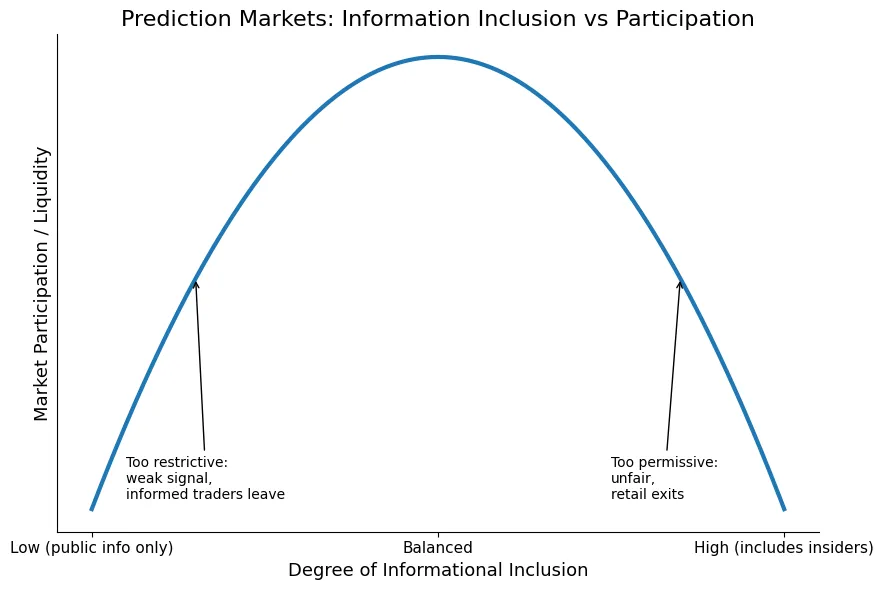
Chart: Trade-off curve between informational efficiency and perceived fairness
We therefore face several distinct failure modes:
Too many sharks, eating all the fish
Insider trading standards are too lax: markets become highly informationally efficient, but retail traders clearly perceive the market as “manipulated”—always pitted against insiders. Retail traders depart, liquidity dries up. This is the failure mode I previously described. This is where we stand today—but I believe we’ll soon rebound toward the opposite extreme.
No sharks, no edge
This is the other end of the spectrum. Insider trading is tightly regulated on the platform, with real-time market surveillance and robust regulatory reporting—causing informed trading flows to stay away. These markets thus yield less socially valuable information, becoming mere sentiment aggregators rather than generators of “news before the news.” As a result, platforms struggle to market themselves effectively.
The existential question is whether a “sweet spot” exists—one that maximizes liquidity, convinces retail traders the market feels “fair enough,” and still rewards informed traders for contributing information. The chart suggests such a point may exist—but reality is messier.
My February forecast remains valid. As I wrote then:
“Significant risk persists that insider trading scandals will convince retail traders the market is rigged—causing them to abandon the platform. I predict a string of insider trading incidents this year, compelling platforms to significantly strengthen market surveillance—and driving Polymarket, in particular, away from anonymity.”
I expect Polymarket to eliminate the ability to trade without KYC (currently permitted on non-U.S. platforms) and to intensify flagging of suspicious trading activity. There will be numerous criminal cases involving stolen insider information—but the temptation will remain. Though platforms won’t admit it, there truly is a “socially optimal” volume of insider trading. Can they calibrate it optimally? Will regulators allow them to?
Notably, not all informed traders are insiders. You can become informed by gathering and acting upon publicly available information. Still, a subset of informed traders does indeed misappropriate information.
Join TechFlow official community to stay tuned
Telegram:https://t.me/TechFlowDaily
X (Twitter):https://x.com/TechFlowPost
X (Twitter) EN:https://x.com/BlockFlow_News
 @nic_carter