Trader Taiki Maeda’s Self-Reflection: “Be Greedy When Others Are Fearful”—BTC Is About to Enter an Unbelievable Rally
TechFlow Selected TechFlow Selected
Trader Taiki Maeda’s Self-Reflection: “Be Greedy When Others Are Fearful”—BTC Is About to Enter an Unbelievable Rally
Extreme fear is often the best buying opportunity; Saylor’s monthly purchases are reshaping Bitcoin’s pricing power, and the most doubted rally may have already begun quietly.
 Navigating Web3 tides with focused insights
Compiled & Translated by TechFlow
Host: Taiki Maeda
Podcast Source: Taiki Maeda
Original Title: Bitcoin: The Beginning of The Most Hated Rally
Release Date: April 16, 2026
Key Takeaways
Over the past month, I’ve been aggressively accumulating BTC, as I believe the bottom has already formed. In this video, I’ll explain in detail why BTC has broken out of its traditional four-year cycle and is now climbing the “Wall of Worry”—kicking off a rally that almost no one believes in.

Highlights of Key Insights
On Sentiment & Cycles: A Rally Under Scrutiny
- “I believe we’re at the beginning of the most questioned rally in history—people still don’t believe it, and that’s precisely where I stand to make the most money.”
- “When everyone is gripped by fear, they’ve either already shorted or are fully cashed out—so who’s left to sell?”
- “In April this year, we witnessed the lowest Fear & Greed Index reading in the entire history of crypto. Markets are more fearful today than during the FTX collapse, Three Arrows Capital implosion, or even the pandemic—and yet Bitcoin sits around $74,000.”
- “Broadly speaking, I believe the biggest profits are made at major market inflection points—at the bottom, be aggressive; at the top, be decisive in selling.”
On Identifying Tops & Bottoms: The Marginal Buyer Framework
- “The core framework for timing entries and exits boils down to three questions: What does the current positioning look like? Who else is left to sell? Who else is left to buy? Price is always determined by marginal buyers and marginal sellers.”
- “Markets are forward-looking. The consensus that ‘the bottom will arrive in Q4’ has already circulated for six to seven months. If everyone expects the bottom in Q4, then the actual bottom should occur before Q4.”
On STRC (Stretch) & Saylor: The Perpetual Buy-Side Engine
- “When Stretch demand surges after Bitcoin hits $60,000—not during freefall—it signals indirectly that Bitcoin is fairly valued, or even undervalued, at current levels.”
- “Separate the message from the messenger. People dislike Stretch largely because they dislike Saylor himself—but bringing personal bias into investment decisions is unwise.”
- “Saylor, in essence, is telling us he’ll predictably deploy billions of dollars into Bitcoin each month during the first two weeks.”
On Strategy & Bias: Avoiding the Beta Trap
- “Every time I try to chase Bitcoin’s beta elsewhere—by buying Ethereum or various DeFi tokens—I end up being the beta. I’m the one getting rekt.”
- “As traders, we aren’t hired to forecast whether Saylor will blow up two years from now. We’re hired to assess the current price and ask ourselves: Will it be higher or lower in two months? Six months? Then weigh risk vs. reward—and place our bet.”
- “Altcoin parabolic rallies typically emerge mid-to-late bull markets. If my thesis is correct—that Bitcoin has just bottomed—then we’re still in the very early stages of the next bull run. Focusing on low-risk assets first, then rotating gradually, is the right posture.”
On Reflexivity: Price Shapes Fundamentals
- “When Bitcoin rises, people call it ‘digital gold’ and a ‘store of value.’ When it falls, quantum computing suddenly becomes an existential threat. That’s how markets work.”
- “When Bitcoin drops to $60,000, quantum threats magically resurface. I guarantee: once the price starts rising again, developers will propose quantum solutions—and everyone will cheer, ‘Quantum risk is solved—we can buy again!’”
- “Don’t forget the power of hope. Right now, people are deeply discouraged. Everyone needs a green candle to heal. I hope the market rallies soon. Always reflect on reflexivity—never forget Bitcoin *can* go up, and historically, it *has*, many times.”
Be Greedy When Others Are Fearful
Taiki:
Over the past month, I’ve been actively buying Bitcoin, believing the bottom has formed. In this episode, I’ll clarify why I think Bitcoin has broken its four-year cycle—and why we’re at the start of the most doubted rally in history.
Warren Buffett famously said: “Be fearful when others are greedy, and greedy when others are fearful.” Easy to say, hard to do. Open social media and you’ll see everyone insisting Bitcoin will crash to $55,000 in Q4—so hold cash and wait. Then, when everything’s rallying, they declare, “Q4 altcoin season is locked in.” Cutting through this noise is extremely difficult.
First, let’s consider the word “crisis.” In Chinese, it consists of two characters: danger and opportunity. As a Japanese person, I find this a powerful reminder for investors and traders—when everyone’s fully leveraged long in a bull market, you sense danger; when everyone feels danger, you sniff opportunity. Because when fear dominates, people have either already shorted—or gone fully to cash—who remains to sell?

A useful lens is the monthly Fear & Greed Index. It calculates sentiment at the start of each month. This April, we saw the lowest reading in crypto history. Put simply: people are more fearful now than during the FTX collapse, Three Arrows Capital’s meltdown, Luna’s implosion, or even the pandemic—yet Bitcoin trades near $74,000. Sentiment is terrible—people are losing money, talking about quantum computing wiping Bitcoin out, etc. But is it truly that bad? I don’t think so.
Certainly, the bears will argue: “This time is different—the index doesn’t account for 2026’s unique conditions. It doesn’t grasp quantum risk, nor the four-year cycle, nor the entrenched narrative that ‘Q4 guarantees the bottom.’” Yet I believe the index already incorporates volatility, price action, and sentiment—all those negative crypto narratives are baked into the data. Of course, I could be wrong—like the Japanese soldier who fought on in the jungle for 20 years after WWII ended, perhaps AI stocks are wiser than crypto. But broadly, I believe the biggest profits come at major market turning points—aggressive at bottoms, decisive at tops.
I’m not claiming to be an exceptional trader, but at least I examine data and ask myself: Who’s left to sell? Who’s left to buy? Historical data shows buying Bitcoin when the Fear & Greed Index dips below 20 doesn’t guarantee short-term gains—but over longer horizons, it’s often an excellent entry point. People love buying when euphoria peaks—seeing everyone on social media scream “it’s going up!” feels psychologically comfortable. Statistically, however, Bitcoin trends upward long-term, so extended holding periods usually yield profit. Still, I believe the past two months—Bitcoin under $70,000—may have offered an ideal accumulation window. I’m not urging you to leverage 5x. Rather, going long now likely yields far better returns than shorting. Shorting belongs at tops—not after a 50% drop.
How to Identify Market Tops & Bottoms?
Taiki:
To expand on my Bitcoin bottom thesis, let me start with my top-call logic—because the reasoning I used to predict the top in October 2025 is essentially the inverse of my current bottom thesis.
Simply put, Bitcoin behaves like a commodity: prices rise when buyers dominate, fall when sellers dominate. So ask yourself three core questions: What’s the current positioning? Who’s left to sell? Who’s left to buy? Price is always set by marginal buyers and marginal sellers. This framework applies to any asset: Should I buy this token? Short it? Go long?
Recall last September—just before the Q4 top—social media buzzed with “Q4 altcoin season is locked in.” Why? Because post-halving Q4 rallies occurred in both 2021 and 2017, so consensus declared it inevitable. People piled in—fully leveraged, Bitcoin to $250,000, Ethereum to $10,000—“all settled.” They lost money—but they’re not bearish now. At least, when I scroll Twitter, those most bullish at the top are now screaming Bitcoin will crash to $45,000.
The framework I used to call the top was monitoring DAT (Digital Asset Treasury) status. The prior bull runs—both 2021 and the latest—were driven by Michael Saylor and DAT. Their buying capacity is a key metric. What I observed then: Bitcoin kept hitting new highs, but MST’s MNAV kept collapsing—signaling Saylor might lack the capacity to sustain Bitcoin above $125,000. Sure, some claimed “this time is different,” but reality proved otherwise. Ethereum followed suit—Tom Lee poured massive capital, driving vertical rallies—until his ammunition ran dry, and marginal buyers vanished. His weekly ETH purchases dwindled, making shorting ETH rational. Fundamentally, a $600B market cap couldn’t hold without him. Once Tom Lee exhausted his funds—and stopped earning commissions promoting ETH—price had to fall. That was my top logic: DAT’s buying momentum fading, extreme long positioning, triggering mass liquidations from marginal sellers. Exactly what unfolded.
I believe the bottom is forming now—the exact opposite scenario. Then, DAT lost steam; now, DAT is regaining momentum—and I’m especially watching Saylor. Then, positioning was excessively long; now, consensus holds “Q4 guarantees the bottom.” Many are overweight cash—or even short. Countless Twitter users have abandoned crypto entirely—trading gold or oil instead, becoming geopolitical analysts with near-zero crypto exposure. In such reflexive assets, price appreciation fuels further buying—just as declines amplify selling pressure.
I view the “Q4 guaranteed bottom” narrative as dangerously premature. Markets are forward-looking—this idea has circulated for six to seven months. By Q1 and Q2, more people believed it—selling Bitcoin at losses just to buy cheaper eight months later. I’m not saying they’re necessarily wrong—I’m willing to be contrarian—but for Bitcoin to hit a new low in October requires two things: first, people must have positioned for it and waited to sell; second, massive selling pressure must push prices lower. Yet the Q4-bottom expectation is now so widespread that most who wanted to sell already have. To hit a new low in October, a major panic event would be needed—not impossible, but this analysis is overly simplistic. My assessment is clear: the risk-reward ratio for going long Bitcoin is exceptionally favorable right now. Saylor and STRC’s resurgence is a major development. I believe my “Wall of Worry” thesis—and my STRC call—are ahead of the curve. People remain skeptical—and that’s exactly where I stand to earn the most.
Latest Update on STRC Core Logic
Taiki:
Let me briefly recap my Stretch (STRC) thesis. Simply put, Saylor has largely abandoned the pure game of chasing MST or MNAV premiums—he now focuses entirely on Stretch. Core logic: He holds ~$55B+ in Bitcoin—roughly 3.7% of total supply—and wants to use it as collateral to issue credit products, layering risk management. Essentially, he’s borrowing to buy more Bitcoin. If successful—and Bitcoin surges—the APY paid to lenders gets covered by Bitcoin’s gains, creating long-term shareholder value: “increasing BTC per share.” I’m not a diehard MicroStrategy or Saylor fan—you’d have noticed that over the past six months. But this is a noteworthy development worth tracking.
He files an 8-K every Monday, disclosing prior week’s purchases. Just days ago, he announced buying $1B in Bitcoin via Stretch—this has been his sole consistent purchase source over recent months, making Stretch tracking a reliable proxy for Bitcoin’s trajectory.
Stretch works like this: When STRC trades above $100, he can issue new shares, sell them, and use proceeds to buy Bitcoin. If you hold Stretch, you’re effectively lending to Saylor—earning ~11.5% APY, paid monthly. Hold until the ex-dividend date (typically mid-month), and you’ll receive dividends—e.g., in April, holding until April 14 earned ~$0.96 per STRC share, translating to ~11.5% APR. When Stretch launched, rates were ~7–8%, but demand was minimal. Only recently—after Bitcoin stabilized near $60,000—did STRC gain real traction.
The target range is $100—not a fixed floor. Rates adjust dynamically: if STRC surges past $101 due to strong demand, he lowers the rate; if it drops to $99 or $95, he raises it. Setting 11.5% as the equilibrium point reflects solid market demand—a compelling product.
Before the March 13 ex-dividend date, he bought ~$1.5–1.6B in Bitcoin. No time-weighted rewards exist—just hold until the cutoff. Hence, STRC volume spikes parabolically before ex-dates, and Bitcoin’s marginal buying concentrates in these windows.
Before February’s ex-date, buying was modest. By March 12, purchases surged to ~$400M—and this repeats monthly. As long as STRC demand persists, Strategy keeps buying Bitcoin. As long as the market permits financing via this tool, Saylor will keep buying. Specifically: February’s ex-date fell on the last day, with relatively light buying. But by March 12, purchases exploded to ~$400M. This trend confirms: sustained STRC demand drives continued Bitcoin buying—and Saylor will keep purchasing as long as the market allows.
STRC Progress Snapshot: April
Taiki:
In March, I released a bullish video based on several observations: March’s trading volume showed clear parabolic growth while volatility declined—indicating strong interest in the 11.5% APY/APR and willingness to hold long-term; markets broadly viewed $60,000–$70,000 as Bitcoin’s fair-value range, supporting funding at these levels; and Saylor’s cash reserves are sufficient for two years of operations. Short-term, Stretch offers attractive returns—if investors accept its risks.
Based on this, I concluded the trend would persist. Saylor bought $1.56B in Bitcoin in March—I expected even more in April. If this continues, markets will need to reprice expectations for May, June, July, and beyond. Below $70,000, this remains an exceptionally attractive opportunity.
I also predicted broader institutional adoption of STRC. The newly launched on-chain Stretch project (which I’m mining myself) may accelerate this. Have these predictions held up? Yes.
First, BlackRock’s Preferred and Income Securities ETF. With ~$13B AUM, its benchmark index is set by ICE (Intercontinental Exchange). Notably, as of this week, Strategy Preferred Shares—including STRC, SDRK, and STRF—are the ETF’s second-largest holdings.
Even more striking: This position’s market value grew from ~$200M in March to $344M in April—while everyone on Twitter called it a Ponzi scheme destined for tears, BlackRock bought more. Of course, ICE and BlackRock endorsing Stretch doesn’t guarantee universal institutional adoption. BlackRock may buy now to sell later—so this isn’t necessarily sticky capital. Still, fixed-income ETF capital is generally stickier than random Solana “meme coin” holders.
Now, April’s volume data. This estimates the 10 trading days before the ex-dividend date—I approximate using bitcoin.co and 8-K filings, so figures are approximate. According to these sources, he bought ~$3B in Bitcoin in April, concentrated in a two-week window—perhaps explaining Bitcoin’s rise from ~$67,000 to ~$75,000. I identified this pattern: going long Bitcoin below $70,000 carries manageable risk. I still hold these long positions—watching how things unfold.
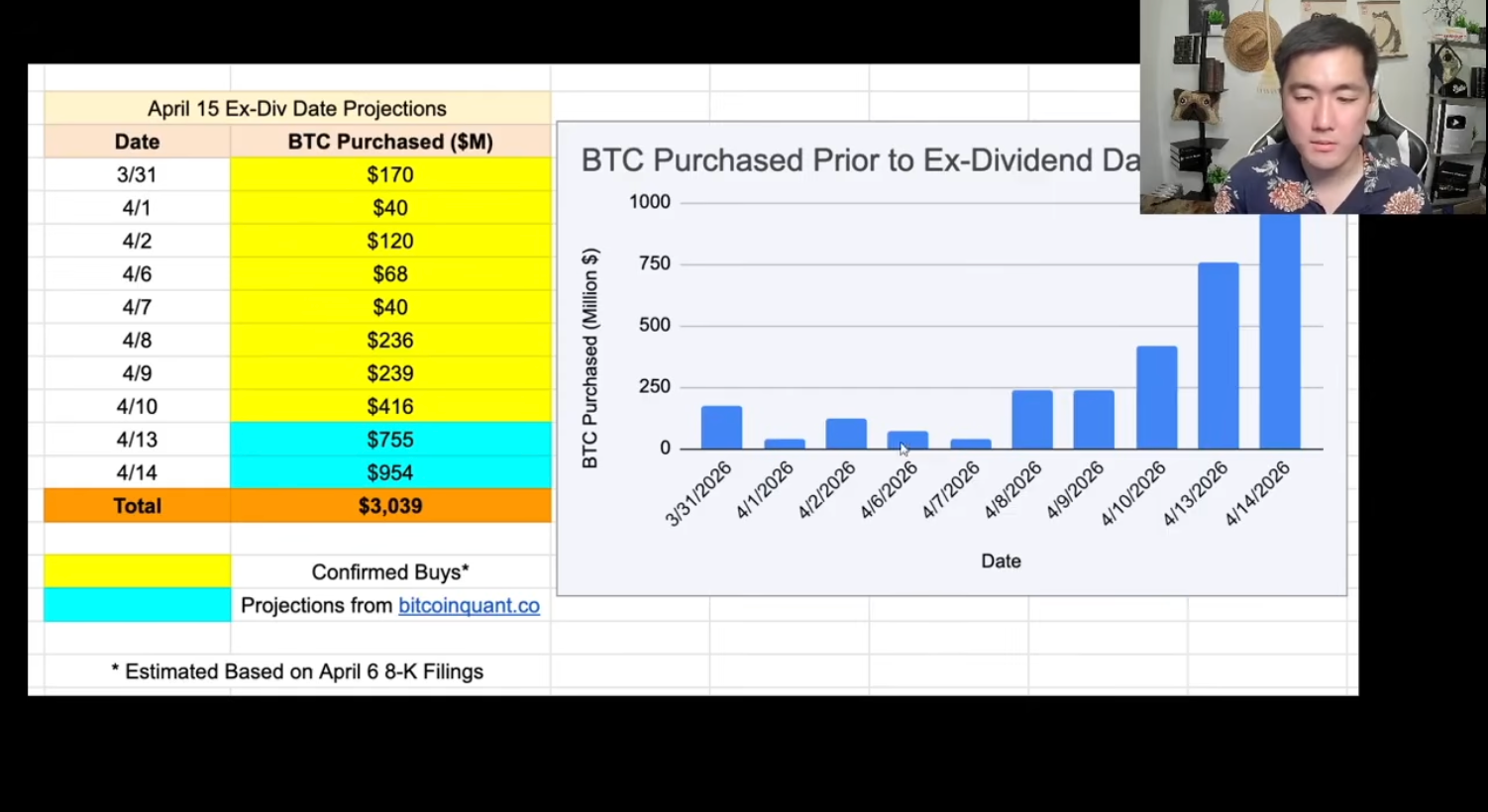
So, back to the question: He bought $1.6B in March, ~$3B in April. How much next month? In June, July, next year? I don’t know—but I lean toward >$1B, possibly $2B or $3B. My last video estimated ~$2B—yet reality exceeded that, so perhaps I should be more optimistic. That’s one reason I keep adding Bitcoin.
Markets are forward-looking—the “buy two weeks before ex-date” strategy won’t stay efficient forever. Markets will eventually price it in. But as long as this marginal buying persists, Bitcoin *will* rise—especially as equities hover near all-time highs and geopolitical tensions are already priced in.
Some claim Saylor is Bitcoin’s only buyer—indeed, it feels that way. But Saylor can’t print money. Markets decide whether he can buy. He only buys when markets buy his products. When Stretch demand surges *after* Bitcoin hits $60,000—not during freefall—it signals Bitcoin is fairly valued, or even undervalued, at current levels. I’m uncertain—but Bitcoin’s risk-reward profile looks favorable. As stated: Saylor can’t buy arbitrarily—he needs funding, and people only fund him when comfortable with Bitcoin’s future price.
What Are STRC’s Risks? How to Address These Concerns?
Taiki:
Now, let’s discuss risks—what many dislike most about Stretch.
First, leverage risk. He *is* borrowing to buy Bitcoin—a high-stakes bet. Critics warn: if the pile grows too large—$20B, $30B, $40B—it could pose systemic risk to Bitcoin. True—but if he borrows that much and buys that much, Bitcoin would likely be sky-high by then, given its reflexive nature. Stretch performs poorly during Bitcoin crashes—since it’s Bitcoin-collateralized. When Bitcoin rises, he can borrow more, and markets trust Stretch’s sustainability. Even the worst-case scenario—Saylor’s liquidation—requires Bitcoin first surging, then crashing. Logically possible, but in that scenario, I’d go long Bitcoin first.
Currently, he has ~22 months of dividend coverage. Even if Bitcoin stagnates, he can pay dividends for over a year. Of course, continued borrowing shortens this runway. Worst case: Bitcoin flatlines—if he keeps borrowing and buying without price response, cash reserves deplete, forcing Bitcoin sales, sub-1x-MNAV MSTR issuance, or Stretch dividend default. Possible—but not next month, not in three months. Earliest plausible timeline: six to eight months out—by then, clearer signals will show whether crypto truly collapses.
Another argument: If Stretch grows large enough, it becomes a systemic risk to crypto—so Ethereum is safer. My view: Saylor won’t sell these Bitcoins, so the risk isn’t as urgent as it sounds. People overanalyze his potential failure—partly because they *want* him to fail. He *is* cringey—posting AI-generated images daily. Honestly, it’s awkward—but that’s not a sound investment rationale.
Stretch actually gives him low-buy/high-sell flexibility. He borrows billions near $70,000 to buy Bitcoin. If Bitcoin hits $140,000, MST’s MNAV surges. Then he can issue MSTR shares publicly, cash out, repay Stretch debt, and deleverage. How would markets react? Positively—“Great job, Saylor! Bought at $70K, cashed out at $140K, boosted BTC per share.” He could also let Stretch trade above $101, lowering next issuance’s APY as markets accept lower rates. Or he could repay prior loans, cutting dividend costs. Saylor retains significant control. My read: He thinks Bitcoin at $74,000–$75,000 is cheap, wants to keep buying, and will eventually lower dividend rates. But I’m not his psychoanalyst—so I can’t be certain.
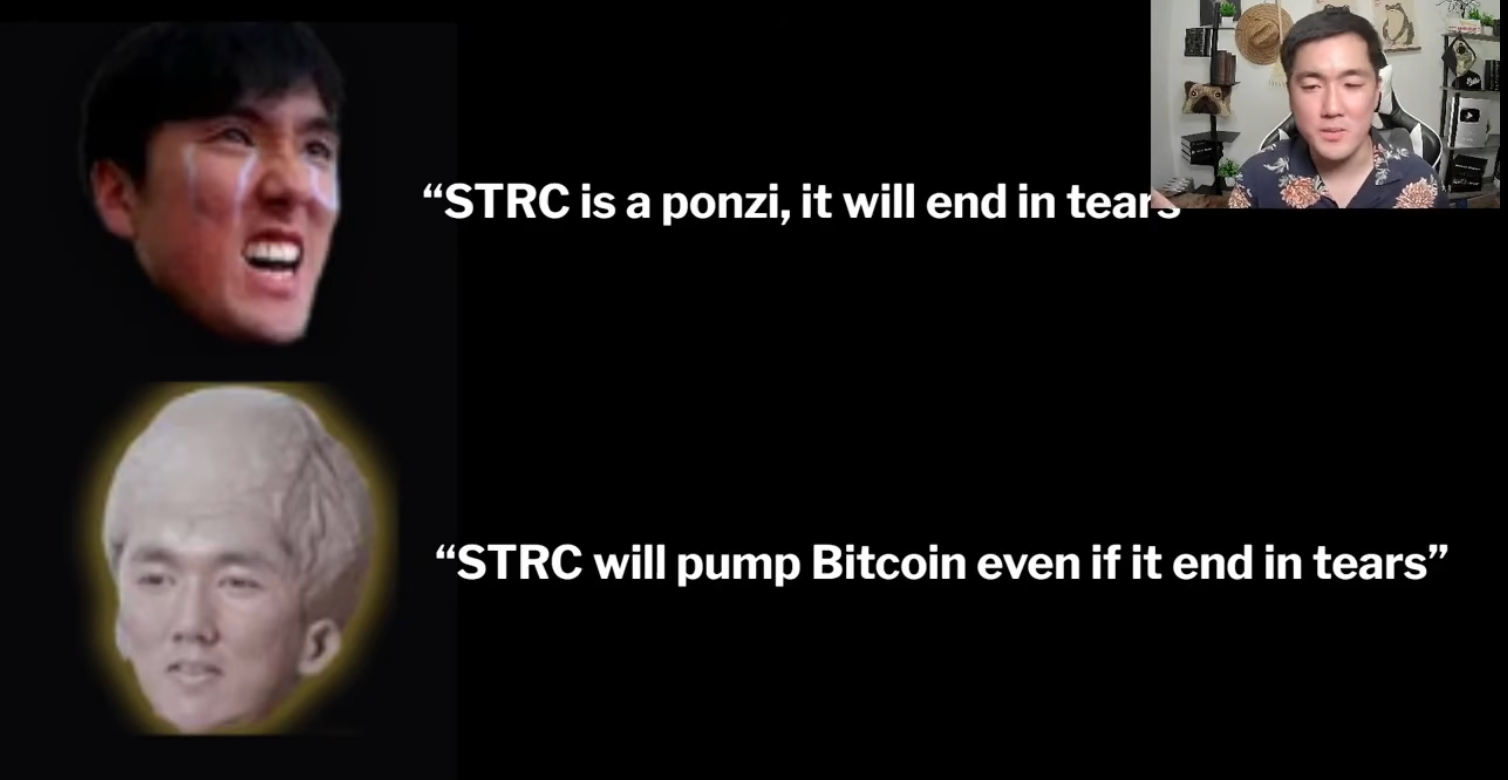
If Bitcoin soars to the moon in four years then crashes, someone will screenshot this to mock me. But as a trader, shorting Bitcoin now is less sensible than siding with Saylor—he’ll keep buying. Even if this structure implodes, Bitcoin must surge first—I want to ride that wave. If he successfully deleverages, the story ends well. Saylor claims Stretch could reach $1T market cap—I’m unsure, but who knows? In some parallel universe, Bitcoin hits $1M, and Stretch becomes a 9%-yield Bitcoin-backed product in every ETF.
On “Ethereum is safer”: Saylor holds ~3.7% of Bitcoin supply, while Tom Lee bought ~4% of Ethereum supply in under a year. If concentration risk worries you, Tom Lee poses a greater threat to Ethereum than Saylor does to Bitcoin—despite lacking Saylor’s leverage dimension. And if Stretch grows, Tom Lee will inevitably launch a similar product—Ethereum rises, Kyle Samani does the same for Solana—and everyone loads up for 2027, then crashes. Poetic, really. I hope I spot the top again. Tom Lee just hit 4% ETH ownership, earning 500,000 Bitmine shares—worth ~$10M at current prices.
Separate information from the messenger. People dislike Stretch mainly because they dislike Saylor. But injecting personal bias into investment decisions is unwise. I’m not a diehard MSTR fan—I score ~100 IQ, and I can’t convince myself to buy MSTR. I just go long Bitcoin directly. But you *must* separate the message from the messenger.
Saylor, in essence, tells us he’ll predictably deploy billions into Bitcoin each month during the first two weeks. If this happened with Ethereum, people would cheer. It’s only controversial because it’s Saylor.
The past seven months have been brutal for crypto holders—we’ve forgotten Bitcoin *can* rise. Consider this: What if Bitcoin *does* rise? It’s possible—and has happened repeatedly. Check Bitcoin’s long-term chart. Everyone debates Q1 vs. Q2 vs. “Q4 guaranteed bottom”—but Bitcoin is a strong asset. I believe you should consider buying below $70,000. Those obsessing over Q4 may witness the most doubted rally in history. Markets climb the Wall of Worry—equities are already at all-time highs, yet everyone fears war. Markets are forward-looking: if everyone expects Q4’s bottom, the bottom should arrive *before* Q4.
My Strategy & Positioning
Taiki:
Let me share my plan and positioning. In my last video, I mentioned holding Hype, Bitcoin, and cash for opportunistic buying during dips. In this recent drop, I bought Hype—but didn’t add more. Instead, I aggressively accumulated Bitcoin—both spot and futures. My position is heavy—I hope not liquidated, though it’s possible. I’m also mining the on-chain Stretch project—more on that shortly. If markets surge, I’ll likely hold spot positions and consider shorting Solana.
My Solana short thesis mirrors my prior Ethereum short: L1 narratives are dead, FTX legacy token unlocks continue for years, and “meme coin culture” is exhausted—so I’m broadly bearish. I haven’t finalized this decision yet—I’m currently bullish.
Last cycle, I went long altcoins, assuming “BTC up → alts up.” Reality: most alts are garbage—too many, too diluted. Last cycle, even “cycle stars” like Solana only moved *after* Bitcoin doubled from its bottom—BTC bottomed at $15,000–$16,000, then rallied on ETF expectations, *then* alts followed. So I’m focused on Bitcoin now. If I want amplified Bitcoin exposure, I’ll add leverage—not buy Ethereum or random DeFi tokens as beta. Every time I do, *I become* the beta—getting rekt.
I favor Bitcoin and Hype. Hyperliquid’s logic feels clear, so I hold it. If Bitcoin rallies significantly, I’ll shift some profits elsewhere—altcoin parabolas peak mid-to-late bull markets. If my thesis is right—Bitcoin just bottomed—we’re in the earliest stage of the next bull run. Focus on low-risk assets first, then rotate gradually—correct posture.
History also shows new tokens often outperform. Older coins burdened by heavy unlocks and VC holdings struggle to lift off. If Bitcoin hits $100,000, new narratives and themes will emerge—deal with that then. For now, focus on Bitcoin—the ultimate asset—and chase altcoin returns opportunistically.
How to Farm STRC Airdrops On-Chain
Taiki:
Now, on-chain Stretch mining. In my last video, I mentioned mining Saturn—first, a caveat: Stretch isn’t risk-free. Do your own research. But consider this: On-chain DeFi holds billions, paying 3–4% yields amid smart-contract risks. Stretch carries risk—but is it *that* much riskier than depositing funds in a frequently hacked DeFi protocol? Unclear.
Strategy actively promotes on-chain Stretch products—Saylor knows continuous Stretch adoption is prerequisite to sustained Bitcoin buying. At the Bitcoin Mining Conference, Saylor discussed “digital credit”: combining Stretch with buffers (e.g., USDC, U.S. Treasuries) as collateral to issue stablecoins—even at 11.5% Stretch APY, yields ~8–9%. A superior alternative to digital Treasuries. At recent Digital Asset Summits, he noted teams developing senior/subordinated products atop Stretch—subordinated tranches offer higher risk/reward, senior tranches lower. This is already happening.
Stretch’s growth is explosive—so tracking these on-chain derivatives makes sense. If someone tokenizes Stretch and builds leveraged products atop it, I’ll join the mining. Frankly, for six to seven months, I struggled to find protocols I confidently recommend—but this direction feels genuinely promising.
The on-chain Stretch project may be the first “Saylor-endorsed on-chain initiative”—no guaranteed upside, but genuine Saylor backing is plausible. For example, APYX hosted a Twitter Spaces with Saylor—a meme project collaborating with Saylor, unprecedented in on-chain ecosystems.
Last video, TVL was ~$40M—now nearing $130M, strong growth. Season 1 token allocation is 5% of APYX’s total supply, starting Feb 27—running 12 weeks or ending early if TVL hits $1B (unlikely, so mid-to-late May). I joined the first 6 weeks when TVL was low, then shifted positions to Saturn. Honestly, I don’t know who’ll win—I’d diversify across projects.
They secured $800K in funding from Binance and others. Season 1 mining began April 8—ends Aug 8, or earlier if TVL hits $500M. One uncertainty: Season 1’s token allocation ratio hasn’t been disclosed—this opacity is uncomfortable, but the team should announce it soon. If you’ve mined USDA before, Saturn’s mechanism is similar—USDAT (U.S. Treasury-backed, like USDC) and stUSDAT (staked version, yielding more from Stretch + Treasuries, but higher risk—currently ~10%, early stage, likely rising). I’m currently in Curve LP (USDC/USDAT), earning 20x积分 acceleration. Pendle mining often yields more, but I’m staying in Curve for now.
I chose USDAT over stUSDAT—to avoid direct Stretch exposure—though it sounds odd, given I’m advocating Stretch. My logic: Holding Bitcoin already expresses indirect confidence in Stretch’s success. If you accept Stretch’s risk, buying Bitcoin makes sense—because if you accept it, others will too, sustaining demand and keeping the engine running.
Final Thoughts: Let Green Candles Heal Market Sentiment
Taiki:
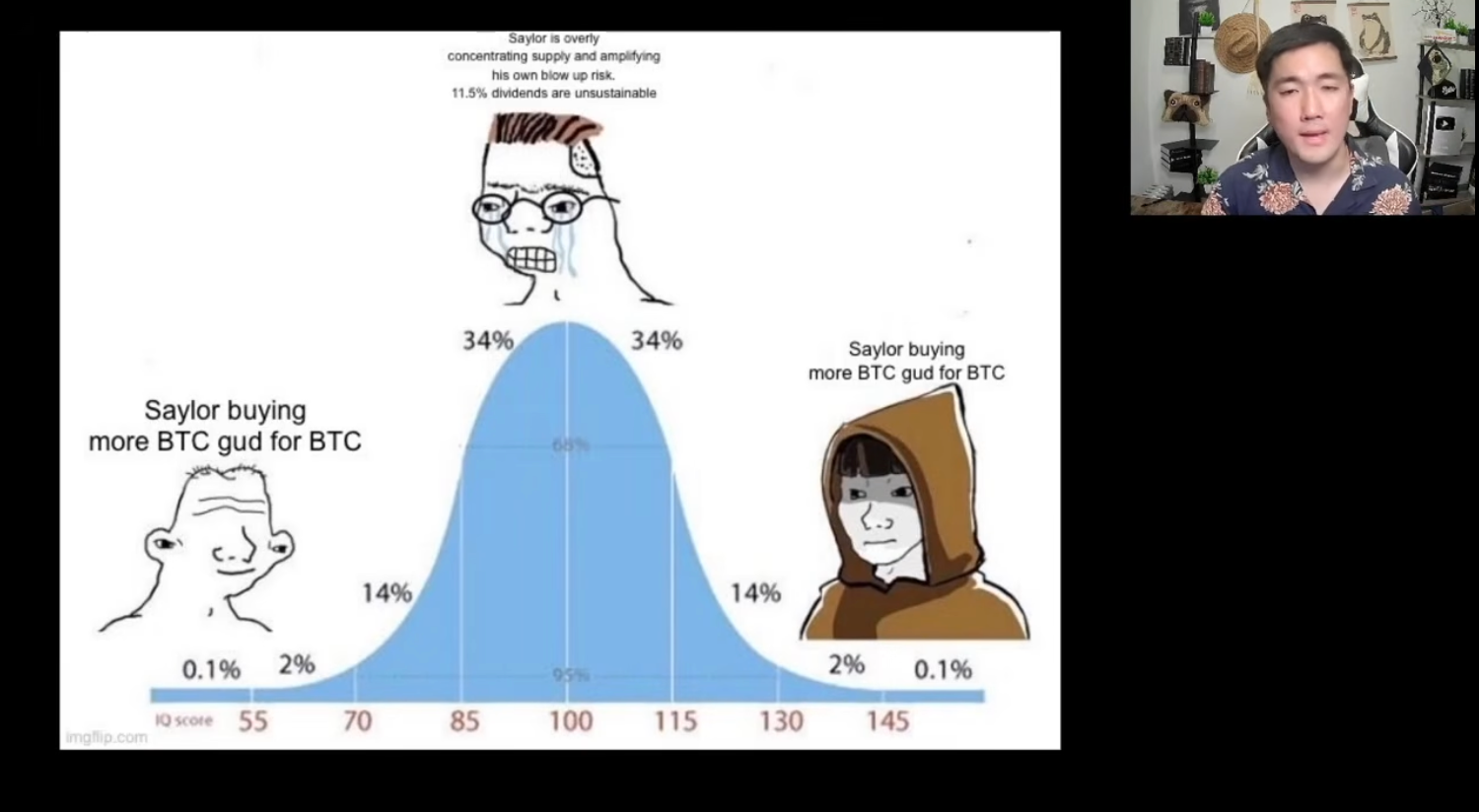
Finally, a summary. I love this “Mid-Curve” chart—and I can speak to it because I *am* the Mid-Curve: a recovering Mid-Curver trying to evolve left or right, but clearly still Mid-Curve. The Mid-Curve thesis is “Stretch is unsustainable”—superficially compelling, yes, it looks dangerous. But as traders and investors, we’re not hired to predict whether Saylor blows up in two years. We’re hired to look at today’s price, ask: Will it be higher in two months? Four? Six? Twelve? Then weigh risk vs. reward—and place our bet.
My view on Stretch is simple: Saylor buying Bitcoin is good for Bitcoin. Markets allow him to keep buying—if this continues, Bitcoin rises. I don’t know when it ends—but while it does, I’ll hold Bitcoin, and sell when things change. Like AI bubbles or crypto bubbles—anytime during a bubble, you can say “this is a bubble,” but bubbles last longer than expected—and Saylor might even successfully deleverage someday.
My Bitcoin thesis: Bitcoin below $70,000 is cheap—I buy, add some futures for flavor, and may close later. I recorded this on April 15—if you watch a week later, I may have updated views on Twitter.
Remember reflexivity: Bitcoin rises → people declare “digital gold,” “store of value,” “Bitcoin works” → perceived fundamentals improve → price rises further. Conversely, when Bitcoin falls, quantum threats resurface instantly—people hesitate to buy. When Bitcoin rises, a developer proposes a quantum solution—and cheers erupt: “Quantum solved—we can buy again!” Think about it: At $120,000, no one cares about quantum—not even those who knew the risk—because price rises, so you ignore it. At $60,000, quantum suddenly matters. I guarantee: when price rises again, a Bitcoin developer will propose a quantum solution—and everyone will cheer, “Quantum solved—we can buy again.” Same with Stretch—Bitcoin rises → Stretch looks safer → demand rises → Saylor buys more Bitcoin → Bitcoin rises further.
A full bullish narrative: Bitcoin rises on Stretch, Ethereum rises on Tom Lee’s version, Solana’s DAT version launches, Solana rises, everyone loads up for 2027, then crashes—poetic. If that day comes, I hope I spot the top again.
In short: Saylor buying Bitcoin is good for Bitcoin—so I hold Bitcoin. If circumstances change, I’ll sell Bitcoin. I love Bitcoin—I’ve sought a good entry point, and I believe below $70,000 is it. Let’s buy, add some futures for flavor, and see what happens.
Don’t forget the power of hope. People are deeply discouraged right now—everyone needs green candles to heal. I hope markets rally soon. Always reflect on reflexivity—never forget Bitcoin *can* rise, and historically, it *has*, many times.
Join TechFlow official community to stay tuned
Telegram:https://t.me/TechFlowDaily
X (Twitter):https://x.com/TechFlowPost
X (Twitter) EN:https://x.com/BlockFlow_News
 深潮TechFlow