

Backed by 20+ Institutions: How Sui’s New Primitive Hashi Rewrites Bitcoin’s Financial Trust Rules
TechFlow Selected TechFlow Selected
Backed by 20+ Institutions: How Sui’s New Primitive Hashi Rewrites Bitcoin’s Financial Trust Rules
If the endgame of Bitcoin finance is to make Bitcoin the native collateral for on-chain finance, then what Hashi is building may be the first pile driven into the foundation of that bridge.
 Navigating Web3 tides with focused insights
Author: TechFlow
While market attention has been rotating among U.S. equities, AI, and gold, Sui recently announced a new initiative:
Hashi—a Bitcoin-native collateral primitive built on Sui—is set to launch and has already secured backing from top-tier institutions.
Bitcoin finance is a long-discussed yet still unresolved topic:
As the largest on-chain asset vault—with a market cap exceeding $1.4 trillion—less than 0.22% of Bitcoin is currently used in DeFi.
The core reason this remains unresolved lies not in insufficient functionality, but in flawed trust assumptions. In past attempts, users were frequently misled: you thought your Bitcoin remained in your custody, when in fact it resided on someone else’s ledger. The collapses of Celsius, Voyager, Genesis, and others repeatedly sounded the alarm on the logic of “sacrificing trust for efficiency.”
This is especially true for synthetic Bitcoin. Although it attracted a sizable retail user base, this structure failed to convert large volumes of Bitcoin into DeFi capital—and did little to attract institutions or major asset holders demanding stronger safeguards.
It is precisely this gap that catalyzed the development of Hashi—the foundational primitive introduced by Sui:
Rebuilding the most critical trust foundation for Bitcoin finance.
Making native BTC collateralization transparently composable within Sui’s smart contract environment—no wrapping, no synthetics, no handing over keys to any centralized entity—and turning this capability directly into a reusable interface.
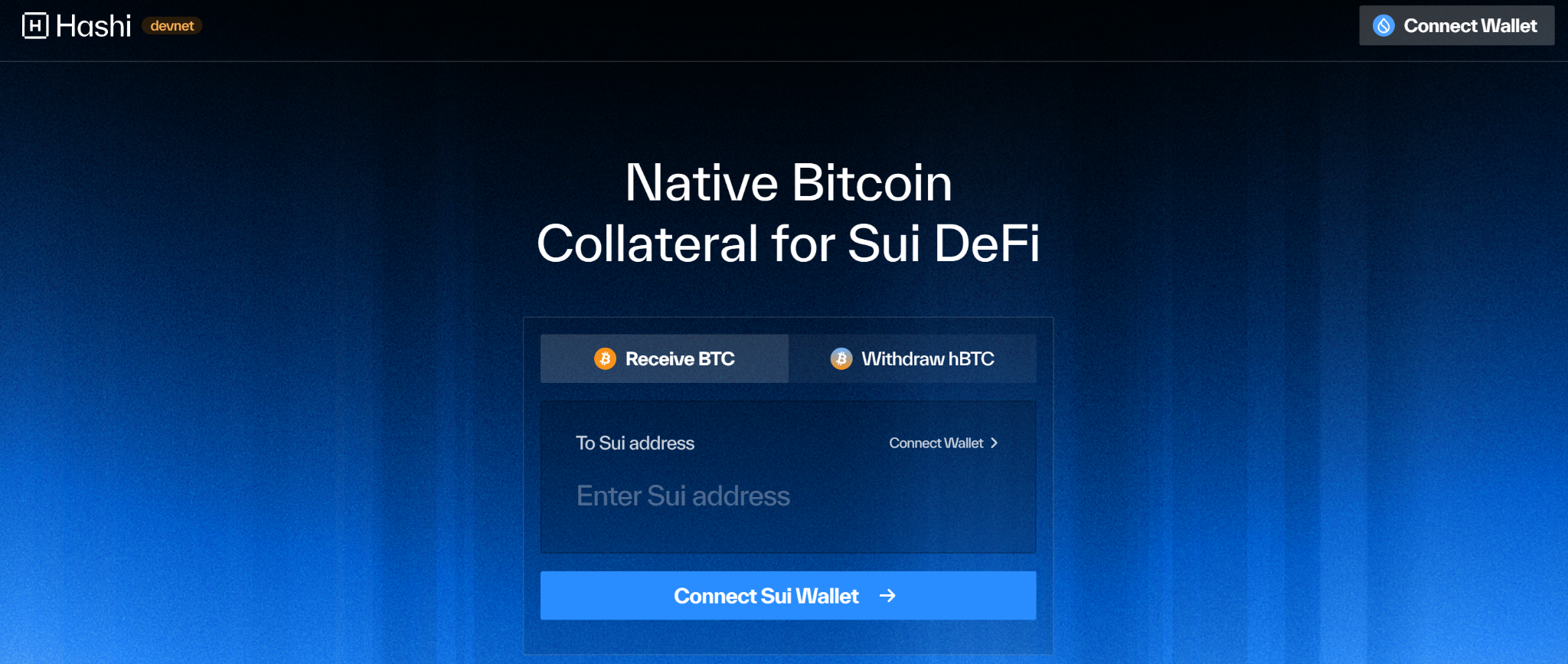
Hashi’s Native BTC Programmability: BTC Stays on Bitcoin, Collateral Rights Enter Sui
Hashi’s design philosophy can be summarized in one sentence:
The asset resides on the Bitcoin network; the rights reside on the Sui network—both conditions hold simultaneously and independently.
Suppose you own one Bitcoin and wish to use it as collateral to borrow USDC.
In most prior solutions:
You either deposit your BTC with a centralized platform to obtain borrowing capacity—or accept wrapped BTC. At some point, your Bitcoin must be handed over to someone else, effectively trading “trust in an entity” for “programmability.”
With Hashi:
- Deposit: Users send BTC to a dedicated address (a unique Bitcoin deposit address generated by Hashi for their Sui address). The private key for this address belongs to no individual—it is jointly managed by Sui validators. Only when a sufficient quorum of validators agrees can the BTC be moved. This means no single entity can abscond with your funds unless they control more than one-third of the entire Sui validator set.
- Certificate Generation: Validators monitor the Bitcoin network. Once they confirm your BTC has been securely locked in, they mint a corresponding collateral certificate on Sui. This certificate is neither a newly issued token nor a wrapped asset—it is simply an on-chain proof verifying that one real BTC has been locked, and that you are its rightful owner.
- Use as Collateral: With this certificate, you can borrow, participate in DeFi, or deploy yield strategies—all governed by code-enforced rules in Sui smart contracts, with no human intervention possible.
- Repayment & Withdrawal: Upon repayment, validators automatically release the original BTC on the Bitcoin mainnet via MPC threshold signing, enabling withdrawal to any Bitcoin address—fully automated, with zero manual oversight.
- Guardian Layer: To guard against extreme scenarios (e.g., validator collusion), Hashi introduces an additional Guardian Layer as secondary monitoring and fallback protection—primarily overseeing large withdrawals or anomalous thresholds to prevent systemic risk.
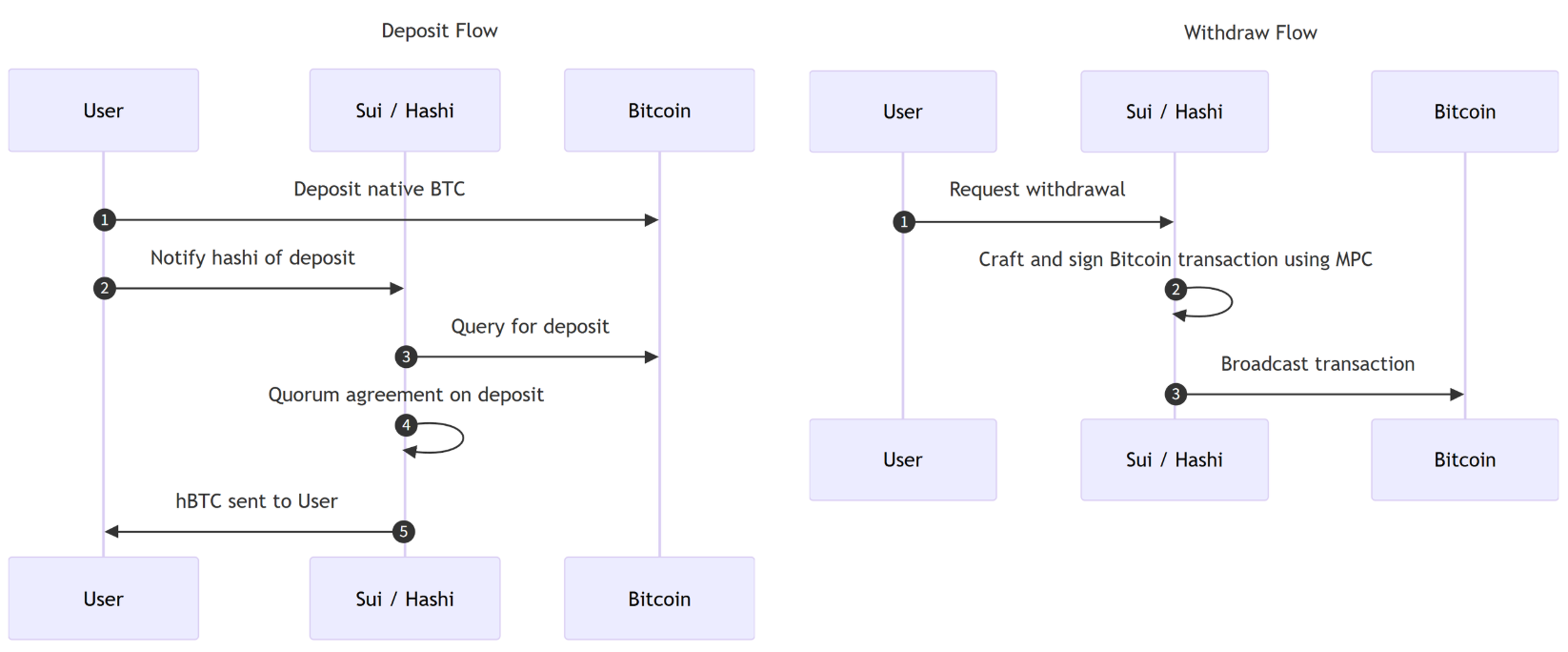
Throughout its lifecycle:
BTC remains on the Bitcoin mainnet—not migrated into an internal account of any platform;
No single centralized entity holds exclusive private key control;
What circulates on Sui is collateralized rights backed by real BTC—reopening native BTC’s programmability;
And users need only trust the validator network and smart contracts.
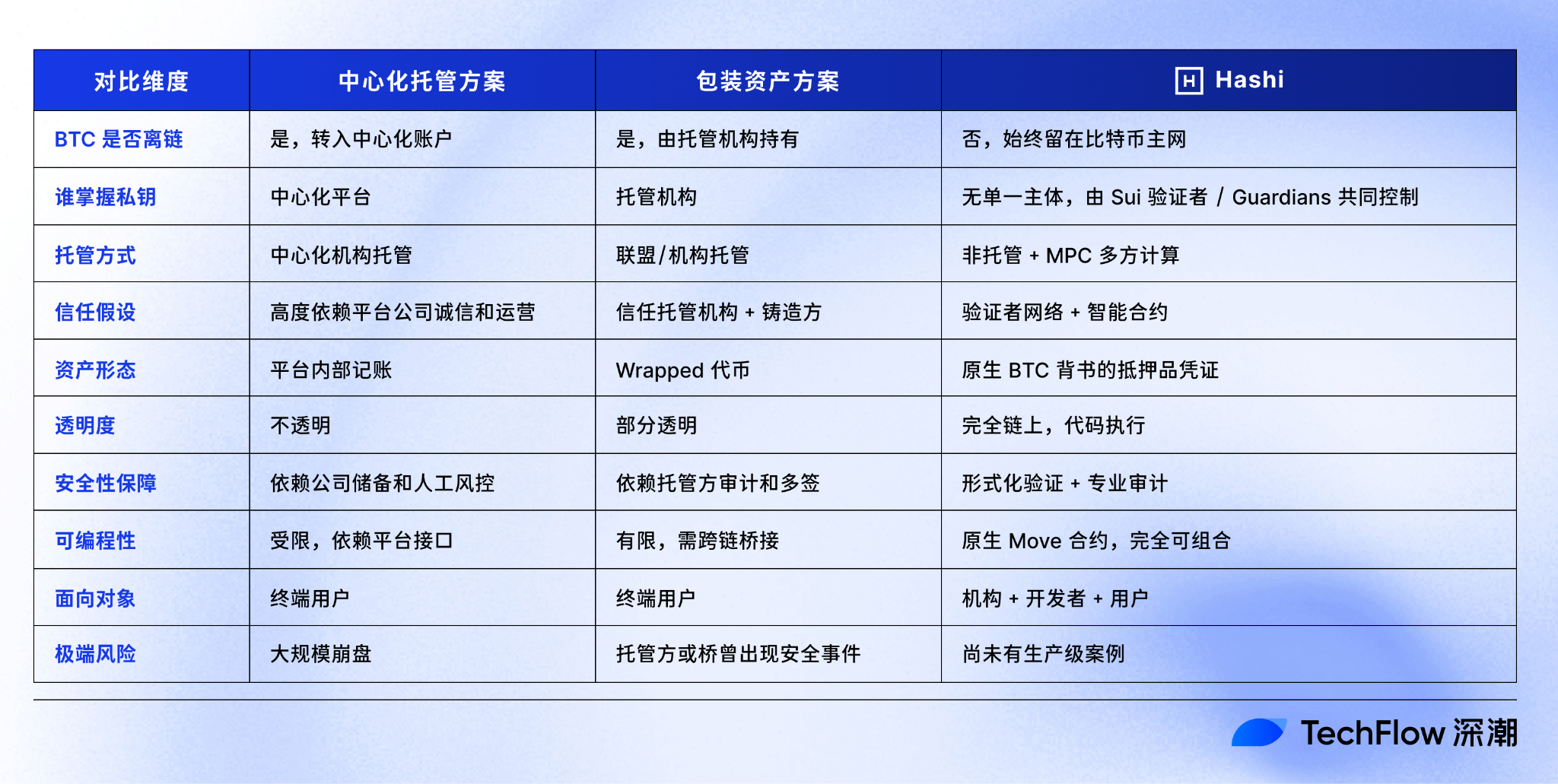
In short, Hashi aims to enable on-chain financial systems to directly recognize native BTC collateralization—while minimizing reliance on centralized trust.
Differences may seem subtle during stable market conditions—but during platform failures or liquidity crises, they determine whether your BTC remains yours.
Not a Product—A “Primitive”: A Standard, Reusable Building Block
By design, Hashi represents a more decentralized, trust-minimized, secure, and transparent Bitcoin finance solution.
Yet viewing Hashi solely as a “solution” risks overlooking its most promising aspect.
For years, Sui has pursued evolution—from “a blockchain” to “a full developer infrastructure stack.” Whether launching Walrus, Seal, or Nautilus, Sui’s goal has consistently been to deliver native, full-stack capabilities across execution, storage, access control, and off-chain computation—empowering developers and laying essential groundwork for ecosystem growth.
Bitcoin finance is no exception.
Per its official definition:
Hashi is the first decentralized Bitcoin collateral primitive developed by Mysten Labs, enabling developers to natively process Bitcoin UTXOs directly within Sui’s smart contract language.
The keyword is “primitive.”
In blockchain and DeFi contexts, primitives refer to foundational building blocks or low-level infrastructure components—like a standard LEGO brick:
They are not end-user products, but modular foundations for developers to build upon.
Just as TCP/IP isn’t an app—but every app runs atop it—Hashi isn’t a product, yet lending platforms, yield strategies, and structured products can all be built atop it.
In other words, Hashi does not offer a closed financial service—it delivers a foundational capability: enabling native BTC to serve as collateral directly callable by Sui smart contracts.
What that collateral is used for, how it’s deployed, and under what rules—all decisions left to contracts, developers, and markets.
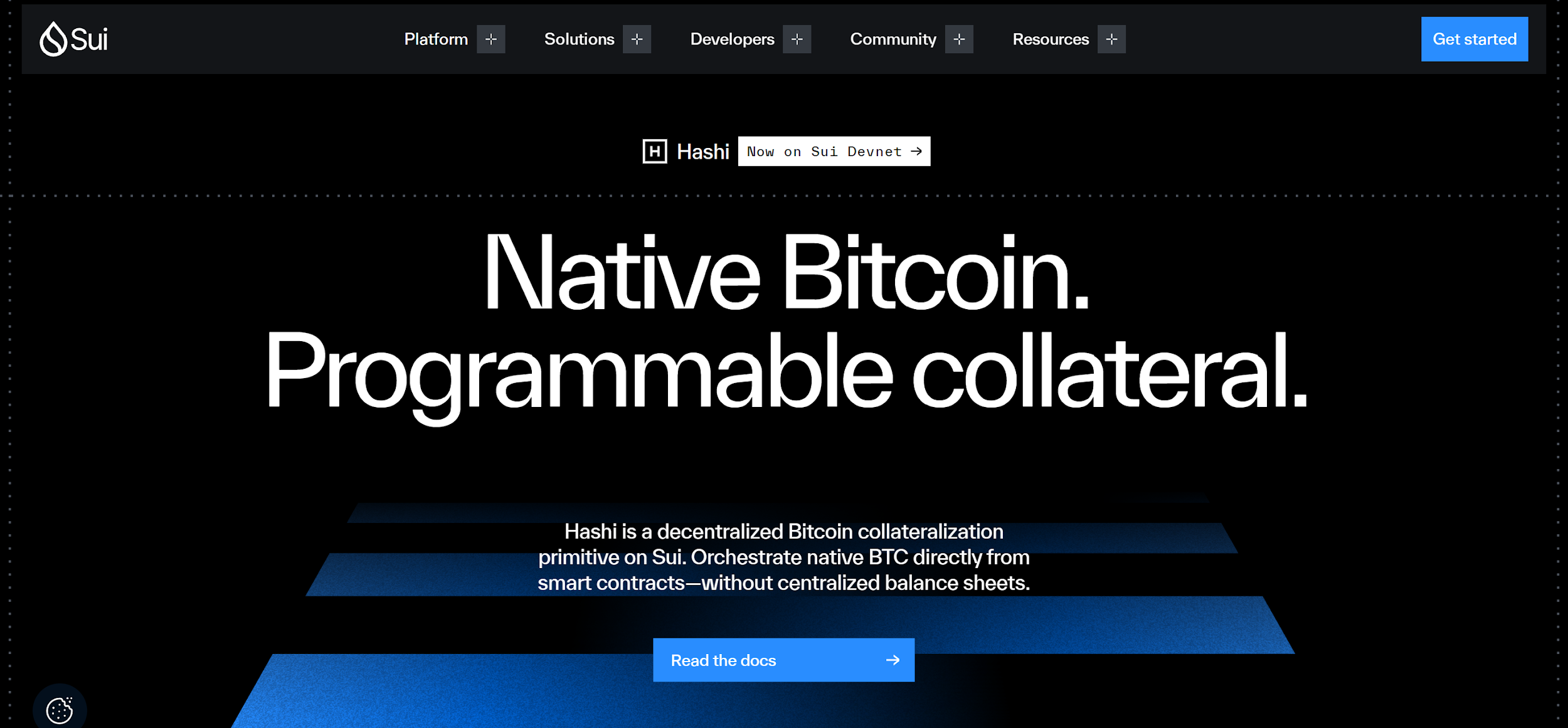
Prior to Hashi, developers building BTC-collateralized protocols faced steep hurdles: either accepting trust risks from centralized custody—or building complex native BTC collateral logic from scratch.
As a primitive, Hashi transforms that challenge into a directly reusable interface.
Developers now integrate Hashi’s mechanisms directly into their protocols—granting them native BTC collateral support out-of-the-box—without reinventing underlying infrastructure. Development barriers and time-to-market shrink dramatically.
Users—whether institutional or retail—will, for the first time, gain genuine yield-generating capability using Bitcoin—without surrendering control. Initially, lending will be Hashi’s primary use case: enabling BTC to be lent or used as collateral to borrow stablecoins. Over time, Hashi’s scope will expand to treasuries, insurance, structured products, credit derivatives, and RWA yield strategies.
Bitcoin is the world’s most widely accepted and deepest-liquidity asset—yet historically, this wealth has remained nearly invisible to on-chain finance: massive, yet non-programmable; valuable, yet imperceptible and uncallable by smart contracts.
Thus, by transforming native BTC collateralization into an interface any developer can call directly, Hashi unlocks far more than just another product or protocol—it opens up an expansive upper-layer application landscape.
That judgment—that this path is correct—is already confirmed by Hashi’s broad institutional backing.
Institutional Day-One Support: A Complete Ecosystem Map Around Hashi
Hashi is currently live on Sui Devnet—intended primarily for developer testing and auditing—not yet in production. Yet it has already secured explicit integration commitments from multiple industry-leading institutions.
In custody and infrastructure: Major players including BitGo, Blockdaemon, Cobo, and Ledger have committed to bridging institutional BTC from cold storage into on-chain collateral use cases.
In trading and liquidity: Institutions such as FalconX, Bullish, and CF Benchmarks bring reliable pricing, liquidity exit channels, and institutional-grade counterparty support to Hashi.
In security and compliance: Security auditors OtterSec, formal verification firm Certora, and cryptography and zero-knowledge proof research & engineering team Asymptotic have all pledged support—conducting smart contract audits, formal verification, and cryptographic and ZK research ahead of Hashi’s mainnet launch.
Meanwhile, projects including Suilend, Scallop, NAVI Protocol, Matrixdock, and Bluefin have announced plans to integrate Hashi—unlocking on-chain finance potential and delivering BTC-backed lending experiences rapidly to both retail and institutional users.
Additionally, Soter Insure—a provider of institutional-grade insurance solutions—has announced collaboration with Hashi to embed institutional-grade insurance as a risk mitigation layer.

These institutions collectively represent thousands of billions of dollars in nominal Bitcoin value and mature, compliant infrastructure. Their decision to commit to Hashi at the Devnet stage signals that—upon mainnet launch—massive volumes of institutional BTC assets will be operationally ready to enter on-chain environments.
Moreover, reviewing these 20+ institutions reveals something notable: they collectively cover nearly every functional layer required for a complete Bitcoin finance ecosystem—from secure BTC custody and on-chain collateralization, to price discovery, liquidity support, lending protocols, yield strategies, RWA integration, security auditing, and user onboarding. An end-to-end pipeline is already taking shape.
In other words, behind this list of supporters lies a fully formed Bitcoin finance ecosystem—ready to go live on Day One of Hashi’s mainnet launch.
Conclusion
Of course, Hashi remains in the Devnet phase. It has yet to undergo long-term validation under mainnet conditions, real-world asset scale, or extreme market volatility—its production-grade performance still requires time to prove. The road to Bitcoin finance has never flattened instantly with the emergence of a new primitive.
Yet the market’s clear endorsement—evidenced by Day-One integration commitments from over 20 leading institutions spanning custody, liquidity, security, and protocol layers—is unmistakable.
The Bitcoin finance narrative has spanned years—but the true inflection point has never been about “what’s possible,” but rather “why should we trust?”
Past solutions—whether centralized custody or wrapped assets—essentially forced users to choose between two options: surrender control to earn yield, or retain keys and remain excluded from on-chain finance.
Hashi seeks to rewrite the question itself: making native BTC collateralization a foundational, developer-callable interface—so Bitcoin’s slumbering trillion-dollar vault becomes truly “visible” to the smart contract world for the first time—non-custodial, verifiable, and composable.
Reconstructing trust is always harder than stacking features.
If the ultimate goal of Bitcoin finance is for Bitcoin to become native collateral in on-chain finance, then Hashi may well be driving the first pile into that bridge’s foundation.
Join TechFlow official community to stay tuned
Telegram:https://t.me/TechFlowDaily
X (Twitter):https://x.com/TechFlowPost
X (Twitter) EN:https://x.com/BlockFlow_News
 深潮TechFlow















