Prediction Market Giants Clash: Kalshi and Polymarket Competition Heats Up
TechFlow Selected TechFlow Selected
Prediction Market Giants Clash: Kalshi and Polymarket Competition Heats Up
Prediction Markets Under Regulatory博弈
 Navigating Web3 tides with focused insights
By Yash Roy, Bloomberg
Translated by Saoirse, Foresight News

This ad, run by U.S. prediction market platform Kalshi in March at Washington, D.C. bus stops, declared “We Don’t Do Death Markets” — highlighting its federal regulatory compliance to attack rival Polymarket’s unregulated overseas operations and sensitive contracts tied to military conflicts. Photo: Daniel Hoyer / Bloomberg
As competition intensifies in the burgeoning prediction markets sector—and as Washington steps up regulatory scrutiny—Kalshi and Polymarket are trading explosive accusations in a heated public feud.
The two platforms have clashed repeatedly before, but tensions have now escalated sharply: Kalshi has launched a highly targeted advertising campaign, and its employees have publicly criticized Polymarket, dramatically escalating the rhetoric.
Benjamin Freeman, Kalshi’s head of political and election markets, posted on social media Monday: “Polymarket’s irresponsible, dangerous, and potentially unlawful conduct threatens the very existence of legitimate prediction markets in the United States.”
The accusation triggered an immediate and fierce back-and-forth.
In a statement, Polymarket responded: “We welcome competition—but believe discussions should be grounded in facts. Misleading the public harms the entire industry and its participants.”
Kalshi spokesperson Elisabeth Diana fired back directly: “It’s laughable for a company whose vast majority of trading volume occurs offshore, outside any regulatory oversight—and whose own platform rules explicitly permit ‘death markets’—to make that claim.”
(“Death markets” is an industry term for prediction market contracts that directly or indirectly bet on human death, armed conflict, assassination, or other life-related events—also known as “assassination markets.”)
This internal rift comes at a pivotal moment, as Polymarket and Kalshi vie for leadership in the fast-growing prediction markets sector—a space offering Americans a novel way to wager on outcomes ranging from sports events to election results. According to user-curated data on Dune Analytics, both startups recently hit record weekly trading volumes, with their combined nominal trading volume nearing $6 billion.
Prediction Market Trading Volume Reaches Billions
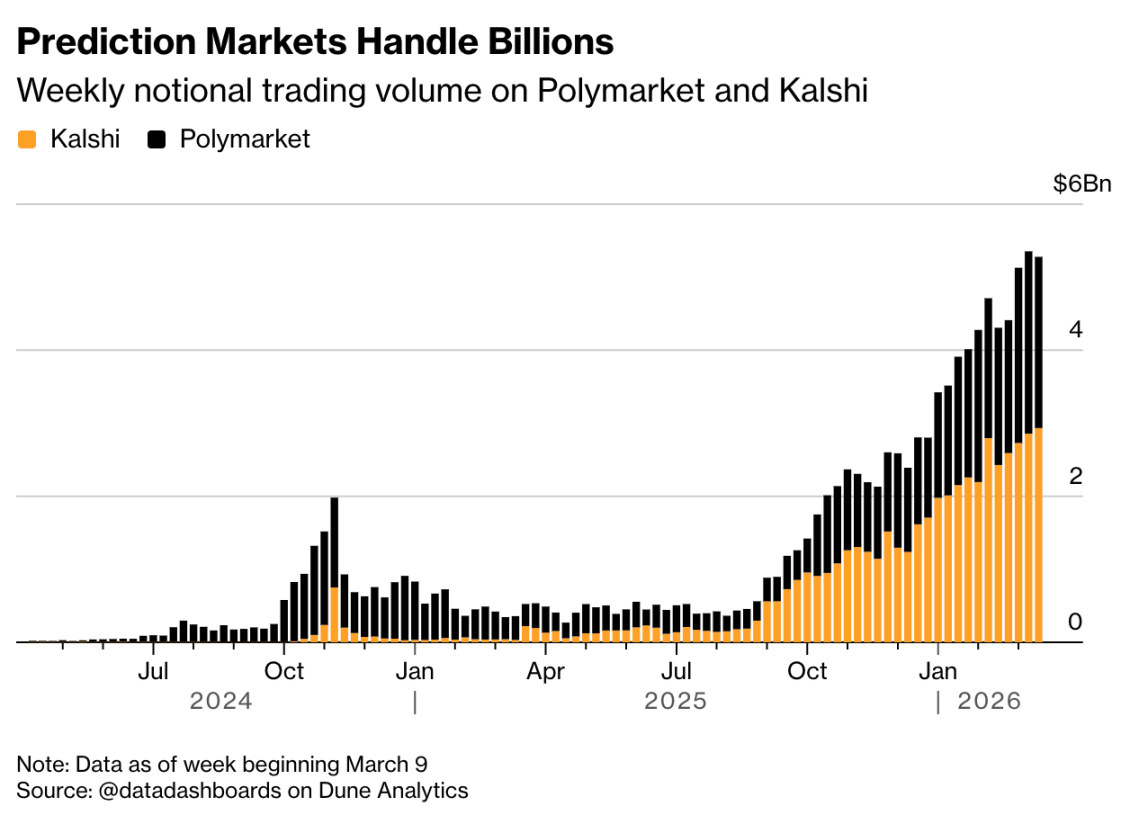
Weekly nominal trading volume for Polymarket and Kalshi. Note: Data through the week ending March 9. Source: @datadashboards on Dune Analytics
At the heart of the dispute lies a fundamental divergence in platform structure and operational rules. Kalshi is headquartered in the U.S. and regulated by the Commodity Futures Trading Commission (CFTC); Polymarket’s primary platform operates offshore.
Leveraging its offshore status, Polymarket has listed contracts tied to military conflicts—including those involving Iran—drawing sharp criticism from Kalshi, which deems such products both unethical and illegal.
One Kalshi ad bluntly states: “We Don’t Do Death Markets.”
Beginning earlier this week, Kalshi rolled out this marketing campaign—framed as a “list of platform rules”—across bus and subway stations in Washington, D.C.
One ad reads: “Rule #1: We prohibit insider trading because Kalshi is a federally regulated U.S. exchange.” To industry observers, the subtext is unmistakable: Polymarket’s main platform falls outside the jurisdiction of U.S. regulators.
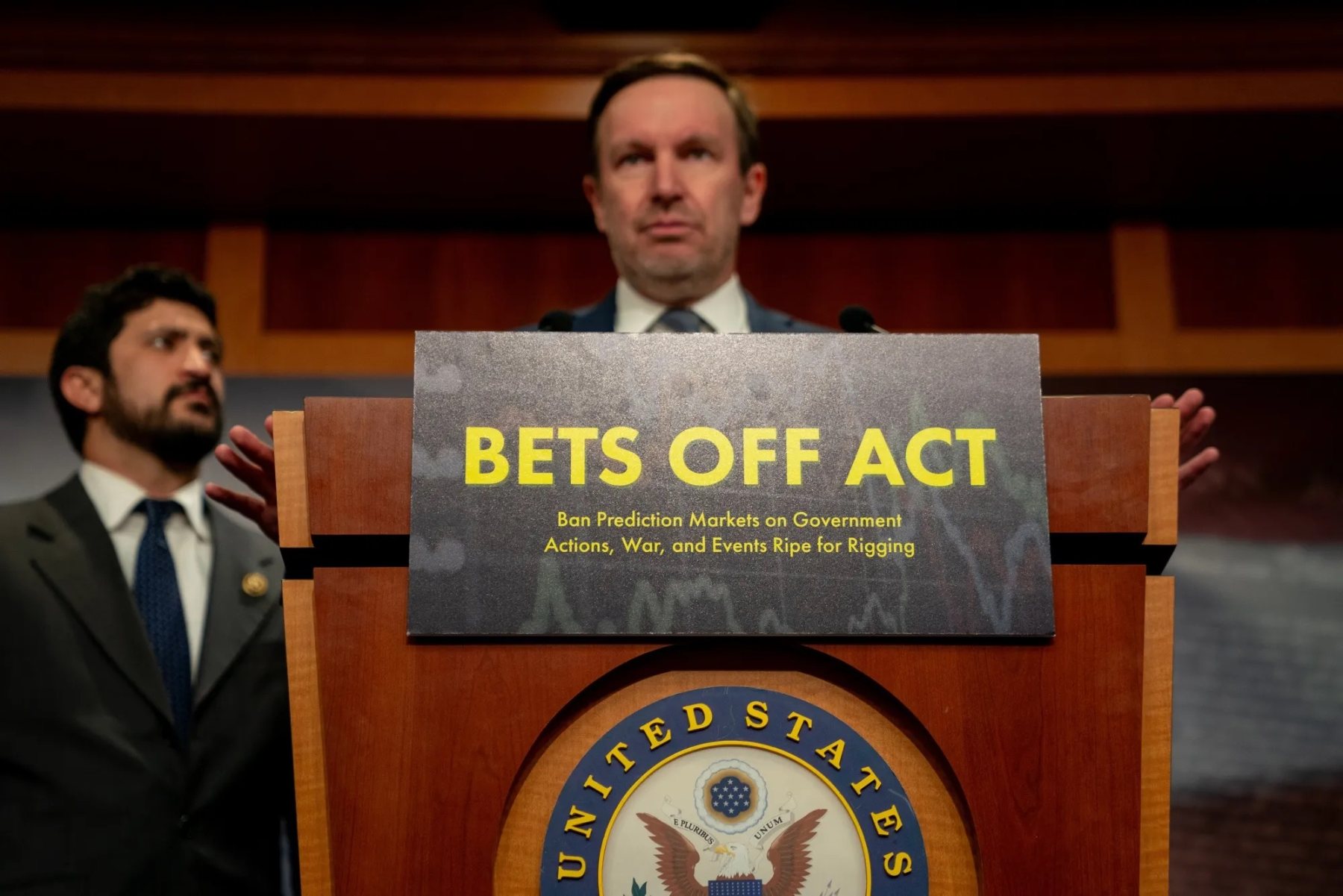
The “BETS OFF Act” logo. Rep. Greg Casar and Sen. Chris Murphy speak at a press conference on the “Ban on Exploitative Trading in Sensitive Operations and Federal Functions (BETS OFF) Act.” Photo: Stephanie Reynolds / Bloomberg
Allegations have surfaced that insiders improperly wagered on U.S. military actions in Iran and Venezuela, prompting Congress to focus on insider trading within prediction markets. Kalshi has taken a harder line, imposing fines and trading suspensions on users it deems noncompliant; Polymarket has historically been more permissive, though it recently unveiled its own insider trading policies amid rising regulatory attention.
Kalshi spokesperson Diana said: “We want to make these critical distinctions clear. Right now, many people in the market conflate Kalshi and Polymarket—and blur the distinct regulatory paths each has taken.”
Beyond its offshore main platform, Polymarket also operates a U.S.-regulated platform currently in testing. In its statement, the company said both platforms uphold “the same rigorous standards for market integrity—including prohibitions on insider trading and market manipulation, active trade monitoring, and ongoing engagement with regulators and law enforcement.”

A Polymarket listing on whether the Houthis will attack Israeli territory. Photo: Gabe Jones / Bloomberg
Just months ago, Kalshi co-founder Luana Lopes Lara sought to ease tensions between the rivals. In an October social media post, she expressed hope the industry could move beyond “destructive infighting” and collaborate toward growth.
That vision now appears largely dashed.
Tensions have grown even harder to resolve since Brian Quintenz—a Kalshi advisor and former CFTC commissioner—entered the fray. Responding to reports that prosecutors are investigating insider trading, Quintenz publicly hinted this week on social media that Polymarket should be the investigation’s primary focus. When contacted by Bloomberg News, he declined to comment further.
Join TechFlow official community to stay tuned
Telegram:https://t.me/TechFlowDaily
X (Twitter):https://x.com/TechFlowPost
X (Twitter) EN:https://x.com/BlockFlow_News
 @Bloomberg