Will Wall Street Move the Entire Financial System onto Blockchain?
TechFlow Selected TechFlow Selected
Will Wall Street Move the Entire Financial System onto Blockchain?
Wall Street Is Going Fully On-Chain—Has the Largest Infrastructure Revolution in Traditional Finance History Begun?
 Navigating Web3 tides with focused insights
By Jason Rosenthal
Translated by AididiaoJP, Foresight News
Wall Street is no longer merely dabbling symbolically in blockchain—it is migrating onto it.
After years of观望, institutional pillars of global capital markets—including exchanges, clearinghouses, and electronic trading platforms—are shifting operations on-chain.
What’s unfolding today is the largest infrastructure upgrade to capital markets since their shift to electronic trading three decades ago.
Yet most people won’t realize this transformation has occurred until it’s complete.
Why Now: Speed Changes Everything
Every institution moving in this direction shares the same conviction—that on-chain infrastructure will dramatically accelerate the flow of capital. History has made clear what follows.
Consider the transformation brought by electronic exchanges in the 1990s: before electronic communications networks and online brokers, executing a trade took minutes; bid-ask spreads were quoted in fractions; market access was constrained by geography and capital requirements. As infrastructure improved, spreads narrowed sharply, commissions fell from $150 to $9.95—and then to zero—trading volumes exploded, and retail participation surged. By the 2000s, markets looked nothing like those of the 1990s—not just cheaper, but vastly larger in scale.
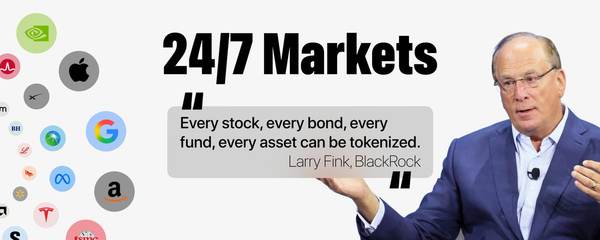
Tokenization applies the same logic across the entire global financial system: enabling 24/7 trading, instant settlement, seamless cross-border movement, fractionalizing assets previously requiring six-figure minimums, and allowing collateral to move in real time instead of sitting idle overnight. The result? Faster capital velocity, broader participation, and a significantly larger total market size.
What does tokenization actually mean? Tokenized assets are digital representations of real-world assets—such as U.S. Treasuries, Apple stock, or real estate deeds—recorded on a blockchain as programmable tokens. Unlike traditional models where custodians track ownership via centralized databases within a single time zone during business hours, tokenized assets live on-chain: they can be instantly transferred, programmed, and settled anywhere in the world, at any time.
They are not derivatives—they are the underlying real assets themselves, running on superior infrastructure.
Institutions Are Already Moving
In December 2025, the Depository Trust & Clearing Corporation (DTCC) received a “no-action” letter from the U.S. Securities and Exchange Commission (SEC), authorizing it to tokenize real-world assets on approved blockchains. DTCC processed $3.7 trillion in transactions in 2024. It plans to launch production-grade tokenized U.S. Treasury services in the first half of 2026.
On January 19, 2026, the New York Stock Exchange (NYSE) announced a platform for 24-hour on-chain trading and settlement of U.S. equities and ETFs—supporting fractional shares, instant settlement, and stablecoin financing—in partnership with BNY Mellon and Citibank to provide tokenized deposit support for ICE’s clearinghouse. The world’s most iconic securities exchange is moving on-chain.
In August 2025, Tradeweb executed its first fully on-chain, USDC-financed real-time trade in U.S. Treasuries—executed on a Saturday, outside traditional settlement windows, with participants including Bank of America, Castle Securities, DTCC, and Virtu Financial. Its scope expands quarterly and now includes cross-border and intraday settlement. Nasdaq also filed its own rule-change proposal with the SEC in September 2025.
These developments increasingly reflect a systemic migration—not isolated experimental pilots.
Hidden Costs in the Current System
A second force driving this shift is that the existing market structure is built around intermediaries—not around the market itself.
Take a typical equity trade: investors pay bid-ask spreads to brokers. In institutional trading, prime brokers charge financing fees. Exchanges and transfer agents levy their own fees. Custodians charge for asset safekeeping. DTCC charges fees across clearing, netting, and settlement. Even after the U.S. finally achieved T+1 settlement in 2024—a reform decades in the making, given prior multi-day cycles—funds remain locked overnight, creating a “structural cost” for all participants.
Smart contracts and atomic settlement compress these layered steps. Today, counterparties can transact and achieve final settlement instantly, on-chain.
The rent extraction—the profit margins—built into the current system won’t vanish… they’ll become opportunities for new entrants. In other words, incumbents’ profit margins are precisely the opportunity space for building new infrastructure.
Finally, regulatory clarity—long elusive—is now beginning to materialize. If current momentum continues, the CLARITY Act could have the same impact on traditional finance as the GENIUS Act has already had on stablecoin adoption and development.
The institutional guardrails large players have been waiting for are finally within reach. So what does this mean for builders?
The migration of global financial infrastructure onto-chain will create demand for entirely new categories of products and services.
The legacy institutions moving fastest aren’t your competitors—they’re your customers. DTCC has no intention of building middleware; NYSE isn’t building compliance tooling; Tradeweb isn’t developing cross-border distribution layers.
These institutions are laying down regulated, institutional-grade foundational layers. Founders build everything that runs on top.
This mirrors the 1990s exactly. Exchanges didn’t build E*TRADE, Bloomberg, or the next-generation order management and prime brokerage platforms—visionary founders did.
More participants. Faster capital velocity. Lower friction.
Greater liquidity. Larger markets.
History has already revealed the endpoint of this trajectory.
The window to build foundational infrastructure for tokenized financial markets is open.
Join TechFlow official community to stay tuned
Telegram:https://t.me/TechFlowDaily
X (Twitter):https://x.com/TechFlowPost
X (Twitter) EN:https://x.com/BlockFlow_News
 @jasonrosenthal