Seats of Power: A Covert Struggle for Crypto’s Future
TechFlow Selected TechFlow Selected
Seats of Power: A Covert Struggle for Crypto’s Future
Pro-crypto Democrats do exist—they simply happen not to hold key positions with actual legislative power.
 Navigating Web3 tides with focused insights
By: David Christopher
Translated by: Saoirse, Foresight News
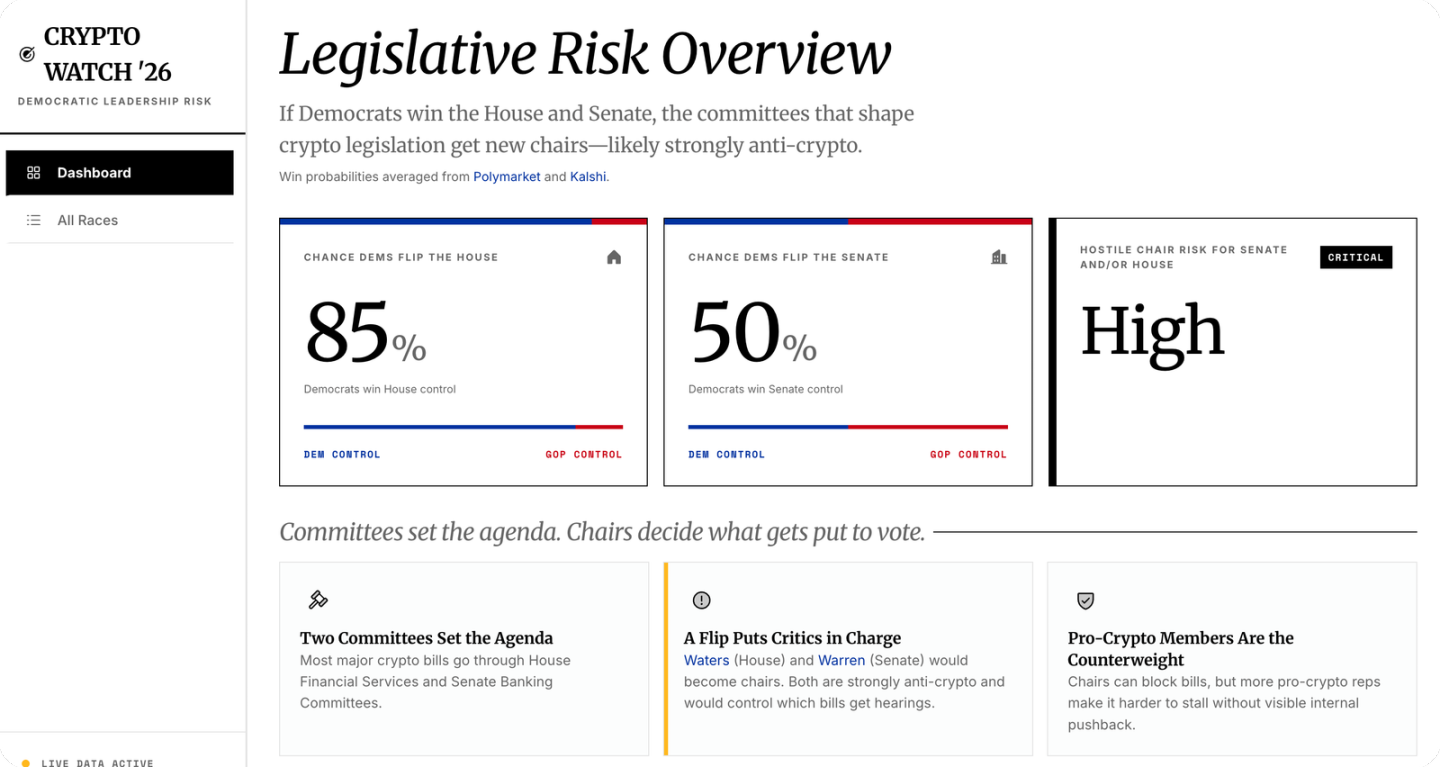
How much risk does this midterm election pose for the crypto industry? As the likelihood of Democrats sweeping both the House and Senate in the midterms continues to rise, I aim to assess—using current polling data—the potential implications for the future trajectory of the crypto sector.
To that end, I consulted prediction markets and resources such as Stand with Crypto (SWC), a platform that documents candidates’ policy positions on crypto. I integrated these inputs to build an analytical dashboard.
Although the dataset remains under active refinement, I have established a core database tracking key districts where Democratic candidates hold leads—and linking those leads to their stances on crypto policy and potential influence over congressional committees. This preliminary analysis reveals the coming months’ regulatory landscape: superficially offering room for cooperation, yet revealing deep-seated structural tensions upon closer inspection.
The Surprising Reality
First, it’s important to clarify that Democratic support for the crypto industry is higher than commonly assumed—at least on certain bills.
In the House, 101 Democratic members (roughly 48% of the caucus) voted in favor of the GENIUS Act; in the Senate, 18 Democrats (40%) voted to advance the bill to a full floor vote. This appears to constitute tangible bipartisan backing. Yet this support is confined strictly to this one bill. Once legislation reaches the critical decision-making stage—the committee process—this coalition vanishes entirely.
That is precisely where the problem lies.
The Real Source of Influence
Crypto-related legislation is never brought directly to a full-chamber vote.
Whether concerning stablecoin regulation, market structure reform, or defining the authority of the U.S. Securities and Exchange Commission (SEC), all such proposals must first pass through committee review. The House Financial Services Committee (HFSC) and the Senate Banking Committee are the two pivotal bodies determining the fate of crypto legislation. Market-structure bills also require input from the Agriculture Committee regarding the Commodity Futures Trading Commission (CFTC)’s jurisdiction.
Committee chairs wield absolute control over the agenda: deciding which bills receive hearings, which proceed to markup, and which quietly expire amid procedural gridlock. A chair opposed to a bill need not formally vote it down—they can simply refuse to schedule it, effectively killing it outright.
Recent Republican chairs have amply demonstrated the power of this authority:
- Senate Banking Committee Chair Tim Scott advanced the GENIUS Act through committee and helped secure its passage on the Senate floor;
- Former HFSC Chair Patrick McHenry championed the FIT21 Act, making it the first major crypto market-structure bill to pass the House;
- Current HFSC Chair French Hill has continued this momentum, shepherding related bills—including the CLARITY Act—through the House (though the CLARITY Act remains stalled in the Senate) and regularly holding hearings on digital assets and capital markets modernization.
So what changes if Democrats win across the board?
The majority party controls every committee chairmanship—without exception. If Democrats regain the House, they will control all House committees; if they win the Senate, they will control all Senate committees. Committee chairs within the majority party are typically selected based on seniority.
- House Financial Services Committee: The most senior Democrat is Maxine Waters;
- Senate Banking Committee: The most senior Democrat is Elizabeth Warren.
Both are well known for opposing all major crypto bills. Warren led opposition to the GENIUS Act during its Senate Banking Committee deliberations, calling it “a threat to national security.” Waters dismissed the same bill as “an outright crypto scam.”
A crucial battleground in the House lies in subcommittee reorganization following a shift in party control. The majority party dictates new member assignments and proportional representation across subcommittees. Waters would wield significant influence over personnel decisions—including who leads the “digital assets” subcommittee—within the HFSC and its subcommittees. While she cannot unilaterally appoint all members (party leadership and caucus consensus also weigh in), she holds sufficient sway to steer the committee toward her anti-crypto stance.
Indeed, the Democratic contingent on the HFSC already leans strongly anti-crypto: Brad Sherman, Stephen Lynch, Emanuel Cleaver, and Sylvia Garcia all hold hardline opposition positions. Even though pro-crypto Democrats like Jim Himes, Bill Foster, Ritchie Torres, Josh Gottheimer, and Vicente Gonzalez serve on the committee, they cannot control the agenda under Waters’ chairmanship.
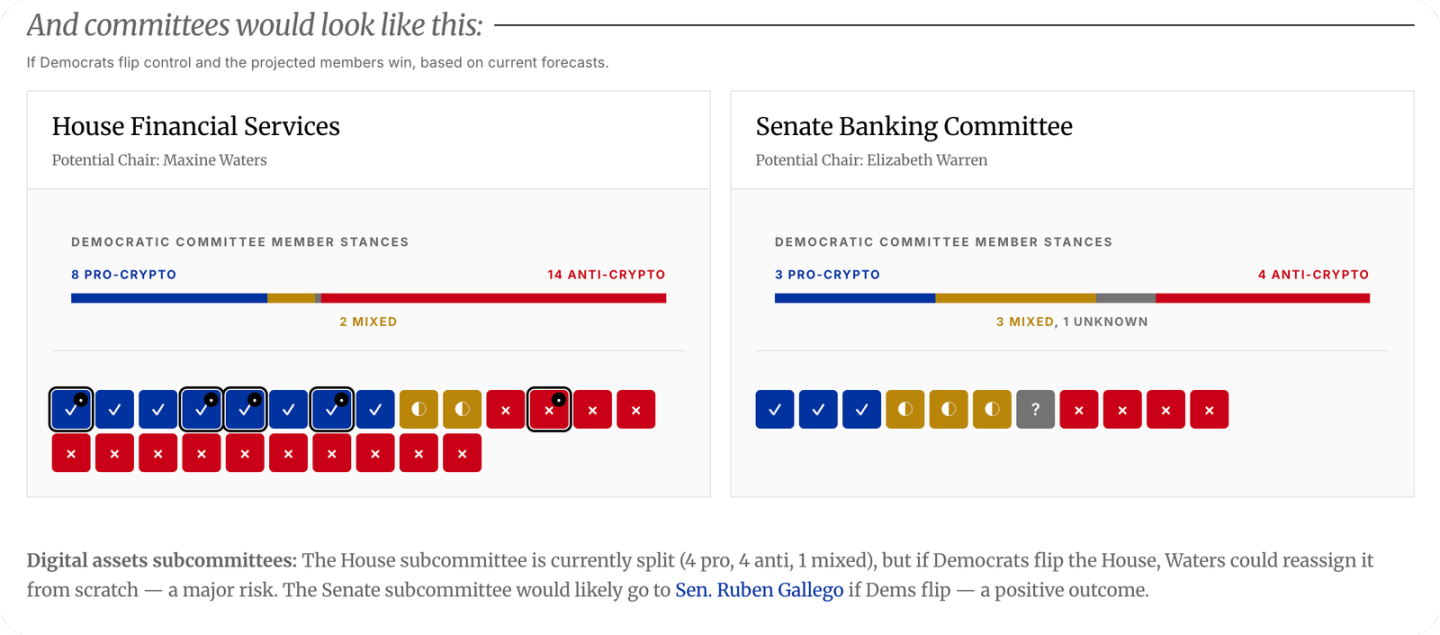
This chart illustrates the crypto-policy alignment across the two key committees should Democrats regain control of Congress in the 2026 midterms—providing a clear visual snapshot of the regulatory environment facing the crypto industry.
The Senate Banking Committee presents a slightly more favorable outlook. Although Warren would assume the chairmanship, its membership is more diverse: it includes pro-crypto senators (e.g., Mark Warner, Ruben Gallego, Angela Alsobrooks), anti-crypto members (e.g., Tina Smith), and swing-vote centrists. A modest silver lining: if Democrats control the Senate, Senator Gallego—who ranks highly on SWC’s pro-crypto rating scale—is likely to chair the Digital Assets Subcommittee. Though Warren retains full control over the committee’s overall agenda, Gallego could carve out space for pro-crypto voices at the subcommittee level.
The Elections That Truly Shift the Balance
Most pro-crypto Democrats currently sit outside the HFSC or Senate Banking Committee. They can certainly vote in favor of relevant bills during full-chamber votes—and even pressure party leadership (though given how highly politicized this issue has become, most members are reluctant to speak up for crypto). But they cannot compel committee chairs to move legislation forward.
Only a handful of races hold the potential to meaningfully alter the power composition of these committees.
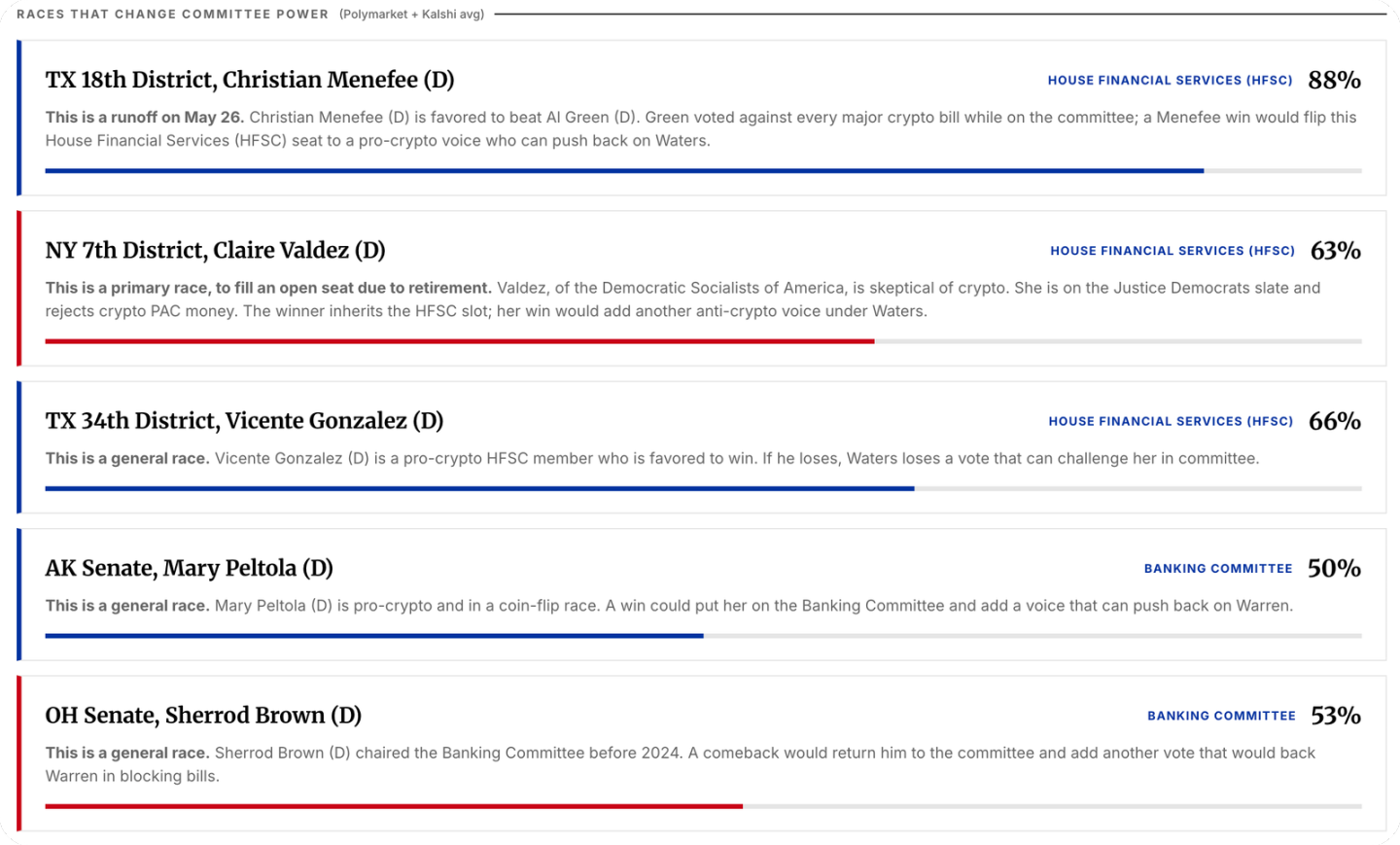
This chart analyzes key congressional districts whose elections will directly shape crypto legislative power in Congress. Data reflects the average of forecasts from Polymarket and Kalshi prediction markets, highlighting which outcomes would shift the crypto-policy alignment of the HFSC and Senate Banking Committee.
Final Takeaways from the Midterms
The outlook for the House is extremely bleak.
Democrats have an 85% probability of regaining the House—meaning Waters is highly likely to chair the HFSC and exercise full authority to restructure subcommittees and set the legislative agenda. There are only minimal bright spots: Menefee may defeat Green for the seat, and Gonzalez is likely to retain his. These developments might provide limited counterbalance—but they cannot alter the central reality: the chairmanship itself remains firmly in anti-crypto hands.
The Senate represents crypto’s last remaining foothold—and the situation deteriorated further last night: Juliana Stratton defeated Raja Krishnamoorthi in the Illinois primary. According to SWC’s records—and confirmed by Fairshake’s $7 million expenditure opposing her—Stratton is a staunch anti-crypto politician.
Adding to the frustration is the broader picture: roughly 47% of Democratic members of Congress supported the GENIUS Act, and 37% of House Democrats backed the CLARITY Act—pro-crypto Democrats do exist. Yet a bill’s fate is never determined by full-chamber votes; it hinges entirely on committee sentiment. Committee votes on market-structure legislation follow strict party lines. Existing pro-crypto support simply fails to translate into influence at the decisive stage of the legislative process.
The crypto industry should not be so deeply politicized. Pro-crypto Democrats do exist—yet they happen to occupy no positions of real legislative authority.
Join TechFlow official community to stay tuned
Telegram:https://t.me/TechFlowDaily
X (Twitter):https://x.com/TechFlowPost
X (Twitter) EN:https://x.com/BlockFlow_News
 Bankless