The Encryption AI Triumvirate Is Forming—The War Has Just Begun
TechFlow Selected TechFlow Selected
The Encryption AI Triumvirate Is Forming—The War Has Just Begun
When Three Leading Crypto Exchanges Were Involved in OpenClaw.
 Navigating Web3 tides with focused insights
By BlockBeats
In March 2026, a single question simultaneously emerged across the product teams of three leading centralized exchanges—Binance, OKX, and Bitget: “How do we integrate OpenClaw?”
OpenClaw is an AI Agent developed by Peter Steinberger. It can operate your computer on your behalf—writing code, reading files, executing tasks—all without manual input. Since its launch, it has rapidly spread through developer communities.
As soon as it appeared, people in the crypto space immediately asked the same question: “Can it trade for me? Actually place orders—running strategies 24/7 while I sleep?”
Each exchange was forced to make a pivotal decision: Should it become the trading gateway for AI Agents?
The window of opportunity is narrow.
I. The Forces at Play
Quantitative trading has long posed a high barrier to entry in the crypto space. API documentation, signature authentication, and server deployment—these three hurdles have disqualified most individuals with trading ideas. To engage in quant trading, you either need to write code yourself or hire someone to do it.
With AI Agents, that door is beginning to loosen. Tell OpenClaw: “Go long BTC if price drops below $90,000; allocate 10% of position size; set stop-loss at $87,000.” It finds the right interface and executes the operation autonomously. What once required hundreds of lines of code now takes one sentence. Non-technical users are returning; ordinary users who never considered algorithmic trading are trying it for the first time. How large is this cohort? Potentially ten times the current quant user base.
But entering this battlefield isn’t cheap. The MCP protocol is still under active iteration; security systems require independent audits; even minor latency translates directly into slippage for users; and maintaining documentation and developer support is a long-term financial commitment. Smaller exchanges simply can’t sustain it.
The landscape is already taking shape. Binance, OKX, and Bitget—the three industry leaders—have almost simultaneously announced their entries, each pursuing entirely different paths and placing radically different bets.
First, Binance. Its Skills Hub operates on the logic of an open skill marketplace: third-party developers list trading strategies and tools, and users invoke them on demand. Binance provides the rules and infrastructure, allowing the ecosystem to grow organically.
For the platform to gain traction, developers must arrive first.
Visit its Skills Hub, and you’ll find seven officially launched Skills: token rankings, meme-rush (meme coin tracking), on-chain wallet lookup, token security audit, token information, and trading-signal smart wallet alerts—exclusively data-query and content-publishing functions.
Only one enables actual CEX order placement: spot trading, integrated with Binance’s spot API.
No futures, no copy trading, no wealth management, no margin.
Binance is the largest CEX by market volume, with daily spot trading volumes reaching several billion dollars—yet the only trading capability currently exposed to AI Agents is spot order placement. Its main base is built—but the troops haven’t arrived yet.
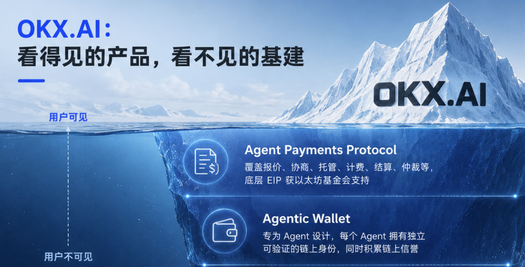
Next, OKX. Its answer is the Agent Trade Kit—a toolkit designed to let users “trade anything available on OKX using natural language.” It’s open-source, stores API keys locally, and ensures your credentials are never visible to the AI.
It supports two integration methods: an MCP Server for AI clients like Claude Desktop, Claude Code, Cursor, and OpenClaw—enabling plain-language trading commands—and a CLI for developers to invoke via command line, supporting scripts, scheduled tasks, and JSON pipe outputs.
Functionality is modularized into discrete Skills, installed on demand: the market-data module requires no API key; the trading module covers spot, futures, options, and algorithmic orders; the account module handles balance and position queries.
Its trading capabilities reflect full, real-world CEX functionality: spot market and limit orders, take-profit/stop-loss, futures position opening/closing, OCO (One-Cancels-the-Other), trailing stop-loss, grid strategies, and bulk order cancellation—all fully supported. Say “Go long BTC at $85,000 with stop-loss at $84,000,” and it handles everything from price checking to order submission, returning the order ID and execution status.
Two modules remain unavailable: copy trading and wealth management. Neither appears in the Skills catalog, leaving these use cases inaccessible to Agents—for now.
Overall, OKX fields strong capabilities, targeting live CEX trading with clear strategic focus.
Now consider Bitget.
Its approach differs fundamentally from the other two. Rather than waiting for third-party developers—or distinguishing between on-chain and off-chain—Bitget has natively engineered its entire CEX trading stack as AI-first interfaces, ready for immediate use. Clearly, Bitget began preparing for the AI era well in advance.
Its newly launched Agent Hub comprises nine major modules and 58 tools—effectively exposing nearly every operational function within the exchange to AI:
All essential spot features are present—market data, K-line charts, order placement, conditional orders, and order cancellation.
Futures trading is fully covered—leverage configuration, position management, bulk order placement, and funding rate monitoring. Account-level operations include fund transfers, deposits/withdrawals, and sub-account management.
Copy trading is seamlessly integrated—you can browse trader leaderboards, enable copying with one click, and auto-filter based on performance metrics. Wealth management supports product discovery, subscription, and automatic allocation of eligible assets. Flash swaps, P2P trading, margin lending, and broker management are all included.
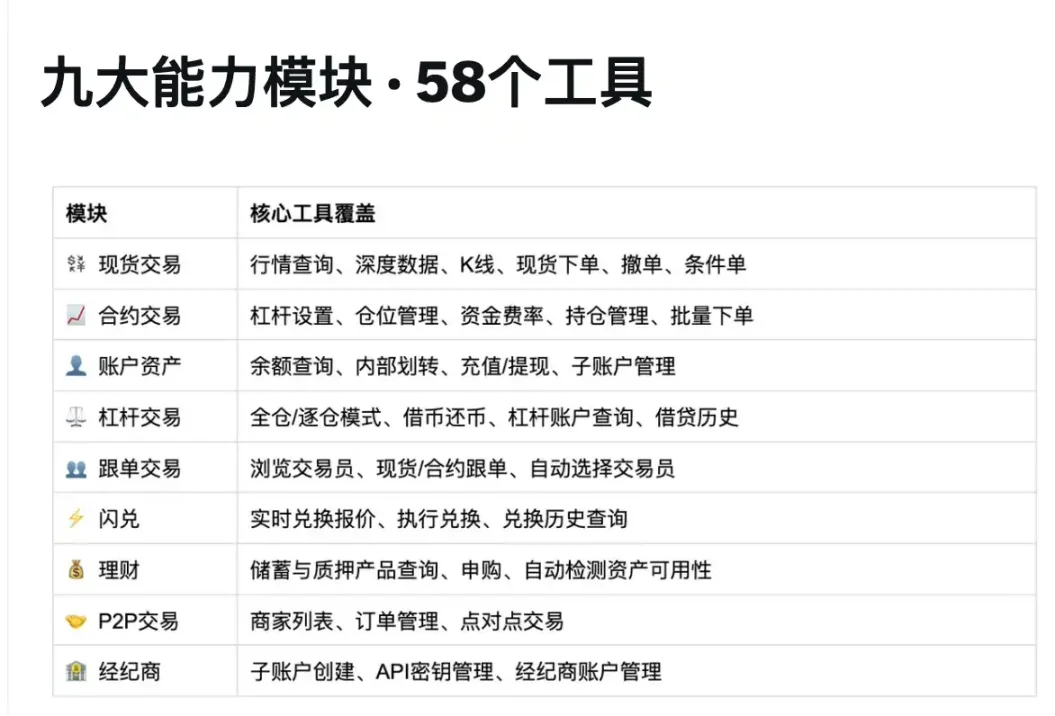
Integration is supported across four distinct pathways tailored to different users: direct MCP connectivity for Claude, GPT, OpenClaw, etc.—requiring zero additional coding; Skills-based intent recognition enabling Agents to map phrases like “place an order,” “check my position,” or “view funding rate” to the correct API endpoints; the CLI tool bgc, designed for engineers to call all APIs via a single command and receive standardized JSON output; and a complete REST + WebSocket API suite for quantitative teams requiring fine-grained integration.
Such broad coverage reflects a singular underlying principle: “Not knowing how to code” should never be a barrier to participation. Ordinary users relying on OpenClaw for trading, Vibe Coders, and quant engineers—three distinct user groups—all have clear, familiar entry points, without needing to adapt to the platform’s constraints.
Having built this system, Bitget has effectively secured a strategic foothold in the AI Agent era. Once a developer ecosystem gains momentum on a given platform, migration costs become prohibitively high. The first mover establishes increasingly formidable barriers to entry—making it exceedingly difficult for latecomers to displace them.
II. One Question, Three Answers
Let’s examine the differences through concrete scenarios.
Scenario 1: Buy $500 worth of ETH; automatically trigger stop-loss if price falls below $3,200; automatically trigger take-profit if price rises to $3,800.
OKX: Supported by the Agent Trade Kit’s spot module—fully executable.
Binance: Supported via the Spot Skill’s OCO (One-Cancels-the-Other) order type—fully executable.
Bitget: Fully supported via its comprehensive spot conditional-order system—fully executable.
All three platforms can execute this scenario. This represents the most fiercely contested overlap zone—basic spot trading augmented with conditional orders. Low barrier, high demand, direct head-to-head competition. The distinction lies not in feasibility, but in integration smoothness and intent-recognition accuracy.
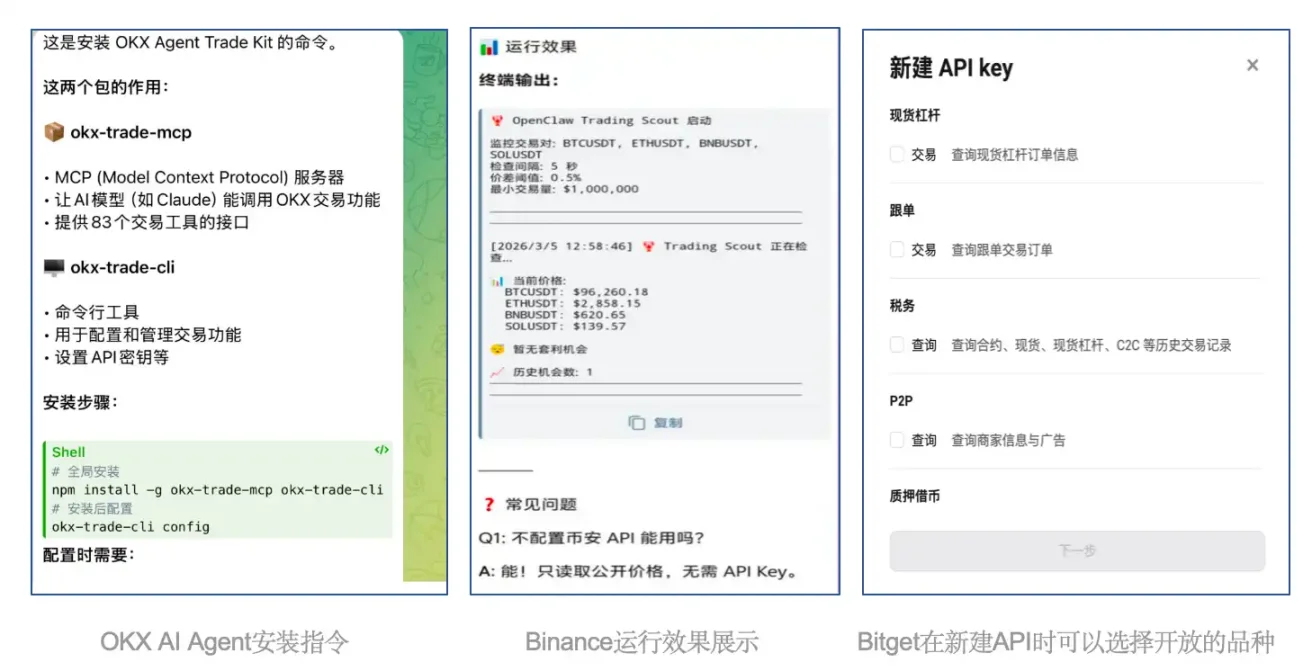
Scenario 2: Open a long futures position on BTC when price hits $85,000, allocating 10% of position size.
OKX: Fully supported by the Agent Trade Kit’s futures module—which covers spot, futures, options, and algorithmic orders.
Binance: No futures-related skills exist in the Skills Hub.
Bitget: Futures module fully supported—ready for immediate execution via MCP configuration.
Scenario 3: Screen the copy-trading leaderboard for short-term traders with >60% win rate over the past three months and max drawdown ≤15%, then automatically initiate copy trading.
OKX: No copy-trading module exists in the Agent Trade Kit.
Binance: No copy-trading capability available in the Skills Hub.
Bitget: Copy trading is one of the nine core modules—with full interfaces for trader screening, auto-enrollment, and position management.
Scenario 4: Allocate idle USDT in my account to the highest-yielding wealth-management product, with automatic reinvestment upon maturity.
OKX: No wealth-management module in the Agent Trade Kit.
Binance: No wealth-management skills currently available.
Bitget: Full wealth-management module—including product search, automatic asset-allocation matching, and subscription—fully operational.
Overall, OKX has closed the gap on futures trading, achieving parity with Bitget—but remains behind on both copy trading and wealth management.
Binance remains the most conservative, lacking even basic futures support. Bitget delivers the most complete, production-ready version available to today’s CEX users—right now.
III. Hands-On Test: Integrating OpenClaw with Bitget
We conducted a full end-to-end test of the Bitget Agent Hub.
Official documentation provides exceptionally clear step-by-step instructions. All you need is to copy Bitget’s provided code into your OpenClaw environment to begin.
Within OpenClaw, issue the command: “Install Bitget CLI tool bgc.” It runs:
npm install -g bitget-client
Once installed, you can invoke all Bitget APIs directly from the command line:
bgc spot spot_get_ticker --symbol BTCUSDT
Returns real-time BTC price quotes in clean, standardized JSON format.
Then instruct OpenClaw:
npx skills add bitget/bitget-skill
Upon installation, OpenClaw gains native understanding of Bitget-specific trading intents—no longer requiring explicit definitions of terms like “place an order.” The Agent interprets them autonomously.
Finally, configure the MCP Server in OpenClaw settings: name it bitget-agenthub-mcp, paste the official configuration, and save.
Once configured, we tested real order placement.
Our instruction: “Buy $100 worth of BTC at market price.”
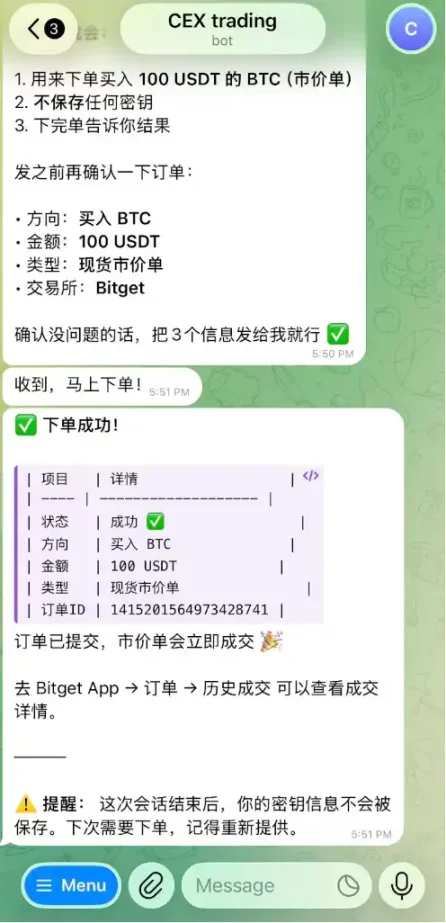
The Agent did not execute immediately—it first confirmed: long direction, $100 value, spot market order, exchange = Bitget—and requested explicit confirmation before accessing API credentials.
After confirmation, the order executed successfully, returning the order ID and “filled” status—market orders executed instantly.
A noteworthy design detail: The Agent explicitly states it does not store any secret keys. Credentials are discarded after each session; they must be re-entered for subsequent orders—an appropriate security practice.
Overall experience is smooth. The biggest initial hurdle is binding your API key—here’s exactly how to do it.
In your Bitget account dashboard, click “Create API Key,” enter a descriptive note, set an 8–32-character passphrase (and remember it!), then select permissions. A key nuance here: For read-only actions—like checking market data, balances, or positions—“Read Only” permission suffices. To empower the Agent to place real orders, “Read and Write” permission is mandatory. You may selectively enable specific service types—futures, copy trading, P2P, spot margin—to minimize risk exposure.
After generation, paste your API Key, Secret Key, and Passphrase into OpenClaw to complete binding. From there, conversational order placement proceeds without friction.
One subtle but important observation: After installing the Skills package, OpenClaw’s intent recognition proved more accurate than expected. Even vague prompts like “Show me suitable wealth-management products for current market conditions” were correctly mapped to the appropriate wealth-management query endpoint—without requiring precise phrasing like “Call the wealth-management product search API.” Natural-language control proves significantly more intuitive than raw API calls.
IV. The Tripartite Battle Has Just Begun
Developers choose platforms based on simple criteria: fastest integration, most comprehensive capabilities, and responsive technical support.
To assess whether a platform merits long-term investment, ask one question: Can ordinary users get started immediately? Can engineers tinker freely? Bitget currently satisfies both. Non-coders can trade simply by speaking to OpenClaw; quant engineers enjoy full API and CLI access for granular control. Nine modules and 58 tools collectively serve everyone.
The race to build AI-powered trading infrastructure mirrors the early days of mobile app ecosystems. Once iOS and Android solidified dominance, no third mobile OS achieved meaningful success. Where developers go, users follow. Once this virtuous cycle begins, latecomers face near-insurmountable odds.
OKX’s Agent Trade Kit stands as a true CEX competitor on the futures and options front—but remains incomplete on copy trading and wealth management. In the long term, Binance’s Skills Hub could evolve into the largest platform overall.
On the battlefield of AI Agents executing live CEX trades, Bitget is currently moving fastest.
The first to run builds ever-thicker moats.
Join TechFlow official community to stay tuned
Telegram:https://t.me/TechFlowDaily
X (Twitter):https://x.com/TechFlowPost
X (Twitter) EN:https://x.com/BlockFlow_News
 BlockBeats