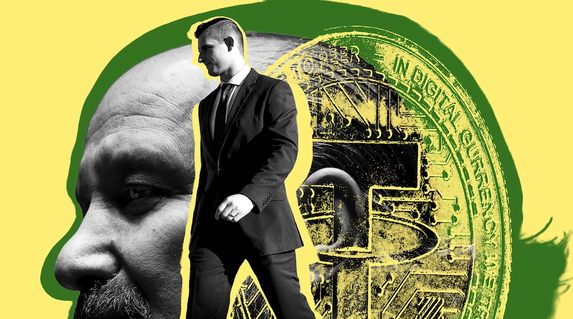
Generating an average profit of RMB 85 million per employee—the world’s most profitable business is not AI.
TechFlow Selected TechFlow Selected
Generating an average profit of RMB 85 million per employee—the world’s most profitable business is not AI.
Generating approximately $85.62 million in profit per employee—nearly 300 times that of Goldman Sachs and 85 times that of NVIDIA.
 Navigating Web3 tides with focused insights
By Clow
In 2024, a company named Tether delivered financial results that left Wall Street stunned.
$1.3 billion in net profit, with approximately 150 employees.
That’s roughly $85.6 million in profit per employee—nearly 300 times Goldman Sachs’ figure and 85 times NVIDIA’s.
This isn’t some AI unicorn or top-tier hedge fund. It’s simply a stablecoin issuer—the company behind USDT.
When these numbers began circulating across financial circles, many people’s first reaction was: “How is this possible?”
But once you understand Tether’s business model, you’ll realize it’s not only possible—it’s inevitable.
01 The World’s Most Profitable Business
Tether’s profit engine is widely known in the industry as the “stablecoin float game.”
The rules are simple: You hand Tether $1 and receive 1 USDT in return. Tether takes your money and invests it in U.S. Treasury securities.
U.S. Treasuries have yielded over 5% annually for years, while USDT pays zero interest.
All of that spread belongs to Tether.
As of end-2025, Tether held $141 billion in U.S. Treasuries—making it the world’s 17th-largest holder, surpassing sovereign nations like Germany and South Korea.
U.S. Treasuries alone generate over $4 billion in annual cash flow for Tether.
And that’s just Layer One.
Layer Two comprises gold and Bitcoin. Tether holds roughly $17 billion in gold and over 96,000 BTC. The sharp rise in gold prices in 2025 generated over $5 billion in unrealized gains.
Layer Three is liquidity premium. What do users give up when they forgo that 5% Treasury yield? They gain access to a digital dollar usable instantly in Turkey, Argentina, Nigeria—and anywhere else. For markets grappling with hyperinflation and strict capital controls, that liquidity is worth far more than a 5% annual return.
At its core, Tether operates as a global “shadow bank”—one without branches or tellers, open 24/7—specializing in capturing massive spreads left untapped by inefficient traditional finance.
02 Breaking Down Traditional Payment Walls
SWIFT was built in the 1970s. Half a century later, its core logic remains unchanged: correspondent banking relay, multiple nodes passing funds sequentially—taking at least three to five business days, with total fees sometimes hitting 7%.
A payment from the U.S. to Nigeria must pass through the originating bank, intermediary banks, and the receiving bank—each taking its cut.
And those banks operate on business hours. A transfer initiated Friday evening won’t even begin processing until Monday.
By contrast, a USDT transfer on the TRON network costs under $1 and arrives in the recipient’s wallet within 30 seconds—24/7, 365 days a year.
The cost differential is staggering. Traditional B2B cross-border payments carry total fees ranging from 1.5% to 7%; retail remittances sometimes exceed 11%. Stablecoin networks typically charge just 0.5% to 2%.
Even deeper is the impact on “access.”
Hundreds of millions of adults worldwide remain unbanked. Yet all one needs is a smartphone and internet connection to create a crypto wallet—and plug into global trade. Across Africa and Latin America, USDT has become a standard tool for SMEs paying international suppliers.
In 2025, next-generation Web3 point-of-sale (POS) systems began leveraging NFC technology for “tap-to-pay” functionality—bringing crypto payments directly to retail checkout counters.
That wall is being breached from every direction.
03 Pay-Fi: Rewriting the Logic of Money
Payment + Finance now has a new name: Pay-Fi (Payment Finance).
Traditional payments solve the problem of “moving money from A to B.” Pay-Fi solves the problem of “moving money from A to B while earning yield en route.”
Protocols like Huma Finance are tokenizing corporate accounts receivable and providing instant financing via on-chain liquidity pools—alleviating prepayment capital pressure in cross-border trade. As of early 2026, Huma’s cumulative transaction volume has surpassed $10 billion, and its T+0 real-time settlement capability is drawing increasing attention from traditional financial institutions.
Infrastructure wars are unfolding in parallel. Ethereum L2s slash on-chain transaction costs via rollup technology; Celestia and EigenDA further reduce data storage fees, enabling mass-scale micropayments. Meanwhile, TRON—backed by massive USDT liquidity and ultra-low transfer fees—remains the world’s busiest stablecoin settlement network.
The stablecoin market itself is fragmenting. USDT commands ~59% market share in offshore payments and emerging markets; USDC wins over U.S.-licensed institutions with its regulatory transparency, dominating institutional-grade, compliance-first transfer and settlement use cases. PayPal’s PYUSD targets retail via merchant networks; Ripple’s RLUSD focuses on interbank large-value settlements.
This market is no longer dominated by a single player—it’s rapidly evolving toward specialized division of labor.
04 Tether’s Ambition Boundary
Having earned so much, what does Tether plan to do with its profits?
Buy mining facilities. In Uruguay, Paraguay, and El Salvador, Tether has invested over $2 billion to build 15 energy and Bitcoin mining sites—with ambitions to become the world’s largest Bitcoin miner.
Buy AI infrastructure. Through channels such as Northern Data Group, Tether has invested over $1 billion in AI compute infrastructure.
Buy robots. At end-2025, Tether invested €70 million in Italian AI robotics startup Generative Bionics; it is also considering a $1.15 billion investment in German robotics firm Neura—with a goal of producing 5 million humanoid robots by 2030.
The underlying logic is straightforward: In an economy increasingly run by AI agents and autonomous robots, value exchange between them will require an instantaneous, programmable digital currency. And USDT is already the most obvious candidate for that role.
Regulatory developments are reinforcing this narrative. In July 2025, the U.S. GENIUS Act was signed into law—opening a legal pathway for regulated entities to issue stablecoins and explicitly excluding stablecoins from the definitions of securities and commodities. The EU’s MiCA framework also went fully live that year, bringing stablecoins squarely into mainstream regulatory oversight.
Wall Street’s inner circle is stepping in too. Cantor Fitzgerald—a primary U.S. Treasury dealer—holds ~5% equity in Tether, and its CEO Howard Lutnick has repeatedly vouched publicly for the authenticity of Tether’s reserves. This deep entanglement signals that Tether is no longer just a crypto project—it has quietly embedded itself into the fabric of traditional finance’s interest network.
05 Summary
From stablecoin issuer to one of the world’s top 20 U.S. Treasury holders—and now an investor in robot factories—every step of Tether’s expansion points in the same direction:
Monetary sovereignty is quietly shifting—not from central banks’ printing presses, but toward digital networks capable of delivering higher efficiency and lower friction.
This shift is not revolutionary—it’s permeating.
SWIFT still runs. Banks remain open. The Fed continues adjusting rates. But another system is growing, at astonishing speed, in the interstices of the old.
For everyone caught in this transition, perhaps the most important question is:
Over the next decade, in which system will your money operate?
Join TechFlow official community to stay tuned
Telegram:https://t.me/TechFlowDaily
X (Twitter):https://x.com/TechFlowPost
X (Twitter) EN:https://x.com/BlockFlow_News
 白话区块链
白话区块链