

Why Do 85% of Token Launches Ultimately Become Costly “Funerals”?
TechFlow Selected TechFlow Selected
Why Do 85% of Token Launches Ultimately Become Costly “Funerals”?
Before thinking about how to launch, first consider how to deliver genuine user needs.
 Navigating Web3 tides with focused insights
By: Eli5DeFi
Translated by AididiaoJP, Foresight News
Token launches in 2026 must confront a harsh reality.
It’s not a celebration, nor is it a reward for your hard work building the project.
Instead, it resembles an “open arena”—any flaw in your tokenomics will be instantly spotted, publicly amplified, and ruthlessly exploited by seasoned participants whose models outperform yours.
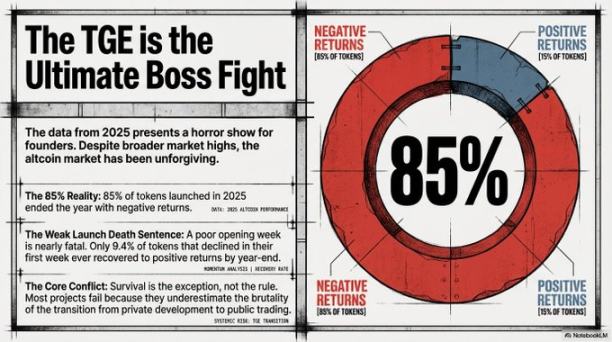
Arrakis Research analyzed data from 2025 (link)—and the result was unambiguous: 85% of token launches ended with negative returns.
Don’t blame market conditions. Bear markets don’t selectively target poorly designed tokenomics while sparing well-designed ones.
This number is the market sounding an alarm for founders: most people show up for a fight armed only with ceremonial scissors.
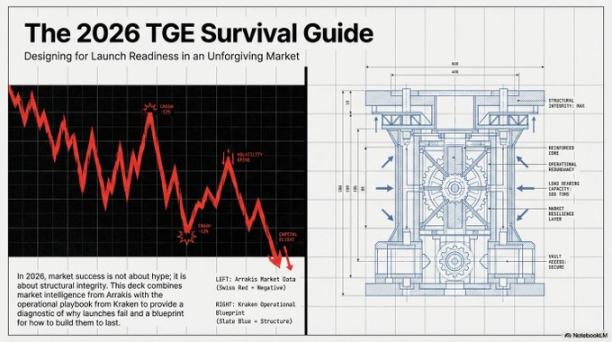
The good news? The surviving 15% didn’t succeed by luck. They succeeded through rigor—and their methods are replicable.
“Poor performance in the first week of launch is effectively a death sentence. Data shows only 9.4% of tokens that declined in Week 1 ever recovered.” — Arrakis Research
This statement deserves careful reflection.
Executive Summary
- Your token fails—not due to bad luck, but because you never designed it to succeed.
- Of tokens launched in 2025, 85% declined over the full year. This is a design problem—not a market problem.
- Launching with a Fully Diluted Valuation (FDV) exceeding $1 billion effectively hands money to people who will never use your product—and helps them “dump at the top.”
- Staking, governance, and custody aren’t “add-ons.” They’re the token’s immune system. Without them, your token collapses on day one.
- Only 9.4% of tokens that decline in Week 1 recover. First-week performance essentially determines survival.
The “Physics” Behind Token Generation Events (TGEs)
Here’s a useful mental model borrowed from physics. Every token launch involves two opposing forces:
- Sell pressure = Gravity. It exists objectively and patiently—regardless of your grand vision.
- Real demand = Rocket engine.
The issue isn’t whether gravity exists (it always does), but whether your engine is powerful enough to escape it. Sadly, most teams build rockets without engines—and then blame the planet’s gravity.
Who Sells on Day One? (And Why It’s Not Their Fault)
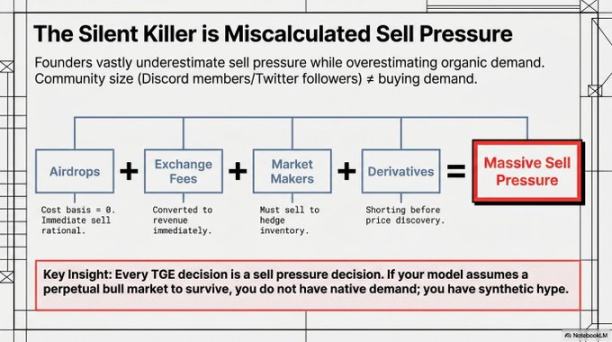
Many founders make a critical mistake here: interpreting sell-offs as betrayal. In reality, it’s simple math.
Airdrop recipients acquired tokens at zero cost. Converting free tokens into real cash is the rational choice. Data shows 80% of airdrop recipients sell within the first 24 hours—not out of disloyalty, but human nature.
Centralized exchanges receive tokens as listing fees—that’s their revenue. Liquidating inventory is both justified and reasonable.
Market makers operating under a “borrowing model” must sell part of their borrowed tokens to hedge risk and fund stablecoin reserves for quoting. This isn’t betrayal—it’s an inherent part of the model you agreed to, governed by mathematical logic.
Experienced short sellers move early, before price stabilizes. They’ve been around longer than your project. They aren’t the problem—the problem is that you didn’t anticipate their arrival.
Many projects design tokens assuming these actors don’t exist. But they do. Either account for them—or get schooled by them.
The Valuation Trap (How Math Deceives You)
The most expensive vanity metric in crypto isn’t profile pictures—it’s an inflated Fully Diluted Valuation (FDV).
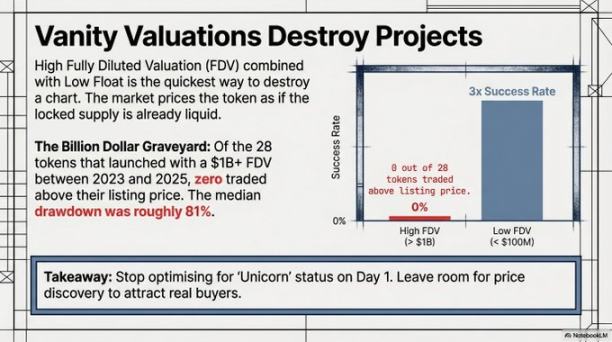
A common tactic: the team releases only 5% of tokens into circulation (“low float”) while touting a $1 billion FDV.
Markets quickly calculate: Are the remaining 95% of unlockable tokens priced as if they’ll “never unlock”? Impossible—they *will* unlock. When they do, price plunges like a ski jump.
The data is alarming—every founder should see this:
FDV at Launch
- Above $1 billion: Not a single token closed the year above its launch price. Median drawdown: 81%.
- Below $100 million: Probability of strong Month 1 performance is three times higher than for tokens with >$500M FDV.
That’s a 100% failure rate—not 70%, not 90%, but 100%.
Yet founders keep repeating this, because “$1B FDV” looks impressive in press releases—and makes early investors’ paper valuations look attractive before they can actually exit. In short, it’s a “pricing illusion,” one the market will puncture mercilessly.
Obsessing over launch-day FDV is like judging a company’s success by how polished its pitch deck looks. It fools those who ignore long-term fundamentals. A lower valuation creates space for genuine price discovery—and sustainable price action. Quiet launches survive; vanity launches die.
Four Talismans (What Actually Works)
Arrakis distilled four key pillars that separate survivors from tuition-payers. We add our own interpretation.
Talisman #1: Anti-Sybil — Filter *Before* Launch
Two contrasting cases tell the story clearly:
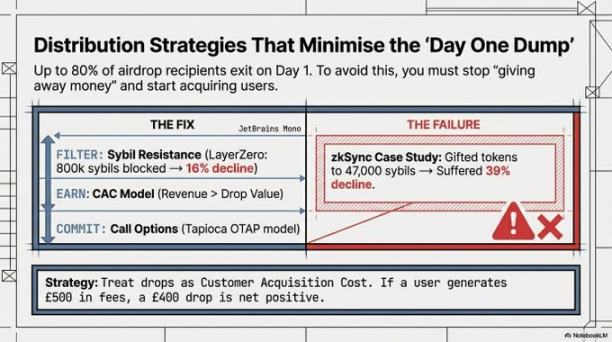
- @LayerZero_Core invested heavily pre-launch, identifying 800,000 Sybil addresses (airdrop-farming accounts). These users would dump tokens instantly and vanish forever. Result: only a 16% decline in Month 1.
- zkSync applied minimal filtering, resulting in 47,000 Sybil addresses receiving airdrops. Result: a 39% decline over the same period.
That 16% vs. 39% gap is the cost of skipping homework.
Anti-Sybil measures may seem cumbersome—but ask yourself: Are you paying for real users, or feeding parasites? Airdrop farmers don’t want your product—they want your tokens. Raise the cost of entry for non-users.
Talisman #2: Revenue-Based Airdrops — Treat Airdrops as “Customer Acquisition Cost”
Reframe airdrops: Don’t treat them as “community rewards.” Treat them as “customer acquisition cost.”
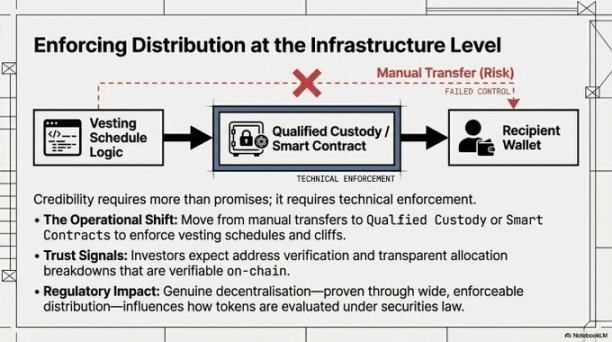
If a user pays $500 in protocol fees, and you reward them with $400 worth of tokens—even if they sell all tokens immediately, the acquisition remains profitable (net +$100). Real economic activity has already occurred; token selling is just a ledger entry—not a crisis.
Talisman #3: Infrastructure Readiness — Don’t Roll Out an Engineless Car
Staking and governance functions must be fully operational *the moment* the token launches—not “coming soon,” not “in development,” but *immediately available.*
Without them, this happens:
Early supporters receive tokens but find they cannot stake for yield or vote on proposals. Capital sits idle. Idle, non-yielding capital gets sold—not out of disloyalty, but basic financial logic.
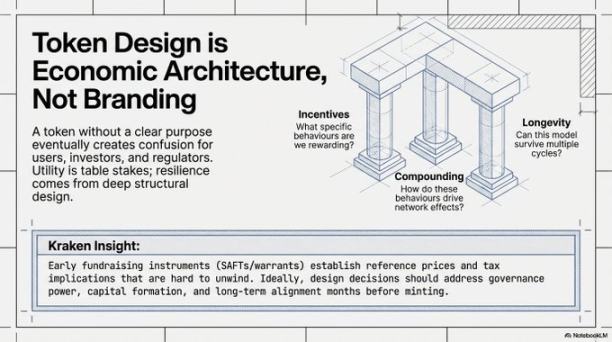
Also, a qualified custody solution must be live from Day One—it’s a hard requirement institutional investors scrutinize. If custody is merely a multisig without a compliance framework, large capital won’t enter. This isn’t bureaucracy—it’s their risk management.
Talisman #4: Choosing the Right Market Maker — Understand What You’re Buying
Market makers provide “depth” (market liquidity), not “demand” (buyers). This distinction is critical. Some founders hire market makers expecting a “price protection squad.” They only smooth existing trades—they don’t create buyers.
- The “retainer model” is more transparent and preferable.
- The “borrowing model,” while functional, inherently conflicts: the market maker’s hedging needs oppose your goal of price stability.
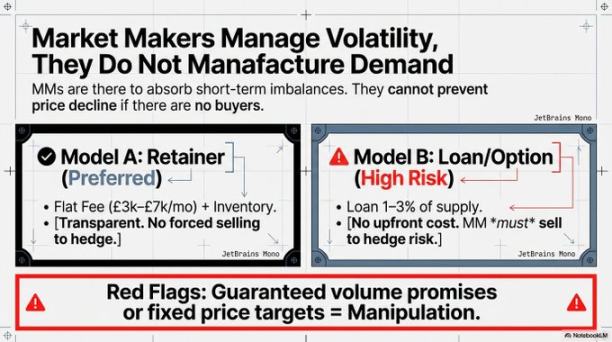
Red flags when selecting a market maker:
- Guaranteeing volume targets
- Refusing to accept your terms
- Promising to “support price” under massive sell pressure
These may indicate wash trading—not legitimate market making.
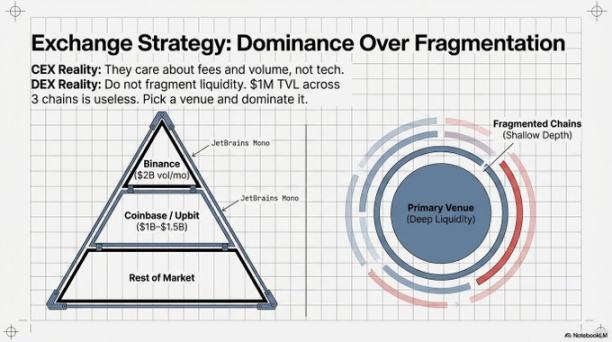
Liquidity must be concentrated. Spreading $1M across three chains leaves shallow depth on each—vulnerable to any volatility. Focus on one primary venue and deepen liquidity there. Depth in one place beats thin coverage across three.
Ultimate Goal: Decentralization
The infrastructure and distribution strategies discussed above are defensive. The true long-term objective is for the protocol to mature across four dimensions:
- Decentralized Development: Not just internal devs writing code—but third parties contributing via funded programs.
- Decentralized Governance: Transparent decision-making, multi-stakeholder participation, and execution of actual proposals.
- Decentralized Value Distribution: Economic design that benefits broad participants—not just an internal clique.
- Decentralized Participation Channels: Global users can stake, vote, and engage via low-barrier, compliant mechanisms—not limited to crypto veterans.
This is where the Arrakis framework shines. A protocol that launches fully prepared—but fails to advance real decentralization—only postpones centralized risk. It doesn’t solve it.
Final Thoughts
Arrakis’s research stands out as one of the most rigorous TGE analyses this quarter. Its core insight is correct: token launches are infrastructure deployments—not marketing events.
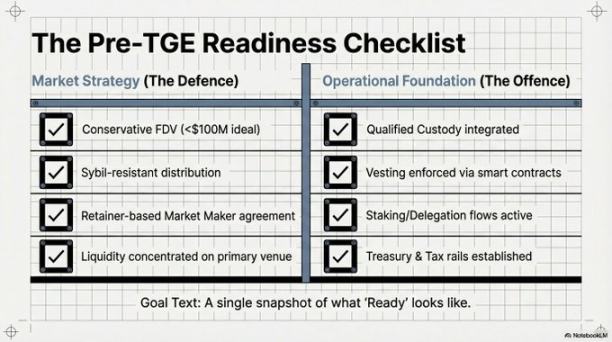
Teams treating launches as marketing often produce flashy “Week 1 charts”—followed by ski-jump crashes. Teams treating them as infrastructure—rigorously modeling sell pressure, preparing months ahead, avoiding inflated FDVs, filtering sybils—consistently land among the surviving 15%.
We’d add one point: Real demand for the token must stem from the protocol’s intrinsic utility—not marketing hype. Users must genuinely need the token to access the value created by the protocol. If the token’s sole use case is “governing an unused protocol,” even perfect Sybil resistance and flawless custody won’t save it. Governing something useless has no value.
Before planning your token launch, focus first on building real demand.
Join TechFlow official community to stay tuned
Telegram:https://t.me/TechFlowDaily
X (Twitter):https://x.com/TechFlowPost
X (Twitter) EN:https://x.com/BlockFlow_News
 @eli5_defi















