Spring Festival Asset Security Handbook: How to Protect Your Tokens While Visiting Family and Friends
TechFlow Selected TechFlow Selected
Spring Festival Asset Security Handbook: How to Protect Your Tokens While Visiting Family and Friends
The Spring Festival is a time when the pace slows down, and it is also the most suitable time window of the year to restructure risk profiles.
 Navigating Web3 tides with focused insights
Author: imToken
As the Lunar New Year approaches, it’s once again time to bid farewell to the old year and welcome the new—a natural moment for reflection:
Did you fall victim to a rug pull last year? Did you buy in right before the price dropped—“buy and stand guard”—because of hype from KOLs calling trades? Or were you caught by increasingly rampant phishing attacks, suffering losses after clicking malicious links or signing fraudulent contracts?
Objectively speaking, the Spring Festival itself does not create risks—but it can amplify them. When fund flows accelerate, when attention is diverted by holiday activities, and when trading pace quickens, even minor oversights become far more likely to escalate into real losses.
So if you’re planning to rebalance your positions or organize your funds around the holiday period, consider giving your wallet a “pre-holiday security checkup.” This article outlines several real-world, high-frequency risk scenarios—and details concrete steps ordinary users can take.
I. Beware of AI Deepfakes and Voice-Simulation Scams
The recent viral sensation SeeDance 2.0 has reminded everyone of an uncomfortable truth: in this era of accelerating AGI adoption, “seeing is believing” and “hearing is believing” are no longer reliable.
Indeed, starting in 2025, AI-powered video and voice fraud technologies have matured significantly—voice cloning, face-swapping, real-time facial expression mimicry, and tone simulation have all entered an “industrialized phase”: low-barrier, scalable, and easily replicable.
Today, AI can even precisely reconstruct a person’s voice, speech rhythm, pauses, and subtle facial expressions. That means such risks are especially heightened during the Spring Festival.
For example, while traveling home or during a lull at a family gathering, you receive a voice or video message on Telegram or WeChat from someone in your contact list—urgently claiming their account is restricted, they need help sending red packets, or asking you to temporarily advance a small amount of tokens. They request an immediate transfer.
The voice sounds perfectly natural; the video even shows a “real person.” With your attention fragmented by holiday distractions, how would you verify authenticity?
In previous years, video verification was nearly the most reliable identity check—but today, even live video calls with the camera on are no longer 100% trustworthy.
Under these circumstances, relying solely on visual or audio cues is no longer sufficient. A more robust approach is to establish offline verification mechanisms with your inner circle—family members, business partners, or long-term collaborators—such as pre-agreed secret codes or questions whose answers cannot be deduced from publicly available information.
Also worth re-examining is a common pathway risk: links forwarded by acquaintances. Traditionally, terms like “on-chain red packets” or “airdrop bonuses” easily go viral across Web3 communities during the Spring Festival. Many users aren’t scammed by strangers—they click carefully disguised authorization pages because they trust friends’ forwards.
Thus, remember this simple yet critical principle: Never click any unverified link directly from social media—even if it comes from a “trusted contact”—and never authorize anything via such links.
All on-chain operations should be conducted exclusively through official channels, bookmarked URLs, or trusted entry points—not inside chat windows.
II. Conduct a “Year-End Wallet Cleanup”
If the first category of risk stems from technologically forged trust, the second arises from hidden vulnerabilities we ourselves accumulate over time.
As widely known, token approvals are among the most fundamental—and most overlooked—mechanisms in DeFi. Every time you interact with a dApp, you grant a smart contract permission to manage your tokens. That permission may be one-time or unlimited; short-lived or persisting indefinitely—even long after you’ve forgotten the interaction ever occurred.
Ultimately, approvals themselves may not pose immediate danger—but they represent persistent exposure surfaces. Many users mistakenly believe assets are safe as long as they’re not held within a contract. Yet during bull markets, people frequently experiment with new protocols—participating in airdrops, staking, yield farming, and other on-chain interactions—leading to a steady accumulation of approvals. When interest wanes and protocols fall out of use, those permissions often remain active.
Over time, these redundant historical approvals resemble a pile of unattended keys. If a long-forgotten protocol later suffers a smart contract vulnerability, losses can quickly follow.
The Spring Festival offers a natural opportunity for cleanup. Using the relatively calm window before the holiday, conducting a systematic review of your approval history is a highly worthwhile action:
Specifically, revoke unused approvals—especially unlimited ones; apply limited-amount approvals for large holdings you hold regularly, rather than granting full balance access indefinitely; and separate long-term asset storage from daily operational assets—establishing a clear hot-wallet/cold-wallet tiered structure.
In the past, users often relied on external tools (e.g., revoke.cash) for such audits. Today, major Web3 wallets natively support approval detection and revocation—allowing direct inspection and management of historical approvals within the wallet interface.
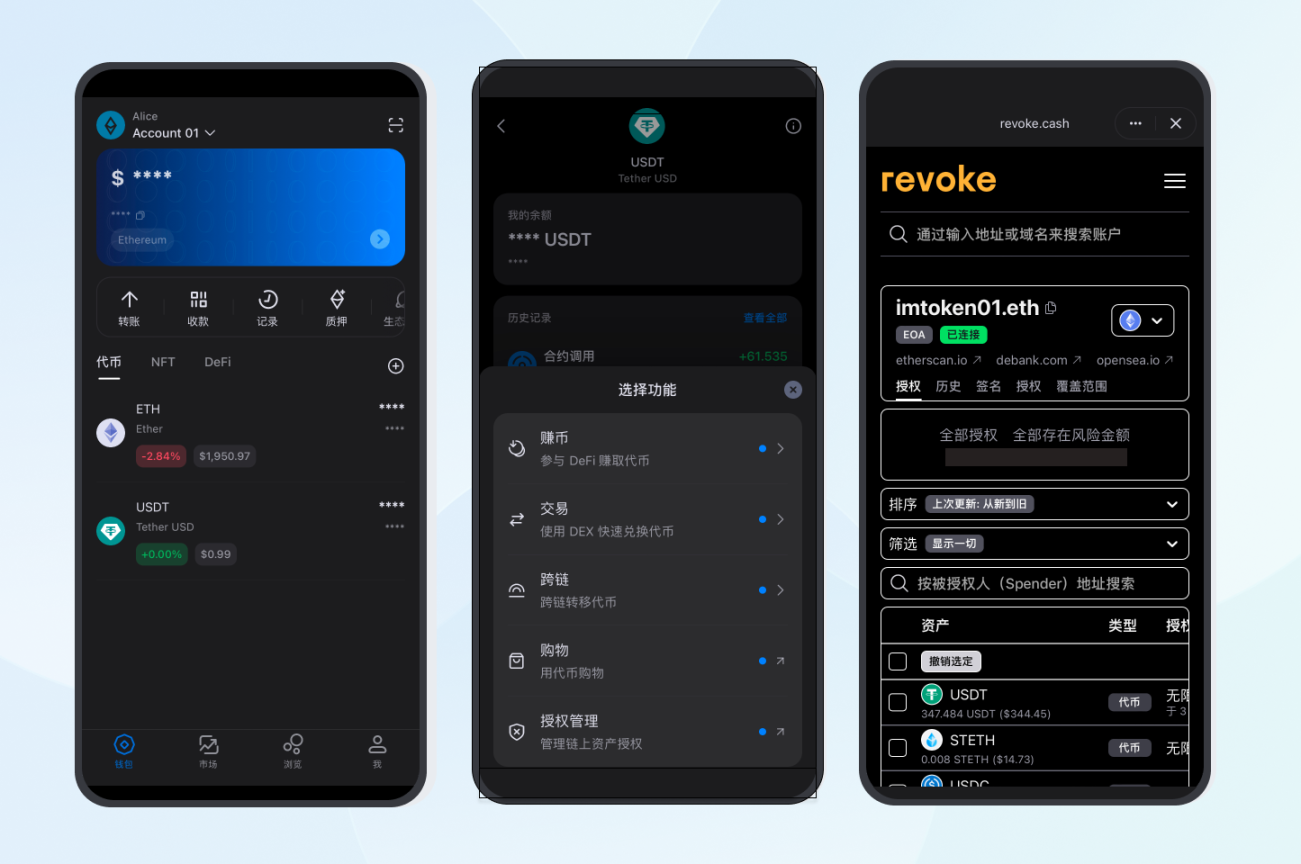
At its core, wallet security isn’t about never approving—but about adhering to the principle of least privilege: granting only the permissions strictly necessary for current tasks, and promptly revoking them when no longer needed.
III. Stay Vigilant During Travel, Socializing, and Routine Operations
If the first two categories stem from technological advancement and permission accumulation, the third arises from environmental shifts.
Spring Festival travel—returning home, vacationing, visiting relatives—often entails frequent device switching, complex network environments, and dense social interactions. In such contexts, private-key management and routine operational security become markedly more fragile.
Mnemonic phrase handling is the classic example. Saving mnemonics as screenshots in your phone gallery or cloud storage—or forwarding them to yourself via instant messaging—is usually done for convenience. But in mobile settings, that very convenience becomes the greatest vulnerability.
So remember: Your mnemonic must remain physically isolated—never stored online. The baseline for private-key security is complete air-gapping.
Social situations also require boundaries. Casually displaying large asset balances or discussing specific portfolio sizes during festive gatherings may seem harmless—but can inadvertently lay the groundwork for future risks. Even more dangerous are attempts—under pretexts like “sharing experience” or “teaching guidance”—to coax you into downloading counterfeit wallet apps or browser extensions.
All wallet downloads and updates must be performed exclusively through official channels—not via redirects from chat windows.
Beyond that, always confirm three things before sending any transaction: network, recipient address, and amount. Countless whales have already lost substantial assets due to “similar-start-and-end-address” attacks—where attackers generate massive numbers of addresses matching legitimate ones only in the first and last few characters. In recent months, such phishing attacks have become industrialized:
Attackers generate vast “seed libraries” of blockchain addresses with varying start/end character combinations. Once a target address receives funds, attackers instantly scan their seed library for matches—and immediately execute associated transactions, casting wide nets in hopes of catching victims.
Some users copy addresses directly from transaction histories and only verify the first and last few characters—falling prey exactly as intended. As Yu Xian, founder of SlowMist, put it: “These start-and-end-address phishing attacks are pure spray-and-pray—voluntary bites, probabilistic games.”
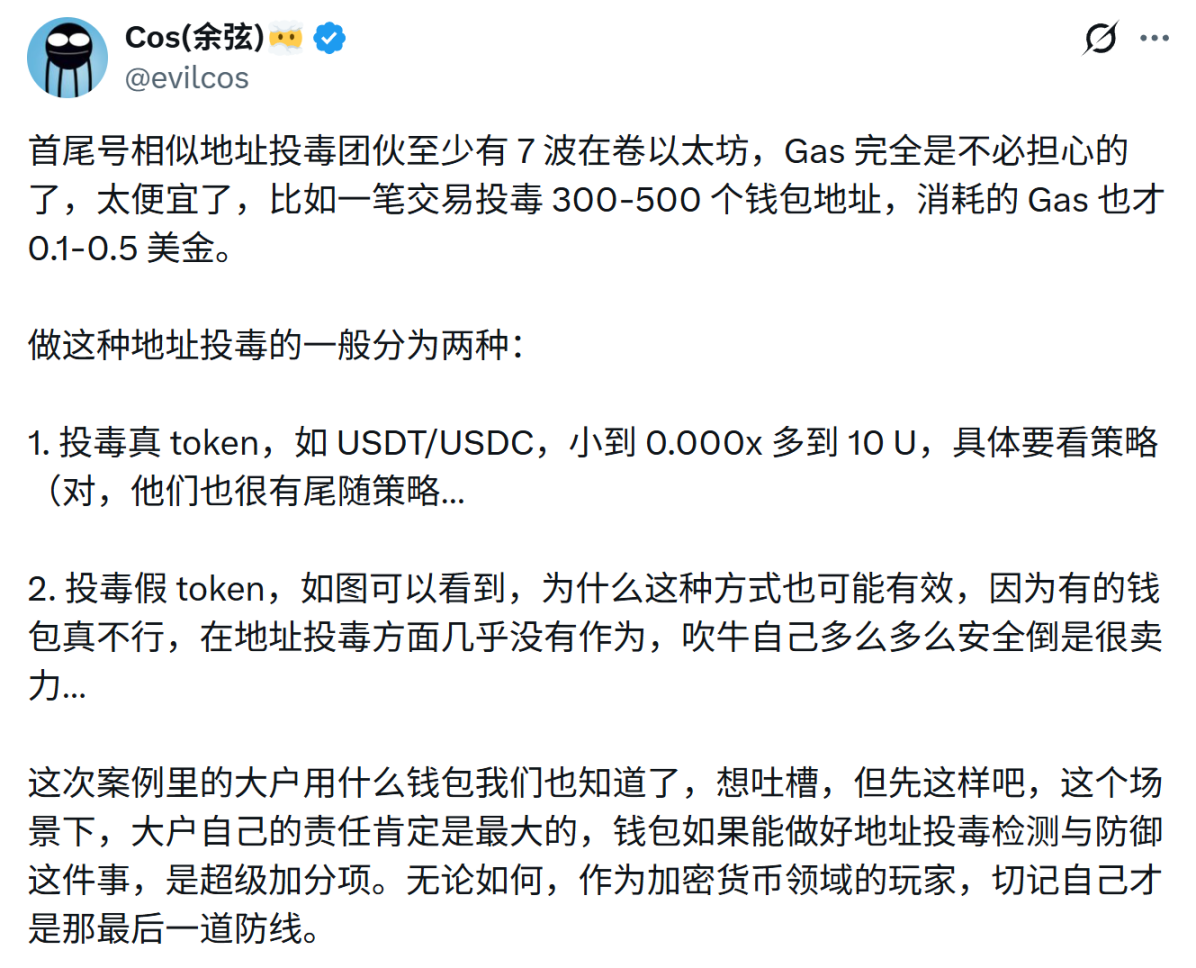
With near-zero gas costs, attackers can poison hundreds or even thousands of addresses en masse—waiting for just a few users to slip up while copying and pasting. One successful hit yields returns vastly exceeding the cost.
None of these issues involve sophisticated technology—they stem entirely from everyday habits:
- Verify the full address string—not just the first and last few characters;
- Never copy a recipient address directly from transaction history without thorough verification;
- Before sending to a new address for the first time, always conduct a small test transaction;
- Prioritize using address whitelisting features to securely manage frequently used addresses;
Within today’s EOA-dominated decentralized ecosystem, users remain their own first line of defense—and final safety net.
Final Thoughts
Many feel the on-chain world is simply too dangerous—and unfriendly to ordinary users.
Frankly, Web3 indeed cannot offer a zero-risk environment—but it *can* become one where risks are manageable.
The Spring Festival is a moment of slower pace—and arguably the best annual window to restructure and audit your risk posture. Rather than scrambling to act hastily during the holiday, proactively complete your security checks now. Rather than reacting post-loss, optimize permissions and habits in advance.
Wishing you a safe and joyful Spring Festival—and may every user’s on-chain assets remain stable and secure throughout the coming year.
Join TechFlow official community to stay tuned
Telegram:https://t.me/TechFlowDaily
X (Twitter):https://x.com/TechFlowPost
X (Twitter) EN:https://x.com/BlockFlow_News
 @imTokenOfficial