Wall Street's Move into Prediction Markets Signals the End of the Retail Frenzy Era
TechFlow Selected TechFlow Selected
Wall Street's Move into Prediction Markets Signals the End of the Retail Frenzy Era
When Wall Street's sophisticated machinery begins operating at full speed, the era of easy profits from information asymmetry may be gone for good.
 Navigating Web3 tides with focused insights
By Niuke, TechFlow
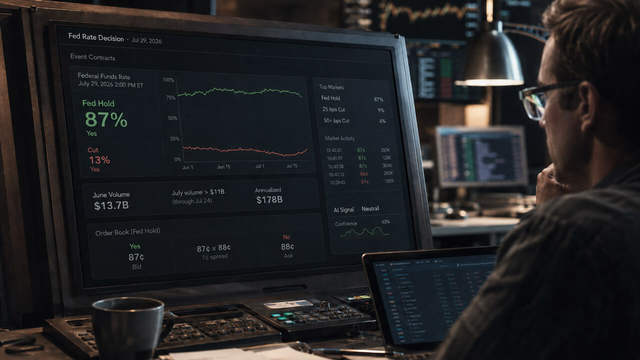
It’s finally happening. The prediction markets, once dominated by political enthusiasts, speculative retail traders, and bounty hunters, are now welcoming a new wave of quiet yet deadly players.
According to a Thursday report by the UK's Financial Times, several prominent trading firms—including DRW, Susquehanna, and Tyr Capital—are building dedicated teams for trading on prediction markets.
DRW posted a job listing last week offering up to $200,000 in base salary for traders capable of “real-time monitoring and trading active markets” on platforms like Polymarket and Kalshi.
Susquehanna, an options trading giant, is hiring prediction market traders who can “detect incorrect fair values,” identify “anomalies” and “inefficiencies” in prediction markets, while also assembling a specialized sports betting trading team.
Crypto hedge fund Tyr Capital continues to recruit prediction market traders who are already running complex strategies.
The data underscores this expanding ambition.
Monthly trading volume has surged from less than $100 million at the beginning of 2024 to over $8 billion by December 2025, with a record single-day volume of $701.7 million reached on January 12.
When the capital pool grows deep enough to accommodate institutional scale, Wall Street’s entry becomes inevitable.
Arbitrage First
In prediction markets, institutions and retail investors aren’t even playing the same game.
Retail traders often rely on fragmented information to predict individual events—an activity that remains essentially gambling. Institutional players, by contrast, focus on cross-platform arbitrage and structural market opportunities.
In October 2025, Boaz Weinstein, founder of hedge fund Saba Capital Management, said during a closed-door meeting that prediction markets allow portfolio managers to hedge investments with greater precision, particularly around the probability of specific events occurring.
Standing next to Polymarket CEO Shayne Coplan at the time, he remarked: “A few months ago, Polymarket priced the odds of a recession at 50%, while credit markets implied only about 2%. You can now design countless pairs trades that were previously impossible.”
According to Weinstein, a hedge fund manager could buy a “no recession” contract on Polymarket, which would be relatively cheap given the 50% perceived likelihood of recession.
At the same time, they could short bonds or credit products in the credit market that would plummet during a downturn—products still priced high due to the market pricing in only a 2% chance of recession.
If a recession does occur, the small loss on Polymarket would be dwarfed by large gains in the credit market as overvalued bonds collapse.
If no recession occurs, the trader profits on Polymarket and may take a small loss in credit markets—but still ends up net positive overall.
Prediction markets have thus become a novel “price discovery tool” for traditional finance.
The Arrival of the Privileged Class
What further tips the scales are privileges built into the rules themselves.
Susquehanna is Kalshi’s first designated market maker and has entered into event contract agreements with Robinhood.
Kalshi offers market makers numerous advantages: lower fees, special trading limits, and more streamlined access—specific terms remain undisclosed.
The arrival of market makers will rapidly transform this landscape.
Previously, prediction markets frequently suffered from liquidity shortages, especially for niche events. When attempting to trade large volumes, users often faced wide bid-ask spreads or simply couldn’t find counterparties.
Professional institutions will quickly eliminate obvious pricing errors. Any noticeable price discrepancies across platforms—or clearly irrational probability pricing—will be swiftly arbitraged away.
This is hardly good news for retail traders. The days when you could easily profit by spotting that “Trump winning” was priced at 60% on Polymarket versus 55% on Kalshi will likely vanish.
With Wall Street employing PhDs earning six-figure salaries, prediction contracts may soon enter an era of professionalization and diversification—going beyond simple binary event outcomes to include:
1. Multi-event combo contracts, similar to parlay bets in sports betting
2. Time-series contracts, predicting the probability of an event occurring within a specific timeframe
3. Conditional probability products—e.g., if event A happens, what’s the probability of event B?
...
Looking back at financial history, every emerging market—from foreign exchange to futures, and later cryptocurrencies—has followed a similar trajectory: ignited by retail traders, ultimately dominated by institutions.
Prediction markets are now repeating this cycle. Technological edge, capital scale, and privileged access will ultimately determine who survives in this game of probabilities.
For retail participants, while narrow opportunities may persist in long-term forecasts or niche domains, one reality must be accepted: when Wall Street’s precision machines begin operating at full speed, the era of easy profits from information asymmetry is likely gone for good.
Join TechFlow official community to stay tuned
Telegram:https://t.me/TechFlowDaily
X (Twitter):https://x.com/TechFlowPost
X (Twitter) EN:https://x.com/BlockFlow_News
 深潮TechFlow