From Crypto to Wall Street, Bitget TradFi: One Account to Buy Globally
TechFlow Selected TechFlow Selected
From Crypto to Wall Street, Bitget TradFi: One Account to Buy Globally
Bitget TradFi offers a cross-market, cross-asset unified account experience, making global asset allocation more flexible and convenient.
 Navigating Web3 tides with focused insights
Author: WhiteRunner
Looking back at the crypto industry in 2025, there have been too many unpredictable changes. The entire first half of the year was dominated by Trump, with regulations being implemented, policies turning friendly, BTC breaking new highs, and the industry filled with joy and laughter. Everything was running counter-cyclically and surging upward. However, after the largest liquidation event in crypto history on October 11th, countless people failed to escape the "slaughter," the crypto market turned bearish, and everything fell back to the starting point of the year.
Over the past year, Bitcoin's price has fallen by 7%, Ethereum's price has fallen by 10%, and the current sentiment index is "fear." Global economic uncertainty, coupled with a sharp drop in crypto market liquidity, multiple institutional liquidations, and increasing regulatory pressure, have led to capital outflows and reduced trading volume in the crypto market. The volatility of the cryptocurrency market is at a historical high, severely testing investors' risk tolerance.
In stark contrast to the crypto market, traditional financial market (TradFi) representative assets like gold and other precious metals have demonstrated remarkable resilience and appreciation over the past year. The price of gold broke its historical high, reaching above $4,500 at one point, with an annual increase of approximately 65%. Gold, originally seen as "traditional and old-fashioned" and a "safe-haven asset," suddenly became "attractive," performing far better than the "digital gold," Bitcoin.
Meanwhile, as crypto regulatory policies are gradually implemented across regions, many traditional financial institutions have begun to express their embrace of blockchain and attempt to tokenize assets. The integration of TradFi and the crypto market is a significant trend. "Gold tokenization" is one of the most noteworthy tracks within this trend. The "Gold Godfather," Peter Schiff, also announced a tokenized gold project recently. Some analysts believe that gold, through tokenization, gains DeFi liquidity, and its scale is expected to exceed $15 billion by 2026, becoming the most stable macro hedge anchor for RWA. The applicability of gold tokenization in the payment sector will pose a significant challenge to Bitcoin.
Facing these immense uncertainties, an all-in investment strategy focused on a single crypto asset carries extremely high risks. 2026 will undoubtedly be the inaugural year for diversified asset allocation. Now is an excellent time for you to re-evaluate your investment portfolio.
Why is there a crypto bear market and a gold bull market?
What factors have driven the remarkable performance of precious metals like gold this year?
Simply put, first, because the U.S. government's high deficits and debt issues remain unresolved, with the national debt approaching the $40 trillion mark. As the Federal Reserve cuts interest rates and inflationary pressures persist, the purchasing power of the U.S. dollar is weakened, leading investors to turn to value-preserving assets like gold to hedge against currency devaluation risks. Additionally, strategic reserve adjustments by global central banks have also contributed to continuously rising gold demand, especially amid the global de-dollarization trend, where gold is gradually becoming a core alternative asset.
It can be said that the more chaotic the world, the more valuable gold becomes, demonstrating its immense "anti-fragility."
Besides gold, physical assets in 2025 actually experienced a rare super bull market. Silver, another precious metal, surged by 152.04% over the past year. In forex, EUR/USD rose by 16.18%, and GBP/USD rose by 8.75%. Among global indices, the S&P 500 gained approximately 16.18%, the Nasdaq 100 gained 18.3%, and the Nikkei gained 29.3%.
In contrast, the "top two" cryptocurrencies (BTC and ETH) can only be described as somewhat awkward.
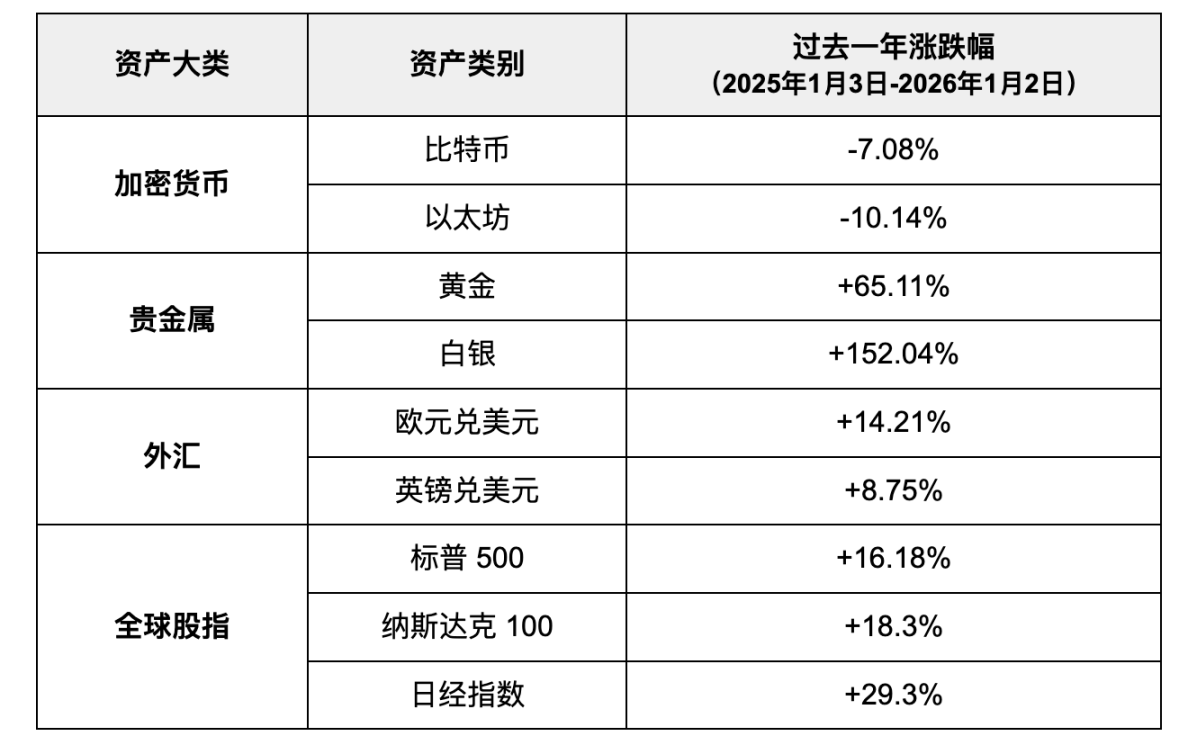
Data source: TradingView
From the above comparison, it can be seen that many crypto believers' investment strategies, which rely solely on the cryptocurrency market, actually face significant volatility risks when confronted with insufficient market liquidity or external shocks. In contrast, traditional safe-haven assets like gold, as well as TradFi markets like U.S. stocks and the Nikkei index, have demonstrated stronger risk resilience and steady appreciation potential.
Therefore, "don't put all your eggs in one basket." A diversified asset allocation strategy is becoming increasingly important. Appropriately diversifying investments through traditional assets like gold, silver, forex, or U.S. stocks can not only effectively hedge against volatility risks in the crypto market but also capture growth opportunities in other markets, helping investors achieve stable returns in different market environments.
Multi-asset opportunities are clear, but the path is fragmented
Although there are many opportunities for substantial returns in the global TradFi market, one of the challenges in capturing opportunities across different assets is the need to switch between various channels:
- Trade U.S. stocks on a brokerage app, participate in gold ETFs through funds
- If you want to participate in forex or crude oil, you need to additionally register on MT5 or a forex platform
- If you are also interested in crypto assets like Bitcoin and Ethereum, cryptocurrencies involve KYC, OTC deposits/withdrawals, wallet key custody, etc.
Each asset market requires separate accounts, fund transfers, and learning curves, making "multi-asset allocation management" extremely fragmented. The incompatibility between investment tools and assets is becoming the biggest obstacle to multi-asset allocation.
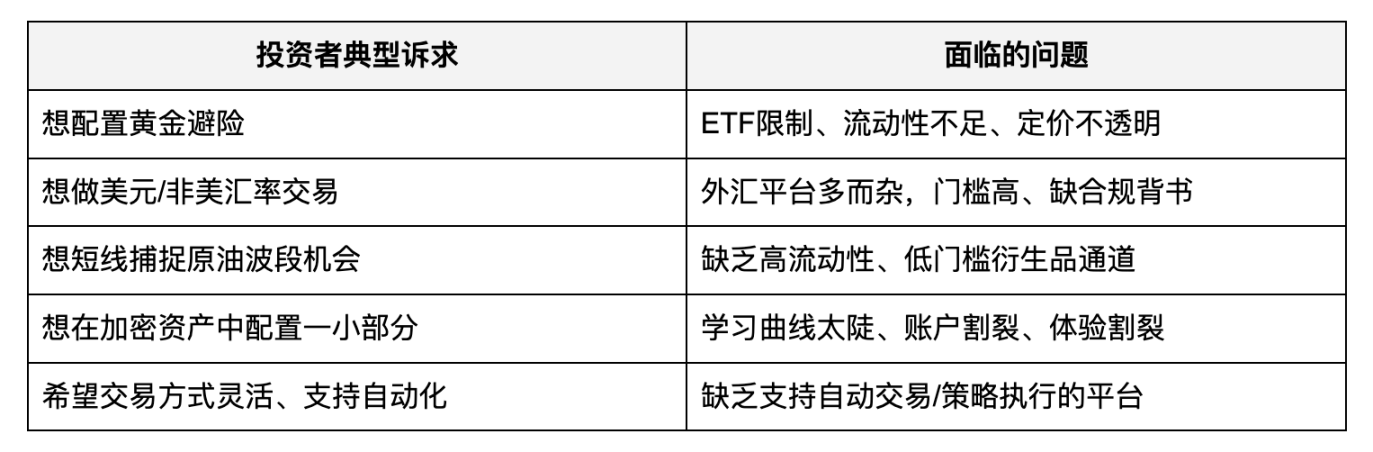
This is a structural mismatch: there are many cross-market opportunities globally, but tools in various fields are still confined to "local logic."
This is also the background of why I noticed Bitget TradFi. When Bitget announced the launch of TradFi, I quickly obtained test access to experience it. I believe its greatest value lies precisely in attempting to integrate this structural mismatch into a unified experience, consolidating multi-market trading under one account, one system, and one language to lower the psychological and technical barriers to "cross-asset allocation."
One account for multiple markets, asset allocation is no longer "fragmented"
Imagine this scenario: you have a sum of money, you want to capture an upward trend in the gold market, while also paying attention to USD/JPY exchange rate fluctuations, and you also hope to allocate a portion of funds to Bitcoin. Typically, you would need to operate across at least three platforms, involving separate registration, KYC, transfers, deposits/withdrawals, currency conversion, etc. The cumbersome steps waste not only time but also represent the cost of missed opportunities.
However, within Bitget TradFi's account system, the above operations can be completed under one account.
Unified account structure: from "asset fragmentation" to "asset synergy"
Bitget TradFi provides a unified trading account. Users utilize the stablecoin USDT as the base capital to directly participate in various global asset trades, without needing to transfer funds to external platforms or convert to fiat currency.
The following outlines the core capabilities of this account structure:
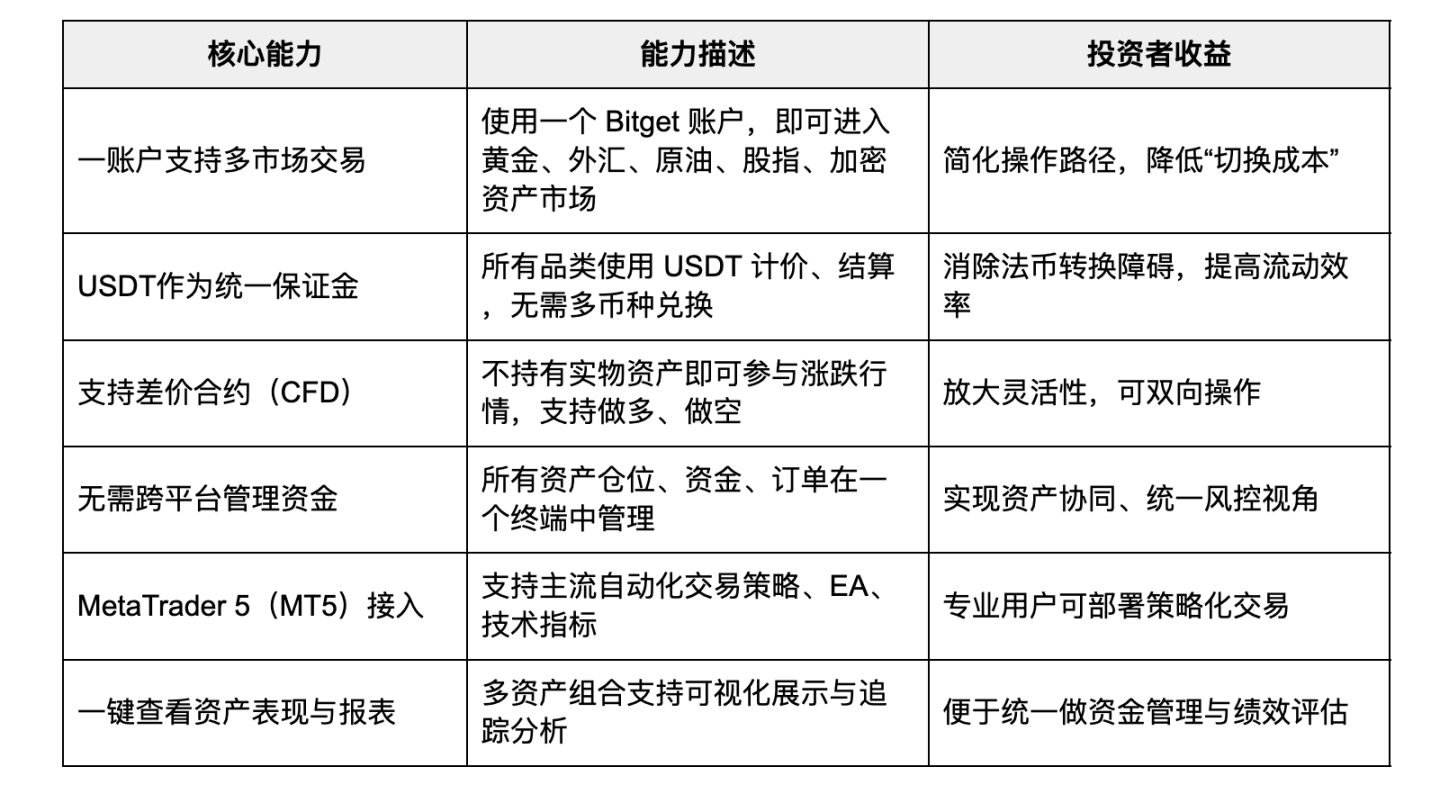
This structure is not an "addition" to a specific trading platform but a re-engineering of the underlying trading logic. It is more like integrating the capabilities of an "exchange + multi-asset broker + automated tools" into a compact trading workstation.
Advantages of this structure:
- No need to relearn new platforms or new systems. If you have used any exchange app before, Bitget TradFi's interface and logic will feel familiar. For traditional financial investors, the built-in MT5 will feel especially familiar, ensuring strong continuity in operational habits.
- Reduces the risk of fund dispersion and account fragmentation. You don't need to split your funds across multiple platforms, taking on the management responsibilities and potential risks associated with multiple platform accounts and funds.
- Facilitates the construction of cross-asset strategies. For example, simultaneously going long on gold and shorting U.S. stock indices, while using crypto assets to hedge tail risks—this is something traditional brokerages and crypto exchanges struggle to accomplish in a one-stop manner.
A typical configuration example:
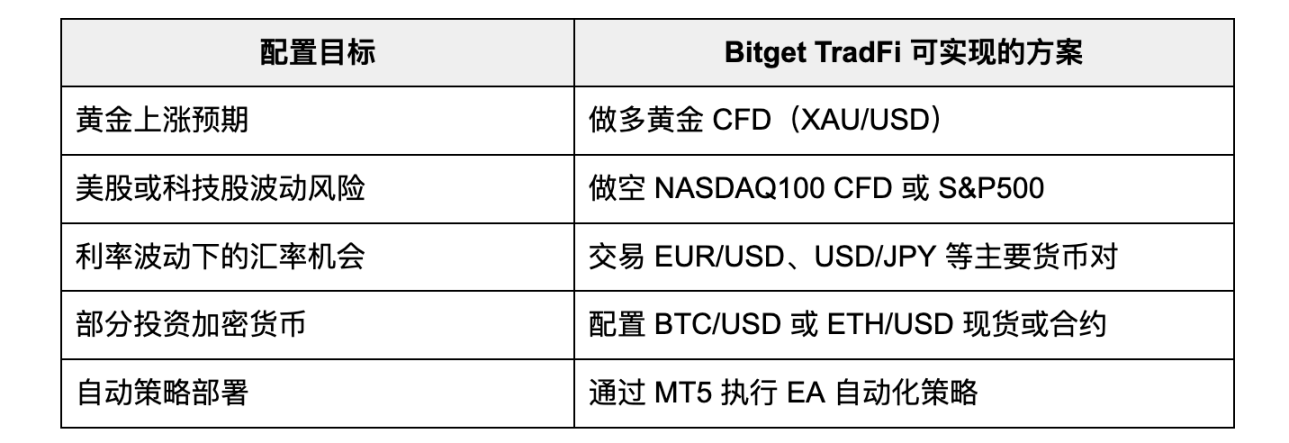
In the past, building such a portfolio might have required you to simultaneously manage a securities account, a forex account, a crypto exchange wallet, and several different risk control systems. Now, it only requires one Bitget TradFi account and one type of USDT capital.
This is a structural leap from "platform splicing" to "account integration."
Under this trend, the question "on which platform should I buy gold?" is itself being replaced by "in which system should I configure my all-market strategy?"
Can the trading experience balance both crypto and traditional finance?
In the financial markets, there are numerous choices for asset management platforms, but few truly offer an integrated trading experience. Traditional brokerages typically focus on risk control and compliance. While they ensure transaction security, their functionalities are often limited, struggling to meet modern investors' needs for multi-asset exposure and efficient operations. Crypto exchanges, while leading in flexibility and innovation, often lack sophisticated asset support and a unified account system, causing users to face complex operational and management issues during cross-market trading.
Bitget TradFi offers a middle path: through a unified operating system, it integrates various financial trading methods within the same account, while also providing the tool support needed by professional traders, breaking the limitations of traditional platforms. Bitget TradFi not only balances liquidity and efficiency but also meets investors' demands for convenient and flexible cross-market allocation.
Compared to traditional CFD brokerages, what advantages does Bitget TradFi have?
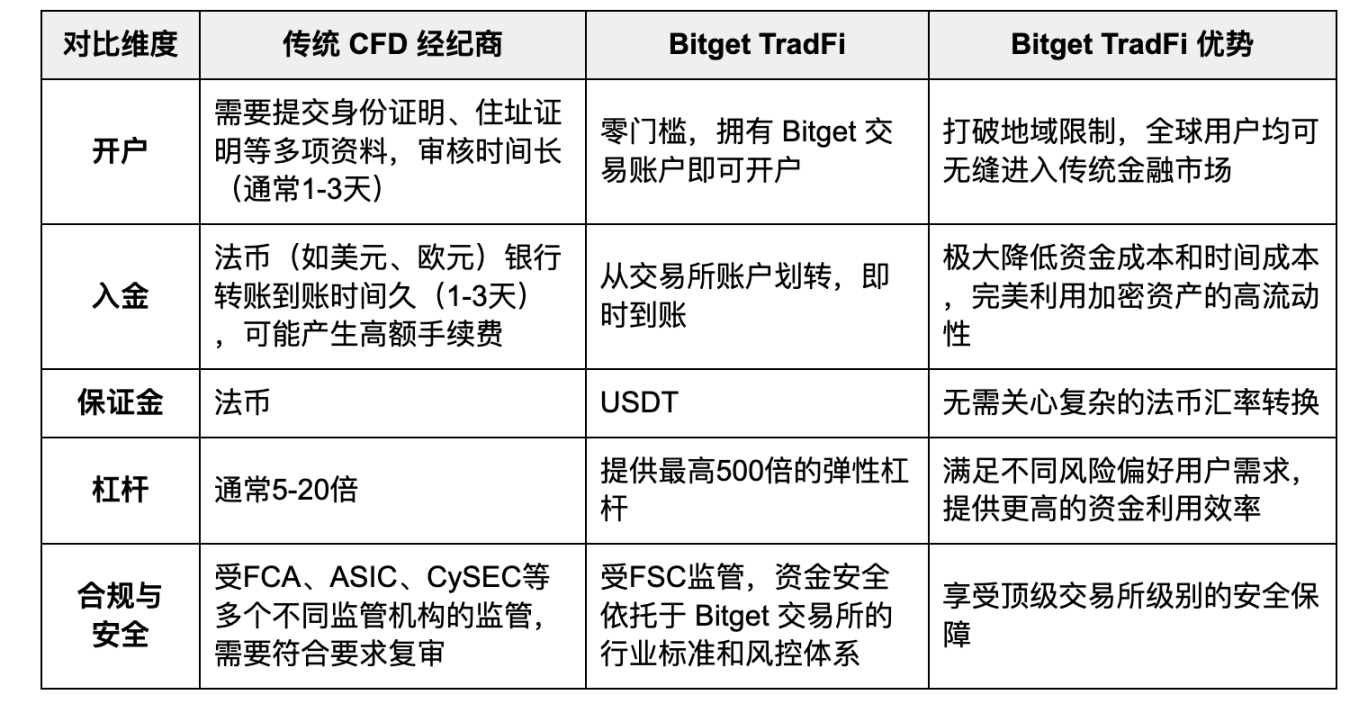
Platform security is more important than trading experience
Among all comparisons of trading platforms, there is one issue users easily overlook but should prioritize above all else: security.
No matter how good the trading experience or how comprehensive the features, if security or compliance issues arise at the platform level, the loss for users is "full-portfolio level." So, what are the actions in Bitget TradFi's security sector?
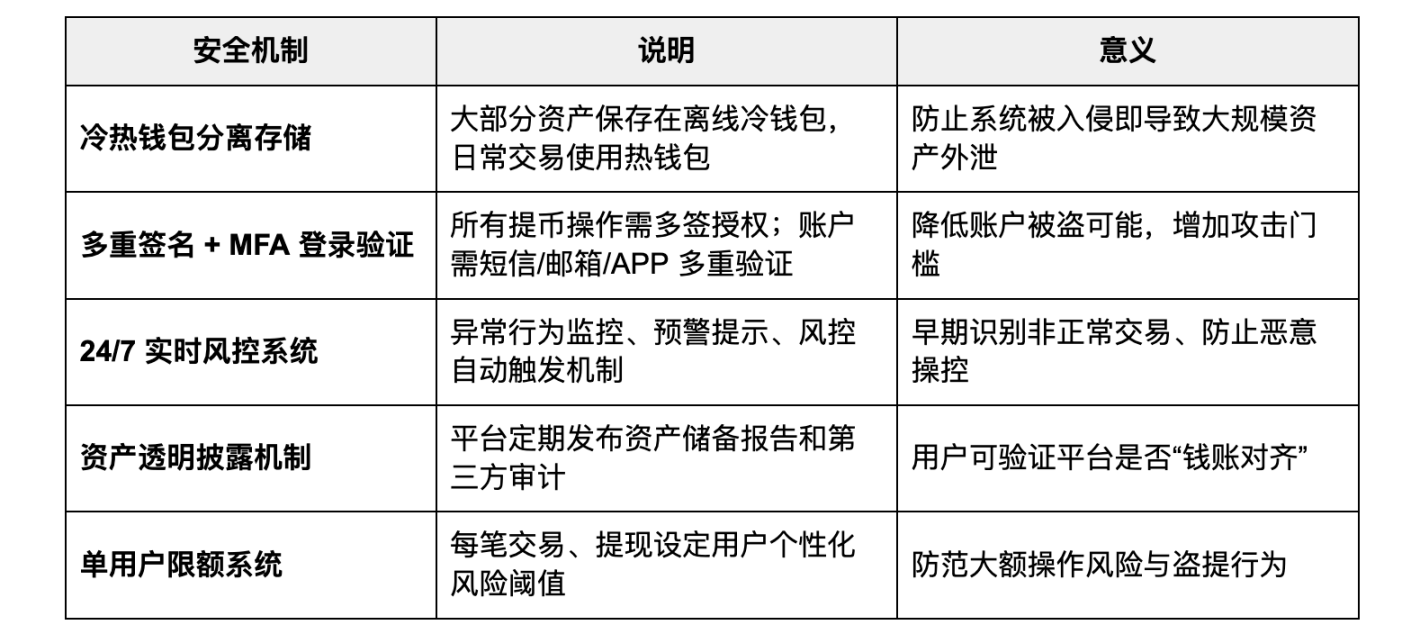
1. Security Mechanisms
As a mainstream global cryptocurrency exchange, Bitget has not experienced any major security incidents since its operation began in 2018. In terms of security design, Bitget TradFi continues its core mechanisms:
Security Mechanisms
Compliance Progress
Regarding compliance, Bitget TradFi adheres to mainstream international financial compliance frameworks. It has currently obtained a license from the Mauritius Financial Services Commission (FSC) and is actively applying for compliance qualifications in other countries or regions.
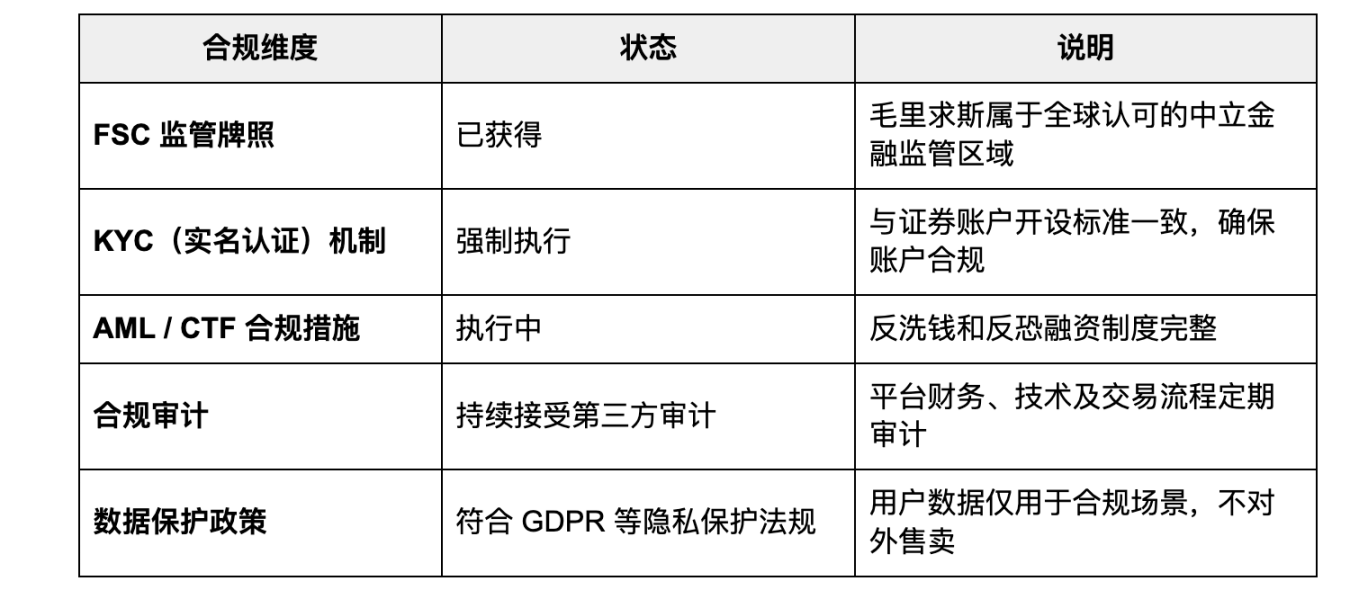
Although a unified "global regulatory system for crypto assets" is still lacking worldwide, more and more countries are introducing specific frameworks. Bitget's continuous advancement of compliance is the best choice for both the platform and its users.
So, what kind of users is Bitget TradFi suitable for?
For readers who have made it this far and are interested in trying Bitget TradFi, let me summarize its core features:
- USDT serves as the bridge between traditional finance and crypto assets;
- CFDs serve as the means for traditional asset allocation;
- A unified Bitget account manages all assets;
- MT5 and automated trading enhance investment strategy efficiency;
- Advancing security and compliance to safeguard investment activities.
So, is this platform worth joining? We can make a judgment based on several key points:
1. Is the trend of global asset allocation worth paying attention to? As diverse markets like gold, forex, stocks, and crypto assets become increasingly intertwined, the demand for global asset allocation will only grow. Whether you want to hedge against inflation, capture forex volatility, or seek investment opportunities in the crypto market, achieving cross-asset allocation on a single platform will significantly enhance your investment efficiency.
2. Does the trading experience meet the needs of professional investors? The multi-asset trading, leverage tools, automated strategies, deep liquidity, and other tools provided by Bitget TradFi offer flexibility and professionalism to investors with some trading experience. Through MT5 integration, investors can manage both traditional financial assets and crypto assets on the same platform, improving trading efficiency and the precision of strategy implementation.
3. Is the compliance and security trustworthy? Through the Mauritius FSC license, robust multi-layered security mechanisms, and compliant KYC/AML measures, Bitget TradFi provides a compliant and transparent trading environment, avoiding the risks users face when trading on opaque platforms. The platform's transparency and risk control capabilities can, to some extent, alleviate investors' security concerns.
4. Is it suitable for your investment style? If you are a middle-class investor pursuing flexible allocation, or if you have previously invested in multiple asset classes (including cryptocurrencies, stocks, forex, gold, crypto) and wish to manage these assets on a single platform, then Bitget TradFi is undoubtedly an ideal choice. It provides you with a convenient operational experience while supporting diversified asset allocation and risk management.
In summary, it is primarily suitable for the following two types of investors:
- Investors with experience in brokerage, banking, gold, forex, or derivatives trading
- Investors who follow global asset allocation trends and have cross-asset portfolio needs
Not just a platform, but a starting point for global asset allocation
This article reviewed how Bitget TradFi responds to market demand changes, from its unified account structure and USDT as the unified currency for cross-asset trading to professional trading tools and a comprehensive security and compliance system, providing investors with a new way of asset allocation and management.
As global market uncertainty increases, investors can no longer rely on single-market investment logic. The cross-market, cross-asset unified account experience provided by Bitget TradFi makes global asset allocation more flexible and convenient.
If you are looking for a new way to diversify your assets and reduce risk, Bitget TradFi offers professional, systematic investment tools to help you navigate multiple markets and capture more opportunities, like a tokenized version of Wall Street.
Are you ready to embrace the new opportunities of global asset allocation?
Join TechFlow official community to stay tuned
Telegram:https://t.me/TechFlowDaily
X (Twitter):https://x.com/TechFlowPost
X (Twitter) EN:https://x.com/BlockFlow_News