Web3 Job Search Reality: The Bull Market Is Here, but the Jobs Are Gone
TechFlow Selected TechFlow Selected
Web3 Job Search Reality: The Bull Market Is Here, but the Jobs Are Gone
Positions are shrinking like a funnel, while job seekers flood in like a tide.
 Navigating Web3 tides with focused insights
By Ada & Liam, TechFlow
Token prices soar, job hunting freezes.
As Bitcoin breaks past $110,000 and Ethereum hits new highs, communities cheer "the bull market is here"—yet the hiring landscape tells a completely different story.
"10,000 applicants for 28 positions"—media headlines may sound exaggerated, but they reflect the real state of Web3 job hunting. Projects are laying off staff, positions are shrinking, and inboxes are flooded with resumes.
In social circles, Web3 recruiter Nancy couldn't help but remark: "This year's hiring standards have become increasingly stringent—not only do they screen for academic background and English proficiency, but also demand experience in vertical projects."
Beneath the surface prosperity lies a contracting, picky, and harsh Web3 workplace. The bull market effect in crypto markets and the industry’s “breaking into the mainstream” have drawn in countless young people and professionals transitioning from Web2—but they quickly discover: jobs aren’t as plentiful as imagined, nor are salaries as high as expected.
Why this contrast between “bull market noise and job market winter”?
As salary myths and survivorship bias lure newcomers, how many can truly establish themselves in this seemingly vibrant yet turbulent Web3 job market?
Soaring Token Prices, Job Market Winter
The Web3 recruitment market is often the most accurate barometer of the industry.
Bitcoin surpasses $110,000, Ethereum reaches new highs, and media outlets are filled with claims that “the bull market has arrived,” yet the reality of the job market is starkly different.
Antoniayly, founder of Web3 recruitment community abetterweb3, clearly perceives this disconnect: "The job market has been deteriorating for a long time—job seekers keep increasing while open positions continue to decline."
Where abetterweb3 once primarily posted job openings, it now increasingly serves as a “job seeker wall.” For example, between August 22 and 27, only 14 new job postings were added, while 24 job seeker profiles were submitted.
Behind these numbers lies a brutal truth: projects are undergoing massive “downsizing.” Even Lido, a staking protocol riding the Ethereum wave, cut 15% of its workforce this year; Sandbox, once a leading metaverse project, laid off 50% of its staff.
The primary market remains persistently depressed. Many once-prominent crypto VCs have either shut down or gone dormant. Without external VC funding, numerous projects reliant on financing have quietly folded—or pivoted toward the AI sector to survive.
The job market faces a severe case of “too many monks, too little porridge”: positions are shrinking like a funnel, while job seekers flood in like a tide.
With supply and demand so unbalanced, hiring teams have become more selective than ever.
"Since last year, many clients have raised their hiring standards—not only requiring candidates to come from major internet firms, but also demanding recent experience at well-known Web3 projects or exchanges,"
says James, founder of Web3 recruiting firm Talentverse. "For roles involving smart contracts, tokenomics, or on-chain interactions, relevant work experience is now mandatory."
Yet even meeting these hard requirements doesn't guarantee success in interviews.
"I've seen countless candidates from top-tier companies with strong technical skills, but their understanding of Web3 remains superficial," shares Yulia, a Web3 recruiter focused on overseas markets. "One P8-level candidate from a major tech giant froze for a full 30 seconds when asked, 'How would you design a MEV-resistant DEX?'"
Hard skills are merely an entry ticket. What employers value more are certain seemingly “mystical” qualities.
"Positive mindset, passion for the industry, intense curiosity, fast learning ability, self-motivation, independent thinking, stress tolerance…" James lists seven or eight traits in one breath. "These may sound intangible, but when candidates have similar backgrounds, these become the underlying criteria for selection."
Overseas teams impose even stricter standards. Yulia reveals her clients (mostly European and American projects) require not just fluent English, but also “cultural alignment.” "They’ll discuss meme culture and cypherpunk ethos during interviews—if you don’t get those references, you’re basically out."
Beneath shrinking hiring demands lies the widespread collapse of startup companies.
Antoniayly feels this deeply: "Around 2021, from infrastructure to applications—wallets, DeFi, social—crypto companies were consistently hiring. Now, only exchanges, major blockchains, and large DeFi apps are still recruiting. It’s as if all the small players in the industry have vanished."
Hiring strategies at exchanges are also shifting. Beyond traditional tech and product roles, more and more operations positions now demand Web2 growth experience. Amid fierce growth competition, candidates skilled in platforms like Bilibili, Xiaohongshu, and private traffic acquisition are becoming highly sought after.
But the most surprising trend involves age.
"Compared to the last cycle, age restrictions have actually loosened significantly," says James, challenging common assumptions. While internet workers worry about being “optimized” at age 35, Web3 is opening doors to some mid-career professionals.
The reason is practical: as Web3 integrates deeper with traditional finance, it needs not just coders, but seasoned professionals who understand capital, have networks, and can navigate regulation.
"Web3 is moving from its wild west phase into professionalization," James concludes. "In the past, courage was enough to strike gold. Now, we need talent combining professional expertise, industry insight, and resource integration."
Mismatched Expectations
Does Web3 lack talent?
"Yes and no." This answer is widely shared among interviewees.
This apparent contradiction highlights a structural issue in the Web3 talent market: on one side, thousands of job seekers submit resumes; on the other, exchanges and projects still struggle to find suitable candidates.
Nancy, based in Singapore and working mainly with top-tier exchanges, observes that operations roles represent a classic case of “false prosperity.”
"Every time we post an operations role, our inbox gets flooded," Nancy says wryly. "But fewer than 1% of applicants actually meet the requirements."
Where’s the problem?
"Many think operations means just tweeting and organizing events," Nancy explains. "But exchanges want domain experts. For futures operations, you must understand contract mechanics, risk control logic, and market maker thinking. For community operations, you need knowledge of DAO governance, tokenomics, and incentive mechanism design."
A real example: a major exchange advertised for a “DeFi Product Operations” role requiring candidates to independently design liquidity mining schemes. Out of hundreds of applications, fewer than 10 truly understood impermanent loss.
"Most people apply for Web3 roles using a Web2 mindset," Nancy summarizes. "They see the word ‘operations’ and apply, regardless of whether it’s content, user, or product ops. This scattergun approach doesn’t work in Web3."
The most subtle mismatch in crypto job hunting occurs between expectations and market realities.
Evan works with several Web3 projects whose founding teams hail from top-tier investment banks or exchanges. These elite teams set extremely high hiring bars, leaving very few qualified candidates.
"I searched the market for three months, interviewed over 50 people—none were a perfect fit," Evan laments. "In the end, I had to advise clients to adjust expectations: either train a product manager in Web3, or hire a Web3 PM to fill specific knowledge gaps."
This “ideal vs. reality mismatch” is common among Web3 startups. They hope to hire hybrid talent—big tech + Web3 experience—with startup-level salaries, only to end up empty-handed.
"Many founders live in their own bubble," complains a veteran recruiter. "They believe their project will be the next Uniswap, so top talent should join for the vision at a lower salary. But in reality, top talent has plenty of options."
Job seekers, too, face a “salary expectation gap.” Despite the outside perception of Web3 as a goldmine, salaries aren’t necessarily higher than expected.
Especially for those coming from traditional finance PE/VC or major internet firms, joining a top Web3 company might even mean taking a pay cut. Their reasons for switching are simple: Web2 has peaked, crypto offers more freedom, and there’s still a chance to achieve financial freedom through investments.
"Survivorship bias—crypto has spawned too many overnight success stories, attracting crowds who believe they can do the same," says an HR professional.
Unwritten Workplace Rules
In the Web3 job market, an unwritten “hierarchy of prestige” exists: tech > product > others.
The most visible manifestation of this hierarchy is the pay gap.
"At the same P7 level, a tech role’s compensation package could be two to three times that of an operations role," Nancy states bluntly. "And tech roles often include token incentives—operations roles rarely do."
Even more brutally, non-technical roles are highly replaceable. "We’ve seen countless cases where non-tech staff are eliminated quickly if they fail to meet targets or deliver high output," says Evan. "But tech roles offer clear career progression paths."
Why is this the case?
"Web3 is fundamentally a technology-driven industry," Evan explains. "No matter how good your marketing is, if the product is poor, users won’t adopt it. But if the product is genuinely innovative, people will flock to it even without promotion."
This “product-first” logic is especially evident in DeFi: Uniswap has almost no marketing team, yet rose to dominate DEXs thanks to its revolutionary AMM mechanism.
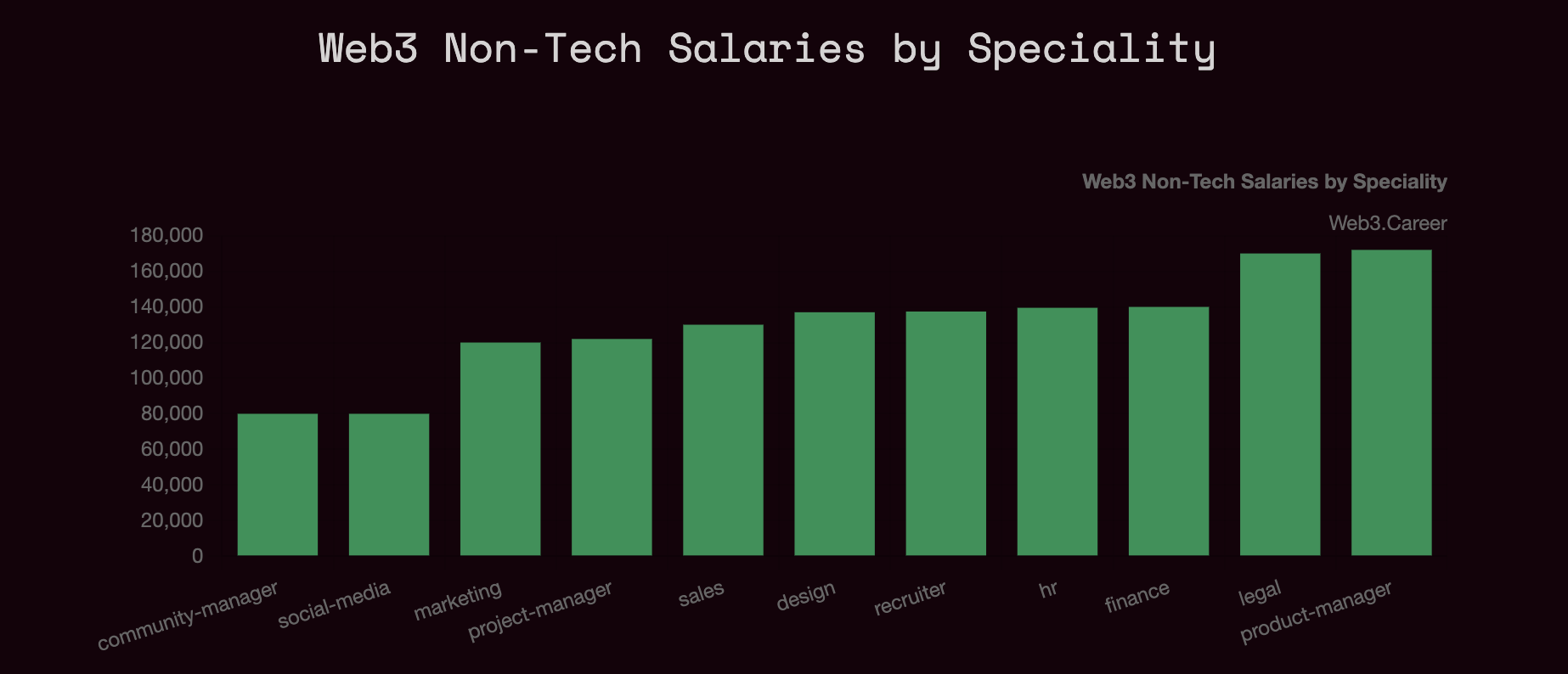
According to web3.career statistics, among non-technical roles, product managers earn the highest salaries, followed by legal, finance, HR, design, sales, project management, marketing, social media operations, and community managers…
Of course, exceptions exist.
"If you're a BD who can drive real business, your status rivals that of engineers," adds Nancy. "For example, a BD who secures a listing on a major exchange can easily earn over a million annually. But globally, there may be fewer than 50 such people."
Still, the crypto industry is far from welcoming to newcomers.
"We only screen—we don’t train. Training a complete beginner is too costly and time-consuming," declares a project founder.
If industry knowledge is the explicit barrier to Web3, then “community acceptance” is the implicit one.
"Web3 is an industry built on trust," says James, cutting to the core. In a space rife with rug pulls and scams, “referrals from trusted insiders” often carry more weight than any resume.
An unwritten rule in crypto: many positions are never publicly advertised.
"A significant portion of exchange hires I encounter happen through internal referrals," Nancy reveals. "Public recruiting takes too long and makes it hard to assess if someone truly understands the field. But if a core contributor recommends someone, you can usually trust it."
Hence, a curious phenomenon: employees who recently criticized a competitor suddenly join that rival; a well-known figure joins an exchange or institution as executive, and gradually brings in former colleagues. To them, old teammates are simply more trustworthy and easier to work with.
This “clique culture” is equally evident in overseas projects. One international Layer2 project includes in its job posting: must have attended ETHDenver or Devcon.
But clique culture has downsides. "It’s always the same people, referring each other, endorsing each other. For newcomers, the barrier to entry is just too high," says Nancy.
Finding Certainty in Uncertainty
Seeing so many rushing into Web3—does it spark your interest too?
Hold on—first consider a cautionary tale.
Evan once worked with a candidate: graduated from a top-tier Chinese university, served as a tech lead at a major internet company.
Seeking new opportunities, he joined a Web3 startup. A year later, the project failed to gain traction, fundraising collapsed, and the company disbanded—he was left unemployed. He tried applying elsewhere, but due to his niche focus in a now-cold sector, his experience didn’t transfer. After prolonged job searching with no results, he resorted to gig work to survive.
"Most people only see the survivorship bias stories, but disappointing cases like this happen every single day," Evan points out.
"Bull markets crave talent; bear markets leave doors empty. A project might fail in months. A hot sector today could be irrelevant in the next cycle."
Failed fundraising, crashing token prices, regulatory hurdles, hacker attacks—any one factor can eliminate a project.
"Web3 is a high-risk industry. If you seek stability, you probably shouldn’t come here," James concludes with cold clarity.
Yet despite this, some still choose to take the leap. Is there a relatively safer path?
Nancy offers advice: "If you have a solid background, start at a major internet firm—but don’t stay longer than three years—then transition to an exchange. They sit atop the Web3 ecosystem and are relatively stable."
Of course, some join startups out of passion and idealism, aiming to build something world-changing. Yulia mentions a candidate who worked as an algorithm engineer at a mid-sized financial firm, with no native Web3 experience. Through self-motivation and years of technical contributions on GitHub, he not only landed a role at a star project but rose to department head within a few years.
"The Web3 talent market, like cryptocurrency itself, is full of volatility," says James. "But in the long run, truly valuable talent—like Bitcoin—will always be recognized by the market."
For those still hesitating, Yulia offers practical advice: "Don’t obsess over going all-in. Just take the first step. Learn a smart contract language, join a DAO, try out DeFi once… Only by participating can you tell if this is your opportunity."
When we asked interviewees about future talent battlegrounds, the answers were strikingly consistent:
The convergence of AI and Web3, the integration of traditional finance with on-chain assets, and trading-focused infrastructure.
This may well be the next direction of talent migration—and the next frontier of Web3.
Join TechFlow official community to stay tuned
Telegram:https://t.me/TechFlowDaily
X (Twitter):https://x.com/TechFlowPost
X (Twitter) EN:https://x.com/BlockFlow_News
 深潮TechFlow