Does Google's blockchain qualify as a Layer1?
TechFlow Selected TechFlow Selected
Does Google's blockchain qualify as a Layer1?
Is GCUL truly a Layer1 public blockchain, or is it closer to a consortium blockchain in the traditional sense?
 Navigating Web3 tides with focused insights
Author: Nicky, Foresight News
Recently, Rich Widmann, Head of Web3 Strategy at Google, announced via social media that Google Cloud has officially launched its blockchain network, Google Cloud Universal Ledger (GCUL), positioning it as a "Layer1 blockchain." This has sparked discussions around its technical classification: Is GCUL truly a Layer1 public blockchain, or is it closer to a traditional consortium chain?
Official Positioning and Core Features
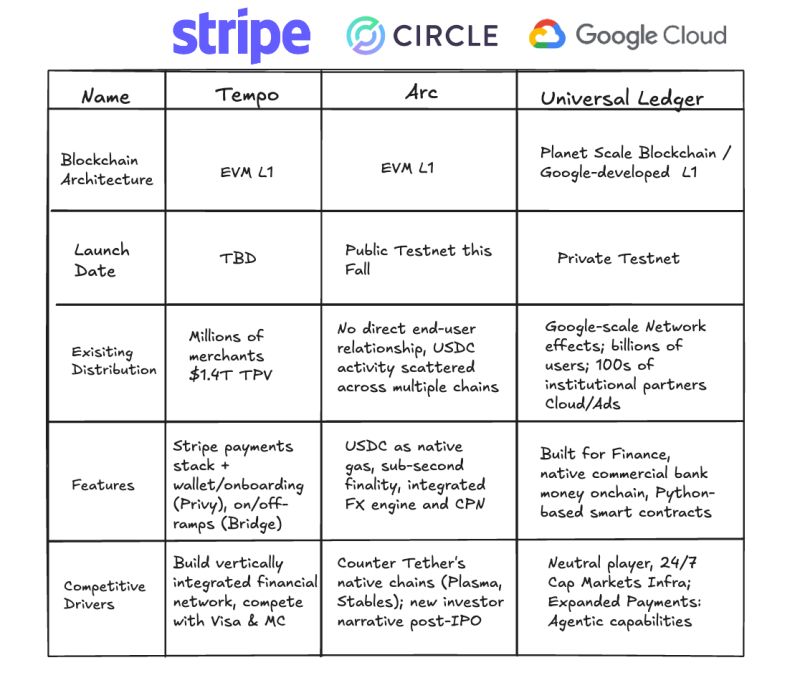
According to official descriptions, GCUL is designed as a "high-performance, trusted neutral, Python smart contract-enabled" distributed ledger platform. It is currently in a private testnet phase, primarily serving financial institutions. Google Cloud emphasizes that GCUL aims to simplify the management of commercial bank monetary accounts and enable multi-currency and multi-asset transfers and settlements through distributed ledger technology, while supporting programmable payments and digital asset management.
In the article "Beyond Stablecoins: The Evolution of Digital Currency," Google further clarified GCUL's positioning: it does not aim to "reinvent money," but rather to address fragmentation, high costs, and inefficiencies in traditional financial systems by upgrading infrastructure. GCUL is packaged as a service delivered via APIs, emphasizing usability, flexibility, and security—particularly advantages in compliance (such as KYC verification) and private deployment.
Notably, early testing of GCUL has already begun in collaboration with the Chicago Mercantile Exchange (CME Group). In March 2025, both parties announced the launch of a distributed ledger pilot to explore solutions for wholesale payments and asset tokenization.
CME CEO Terry Duffy stated that GCUL has the potential to improve efficiency in collateral management, margin settlement, and other areas under the trend of "24/7 trading." Rohit Bhat, Managing Director of Google Cloud Financial Services, described the partnership as a "typical example of traditional financial institutions transforming operations through modern infrastructure."
Layer1 vs Consortium Chain: Definitions and Differences
In the blockchain space, Layer1 typically refers to foundational public blockchains such as Ethereum and Solana, whose core characteristics include decentralization, permissionless access, and transparency. Any user can freely participate in network validation, transactions, or smart contract deployment, with on-chain data visible to all.
In contrast, a consortium blockchain is a permissioned distributed ledger jointly maintained by specific organizations or institutions, with controlled node access and customizable data access rights. Typical examples include Hyperledger Fabric and AntChain. Consortium chains offer advantages in compliance and performance but sacrifice openness and censorship resistance.
Which Model Does GCUL Fit Better?
Based on currently disclosed information, GCUL exhibits clear characteristics of a consortium chain:
-
Private and Permissioned: GCUL explicitly operates on a "private and permissioned network," with node admission and account permissions controlled by governing entities.
-
Target Users: Focused on financial institutions (e.g., CME Group), not open to public participation.
-
Compliance-First: Designed with traditional financial compliance requirements such as KYC verification and fee structures aligned with outsourcing regulations.
-
Technical Architecture: Although it supports smart contracts (based on Python), its underlying infrastructure is centrally maintained by Google Cloud, differing from the decentralized ethos of Layer1 blockchains.
Nevertheless, Google Cloud continues to refer to GCUL as a "Layer1," emphasizing "trusted neutrality" and "infrastructure neutrality"—meaning any financial institution can use it, not limited to specific interest groups. This narrative attempts to blur the boundary between public and consortium chains.
Third-Party Perspectives: Skepticism and Caution
Industry practitioners have expressed diverse views on GCUL’s positioning:
-
Liu Feng, Partner at BODL Ventures, believes GCUL aligns more closely with a "consortium chain," fundamentally different from decentralized, permissionless public blockchains.
-
Omar, Partner at Dragonfly, noted that Google's earlier descriptions of GCUL were ambiguous, but the team now clearly leans toward branding it as a "Layer1," despite incomplete disclosure of technical details.
-
Mert, CEO of Helius, pointed out that GCUL remains a "private and permissioned" system, distinct from the open model of public blockchains.
Despite skepticism, some view GCUL as a form of "incremental innovation." For instance, the pilot collaboration between Google and CME Group indicates institutional demand for distributed ledger technology in use cases like settlement and collateral management. If GCUL can integrate Google’s technological capabilities with financial compliance expertise, it may carve out a practical pathway between traditional finance and blockchain.
Disclaimer: This article is based on publicly available information. The specific technical architecture and operational model of GCUL are subject to further official disclosures by Google.
Join TechFlow official community to stay tuned
Telegram:https://t.me/TechFlowDaily
X (Twitter):https://x.com/TechFlowPost
X (Twitter) EN:https://x.com/BlockFlow_News
 Foresight News