

IOSG | Rebellion and Independence: Reassessing the Appchain Thesis
TechFlow Selected TechFlow Selected
IOSG | Rebellion and Independence: Reassessing the Appchain Thesis
With brand recognition, user mindshare, and highly customized on-chain capabilities, appchains can better accumulate long-term user value.
 Navigating Web3 tides with focused insights
Author: Jiawei @IOSG
Three years ago, we wrote an article about appchains, prompted by dYdX's announcement to migrate its decentralized derivatives protocol from StarkEx L2 to a Cosmos-based chain, launching its v4 version as an independent blockchain built on the Cosmos SDK and Tendermint consensus.
In 2022, appchains were likely a relatively niche technical option. By 2025, with the growing number of appchains—especially Unichain and HyperEVM—the competitive landscape is quietly shifting, forming clear trends centered around appchains. This article explores our appchain thesis from this perspective.
The Choices of Uniswap and Hyperliquid
Source: Unichain
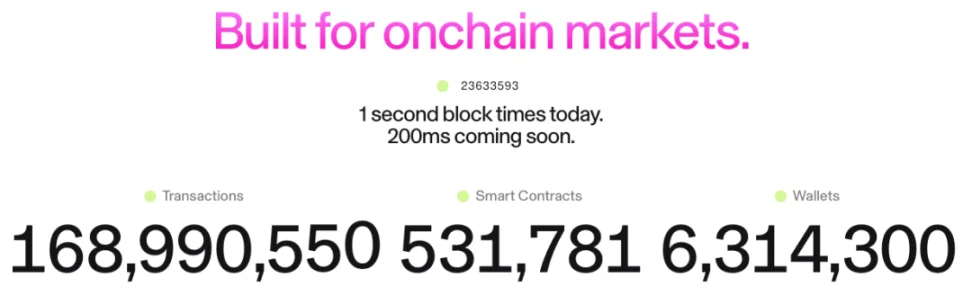
The idea of Unichain emerged early. Nascent founder Dan Elitzer published "The Inevitability of UNIchain" in 2022, arguing that Uniswap’s scale, brand, liquidity structure, and needs for performance and value capture pointed inevitably toward launching its own chain. Since then, discussions about Unichain have continued.
Unichain officially launched this February, with over 100 applications and infrastructure providers now building on it. Its current TVL is approximately $1 billion, ranking among the top five L2s. It plans to introduce Flashblocks with 200ms block times and a Unichain validator network in the future.
Source: DeFiLlama
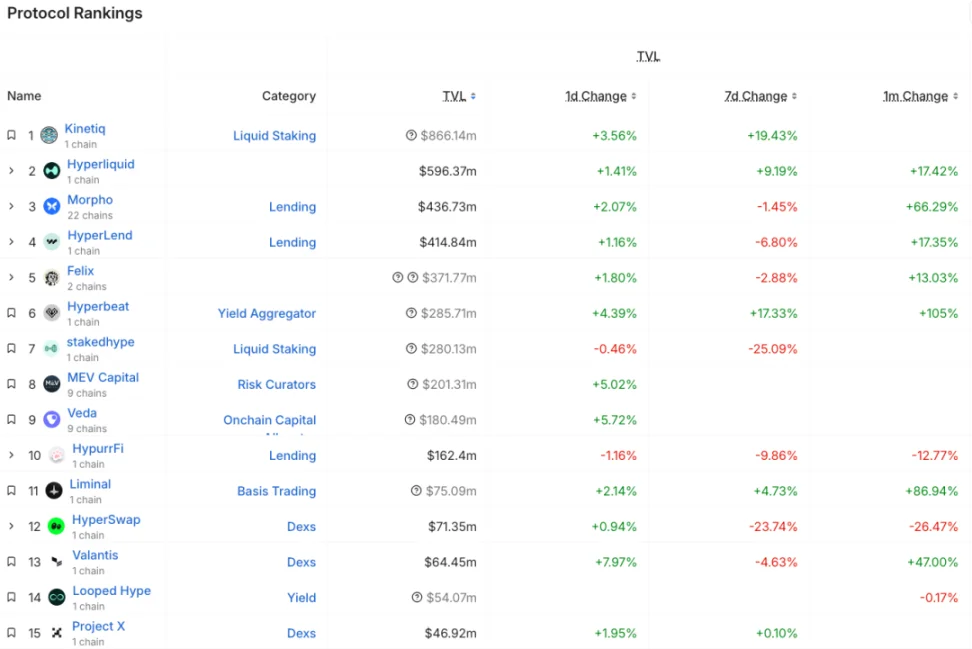
As a perp platform, Hyperliquid clearly had appchain and deep customization needs from day one. Beyond its core product, Hyperliquid has launched HyperEVM, secured by the same HyperBFT consensus mechanism as HyperCore.
In other words, beyond its powerful perp offering, Hyperliquid is exploring the possibility of building an ecosystem. The HyperEVM ecosystem already boasts over $2 billion in TVL, with ecosystem projects beginning to emerge.
From the development of Unichain and HyperEVM, two points stand out:
The L1/L2 competitive landscape is fragmenting. Combined, the Unichain and HyperEVM ecosystems exceed $3 billion in TVL. These assets would previously have resided on general-purpose L1s/L2s like Ethereum or Arbitrum. Top-tier apps going independent directly leads to the erosion of key value sources—TVL, trading volume, fees, and MEV—for these platforms.
Previously, L1s/L2s and apps like Uniswap or Hyperliquid enjoyed a symbiotic relationship: apps brought activity and users, while platforms provided security and infrastructure. Now, Unichain and HyperEVM themselves become platform layers, entering direct competition with other L1s/L2s. They compete not only for users and liquidity but also for developers, inviting other projects to build on their chains—significantly reshaping the competitive dynamics.
Unichain and HyperEVM follow expansion paths fundamentally different from today’s L1s/L2s. The latter typically build infrastructure first, then use incentives to attract developers. In contrast, Unichain and HyperEVM follow a “product-first” model—they begin with a market-proven core product possessing a large user base and strong brand recognition, then build an ecosystem and network effects around it.
This path is more efficient and sustainable. They don’t need to “buy” ecosystems through high developer incentives; instead, they “attract” them via the network effects and technical advantages of their core products. Developers choose HyperEVM because it hosts active traders and real demand, not vague incentive promises. Clearly, this represents a more organic and sustainable growth model.
What Has Changed in the Past Three Years?
Source: zeeve
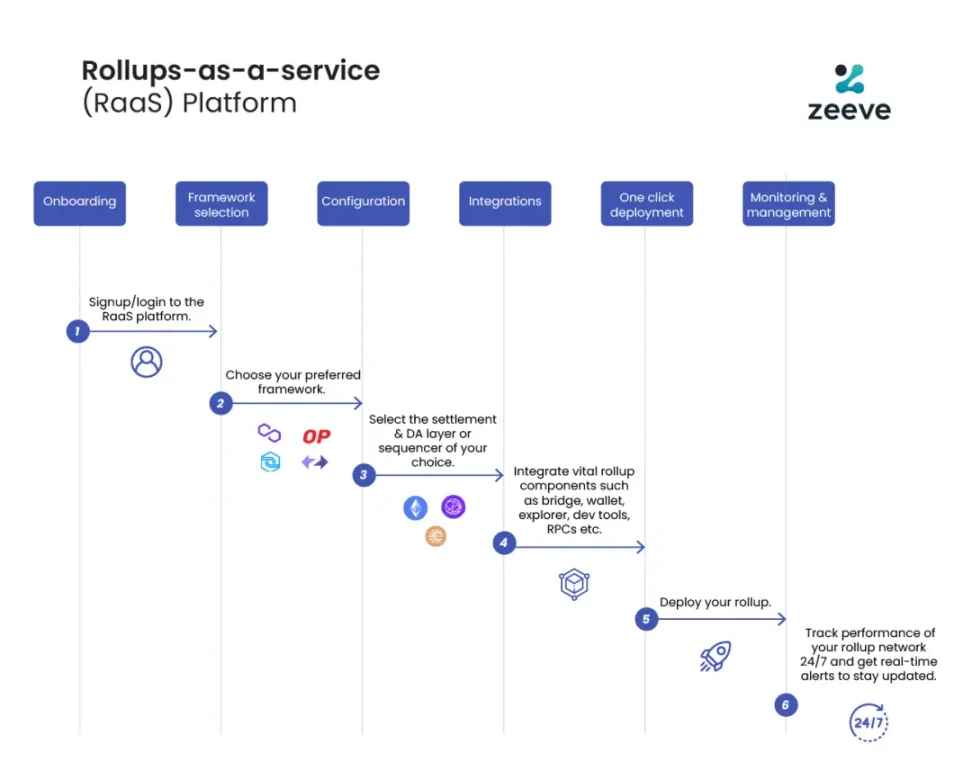
First, technology stacks have matured and third-party service providers have improved. Three years ago, building an appchain required teams to master full-stack blockchain development. Now, with the advancement of RaaS solutions like OP Stack, Arbitrum Orbit, and AltLayer—from execution and data availability to settlement and interoperability—developers can mix and match modular components as easily as selecting cloud services. This drastically reduces the engineering complexity and upfront capital required to launch an appchain. The operational model has shifted from self-hosted infrastructure to service purchasing, enabling greater flexibility and feasibility for application-layer innovation.
Second, brand recognition and user perception matter. Attention is a scarce resource. Users are often loyal to app brands rather than underlying technical infrastructures: people use Uniswap for its product experience, not because it runs on Ethereum. With the widespread adoption of multi-chain wallets and further UX improvements, users interact across chains almost seamlessly—their entry points are usually wallets and apps. When apps build their own chains, user assets, identities, and behaviors consolidate within the app’s ecosystem, creating powerful network effects.
Source: Token Terminal
Most importantly, the desire for economic sovereignty is increasingly evident among applications. In traditional L1/L2 architectures, value flows exhibit a clear “top-down” pattern:
-
The application layer creates value (e.g., Uniswap trades, Aave loans)
-
Users pay fees (application fees + gas fees), part of which goes to the protocol, part to LPs or other participants
-
All gas fees flow entirely to L1 validators or L2 sequencers
-
MEV is split among searchers, builders, and validators in varying proportions
-
Ultimately, the L1 token captures all value except app fees through staking
In this chain, the application layer—which creates the most value—captures the least.
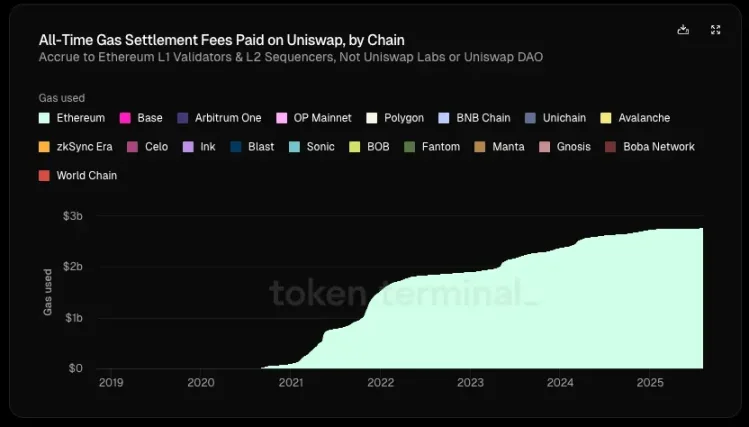
According to Token Terminal, of Uniswap’s total $6.4 billion in value creation (including LP returns, gas fees, etc.), less than 1% goes to the protocol/developers, equity investors, and token holders. Since its inception, Uniswap has generated $2.7 billion in gas revenue for Ethereum—roughly 20% of Ethereum’s total settlement fee income.
But what if an app had its own chain?
It could retain gas fees, use its own token as gas token, internalize MEV by controlling the sequencer to minimize malicious MEV and return beneficial MEV to users, or customize fee models to enable more complex structures.
Thus, internalizing value becomes an ideal choice. When an app gains sufficient bargaining power, it naturally demands a larger share of economic benefits. Therefore, high-quality apps have a weak dependency on base layers, while base layers are strongly dependent on high-quality apps.
Summary
Source: Dune@reallario
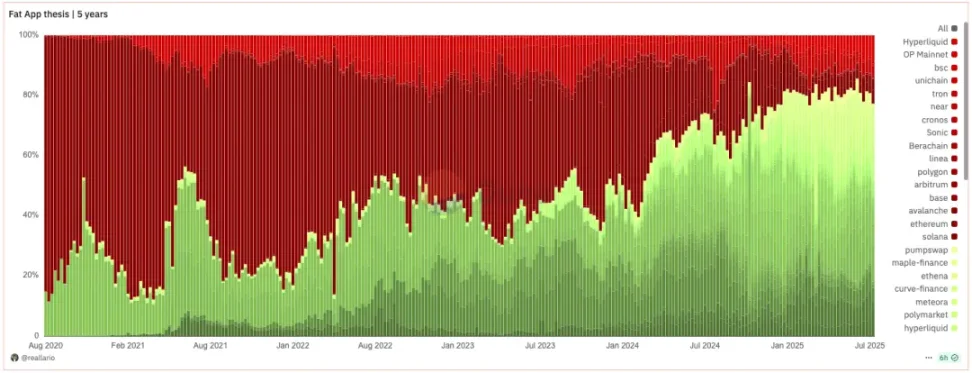
The chart above roughly compares protocol (red) and application (green) revenues from 2020 to present. We can clearly see that the share of value captured by applications has steadily increased, reaching about 80% this year. This may, to some extent, overturn Joel Monegro’s famous “fat protocol, thin application” theory.
We are witnessing a paradigm shift from the “fat protocol” to the “fat application” thesis. Historically, crypto project valuation was primarily based on “technical breakthroughs” and foundational infrastructure progress. Going forward, valuation will gradually shift toward anchors such as brand, traffic, and value capture capability. If apps can easily build their own chains using modular services, the traditional L1 “rent-seeking” model will be challenged. Just as SaaS reduced the bargaining power of traditional software giants, the maturity of modular infrastructure is weakening L1 monopolies.
Top-tier apps’ market caps will undoubtedly surpass most L1s. The valuation logic for L1s will shift from “capturing total ecosystem value” to becoming stable, secure, decentralized “infrastructure service providers.” Their valuations will resemble public goods generating steady cash flows, rather than “monopolistic” giants capturing most ecosystem value. Their valuation bubbles will be compressed to some extent. L1s must reevaluate their positioning.
Regarding appchains, our view is: thanks to strong brand recognition, user mindshare, and highly customizable on-chain capabilities, appchains can better retain long-term user value. In the era of “fat applications,” these apps can not only capture the direct value they create but also build blockchains around themselves to externalize and capture infrastructure-level value—they are both products and platforms, serving end users and other developers alike. Beyond economic sovereignty, top apps will also seek other forms of sovereignty: control over protocol upgrades, transaction ordering and censorship resistance, and ownership of user data.
Of course, this article mainly discusses top-tier apps like Uniswap and Hyperliquid that have already launched appchains. Appchain development remains in early stages (Uniswap’s TVL on Ethereum still accounts for 71.4%). For protocols like Aave that involve wrapped assets and collateral, and heavily rely on composability within a single chain, appchains are less suitable. In contrast, perp platforms requiring only oracle inputs are better suited for appchains. Moreover, appchains are not necessarily optimal for mid-tier apps—each case requires individual analysis. That discussion is beyond the scope here.
Join TechFlow official community to stay tuned
Telegram:https://t.me/TechFlowDaily
X (Twitter):https://x.com/TechFlowPost
X (Twitter) EN:https://x.com/BlockFlow_News
 IOSG Ventures















