Gemini founders Winklevoss brothers: Two decisions that changed everything
TechFlow Selected TechFlow Selected
Gemini founders Winklevoss brothers: Two decisions that changed everything
If Bitcoin becomes a new type of currency, early adopters will reap substantial rewards; if it fails, they can afford the loss.
 Navigating Web3 tides with focused insights
By: Thejaswini M A
Translated by: Block unicorn
Preface
The mediator had just announced Facebook's settlement offer: $65 million. The room fell silent. Mark Zuckerberg’s lawyers waited for a response.
Most people would have taken the cash and walked away. Taylor Winklevoss looked at his brother Cameron Winklevoss, then across the table.
"We want stock."
The lawyers may have exchanged glances. Facebook was still a private company—its shares could be worthless, the company might fail. Cash was real; stock was a gamble.
But Taylor’s answer defined the next decade of their lives. They bet their entire settlement on a company that had stolen their idea.
When Facebook went public in 2012, their $45 million worth of stock was nearly worth $500 million.
The Winklevoss twins pulled off one of the boldest moves in Silicon Valley history. They lost the battle for Facebook, yet earned more from it than most early employees.
In 2013, they struck again, spotting a new opportunity.
The Birth of Mirrors
Before becoming cryptocurrency billionaires or Facebook litigants, Cameron and Tyler Winklevoss were literal mirrors of each other.
Born on August 21, 1981, in Greenwich, Connecticut, they were identical twins with just one key difference: Cameron was left-handed, Tyler right-handed. Perfect symmetry.
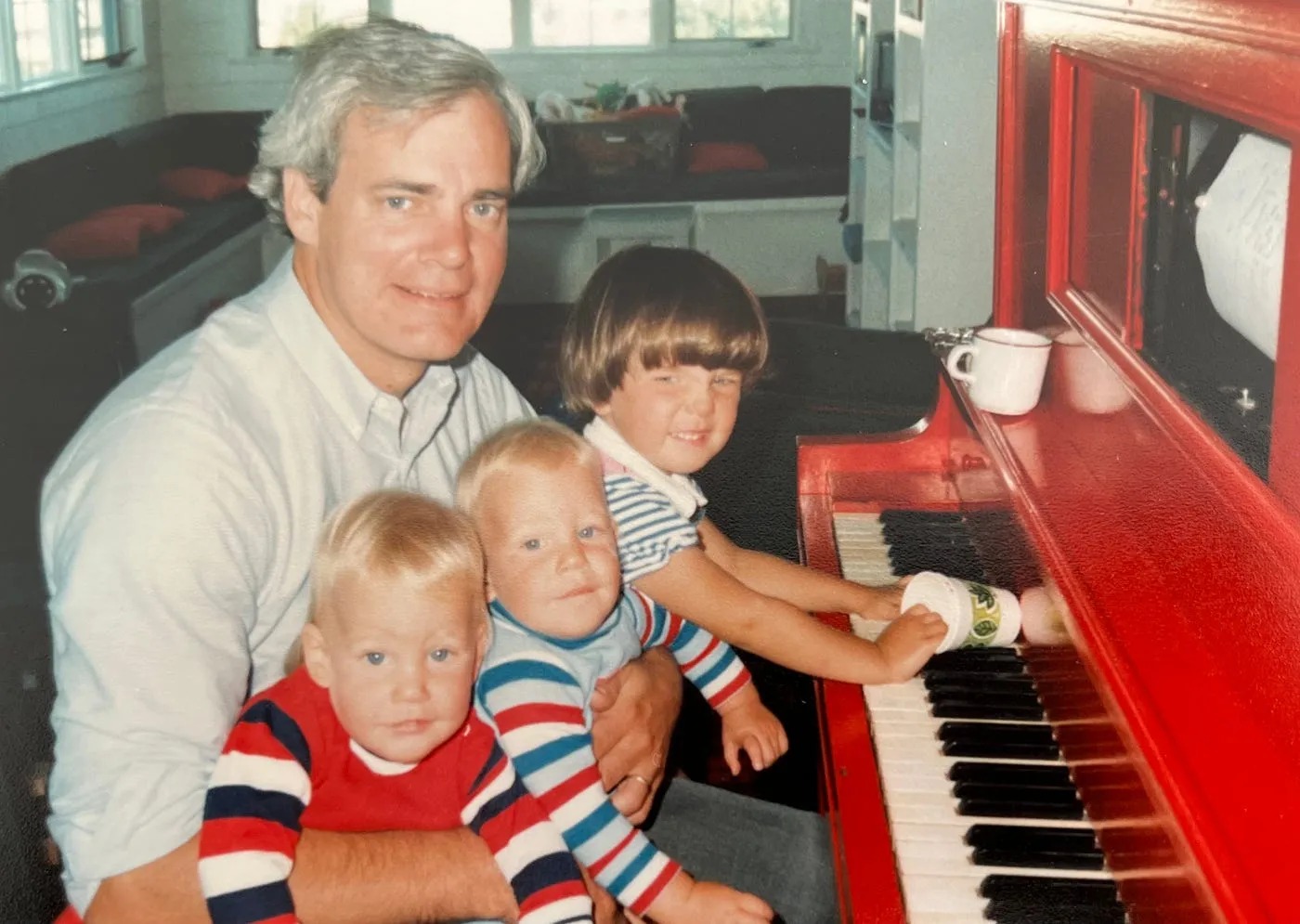
Tall, athletic, and perfectly coordinated, they taught themselves HTML at age 13 to build websites for local businesses. As teenagers, they launched their first web company, creating sites for anyone willing to pay.
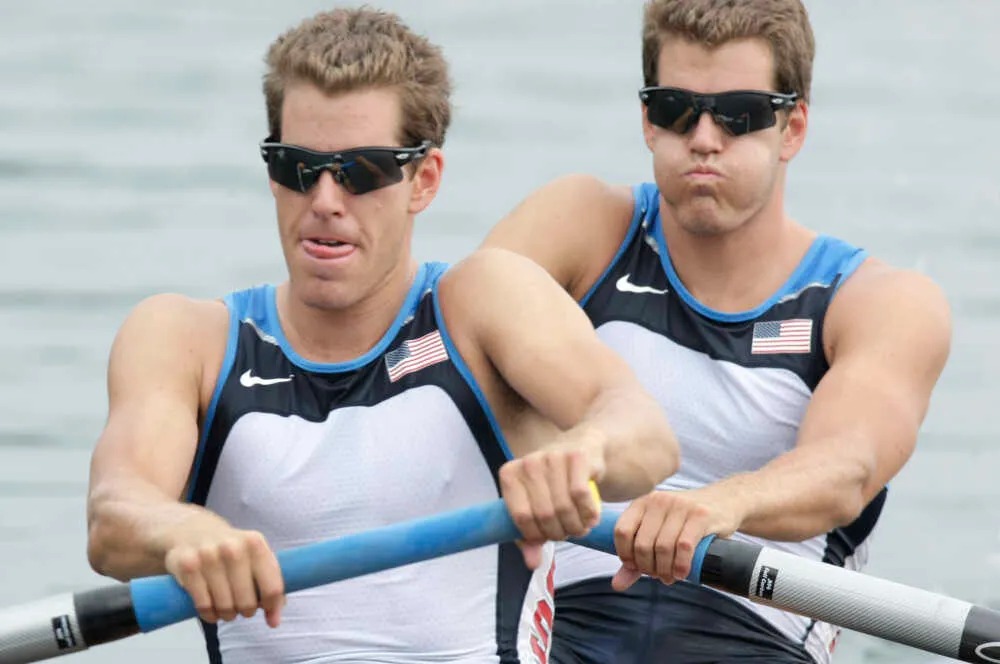
At the Greenwich Country Day School and later Brunswick School, they discovered competitive rowing and co-founded their school’s rowing program.
In an eight-man crew, timing is everything. A fraction of a second too slow, and you lose. Perfect coordination requires reading teammates, reading water, and making split-second decisions under pressure.
They became exceptionally good—good enough to row at Harvard, good enough to compete in the Olympics.
But rowing taught them something far more valuable than athletic honors—the art of perfect timing and seamless collaboration.
Harvard Lab
In 2000, the Winklevoss twins entered Harvard University as economics majors, dreaming of Olympic glory.
Cameron joined the men’s varsity team, the exclusive Porcellian Club, and the Hasty Pudding Club. The brothers committed intensely to competitive rowing—a dedication that eventually took them to the international stage.
In 2004, they helped lead Harvard’s “God Squad” to an undefeated collegiate rowing season. They won the Eastern Sprints, the Intercollegiate Rowing Association Championships, and the legendary Harvard-Yale Regatta.
But a crucial discovery happened off the water.
December 2002, junior year. While studying the social dynamics of elite university life, the twins conceived HarvardConnection, later renamed ConnectU.
Their idea was to create an exclusive social network for college students, starting at Harvard and expanding to other elite universities. They deeply understood the needs of their generation: students wanted to connect digitally, but existing tools were clunky and generic.
There was just one problem: they were athletes and economics majors—not programmers.
They needed help. They needed someone smart, someone who could grasp their vision.
That’s when Mark Zuckerberg appeared.
October 2003, Kirkland House dining hall at Harvard.
The twins pitched their social network idea to Mark Zuckerberg. A sophomore computer science student, he was reportedly working on a project called Facemash where students rated each other’s photos.
Perfect.
They laid out their vision for HarvardConnection. He listened intently, nodded, asked about features and technical details—seeming genuinely interested. They scheduled follow-up meetings.
For weeks, things progressed smoothly. Zuckerberg participated in discussions, explored implementation details, and appeared committed. The twins thought they’d found their coder.
January 11, 2004. While the twins waited for their next meeting with Zuckerberg, he registered a domain: thefacebook.com.
Four days later, instead of meeting them, he launched Facebook.
The twins read about it in The Harvard Crimson—and realized their programmer had become their competitor. They knew they’d been duped.
Legal War
In 2004, ConnectU sued Facebook, alleging Zuckerberg stole their idea, breached an oral contract, and used their concept to build a competing platform.
What followed was four years of legal battle. Legal teams grew, the case became a media sensation. But the lawsuit gave the twins a front-row seat to one of the most significant technological shifts in human history.
During the litigation, they watched Facebook sweep through college campuses, expand to high schools, then open to everyone. The platform they envisioned was conquering the world—just under someone else’s name.
They studied Facebook’s user growth, analyzed its business model, observed its network effects. By the time the 2008 settlement was reached, they understood Facebook better than almost anyone outside the company.
But their biggest competition played out in court, not on water.
Their 2008 decision to take Facebook stock instead of cash proved visionary. When Facebook went public in 2012, their $45 million in stock was nearly worth $500 million.
They proved that “Winklevoss Brothers” could lose a battle yet win the war.
Their athletic careers ran parallel to the legal drama. At the 2007 Pan American Games in Rio, Cameron won gold in the men’s eight and silver in the men’s coxless four. The following year, both brothers competed in the Beijing Olympics, finishing sixth in the men’s coxless pair—ranking among the world’s elite rowers.
Bitcoin Revelation
After the Facebook windfall, the twins tried becoming Silicon Valley angel investors. But every startup rejected them. Why? Mark Zuckerberg would never acquire a company associated with the Winklevoss brothers. Their money became “poison.”
Dejected, they retreated to Ibiza. One night, at a club, a stranger named David Azar approached them holding a dollar bill, saying: “A revolution.”
Standing on the beach, David explained Bitcoin—a fully decentralized digital currency with a fixed supply of 21 million. The twins had never heard of it. In 2012, almost no one owned Bitcoin.
As Harvard economics graduates, they saw Bitcoin’s potential: digital gold, possessing all the qualities that historically gave gold value—but superior.
In 2013, while Wall Street was still figuring out what cryptocurrency was, the Winklevoss twins began investing heavily.
They put $11 million into Bitcoin when it was priced at $100. That amounted to roughly 1% of all Bitcoins in circulation at the time—about 100,000 coins.
Imagine this: Olympic athletes, Harvard grads, young men with limitless options, betting millions on a digital currency most associated with drug dealers and anarchists.
Their friends must have thought they were crazy.
But they had seen a dorm-room idea become a hundreds-of-billions-dollar company. They understood how quickly the impossible could become inevitable.
Their reasoning: if Bitcoin became a new form of money, early adopters would reap massive rewards; if it failed, they could afford the loss.
When Bitcoin hit $20,000 in 2017, their $11 million turned into over $1 billion. They became the world’s first confirmed Bitcoin billionaires.
A pattern was emerging. Cameron and Tyler Winklevoss had vision.
Building Infrastructure
The twins didn’t just buy Bitcoin and wait. They began building infrastructure to drive mass adoption.
Winklevoss Capital provided seed funding for the new digital economy: exchanges (like BitInstant), blockchain infrastructure, custody tools, analytics platforms, and later DeFi and NFT projects. Their portfolio spanned protocol developers (like Protocol Labs and Filecoin) to energy infrastructure for cryptocurrency mining.
In 2013, they filed the first-ever Bitcoin ETF application with the U.S. Securities and Exchange Commission (SEC). It was a near-certain failure, but someone had to go first. In March 2017, the SEC rejected their proposal, citing market manipulation concerns. They applied again; rejected again in July 2018. But their regulatory efforts laid the groundwork for others. In January 2024, spot Bitcoin ETFs were finally approved—marking the culmination of a framework the twins had started building over a decade earlier.
In 2014, BitInstant CEO Charlie Shrem was arrested at an airport for money laundering tied to Silk Road transactions, forcing BitInstant to shut down. The major Bitcoin exchange Mt. Gox was hacked, losing 800,000 Bitcoins. The infrastructure they’d invested in was collapsing. The Bitcoin market was in turmoil.
Yet they saw opportunity in the chaos. The Bitcoin ecosystem needed legitimate, regulated companies.
In 2014, they founded Gemini, one of the first regulated cryptocurrency exchanges in the U.S. While other crypto platforms operated in legal gray zones, Gemini worked with New York regulators to establish a clear compliance framework.
They understood that for crypto to go mainstream, it needed institutional-grade infrastructure. The New York State Department of Financial Services granted Gemini a limited-purpose trust charter, making it one of the first licensed Bitcoin exchanges in the U.S.
By 2021, Gemini was valued at $7.1 billion, with the twins owning at least 75%. Today, the exchange holds over $10 billion in assets and supports more than 80 cryptocurrencies.
Through Winklevoss Capital, they’ve invested in 23 crypto projects, including participating in Filecoin’s funding round and Protocol Labs in 2017.
Rather than fight regulators, the Winklevoss twins worked to educate them. Instead of seeking regulatory arbitrage, they embedded compliance into their products from day one.
Gemini faced challenges, including a $2.18 billion settlement in 2024 over its Earn program. Yet the exchange survived and continues operating.
The twins understood that technology alone wasn’t enough—regulatory acceptance would determine crypto’s fate.
In 2024, each donated $1 million in Bitcoin to Donald Trump’s presidential campaign, positioning themselves as advocates for crypto-friendly policies. Their donations exceeded federal limits, requiring partial refunds, but their stance was clear.
The twins have been vocal critics of the SEC’s aggressive enforcement under Chairman Gary Gensler. Their regulatory battles are both personal and professional. SEC lawsuits against Gemini directly challenge their business model. In June 2025, Gemini secretly filed for IPO.
Current Standing
Forbes currently estimates the brothers’ net worth at $4.4 billion each, totaling around $9 billion, with Bitcoin holdings forming the largest portion of their wealth.
Their crypto assets include approximately 70,000 Bitcoins, worth $4.48 billion, plus substantial positions in Ethereum, Filecoin, and other digital assets.
Gemini remains one of the world’s most trusted cryptocurrency exchanges, with institutional-grade security and regulatory compliance. Its IPO filing marks a significant step toward integration with mainstream financial markets.
In February 2025, the twins became partial owners of Real Bedford Football Club, an eighth-tier English football team, investing $4.5 million.
Partnering with crypto podcaster Peter McCormack, they aim to take the semi-professional team to the Premier League. Their father Howard also donated $4 million in Bitcoin to Grove City College in 2024—the school’s first Bitcoin donation—to fund the construction of the Winklevoss School of Business.
The twins personally donated $10 million to Greenwich Country Day School, the largest alumni gift in the school’s history.
They’ve publicly stated they will not sell their Bitcoin even if its market cap reaches that of gold, demonstrating their belief that Bitcoin is not just a store of value, but a fundamental reimagining of money.
The Harvard Crimson exposed Mark Zuckerberg’s betrayal. A dollar bill on an Ibiza beach ignited a revolution—two moments, before and after they learned to see what others couldn’t. Cameron and Tyler Winklevoss were long seen as having missed the party. It turns out, they simply arrived early at the next one.
Join TechFlow official community to stay tuned
Telegram:https://t.me/TechFlowDaily
X (Twitter):https://x.com/TechFlowPost
X (Twitter) EN:https://x.com/BlockFlow_News