TechFlow Logo
Login/ Sign up
ETH Gas
Gwei
Fear
gas
Understanding the Fluid Mechanism: How to Mitigate Liquidity Crises During Large-Scale Liquidation Events?

Understanding the Fluid Mechanism: How to Mitigate Liquidity Crises During Large-Scale Liquidation Events?

2025.02.11
Share

TechFlow Selected TechFlow Selected

techFlow

Understanding the Fluid Mechanism: How to Mitigate Liquidity Crises During Large-Scale Liquidation Events?

Fluid is currently the only lending market capable of proactively preventing liquidity crises.

2025.02.11 - 02:24:24
Fluid清算流动性
Fluid is currently the only lending market capable of proactively preventing liquidity crises.

Author: DMH

Translation: TechFlow

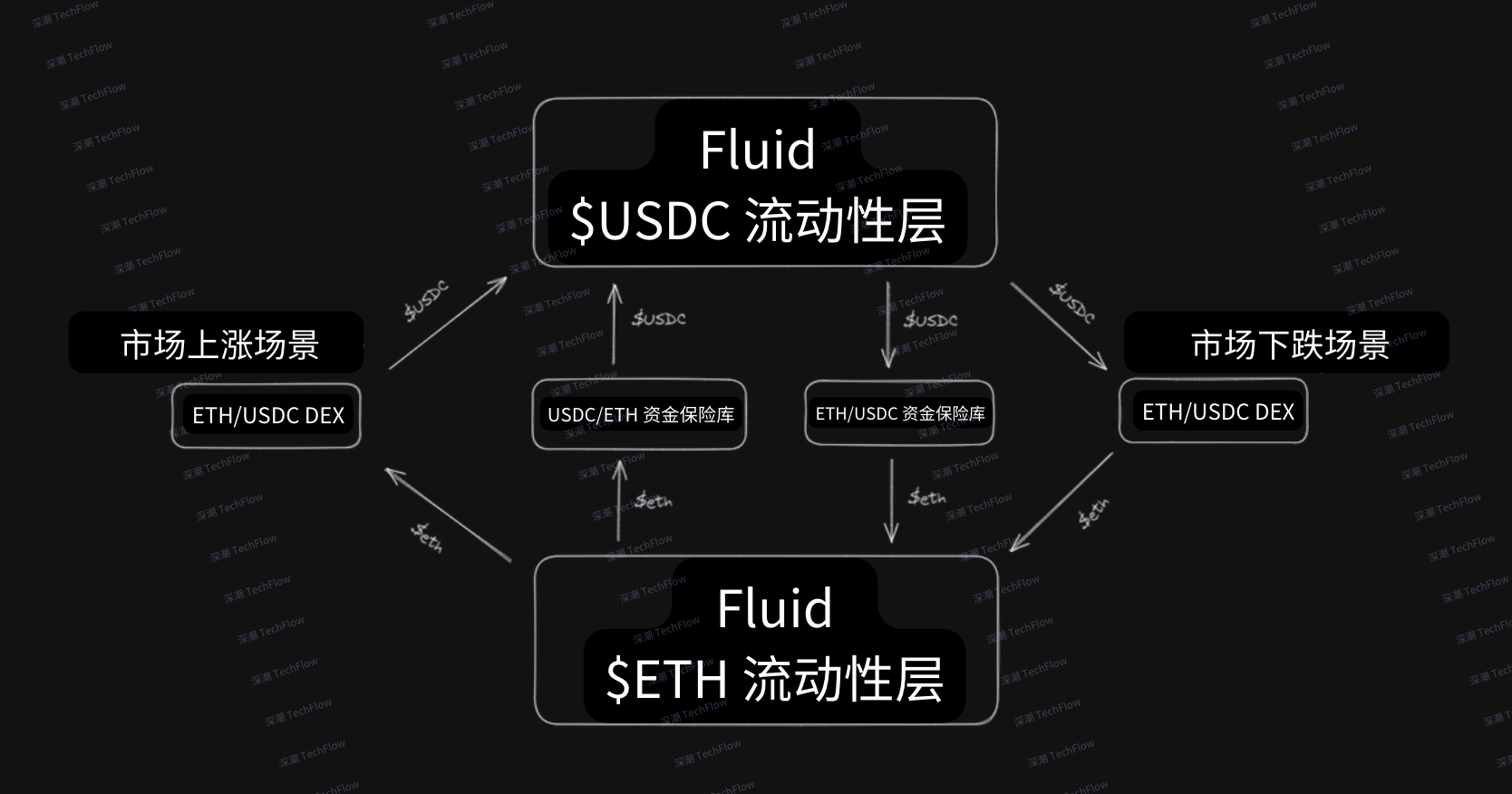
(Original image from DMH, translated by TechFlow)

Summary

  • Fluid performed exceptionally during the largest liquidation event in history, successfully completing liquidations and saving users millions of dollars.

  • Fluid is currently the only lending market capable of proactively addressing liquidity crises.

  • The design of Fluid DEX further enhances the security and user experience of the Fluid lending market.

Background

Last week witnessed the largest-scale liquidation event in market history, and once again Fluid demonstrated its robust stability. During this event, Fluid successfully completed liquidations with the highest liquidation threshold in the market (Liquidation Threshold, up to 97%) and the lowest liquidation penalty (Liquidation Penalty, as low as 0.1%).

What are the main threats faced by lending markets during a liquidation event?

  1. Bad debt arising from failure to liquidate in time.

  2. Assets requiring liquidation reach 100% utilization, making liquidation impossible.

During last August's market crash, ETH plummeted 16% within just four minutes. I previously analyzed in detail how Fluid’s efficient liquidation mechanism helped users recover millions of dollars in losses.
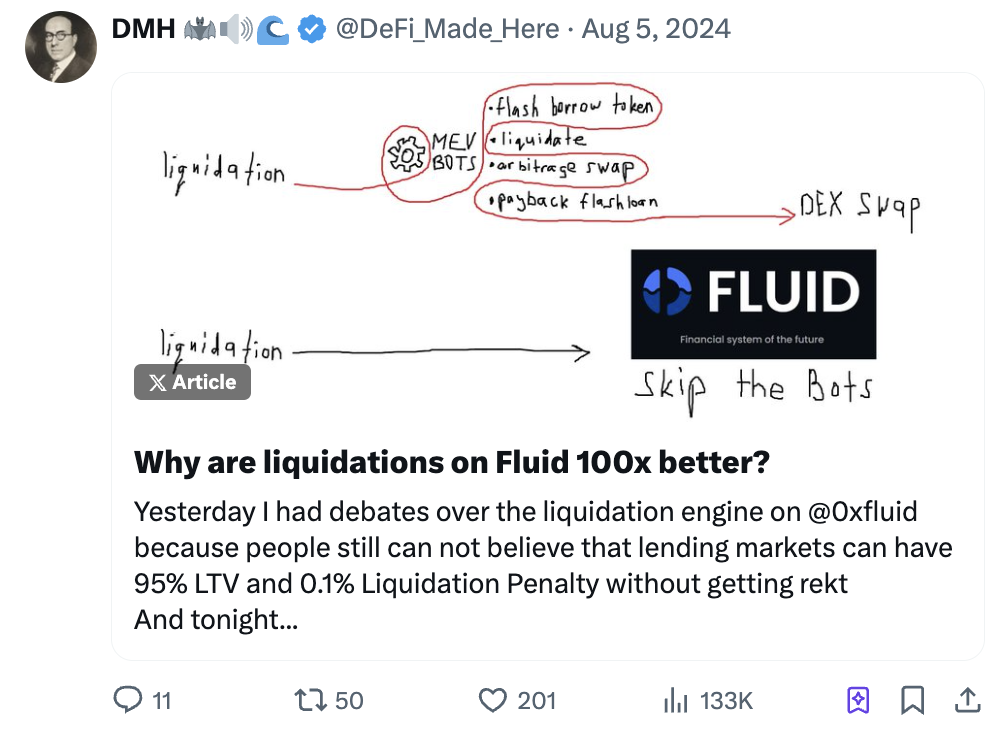
(Tweet details)

However, like other lending markets that rehypothecate assets, Fluid previously lacked a comprehensive security mechanism for liquidity crises. To better illustrate this, it's important to understand the basic liquidation process: liquidators must seize collateral and repay debt to complete a liquidation. If the collateral needing liquidation has already been fully borrowed out, liquidation cannot proceed, resulting in bad debt for the protocol.

How does the introduction of Fluid DEX change the current situation?

In the event of a sudden market crash, ETH in the market will be sold for USDC. In such cases, liquidity providers (LPs) on decentralized exchange (DEX) protocols receive ETH while providing USDC to traders. This process effectively increases ETH liquidity within the protocol and further boosts overall ETH liquidity across the entire Fluid system, thereby preventing liquidity crises.

Conversely, when the market is trending upward, liquidations tend to involve positions with USDC as collateral and ETH as debt. In this environment, more USDC flows into the Fluid system while ETH flows out. This dynamic increases USDC liquidity, making the liquidation process more efficient and seamless.

Fluid is currently the only lending market capable of proactively preventing liquidity crises. In contrast, other lending markets can only respond to liquidity issues through passive measures (for example, increasing borrowing APR when asset utilization rises). However, such passive approaches often prove ineffective during sudden market crashes.

The Fluid lending market was initially powered by Fluid DEX, and now Fluid DEX reciprocates by ensuring ample liquidity is always available during liquidations, giving the Fluid lending market a significant advantage. This synergy dramatically improves capital market efficiency, increasing it tenfold.

Join TechFlow official community to stay tuned

Add to Favorites
Share to Social Media

Related Articles

2026.06.18

Oil prices fall below $80, but Bitcoin hasn’t rallied yet: Liquidity emerges as the key market driver

What truly determines whether Bitcoin can rebound are the Federal Reserve’s stance, ETF fund flows, and market risk appetite.

Oil prices fall below $80, but Bitcoin hasn’t rallied yet: Liquidity emerges as the key market driver
2026.04.07

Balance Sheet: The Next Stage of Liquidity Battlefield for Cryptocurrencies

The next stage of cryptocurrency adoption is determined not by infrastructure, but by balance sheet flows.

Balance Sheet: The Next Stage of Liquidity Battlefield for Cryptocurrencies
2026.02.26

Huobi Growth Academy | Cryptocurrency Market Macro Report: Repricing of Crypto Assets Amid Liquidity Withdrawal

When leverage is liquidated, speculators exit the market, and valuations return to rational levels, projects with genuine long-term value will present ideal entry opportunities.

Huobi Growth Academy | Cryptocurrency Market Macro Report: Repricing of Crypto Assets Amid Liquidity Withdrawal
2026.02.11

Bitcoin ETF Redemptions and the AI Narrative Rotation: Who Is Siphoning Liquidity from the Crypto Market?

The AI narrative is absorbing capital that previously flowed into Bitcoin—and even software stocks.

Bitcoin ETF Redemptions and the AI Narrative Rotation: Who Is Siphoning Liquidity from the Crypto Market?
2026.01.15

Arthur Hayes: Bitcoin Trapped in "USD Liquidity Anxiety" — What Lies Ahead in a Loose Monetary Cycle?

When dollar liquidity expands, both Bitcoin and the Nasdaq index rise.

Arthur Hayes: Bitcoin Trapped in "USD Liquidity Anxiety" — What Lies Ahead in a Loose Monetary Cycle?
2025.12.09

Fed's $400 Billion Liquidity Signal: Bitcoin Awaits Breakout

As the Federal Reserve's policy increasingly impacts the cryptocurrency market, Bitcoin investors are preparing for potential liquidity changes.

Fed's $400 Billion Liquidity Signal: Bitcoin Awaits Breakout
2025.12.04

Huobi Growth Academy | Crypto Market Macro Research Report: A Critical Window for Macro Liquidity, Institutionalization, and Risk Reassessment

Overall, this round of rebound has significantly improved market sentiment, reshaped key technical support levels, and released potential willingness for participation from a funding perspective, but it still remains at a stage away from a trend-driven bull market.

Huobi Growth Academy | Crypto Market Macro Research Report: A Critical Window for Macro Liquidity, Institutionalization, and Risk Reassessment
2025.11.26

Triple pressures on the crypto market: ETF outflows, leverage reset, and low liquidity

The spot liquidity of major cryptocurrencies and altcoins has not yet recovered, leaving the market in a fragile state and more susceptible to extreme price volatility.

Triple pressures on the crypto market: ETF outflows, leverage reset, and low liquidity
2025.11.18

Liquidity crisis, are longs left only with "death queue"?

The crypto market once again experienced a "bulls' death spiral" in mid-November.

Liquidity crisis, are longs left only with "death queue"?
2025.11.18

U.S. financial system liquidity strain: Fed emergency meeting and repo market pressures

Investors should pay attention to the signals from the November FOMC meeting and the Treasury's debt issuance plan to capture the turning point.

U.S. financial system liquidity strain: Fed emergency meeting and repo market pressures
TechFlow Logo

Navigating Web3 tides with focused insights

Contribute An Articleemail
Media Requestsmsg

Risk Disclosure: This website's content is not investment advice and offers no trading guidance or related services. Per regulations from the PBOC and other authorities, users must be aware of virtual currency risks. Contact us / [email protected] ICP License: 琼ICP备2022009338号