With PNET rapidly gaining popularity, would using an AI Agent as a personal tutor for learning be a good angle?
TechFlow Selected TechFlow Selected
With PNET rapidly gaining popularity, would using an AI Agent as a personal tutor for learning be a good angle?
For degens, it's best if expectations never materialize.
 Navigating Web3 tides with focused insights
Written by: TechFlow
Welcome to a day of Solana's ecosystem revival.
With Solana officially announcing its AI hackathon, ai16z has rebounded and surpassed GOAT in market cap, prompting capital to once again flow into AI Agent-related projects.
Looking closely at the hackathon description, the goal is clear — build the best AI Agent product.
Official support signals that, for the foreseeable future, the broader environment will favor AI Agents capable of solving real-world problems or targeting specific directions.
And this expectation may already have been priced in.
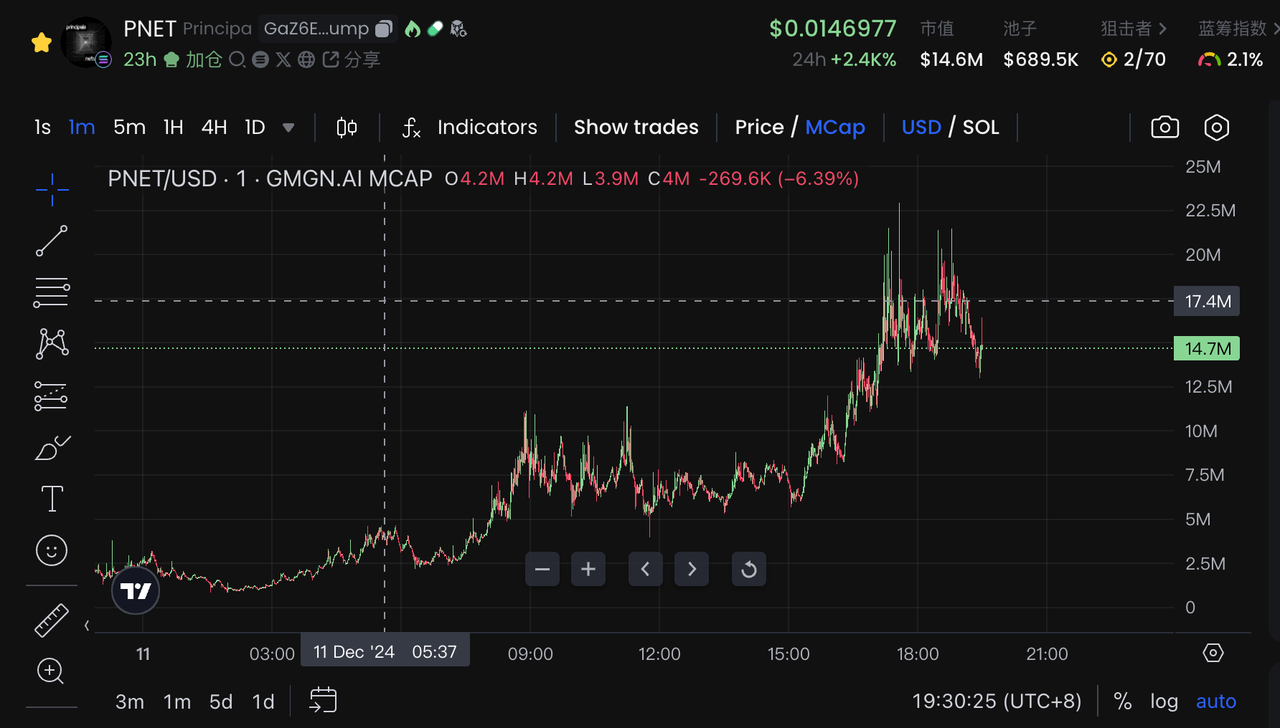
Today, a project called Principals Network saw its token $PNET (note: not PNUT the squirrel) surge within 24 hours of launch, climbing from an initial market cap of around $200K to $15M. There’s now scattered discussion, though it remains outside mainstream narratives.
The project's objective is sharply defined: use AI agents to build a decentralized education network.
From a storytelling perspective, being first matters.
Creating an AI agent-based personalized education assistant and private tutor feels like a fresh narrative. Combined with the AI hackathon’s focus on practical applications, PNET’s expectations are further elevated.
We reviewed its design documents and share more details below.
AI as Personalized Tutor, On-Chain Proof of Learning
Before diving deeper into PNET, we need to understand the core problem it aims to solve.
Traditional online education platforms often face a tension between standardization and personalization: either one-size-fits-all content or prohibitively expensive one-on-one tutoring. With AI Agents, a new solution appears possible.
AI itself can become a personalized private tutor.
PNET’s core design revolves around three key elements:
-
Teaching Agents (AI Tutors)
These are not simple Q&A bots, but domain-specialized AI experts trained for specific subjects such as blockchain, artificial intelligence, or personal development. They can assess learners’ cognitive levels and create customized learning paths.
Through continuous interaction with learners, the AI optimizes teaching strategies, turning instruction into an iterative training process.
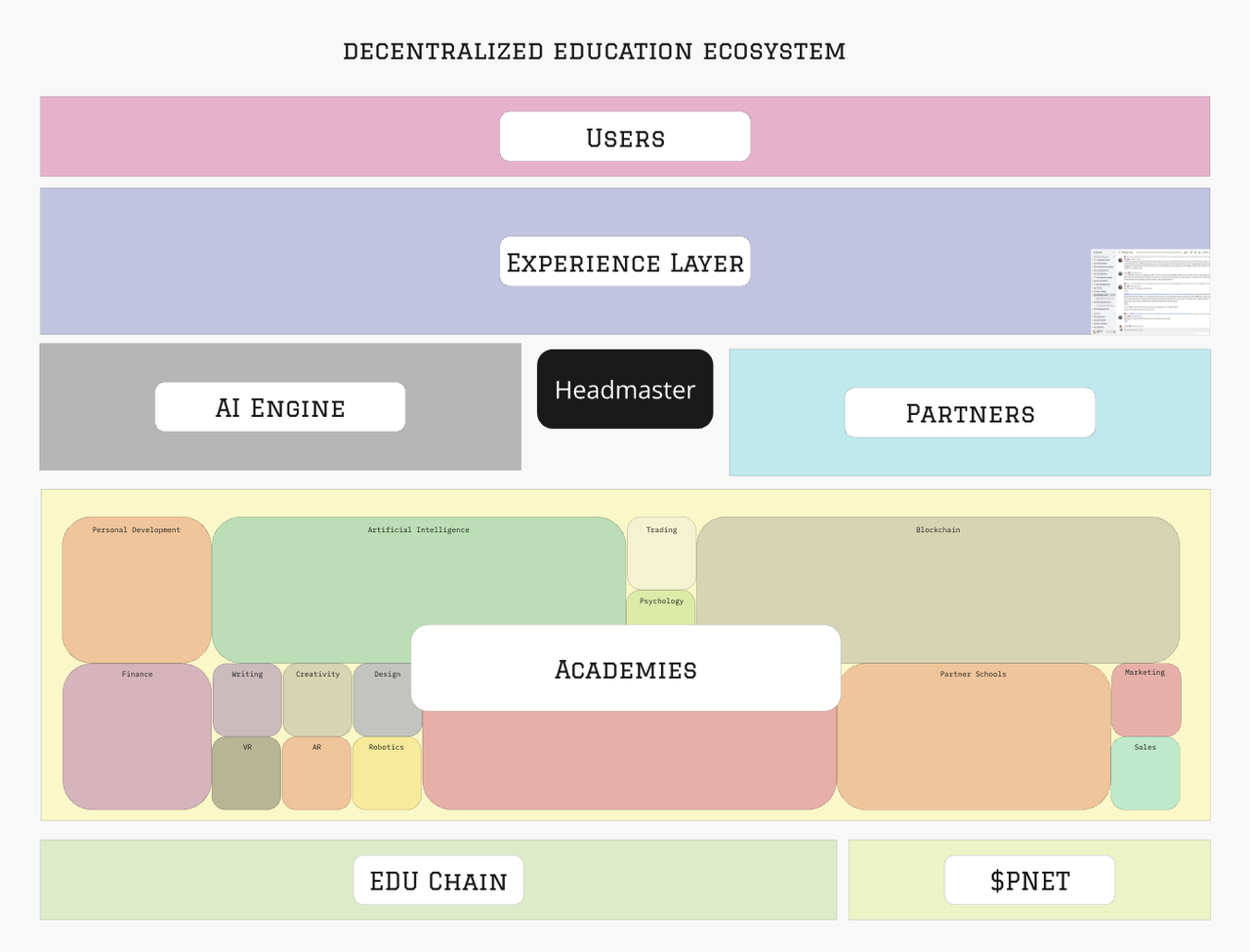
This functionality resides in the AI Engine layer, coordinated by the Headmaster module. (See architecture diagram below)
-
Decentralized Knowledge Graph
Built within Academies, this layer connects knowledge points across disciplines. Continuously expanded and refined through community contributions, it helps AI agents understand relationships between concepts.
This design enables multi-dimensional exploration paths for learners, supporting interdisciplinary learning and knowledge integration.
-
On-Chain Proof of Learning
Built atop the EDU Chain layer, this records every step of a learner’s progress and generates verifiable skill credentials. Crucially, completion rewards are tied to the $PNET token incentive system, adding external motivation for learners.
In theory, these three components form a self-sustaining loop: Teaching Agents draw content and context from the knowledge graph; learning progress is recorded on-chain and fed back to improve instruction; the knowledge graph itself evolves through ongoing learning and validation.
Looking deeper into the architecture, PNET is fundamentally a decentralized education network built on the Solana ecosystem, structured in three layers: AI Principals, Academy System, and EDU Chain.
The AI Principals layer sits at the heart of the system, where specially trained AI Agents act as personalized tutors. These Agents not only customize learning paths based on individual traits but also offer real-time guidance and answers. The Academy System manages educational content and resources, building a dynamically evolving curriculum while coordinating interactions between learners and AI Principals. The foundational EDU Chain, built on Solana, handles credential verification, credit management, and token incentives.
A more detailed breakdown of responsibilities within this architecture is as follows:
-
Infrastructure Layer
-
EDU Chain: The underlying public chain infrastructure
-
$PNET: Native ecosystem token for incentives and governance
-
-
Core Layer
-
AI Engine: Core intelligent teaching engine
-
Headmaster: Central orchestration module
-
Partners: Partner integration module
-
-
Subject Content Layer (Academies)
This layer is particularly interesting, covering multiple domains including personal development, artificial intelligence, trading, blockchain, and other niche and mainstream fields.
Currently, PNET has launched a testnet, but we haven’t seen the full product yet. Market enthusiasm stems largely from forward-looking expectations rather than shipped features. Still, this deep integration of AI, Web3, and education represents a novel direction for online learning.
Potential Link to Open Campus
PNET’s market cap surged from $200K to $15M in just 24 hours. Beyond the innovative “AI Agent for education” narrative, there’s a deeper reason — its potential connection to Open Campus.
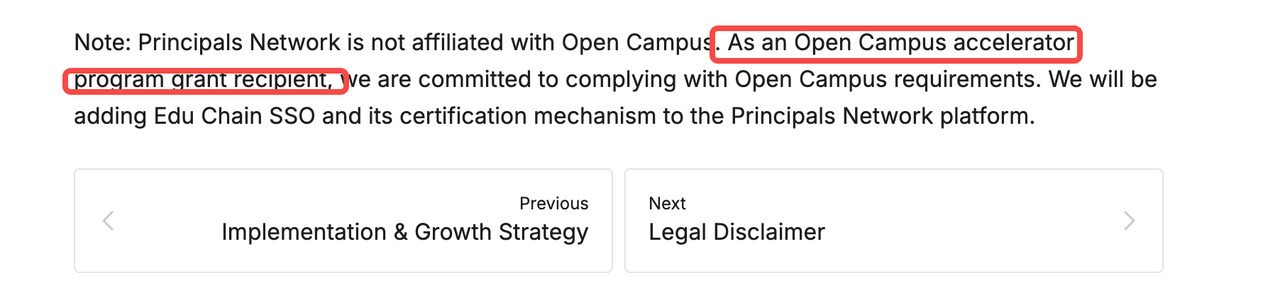
Reviewing the project documentation reveals an ecosystem partnership: Principals Network is a recipient of Open Campus’s accelerator program and has confirmed integrating EDU Chain’s SSO (Single Sign-On) and certification mechanisms into its platform. While seemingly a routine technical integration, it hints at much broader possibilities.
Open Campus, Binance’s major move in Web3 education, received a $3.15 million strategic investment from Binance Labs in 2023. This was widely interpreted as Binance signaling strong confidence in the Web3 education space.
Through this relationship, PNET’s valuation story becomes more compelling.
The project may no longer be just another Solana-based AI education play — it could emerge as a key node connecting to Binance’s ecosystem.
This dual-layer bullish case likely explains why capital is flowing into PNET. Investors appear to be pricing in the prospect of a “Binance-affiliated Web3 education AI project.”
Of course, whether this expectation materializes depends entirely on the project’s future execution.
That said, a project’s greatest speculative window is often when expectations are high but unfulfilled — and for degens, ideally, never fulfilled at all.
Join TechFlow official community to stay tuned
Telegram:https://t.me/TechFlowDaily
X (Twitter):https://x.com/TechFlowPost
X (Twitter) EN:https://x.com/BlockFlow_News
 深潮TechFlow