
Cyber Capital Founder: Ripple is completely centralized, please stay cautious
TechFlow Selected TechFlow Selected
Cyber Capital Founder: Ripple is completely centralized, please stay cautious
Justin Bons believes that XRP is not a cryptocurrency.
 Navigating Web3 tides with focused insights
Author: Justin Bons, Founder of Cyber Capital
Translation: Luffy, Foresight News
Ripple (XRP) is a centralized and permissioned network, contrary to claims made by its executives. XRP misleads investors by falsely advertising its decentralization, while in reality the network is fully controlled by the foundation.
XRP's consensus relies on UNL (Unique Node List), where trusted nodes are determined by centralized entities—including the foundation. XRP consensus is not based on PoS or PoW, but on PoA (Proof-of-Authority), yet they claim to be more decentralized than Bitcoin and Ethereum...
This is all theoretically supported by Ripple’s own documentation. It's hard to find any researcher outside of XRP calling this design "decentralized." Yet, they are deceiving the public.
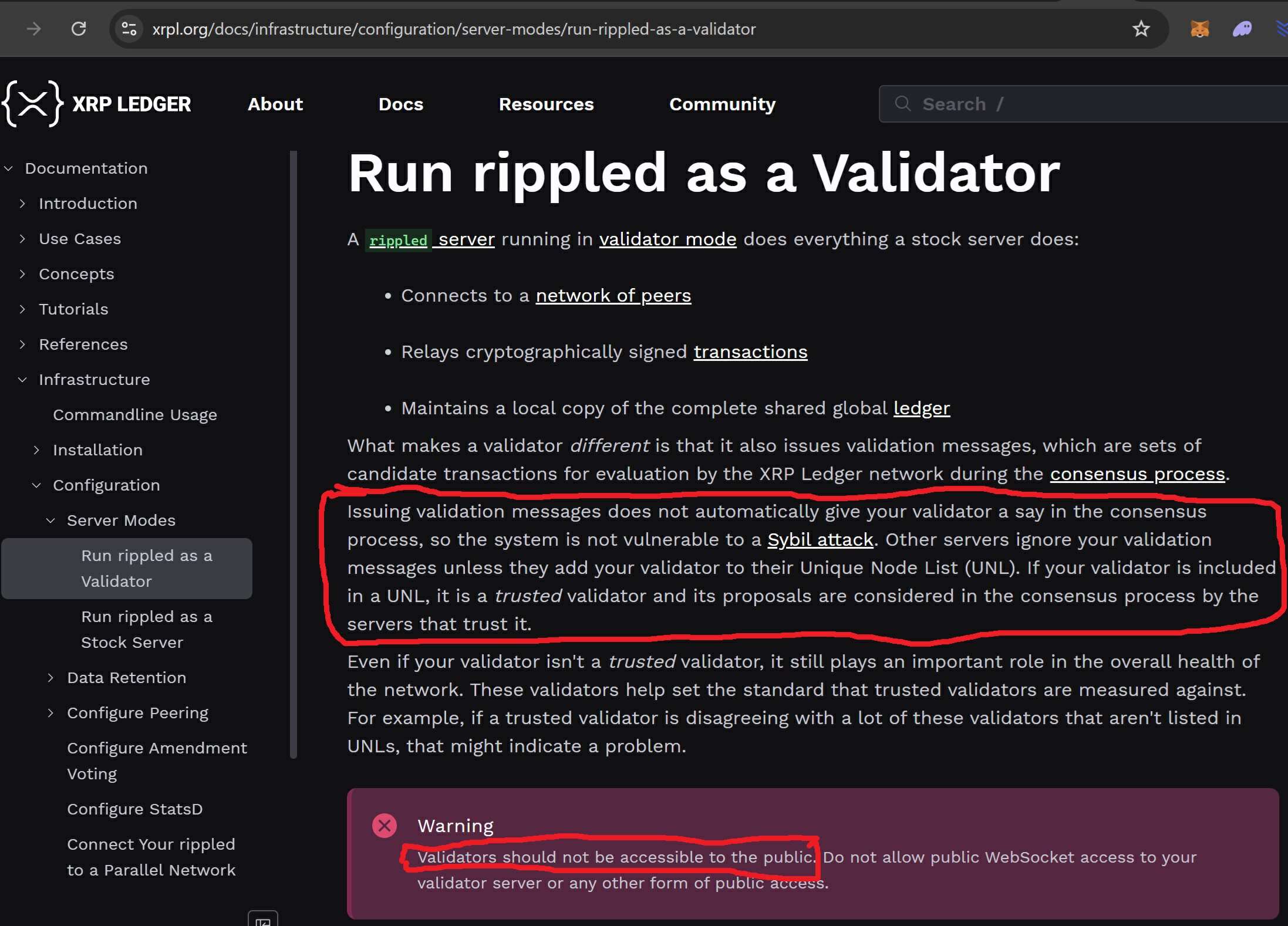
But users can modify their own UNL and choose whom to trust. The wording here is subtle. Truly decentralized cryptocurrencies are "trustless," because no "trust" is required at all. Choosing whom to trust is fundamentally different from being trustless!
XRP is not trustless at all. Worse: if your UNL does not overlap sufficiently with the rest of the network, you face risks. According to Ripple’s documentation, 90% UNL overlap is required to prevent forks.
This means that in practice, direct permission from the XRP Foundation is needed to participate in consensus—making it nearly centralized in terms of blockchain design... Let's now dive deeper into these UNLs.
We've established that UNLs are third-party validators ultimately chosen by the XRP Foundation. This fact is further confirmed as we examine these UNLs: for a long time, there was only one UNL—the dUNL managed by the XRP Foundation.
However, this list isn't static—it's dynamic. The XRP Foundation can change the validator list in a completely centralized manner, without notice, removing anyone who challenges authority.
Over time, two UNLs have emerged: dUNL and XRPLF, both directly funded by the XRP Foundation. This adds another layer of de facto control over the network; let me explain:
Blockchains enable coordination among mutually distrusting parties—all thanks to underlying incentive mechanisms (PoS or PoW). However, XRP has no block rewards or incentives. It's purely based on trust. So how do different UNLs coordinate with each other?
XRP’s argument rests on the idea that different parties can spontaneously organize around new UNL lists without the incentive mechanisms mentioned earlier. Clearly, this is nonsense—because this is exactly what blockchains were invented to solve. New UNLs cannot achieve coordination.
If new UNLs cannot coordinate, it means the foundation holds de facto full control. Control over validators equals control over the network—this resembles a consortium chain.
In every other blockchain, you don’t get to choose validators because they are trustless and permissionless. That’s why validators can remain anonymous—security comes from cryptoeconomic game theory, not trust. This is the fundamental difference with XRP.
XRP is not a cryptocurrency at all. Since it’s neither PoS nor PoW, it must be PoA—what else could it be? Consensus algorithms require validation mechanisms. Trust is the foundation of this system. Therefore: XRP is PoA!
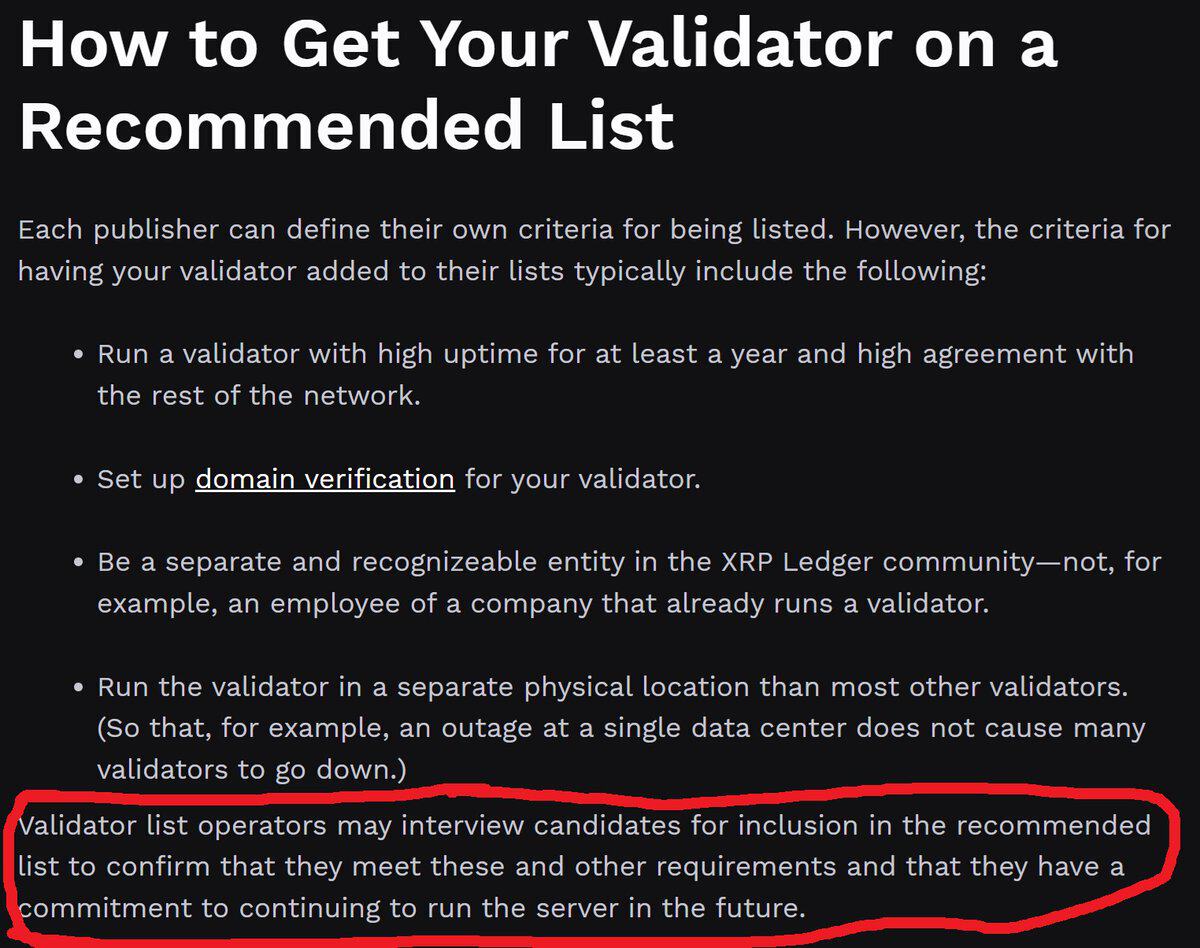
PoA systems always have a central authority appointing validators. But what about the current existence of two "official" UNL lists? Doesn't that contradict my assertion that different UNLs cannot coordinate? This is where things get truly crazy:
Upon close inspection, I found that all UNLs are actually identical—using the exact same set of validators—further proving that the foundation effectively controls the XRP network!
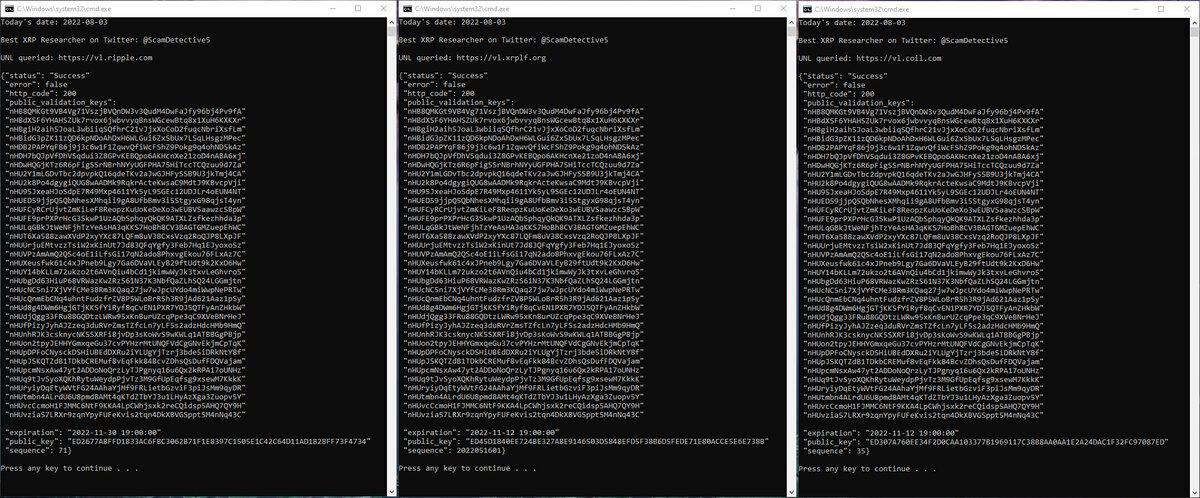
This screenshot is from two years ago, but I’ve confirmed the situation remains unchanged today—proving that new UNLs cannot coordinate independently. Thus, the foundation’s list becomes the de facto standard, as all UNLs must comply or risk being forked.
This also enables censorship by the foundation when pressured, due to their extremely high level of control. This is completely different from how cryptocurrencies operate—and explains why only 20% of validators can halt the network...
There are no rewards for running a trusted validator. Unlike PoW or PoS, where attack costs reflect block rewards paid to miners/stakers. This is why decentralization metrics are highly correlated with block rewards. On XRP, this decentralization metric is zero.
I’ve studied XRP since its early days. I clearly remember people acknowledging the trade-offs in decentralization. Over time, community and leadership claims became increasingly extreme. I say this not to belittle investors, but to empower them.
Help break the XRP echo chamber and stop being exit liquidity for others. XRP’s pre-mine rate is as high as 99.8%, making it one of the most unfair distributions ever—since no new XRP is created, all newly circulating XRP is purchased directly from founders.
I’ve always been interested in early discussions about Ripple’s decentralization. Pretending XRP is permissionless isn’t the right answer. The real solution lies in replacing the UNL system with PoS—transforming XRP into a more traditional decentralized blockchain.
They could also simply admit the facts. I wouldn’t object to that. But using lies to attract ignorant retail investors is wrong. This is where our industry must draw a line and self-regulate!
XRP may currently bribe or deceive the SEC, but they can’t fool us crypto natives. No matter how complex or detailed the rebuttals, some simple truths remain unchanged: XRP today is fully permissioned and centralized.
If you truly care about XRP, take this seriously. Because within this critique lie solutions that could help XRP succeed: either honestly admit its centralization, or transition toward decentralization. The truth shall set us free. Either leave XRP or pressure it to change—nothing is irreversible.
Join TechFlow official community to stay tuned
Telegram:https://t.me/TechFlowDaily
X (Twitter):https://x.com/TechFlowPost
X (Twitter) EN:https://x.com/BlockFlow_News
 @cybercapital















