Clanker Technical Breakdown: How Exactly Are You Using AI to Generate Your Clanker MEME?
TechFlow Selected TechFlow Selected
Clanker Technical Breakdown: How Exactly Are You Using AI to Generate Your Clanker MEME?
Clanker is an autonomous agent based on the Base blockchain, with its core functionality being to assist users in deploying ERC-20 standard tokens.
 Navigating Web3 tides with focused insights
Author: @Web3_Mario
Summary: This week I discovered an interesting project called Clanker. In short, a Farcaster user can interact with this account via text to automatically create a custom MEME coin on Base and simultaneously set up an initial trading pool on Uniswap V3. I spent some time examining Clanker's technical details and would like to share my findings.
What is Clanker?
To begin, let’s briefly introduce Clanker. Clanker is an autonomous agent built on the Base blockchain whose core function is assisting users in deploying ERC-20 standard tokens. Users simply need to tag @clanker on the social platform Farcaster and provide relevant token information (such as name, symbol, and image), after which Clanker handles everything—from token creation and liquidity pool setup to liquidity locking—without requiring any complex technical knowledge from the user.
This simplified token deployment mechanism not only allows blockchain enthusiasts to quickly experiment with creating and managing tokens but also encourages broader participation in the cryptocurrency space. Its main advantages are reflected in three aspects:
• Lowered technical barriers: No programming or smart contract knowledge required; anyone can easily create a token.
• Promoting decentralized economic development: By linking tokens with Uniswap liquidity pools, Clanker contributes to the ongoing growth of the DeFi ecosystem.
• Encouraging community participation: Requesters directly benefit from transaction fee revenues, forming a closed-loop incentive model.
The entire Clanker usage process is very straightforward and consists of three main steps:
1. Meet account requirements: Users must have a Farcaster account with a high Neynar user score, indicating good historical behavior.
2. Submit request: Post a Cast on Farcaster tagging @clanker and include the following information: token name, token symbol (e.g., TKN), and an optional image or GIF.
3. Deployment feedback: Clanker responds based on the request status in one of three ways:
• Confirm successful deployment and provide a link to the token page.
• Ask for clarification on token details.
• Reject deployment if the request does not meet criteria (e.g., low score, deployment limit exceeded).
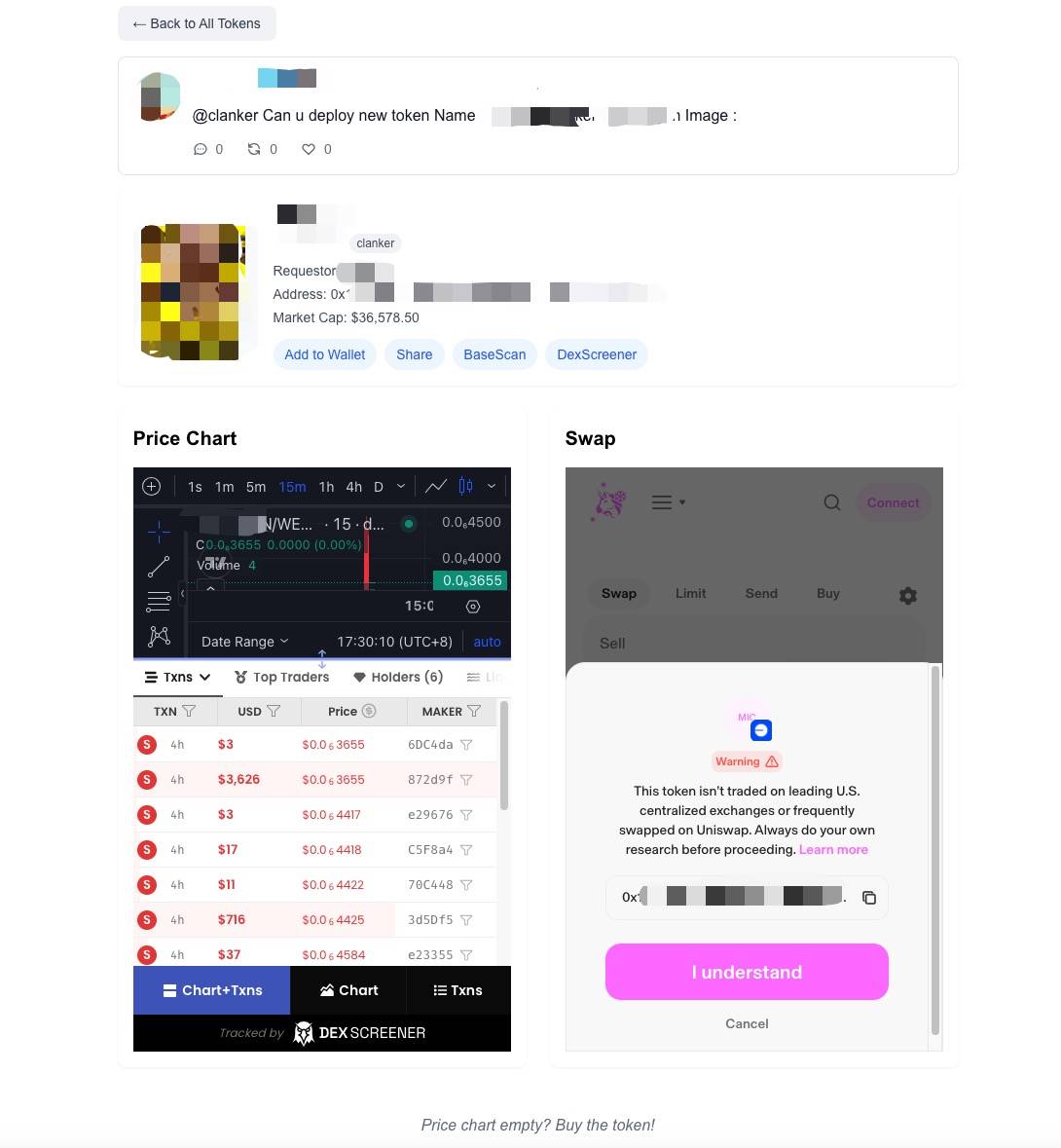
So what exactly happens on Clanker's side?
Next, let’s go over Clanker’s technical implementation. The project doesn’t involve many technical complexities—it essentially comprises two parts. First, it uses Anthropic (AI) to respond to your creation request until Clanker’s backend obtains sufficient executable parameters. Then, it automatically invokes smart contracts to create the token and perform subsequent on-chain operations. After successful creation, basic information is displayed through its simple frontend interface.
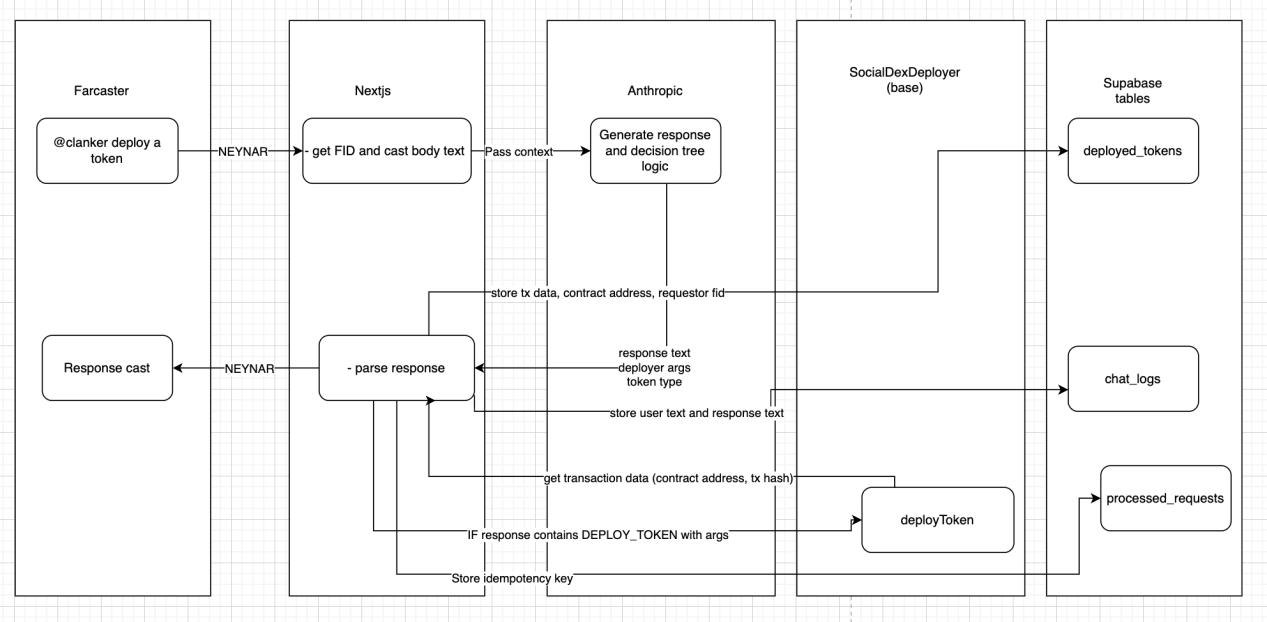
First, let’s introduce Anthropic. The team behind Anthropic consists of scientists and engineers from OpenAI, DeepMind, and other leading AI institutions. Their most well-known product is the Claude series of large language models, known for the following features:
• Strong conversational ability: Capable of smoothly interacting with users across multilingual environments.
• Enhanced safety: Prioritizes ethical and security concerns in user inputs, minimizing the generation of harmful or inaccurate content.
• High flexibility: Suitable for multiple applications including content creation, data analysis, and code generation.
For Clanker, the primary use case is leveraging Claude’s conversational AI capabilities—acting as a customer service agent that communicates via Casts to guide users in providing all necessary information, such as token name, symbol, and logo.
Once this information is obtained, the process becomes straightforward, requiring only a simple backend system. The backend first creates a liquidity pool for the token within Uniswap V3 on the Base chain, with an initial market cap of approximately $30,000. To elaborate slightly: by using the V3 paradigm, Clanker provides one-sided liquidity by placing all newly minted tokens above the initial price. Specifically, Clanker creates a 1% fee tier ETH/token pool and deposits all tokens into a price range extending from the initial price to infinity. The corresponding LP NFT is then locked—under current rules, until the year 2100. All fees generated during this period are collected by the protocol and distributed according to the following rules:
• 60% goes to the Clanker protocol to support platform operations.
• 40% is allocated to the MEME token creator as an incentive for deployment and community engagement.
Overall, this is quite an interesting little application that effectively leverages conversational AI to further lower the barrier to MEME coin issuance. Interested users are encouraged to try it out—each user can create up to one token per day. Of course, the essence of any MEME lies in traffic value; only when this is addressed will your MEME hold real value. For the platform, if it can sustain a wealth effect, community-driven tools will likely emerge to continuously improve the user experience.
Join TechFlow official community to stay tuned
Telegram:https://t.me/TechFlowDaily
X (Twitter):https://x.com/TechFlowPost
X (Twitter) EN:https://x.com/BlockFlow_News
 @web3_mario