

From 0 to 1 Brand Revolution: A16z's Brand Expert Teaches You How to Stand Out in Web3
TechFlow Selected TechFlow Selected
From 0 to 1 Brand Revolution: A16z's Brand Expert Teaches You How to Stand Out in Web3
A brand is the collection of beliefs people hold about your company.
 Navigating Web3 tides with focused insights
Translation/Article by: Cikey
Original video: Positioning and Branding in web3 with Steven Ebert, provided by a16z crypto.
Presented by branding expert Steven Ebert. This session dives into the key elements of brand-building for early-stage Web3 startups, including how to define your brand story and build a minimum viable brand to stand out in a competitive landscape.
Are you wondering how to craft a compelling brand story for your Web3 project or organization?
Are you curious about how a clear brand narrative can clarify goals, optimize messaging, and ultimately capture influence?
Steven Ebert: I work with startups at various stages—early-stage, mature, and well-known companies—primarily helping them tell their stories more effectively.
Today, we’ll focus on early-stage branding. Many founders tend to overlook the importance of brand storytelling in the early days, assuming it's something to address later. However, I want to share what you can do at this stage, what to prioritize, and what can wait.
Take a moment—give yourself 60 seconds, don’t overthink it—and answer instinctively: Why does your project exist? Use as few words as possible, then set it aside—we’ll come back to it later.
Let’s start with a question: "What is a brand?"
It’s something people can recognize.
It’s like a tribe—something people are loyal to.
It’s something you associate with.
...
Your answers reflect common perceptions of brands. If you search Google, you'll find many different definitions.
The definition we’ll use today is: A brand is the collective set of beliefs people hold about your company.
Let’s unpack that—"set of beliefs" refers to people’s perceptions: Is it cool? Useful? Interesting? Do I want to use it? Is it worth it? These are all opinions people form about your company or product. When we say "people," we mean customers, users, but also partners, investors, potential team members, even the crypto community and broader market—in short, the entire world.
And “your company” includes not just you, but your product, team, and what you're bringing to the world. I like this definition because it reminds us that a brand isn’t something you can "set and forget." A brand is more like an organism—it evolves as your product, team, and user base grow. When you launch a product, you’re actually relinquishing some control over your brand, because as more people interact with it, perceptions become more complex.
So now is the time to ask: What do we want our brand to communicate? The core task of branding is actively shaping people’s beliefs about our company—what we might call “perception management.”
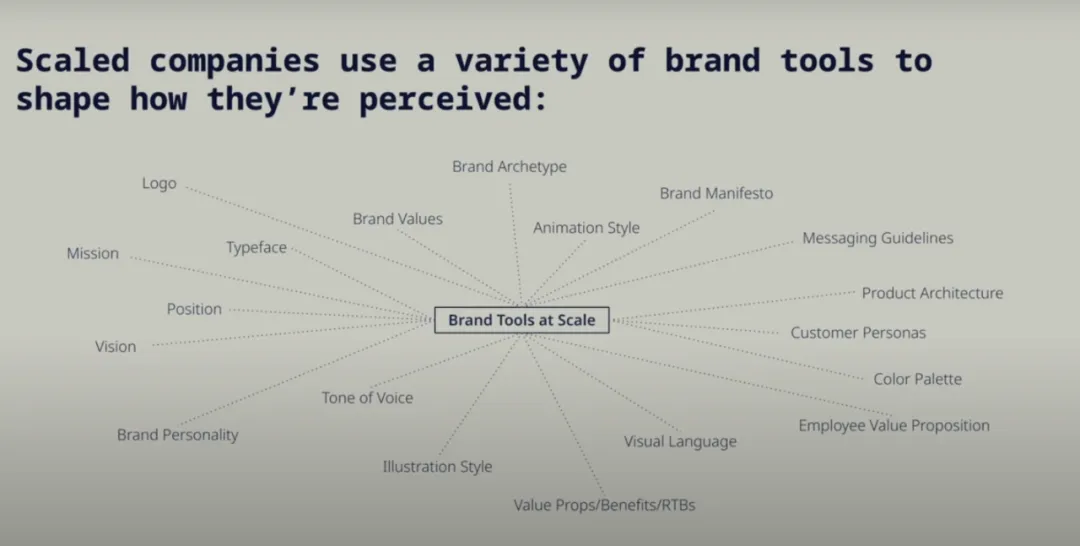
When you're a large company, you have many tools to manage your brand. These include visual and linguistic tools that help consistently communicate who you are and how you want to be perceived in the market.
However, if you're in the early stages of building your company, there are unique challenges you must address—challenges larger companies don’t face.
First, you likely don’t have a large team. Big companies need these tools because they have hundreds or thousands of employees, each acting as a brand ambassador in some way, making consistent messaging difficult.
Second, you probably lack mature operational functions, so many traditional branding tools may not yet be useful.
Third, you’re still searching for product-market fit. Even if you have early users or revenue, your business assumptions aren’t fully validated.
Therefore, you need a more flexible framework to help tell your story in the market—this is called the “Minimum Viable Brand” (MVB). While the term sounds a bit cringe, it captures an important idea: using the most basic ideas to tell your story to the world.
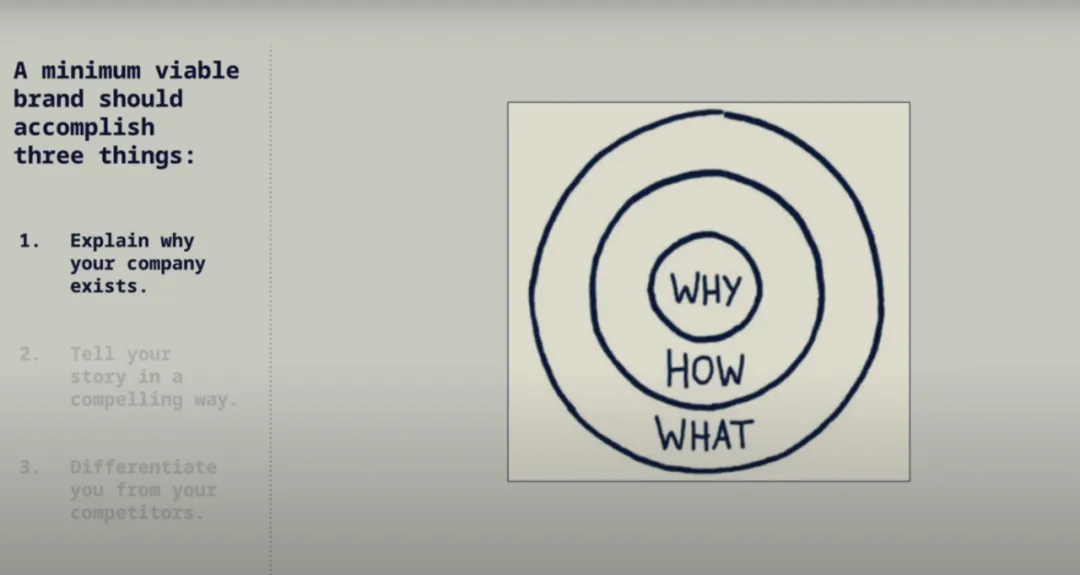
Your Minimum Viable Brand needs to accomplish three things:
1. Explain why you exist
This is likely the most important thing for you to focus on today. Many companies can easily state what product they make, but few can clearly explain *why* they exist. Why do you exist? What problem are you solving? If you don’t consider this early, it becomes much harder to build a coherent brand identity as you scale.
2. Tell your story in a compelling way
This isn't just for marketing—it helps with recruiting and fundraising too. In a tight talent market, having a compelling narrative is critical.
3. Differentiate yourself from competitors
Especially in high-risk, commoditized industries, your brand story may be the only thing that sets you apart.
In short, brand-building is an evolving process. Proactively shaping your brand early helps earn recognition and trust in the market.
We’ve established the need for a “Minimum Viable Brand” and why it’s valuable. Now, how do we actually build it? What should we focus on? Two areas are crucial:
1. The Story Itself
What language will we use? How will we tell this brand story? What ideas do we want to own in the market? How do we describe our approach to solving the problem?
2. Visual Identity
What does our brand look like visually?
Since brand storytelling is my daily work, I’ll spend more time on that part. Visual identity I’ll cover briefly.
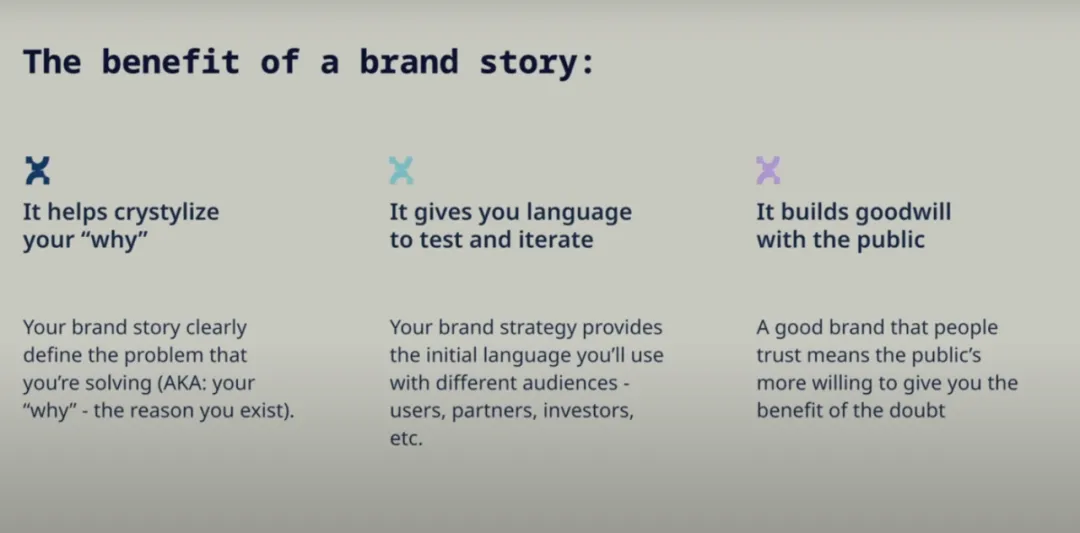
Let’s start with the brand story. A strong brand story is incredibly useful. It helps clearly define the “why”—why your brand exists. It helps define the problem in the market and how you solve it. The brand story is your foundational reason for being. If you can articulate this well, you’ll already be ahead of most brands.
A brand story also gives you a language toolkit you can test and iterate. A brand is alive—it grows and evolves over time. Ideally, when starting out, you have a set of language to use, which you test through conversations with customers, investors, and trusted advisors. Feedback tells you which ideas resonate. As your product evolves, so should your brand language.
There’s a third benefit: a brand story helps accumulate goodwill in the public eye. This is a secondary benefit, but in times of crisis, if you’ve built a strong brand with good reputation and public trust, people are more likely to give you the benefit of the doubt. So a clear brand story is highly valuable.
To better understand how to build a brand story, let’s look at a familiar example: “Zora.”
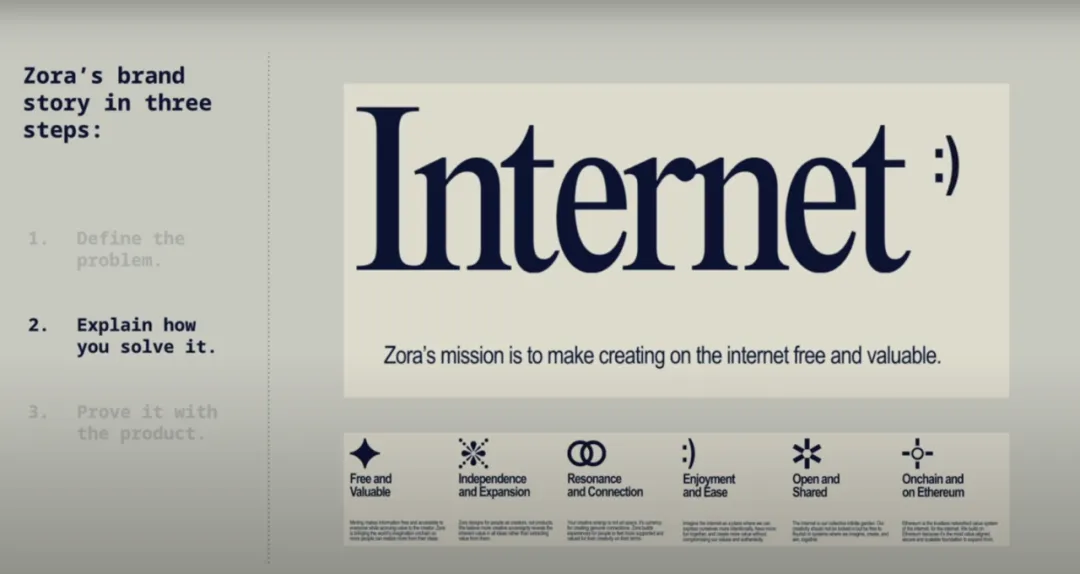
How did Zora build a distinctive brand and evolve it over time? What were the three key steps in their brand story development?
Zora’s brand story evolved through three steps:
1. Clearly define the problem
When Zora first launched, it was an NFT marketplace where creators could mint and sell their NFTs. Shortly after launch, co-founder Jacob gave a talk introducing the concept of ownership of information. He clearly defined the problem: platforms like Instagram, TikTok, and Spotify are essentially private networks that monetize user-generated content while creators receive only “social currency” like likes and follows. This reflects the current default model of internet and content ownership—we haven’t truly escaped the old internet. Zora effectively framed the problem. Interestingly, they coined a new idea—or “meme”—for the future they wanted: the “Internet Renaissance.” This concept describes a future where creators use technology to control their content distribution and relationships with communities, thus capturing the value they create. This language played a vital role in Zora’s development.
2. Propose an innovative vision
Zora didn’t claim to be the sole leader of the “Internet Renaissance,” but rather observed its emergence. They saw the problem and recognized how NFTs and decentralized networks could break monopolies on content control. So they decided to join this movement and contribute in their own way.
They explained how they’d solve the problem. Their mission statement: “Our mission is to make creating on the internet free and valuable.” On top of that, they developed deeper language to explain how they achieve this—what they call beliefs (others call values, pillars, or benefits). This language was detailed, thoughtful, and tightly aligned with their brand.
3. Deliver on the promise through product
This GIF is a recent screenshot—you can see many creators publishing artwork on Zora’s marketplace. Quality varies, but creators retain control and distribute content by building relationships with collectors. This simple three-step process—define the problem, explain the solution, prove it through product—is an effective way to think about brand storytelling.
If you want to go deeper into crafting this language, focus on three aspects:
1. Clarify our why
This will take the most time. Re-define the problem and how we solve it.
2. Articulate product benefits
What do we offer the market? Why would users want to use our product? What value does it provide? Why choose us over others?
3. Define the brand’s “tone of voice”
This is often overlooked in brand strategy. It’s not just *what* you say, but *how* you say it. Understand your target audience first, then tailor your tone accordingly. In short: speak differently to different audiences.
Now, onto visual identity. Most of you will likely partner with designers, since you're here to build great crypto products, not because you're visual designers. If you happen to have both skills, great—but most will need external design partners. You might also work with a strategy partner on brand story, but you’ll almost certainly need an external designer for visual identity.
When choosing a design partner, consider these factors:
1. Target audience
If your product helps crypto enthusiasts buy shitcoins, your visual style will differ greatly from one targeting institutional investors. Take your audience’s needs and preferences seriously.
2. Competitive analysis
Look at what competitors are doing. What’s their brand style? What do you like or dislike? What are industry norms? Can you do something distinct and recognizable?
3. Brand mood
During creative briefings with your design partner, clearly convey the mood and energy you want. If you’ve already defined your brand story, that becomes a powerful creative brief. For example, Zora’s story—making creation on the internet free and valuable—gave designers a strong foundation.
Through these steps, you can effectively define and present your brand story to stand out in the market.
Take Party, for example—a brand that did this exceptionally well.
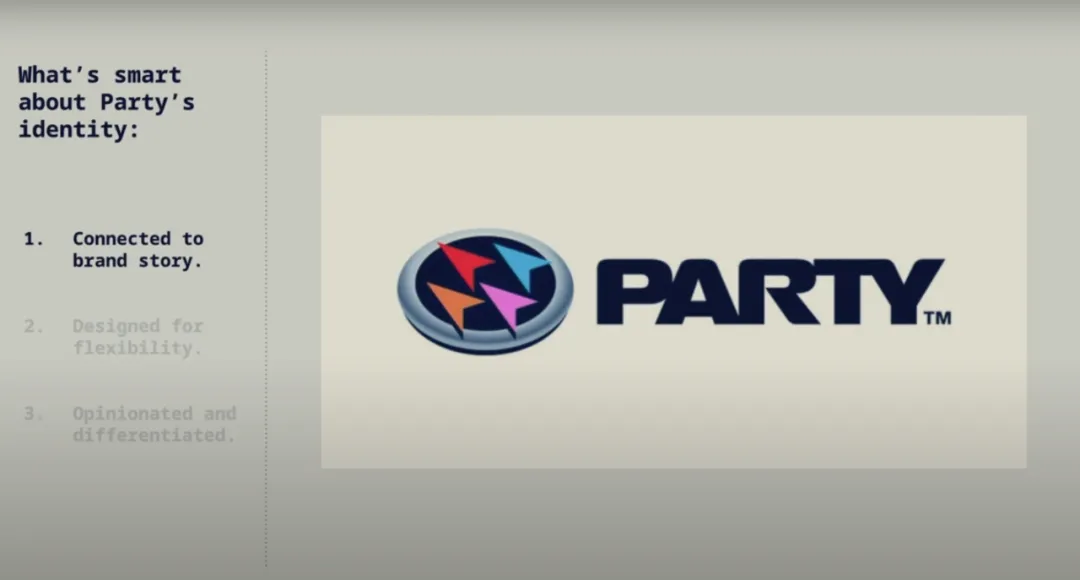
Party is a tool that enables users to perform on-chain actions together. Their mission: “Make crypto multiplayer”—a brilliant piece of brand language. This allows users to simply collaborate—buy, sell, and manage assets together.
Several smart choices stand out:
1. Tight alignment with brand story
If the whole idea is about collaboration, completing tasks together, and bringing groups on-chain, then the logo showing four cursors moving in unison creates an intuitive visual link. This thoughtful connection strengthens the brand.
2. A highly flexible system
This impressed me deeply. Anyone who can build such a robust brand identity system earns my respect. They created a system enabling extreme flexibility in visual communication. They designed distinct logos for the company, app, mascot Kazoo, and underlying open-source protocol. They even created a quality seal, reminiscent of early Nintendo game boxes. Anything from Party feels instantly recognizable and distinct from other brands. No matter what you see, if it’s from Party, you know it immediately—because they spent serious time designing the visual system.
This is especially important if you’re building a consumer-facing brand, not B2B. If you’re working on ZK proofs, maybe brand matters less. But for consumer products, such visual systems are extremely valuable.
Here are some elements to consider:
First, the logo—the symbol representing your brand, which could be an icon, wordmark, or combination.
Second, color palette—consider colors for your website, presentations, and other communications.
Third, typography—most companies use two or more fonts to create contrast between headings and body text.
Finally, a few scattered thoughts before Q&A:
1. Avoid copying existing brand narratives
Once a big brand popularizes a concept, many rush to copy it. For example, Coinbase and a16z successfully promoted ideas like “building a new internet” or “making finance freer and fairer.” If someone uses these today, it feels stale and unoriginal.
2. Be careful with naming clarity
If your company, team, and project all share the same name, it can confuse people. Many lending protocols face this issue. Distinct names help—like OpenSea vs. SeaPort, or Party App vs. Party Protocol—avoiding confusion and preserving brand clarity.
3. Avoid chasing fleeting trends
A few years ago, many brands built around phrases like “GM” and “WAGMI”—now they look outdated. Your brand shouldn’t be trendy for a moment; aim for lasting appeal.
4. Let your brand story evolve with your product
The story you tell today doesn’t have to last two or three years. It should fit the present. Stay open-minded and ready to adapt over time.
I mentioned earlier that visual identity is especially important for consumer-facing businesses. B2B brands need to communicate functionality clearly, not necessarily “coolness.” But for consumer products, visual identity is crucial—especially in crowded markets, where a distinctive brand story helps you stand out.
Lastly, you may need professional help in design. Consider partnering with specialists in strategy or design. But beware: some small agencies charge high fees—like $50k—for basic branding, which may not be cost-effective.
So I suggest not rushing to spend big. Wait until Series A, or even Series C, to invest heavily in branding. The timing depends on how much you’re willing to spend.
When choosing partners, seek individuals or small teams whose taste and thinking align with yours. Once you pick a partner, ask to see their past work and hear how they approach brand and story-building. This helps assess alignment, as the partnership greatly impacts final quality.
Also, stay cautious. If someone calls themselves an agency or independent consultant (a title I also use), be alert—they may try to inflate prices. Always vet thoroughly.
Finally, let me ease the pressure. This may feel overwhelming, especially if you’ve never thought about branding before.
The good news: we’re focused on short-term goals. Right now, your priority should be securing the next round of funding.
So after Demo Day, don’t stress about distant futures. Focus on the next few months. Branding often requires big investments because agencies aim to build brands lasting 3–5 years. But realistically, if you haven’t confirmed product-market fit, predicting 18 months out is hard enough—let alone three years. So focus on shorter horizons. Give yourself freedom and flexibility to focus on what works now, and evolve gradually.
Q&A
Q: What do you think about using AI to generate brand designs—like using MidJourney to create a brand identity for the next funding round?
If you mean using tools like MidJourney to build brand visuals, my view is: If you’re highly skilled at prompting and can make the output not look AI-generated, it’s viable. Some designers excel at this. But if not, AI-generated designs may reduce perceived brand value.
So I recommend caution. If it were me, I’d prefer to invest time in a refined design process, creating a simple yet powerful logo, rather than opting for complex designs that obviously look AI-made.
As a startup, consider collaborating with designers to develop visual elements rooted in your brand DNA, ensuring alignment with your core spirit. Key to this process is efficiency: get a complete brand core report, extract main visual and design directions. For execution, decide whether to work weekly with freelance designers, hire full-time, or partner with a design firm—options depend on resources and needs.
The challenge is that early startups often need to work with agencies to learn frameworks around brand positioning and values—crucial for startups. The first step is usually identifying core brand elements, then building the brand identity around them.
But your situation may vary. When working with early-stage companies, I typically don’t jump straight into executing mission statements or positioning. Instead, I help founders gain confidence in telling their brand story fluidly across different contexts.
Q: How do you build a community when introducing smart contracts to people unfamiliar with them?
Great question—especially given their prior exposure was only to Bitcoin. When building something abstract without ready metaphors, your job is to create those metaphors. Zero-knowledge (ZK) proofs are a perfect example. Companies like Aztec succeeded by finding psychological shortcuts to make the tech understandable. You can discuss multi-party computation and mathematical details—that works for some users—but equally important is explaining why the tech works and why it matters. Like the smart contract analogy: it’s an autonomous machine that executes tasks when conditions are met, no third party needed. Ethereum went through a similar process—finding metaphors for smart contracts, account abstraction, and other technical concepts. By framing money flow in a new way, they made core value accessible even to non-technical users. For multiple audiences—general users and developers—message delivery must be tailored accordingly. For general users, focus on real-world applications; for developers, dive into technical depth. This ensures your message is both comprehensive and digestible.
Q: In the “Why, How, What” framework, how do you balance these three parts when telling your story?
Excellent question. Industry maturity is a good shortcut for determining emphasis. If you’re creating a new category, “Why” matters most—it’s the easiest emotional hook. For example, when solving an abstract problem, the company’s essence lies in “Why.” For emerging categories, focus on “Why.” If your market has competition, “How” becomes more important. If your methodology or delivery differs, “How” stands out. “What” is most useful in less competitive spaces—like functional beverage brands, where you talk more about features. Still, cover all three, but emphasize one based on context.
For instance, saying “We’re solving an untouched pain point” helps convey your core mission and value.
Q: When building a new data layer, if existing metaphors no longer apply, should you adopt a new narrative?
Great question. If existing metaphors aren’t working, try a new narrative. For example, if your data layer solves a different problem than existing “oracles,” highlight that. You can take different approaches—e.g., “We solve this problem differently from the seven competitors.” This emphasizes uniqueness and avoids direct comparison. As we provide not just data, but a new way to transform data into value, such a narrative highlights your differentiation.
Q: How do you build a brand when your target audience is wary of crypto-related language?
If your audience is skeptical of crypto, consider reducing the visibility of crypto itself—make the technology invisible to your solution’s value proposition. Focus on practical benefits enabled by the tech, not the tech itself. Additionally, use education to show how you differ from competitors—explain how your use of crypto adds value. This helps overcome skepticism and effectively communicates brand value.
Q: When a company name no longer fully matches its direction, how do you decide whether to rebrand?
The classic answer is “it depends.” But generally, if your company has built strong brand equity, that reputation is valuable and worth preserving. If the name is completely misaligned (e.g., “Sports Drink Co.” now making hockey pucks), then yes, consider a change.
But if the mismatch is minor or the name is descriptive, consider adjusting your messaging instead of abandoning hard-earned brand value.
Many companies do rebrand—it’s common. We can explore specific messaging strategies for rebranding further.
Join TechFlow official community to stay tuned
Telegram:https://t.me/TechFlowDaily
X (Twitter):https://x.com/TechFlowPost
X (Twitter) EN:https://x.com/BlockFlow_News















