Why Invest in Catizen: On Catizen's Scarcity Amid the Telegram Investment Paradox
TechFlow Selected TechFlow Selected
Why Invest in Catizen: On Catizen's Scarcity Amid the Telegram Investment Paradox
TG's investment paradox actually proves Catizen's scarcity.
 Navigating Web3 tides with focused insights
Author: kirin_alen d/acc
Catizen has amassed over 23 million users in under three months, with nearly 3.5 million daily active users (DAU), generating over $16 million in in-game purchase revenue. The Telegram Premium user community exceeds 2 million members, meaning 40% of Telegram's subscribers are Catizen users. Additionally, there are 1.5 million on-chain users and over 550,000 paying users, achieving an ARPU of $30. Catizen has also announced plans to launch a gaming center.
Coinciding with Ton’s listing on Binance, this article reflects on why we chose to back Catizen at the end of 2022, and why we remain bullish on Catizen within the TG ecosystem today.
When we decided to invest in the Catizen team in 2022, the outcome was entirely unexpected. At that time, FTX had just collapsed, and the industry was at its lowest point. Beyond confidence in Bitcoin and Ethereum prices, there was no clarity on what kind of project might succeed next. The vague intuition was that while NFTs and the Metaverse in 2021 had brought crypto into the mainstream—prompting traditional institutions and celebrities to enter—the experience had largely been disappointing. If the next cycle were to bring mass adoption, the model needed to be more replicable to attract both these groups and new users alike.
"We love growth—we want to bring the IAA+IAP mini-program hybrid monetization model into crypto"
This was the idea the Catizen team shared during our first discussion about the project. By then, they already had GameFi experience. For a team rooted in traditional performance-driven game publishing, purely PvP-based GameFi games lacked long-term potential. Instead, combining crypto cashback with a hybrid monetization model of IAA+IAP (in-app advertising and in-app purchases) felt far more exciting—and better aligned with their expertise in user acquisition and mini-game development. "We believe we should bring the game to our home turf," they said.
"Mini-program games are the gaming equivalent of short videos—both cater to modern fast-paced lifestyles."
I personally resonated with this at the time. During the bear market, bored and scrolling through Bilibili and Douyin, I kept seeing ads for mini-program games (like recommending “Pea Wars,” a merge-tower-defense match-3 game). As a core console gamer, I would normally ignore them—but these game creatives were so human-centric and skillfully hooked me. On quiet, sleepless nights, I’d impulsively click into one, make a $6.8 first purchase, or endlessly watch nested ads just to progress. I’d play for one or two weeks, delete it, then repeat with another later—just like those guys on abstinence forums. The addictive nature and profitability of mini-program games were palpable.
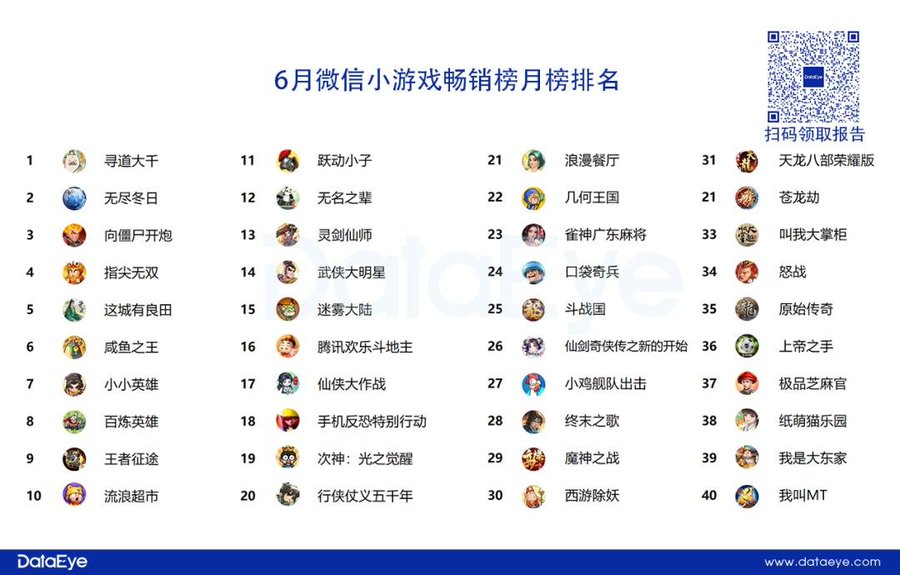
Played almost all of them—games are average but addictive
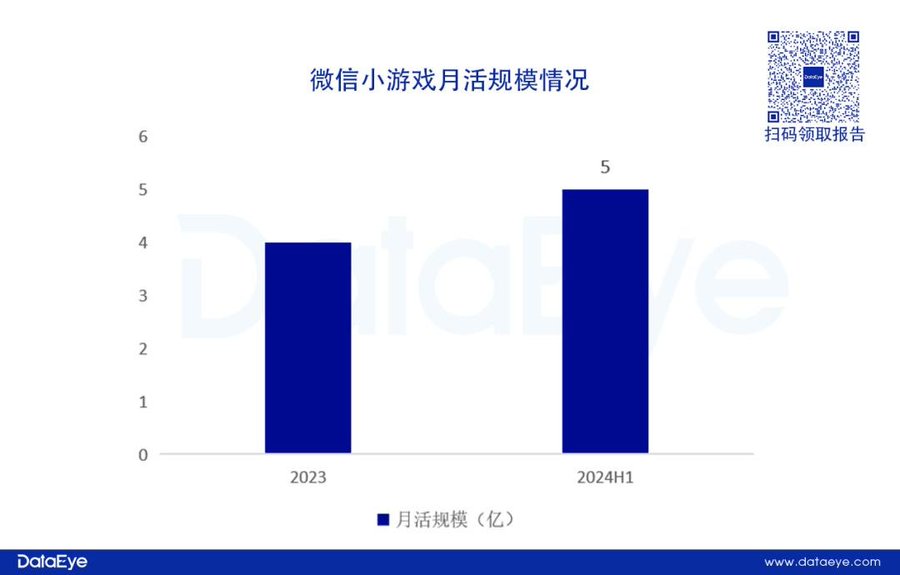
Rapidly growing mini-games
Looking at recent DataEyes reports, domestic mini-program game revenue in China hit 2 billion RMB ($280M) in 2023—one year later, it’s projected to exceed 6 billion RMB ($840M), a 300% annual growth. According to Tencent, monthly active users for mini-program games have surpassed 500 million, with average daily session times around one hour, and 14-day retention exceeding 50%. User habits are solidifying—mini-program games are entering their “iPhone moment.” Meanwhile, overall game market user growth is stagnant, making mini-games the only hope for breakout success in this era of “zero-sum competition.” This mirrors the situation in crypto—seeking growth amid stagnation.
Domestic mini-program games are also evolving—becoming heavier, more diverse, and adopting hybrid monetization models, increasing their value. Mini-game globalization reached $470 million in the first half of 2024, still in early exploration phase, indicating significant room for expansion.
However, exporting mini-program games overseas isn’t easy. The biggest reason is that WeChat Mini Programs provide a built-in traffic source and launcher in China—something absent abroad. PWAs, the predecessor to mini-programs, never took off due to conflicts with Apple’s commission and other interests—until friend.tech surged back into view. (Side note: Try Ton.place—an OnlyFans-style PWA with great UX.)
The team had a solution for this.
"We want to go all-in on the Telegram ecosystem."
At the beginning of 2023, the team believed the answer to “mini-program games + globalization + crypto” lay in Telegram—a platform easiest to compare with WeChat overseas, willing to mimic WeChat’s commercialization attempts, crypto-literate, and boasting massive user scale.
But back then, Telegram and Ton’s infrastructure wasn’t mature, and commercialization efforts were nascent—not yet the established on-ramp for crypto growth it is today. Making this decision and sticking to it wasn’t as straightforward as it seems now. To better communicate and integrate with the TG team, they even studied Russian culture and language. The first wave of traffic红利 in the TG ecosystem came from unseen dedication and effort.
"Why choose cats?" "Because I’m a cat person." "...”
In hindsight, investing in Catizen leaned more on intuition—recognizing the addictive nature and growth potential of mini-games, believing in the market expansion space of IAA+IAP hybrid monetization, trusting that integration with TG could yield strong results, and valuing the team’s proven track record in performance marketing, industry connections, crypto experience, and ambition for success.
If the initial investment was driven more by serendipity, witnessing today’s flourishing landscape of TG mini-programs gives me greater conviction in Catizen’s future.
The former was vaguely correct; the latter eliminates wrong answers.
The Investment Paradox of the TG Ecosystem
1. TG and Ton are decoupled in function—projects must seize TG’s traffic红利
Unlike SOL, what we need is not Ton’s users, but the 900 million potential users on Telegram bringing net-new users to crypto. Even before the Ton ecosystem boomed, trading bots like Maestro, Unibot, Bananagun, and Pepeboost leveraged TG channels to meet users’ demand for quick on-chain transactions—earning massive profits using custodial wallets. They serve Web3 users. But if a project can create products for Web2 users, then TG and Ton wallets become mere traffic and payment conduits—no complex smart contracts needed, simplifying business operations.
Considering TG is still in its early commercialization and traffic红利 phase, and overseas users haven’t yet been saturated by Chinese-style mini-program games (which are still rapidly evolving), combined with H5 limitations of MiniApps, low initial quality and homogenized Tap-to-earn projects are inevitable. However, the evolution toward diversified and heavier MiniApps is equally inevitable. For now, capturing TG’s traffic红利 is paramount—product iteration can follow. And development should prioritize being “human-centric” rather than competing solely on traditional game quality.
2. TG MiniApps resemble small businesses—great for entrepreneurship, poor for investment
Traditional crypto projects emphasize narrative + infrastructure—"get rich, build roads first"—raising round after round from VCs, constructing elaborate infrastructures, only to realize there’s no real demand, turning them into "ghost cities." Token issuance essentially becomes a form of distressed asset disposal—local debt swapped into equity—only rebranded as high-potential assets thanks to compelling storytelling.
Telegram, however, comes pre-equipped with infrastructure and users. Now open for commercial use, it allows entrepreneurs to set up small restaurants, bubble tea shops, massage parlors, and entertainment venues to earn money. Early entrants meeting basic user needs—even mediocre ones—can capture traffic红利, with top performers potentially striking it rich. But these are more like small businesses: founders profit doesn't necessarily mean it's a good investment.
From an investability standpoint, the current low barrier to entry means that if a MiniApp team masters the monetization formula on TG and generates consistent revenue, they likely don’t need funding. Considering post-funding pressures—regulatory risks, the need to inflate narratives for token launches, exchange listings, price stabilization, community management—many founders may prefer to stay quiet and grow organically. Conversely, teams without TG traffic mastery lack appeal to investors. This low cost of falsification differs sharply from traditional crypto infra projects, creating a binary state in fundraising: unproven teams are ignored, while successful ones either refuse funding or demand sky-high valuations.
From an exit perspective, traditional token issuance is less viable than revenue-sharing or dividend models in the TG MiniApp space.
Token exits face founder willingness issues, narrative ceilings, and misaligned business models (most successful consumer companies profit from supply chains and franchising).
Revenue sharing or dividends, while attractive, face real-world legal enforceability challenges in crypto’s loosely governed environment.
TG MiniApps resemble the NFT era—low-barrier digital items where success depends on community building and sales ability. Those who sell gain the right to "continue narrating and fundraising"; those who don’t fail cheaply. But unless creators share profits with investors, by the time a project becomes investable, valuations are already steep—and very few can truly exit via token issuance. Most generate buzz without real returns.
The advantage of TG MiniApps over PFPs is that unlike one-off NFT drops, MiniApps can generate recurring in-app purchase revenue. Yet, in crypto’s weak-contract environment, ensuring transparent distribution of revenue and dividends remains challenging.
Thus, for execution-strong teams, TG MiniApps offer a low-barrier arena to acquire real users and revenue—but for investors, it’s akin to memes for retail—pure luck. Ideal for startups, poor for investments.
Does this mean TG is entirely unsuitable for investment? Not quite. In my view:
The TG investment paradox actually highlights Catizen’s scarcity.
Synthesizing the above logic, investing in TG projects requires teams that:
1. Foundational capability: Achieve PMF, identify synergy between TG channels and applications, and successfully onboard users
This ensures the project has a chance to survive—or generate revenue.
2. Willingness and ability to implement revenue sharing and token issuance
The earlier-discussed difficulty in executing dividends can be resolved if founders are willing to both issue tokens and distribute profits—using smart contracts on-chain to verify revenue and automate payouts, solving both problems simultaneously.
3. Capacity to upgrade and deliver on narrative and business model evolution
The randomness and homogeneity of MiniApp success mean that teams aiming to launch tokens must elevate their narrative and business model—and demonstrate execution capability.
Narrative extensions for mini-games typically fall into two categories: 1) gaming platforms (self-developed or published); 2) gaming blockchains. These are remnants of GameFi’s legacy, now relatively stale. The root cause? Lack of sustained high-quality game supply. Without it, the core issue remains: mass adoption channels haven’t opened, making in-house development slow and costly, and third-party signing lacks bargaining power. Fortunately, TG opens this channel, making the gaming platform story feasible—if teams can consistently discover and publish quality games. Here, Chinese teams have inherent advantages.
And Catizen meets all these criteria:
1. Catizen has already demonstrated its product development, community operation, and traffic monetization capabilities on TG: over 23 million users in under three months, nearly 3.5 million DAU, $16 million in in-game purchase revenue, 1.5 million on-chain users, over 550,000 paying users, and a $30 ARPU;
2. The team has publicly committed to airdrops and ongoing ecosystem empowerment;
3. The team has announced plans to launch a gaming platform with 200 mini-games in reserve—including proven hits from WeChat and Google Play with hundreds of millions of downloads—leveraging Catizen’s deep roots in the Chinese gaming OG community. With mini-game and TG operational expertise, they’re poised to become the most successful gaming platform on TG. Additionally, the team possesses vast short-video content resources, with short-video and e-commerce platforms currently in development.
Conclusion:
Cats are truly adorable!
Join TechFlow official community to stay tuned
Telegram:https://t.me/TechFlowDaily
X (Twitter):https://x.com/TechFlowPost
X (Twitter) EN:https://x.com/BlockFlow_News
 @qiqileyuan