Interpreting DuckChain: Powered by Arbitrum, Building the First L2 Built on TON
TechFlow Selected TechFlow Selected
Interpreting DuckChain: Powered by Arbitrum, Building the First L2 Built on TON
DuckChain is the first EVM-compatible Layer on TON ecosystem incubated by TON SCALE LABS.
 Navigating Web3 tides with focused insights
Author: Aaron, TON Ecosystem Researcher
In the blockchain space, The Open Network (TON) has demonstrated strong growth momentum thanks to its unique advantages and Telegram's massive user base of 1 billion users. CryptoQuant has named it one of the top-performing Layer 1 blockchains in 2024.
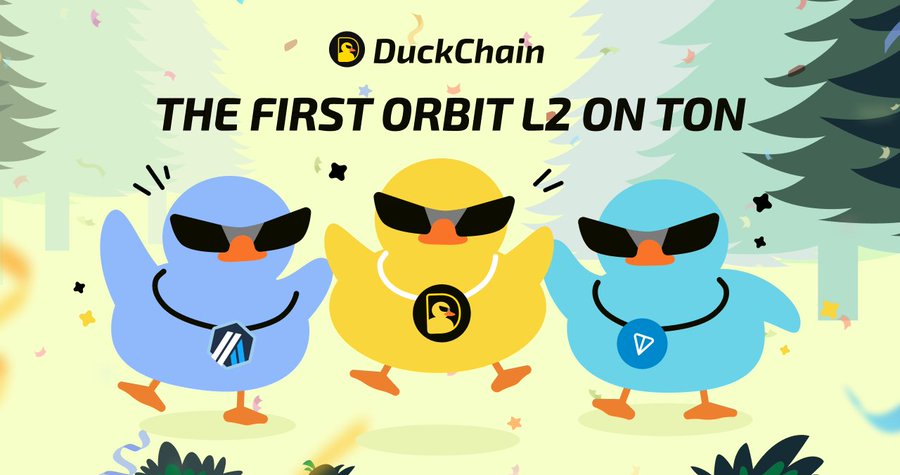
A key indicator of a thriving ecosystem is the continuous emergence of new projects. Recently, DuckChain, a TON Layer 2 project focused on bringing liquidity and users from the EVM and Bitcoin ecosystems, announced a collaboration with Arbitrum, adopting the Arbitrum Orbit solution to build a Layer 2 for the TON ecosystem, aiming to address current challenges such as complex development frameworks and isolated liquidity within the TON ecosystem.
Notably, DuckChain is the first EVM-compatible Layer 2 in the TON ecosystem incubated by TON SCALE LABS and the first non-Ethereum-ecosystem Layer 2 supported by Arbitrum. Its related proposal received 84.5% support in the Arbitrum DAO on August 1.
A Powerful and Practical TON L2 Project
DuckChain is the first TON L2 project to bring liquidity and users from both the EVM and Bitcoin ecosystems. It is also the first non-EVM L2 project built on the Arbitrum Orbit architecture with support from Arbitrum.
DuckChain's whitepaper is both intriguing and complex. In simple terms: DuckChain = TON Users + EVM Infrastructure + Liquidity Integration = Driving Mass Adoption of TON
Backed by TONSCALE LABS and built on the Arbitrum Orbit technology stack, DuckChain integrates with both EVM and Bitcoin ecosystems, aiming to create developer-friendly infrastructure and a user-friendly liquidity layer to enable mass adoption.
The core team behind DuckChain comes from prominent public chains including former Ton, Tron, and ApeChain. Team members are graduates of top universities such as Cambridge, Tsinghua, Columbia, Cornell, and Peking University. With extensive experience in blockchain development and operations, the team is dedicated to building accessible infrastructure and liquidity layers to drive real-world application at scale.
What Will DuckChain Bring to TON?
Infrastructure Level: Enabling Broader Prosperity
The current complexity of TON's infrastructure and development architecture makes building and deploying applications significantly more difficult than on other blockchain platforms, deterring many developers. Additionally, although TON supports smart contracts, their complexity hinders effective integration with Telegram bots. Most Telegram bots are limited to basic token operations, which suppresses innovation and ecosystem growth.
Simplifying smart contract usage and enhancing Telegram bot integration are crucial to unlocking TON’s full potential.
The partnership between DuckChain and Arbitrum will provide developers with a familiar EVM-compatible development environment. By integrating EVM development frameworks with TON, developers can build and deploy applications on the TON ecosystem more easily, promoting widespread adoption.
DuckChain will also offer modules such as staking, markets, bonding curves, and DID to developers and ecosystem projects, enabling seamless integration of various application components on-chain. An open-source community will further boost on-chain activity.
By connecting TON with the EVM ecosystem—especially Ethereum—DuckChain gains access to a vast pool of open-source development resources, mature DeFi protocols, and diverse dApps. This connection not only enables TON to integrate with proven technologies but also attracts developers familiar with the EVM environment, fueling further growth and adoption.
Liquidity Level: Overcoming Limitations
The complexity of the development architecture has also led to insufficient liquidity in TON’s DeFi ecosystem. Currently, TON’s TVL stands at just $700 million, with over 90% concentrated in TON and USDC.
DuckChain will use TON as native gas fees, but through abstraction features, allow multiple tokens to be used for gas payments, thereby increasing liquidity. Users can directly pay gas fees on the TON chain, with transactions batched onto DuckChain, natively aggregating liquidity from both TON and DuckChain.
Moreover, by integrating with the Bitcoin ecosystem—including the BTC mainnet, BTC Layer 2 solutions, and the Babylon ecosystem—DuckChain bridges TON to the largest and most capital-rich market in crypto, bringing abundant liquidity. Additionally, DuckChain users will be able to use liquid staking derivatives (LSD) and liquid staking tokens (LST) for on-chain payments, allowing them to maintain liquidity while earning additional yield. This feature makes both TON and DuckChain more attractive to retail investors and large funds alike, encouraging long-term retention and deeper engagement.
Conclusion
The collaboration between DuckChain and Arbitrum marks a significant advancement in Layer 2 solutions for the TON ecosystem. By introducing EVM development frameworks and enhanced liquidity, DuckChain not only brings new opportunities to the TON ecosystem but also offers innovative solutions to the broader blockchain industry. We look forward to DuckChain achieving greater success in the future and driving widespread adoption and development across the TON ecosystem.
Join TechFlow official community to stay tuned
Telegram:https://t.me/TechFlowDaily
X (Twitter):https://x.com/TechFlowPost
X (Twitter) EN:https://x.com/BlockFlow_News