Connecting Web2 and Web3: Exploring Attestation History and Related Projects
TechFlow Selected TechFlow Selected
Connecting Web2 and Web3: Exploring Attestation History and Related Projects
This article will introduce EAS, Smart Layer, EthSign, Verax, and PADO Labs.
 Navigating Web3 tides with focused insights
Authors: 0XNATALIE, ZHIXIONG PAN
Attestation is not a new concept, especially for those familiar with Ethereum's PoS consensus, where certain steps are referred to as attestation. Additionally, projects like EAS, Smart Layer, EthSign, Verax, and PADO Labs all emphasize their protocol layers' connection to the concept of Attestation. So what exactly does Attestation mean? How is it different from Verification?
History and Definition of Attestation
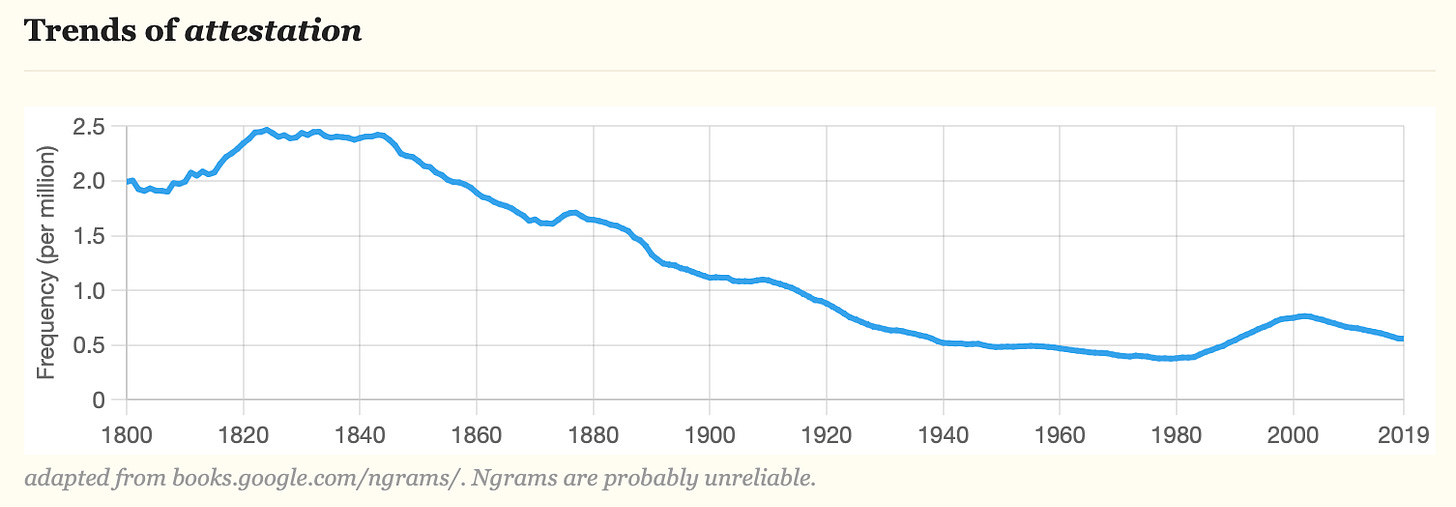
Looking at etymology, Attestation originated in the mid-15th century, meaning "testimony" or "a declaration in support of a fact." Verification emerged slightly earlier, meaning "confirmation" or "corroboration." According to frequency analysis of literature over the past two centuries, Verification has seen steadily increasing usage, while Attestation has declined—Verification appears more than ten times as frequently as Attestation, indicating that Attestation is a relatively niche term.
In Ethereum’s consensus process, Attestation refers to validators’ endorsement of a block’s final state—similar to a voting mechanism. If validators behave maliciously (e.g., Surround Vote) or participate passively (or go offline), they face penalties under the consensus algorithm (Slashing / Inactivity Leak). This implies that participation in Attestation involves a degree of subjectivity.
According to the Cornell Law School dictionary, Attestation is akin to “testimony,” typically required when signing contracts, wills, or other written documents—where a witness must be present and sign to attest to the authenticity of both the document content and the signer’s signature. This process can also be summarized as “witnessing.”
Based on this information, Attestation aligns more closely with meanings such as “witnessing,” “testimony,” or “declaration”—statements made subjectively by an Attestor, which others cannot independently verify for accuracy. In contrast, Verification is far more common and refers to processes that are repeatable and based on deterministic methods.
Understanding these distinctions clarifies why so many projects center their narratives around Attestation—it’s not about solving technical or algorithmic problems, but rather addressing social consensus: how verifiable, declarative events can be standardized, stored on blockchain, enhanced through smart contract composability, and turned into liquid assets.

Attestation Use Cases in Web2:
-
Account verification: Verifying user accounts via email or phone number.
-
Employment verification: Employer-issued proof of employment containing employee details, tenure, position, etc., usually provided by HR departments.
-
Academic credentials: Official diplomas issued by educational institutions, verifiable through systems like China’s Student Information Network to confirm completion of studies.
-
Identity documents: Government-issued IDs such as driver's licenses or passports.
Web3 introduces a paradigm shift in attestation functionality. Trust no longer relies on a single centralized entity but is distributed across a network of nodes, secured by cryptography and consensus algorithms to ensure data integrity and trustworthiness.
Attestation Use Cases in Web3:
-
Proof of digital asset ownership: Digital signatures generated on blockchain proving that a specific address owns a certain quantity or type of digital asset, such as NFTs.
-
Identity verification: Decentralized identity systems enabling individuals to obtain verified identities on blockchain.
-
Smart contract execution proof: Smart contracts issuing attestations confirming expected execution, triggering specific conditions or events.
-
Data integrity and traceability: Digital signatures on blockchain ensuring data integrity and immutability—signatures only validate successfully if data hasn’t been altered.
The potential for combining Web3 and Web2 attestation use cases is vast. Attestation acts as a bridge between digital and real worlds, providing proof mechanisms applicable to verification, endorsement, voting, certification, security, and more. Examples include:
-
Event tickets: Event organizers issue ticket attestations using blockchain technology to prevent counterfeiting or double-spending.
-
Proof of attendance: On-chain attestations not only prove user participation in specific events but also offer digital memorabilia.
-
Email verification: Users link their Web2 and Web3 identities using email attestations, streamlining identity verification.
-
Medical record validation: Patient health records, diagnoses, and treatments stored on blockchain; doctors generate digitally signed attestations verifying data integrity.
-
……
Notable Attestation-Focused Projects
Although still in early development, several Attestation-focused projects have already attracted significant market attention.
1. Ethereum Attestation Service (EAS): Universal Attestation
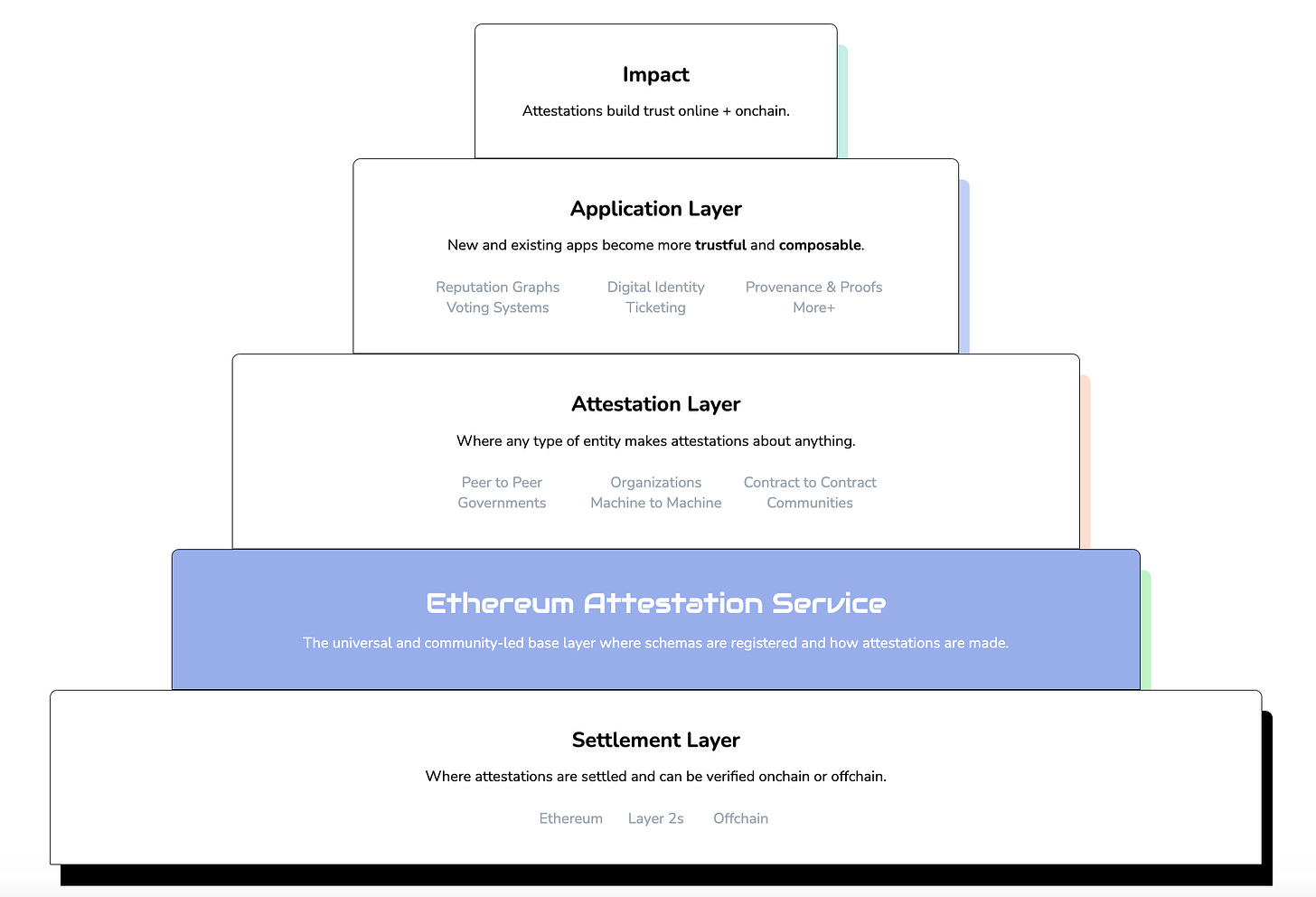
EAS is an open-source infrastructure project for creating attestations on-chain or off-chain. It uses digitally signed, structured data attestations as a means to verify facts, prove authenticity, and establish trust in various online and on-chain interactions. EAS operates via two smart contracts: Schema Registry Contract for registering attestation schemas, and Attestation Contract for managing attestations.
The Schema Registry Contract allows users to register attestation templates defining the structure and format of attestation data. Once submitted and registered, the contract assigns a unique identifier (UID) to each schema for future reference.
The Attestation Contract manages the lifecycle of attestations. Users create attestations using previously registered schemas, fill in specific content according to defined formats, and digitally sign them either on-chain or off-chain. The signed data, along with the schema UID, is submitted to the Attestation Contract. After validating the signature and UID, the contract records the attestation on blockchain, making it publicly verifiable. If needed, attestations can be revoked—not edited—but marked as invalid.
Attestations can be stored on-chain (directly on Ethereum blockchain, ensuring immutability and security) or off-chain (stored outside blockchain, often in decentralized storage like IPFS), allowing private, on-demand sharing.
2. Smart Layer: Identity Verification
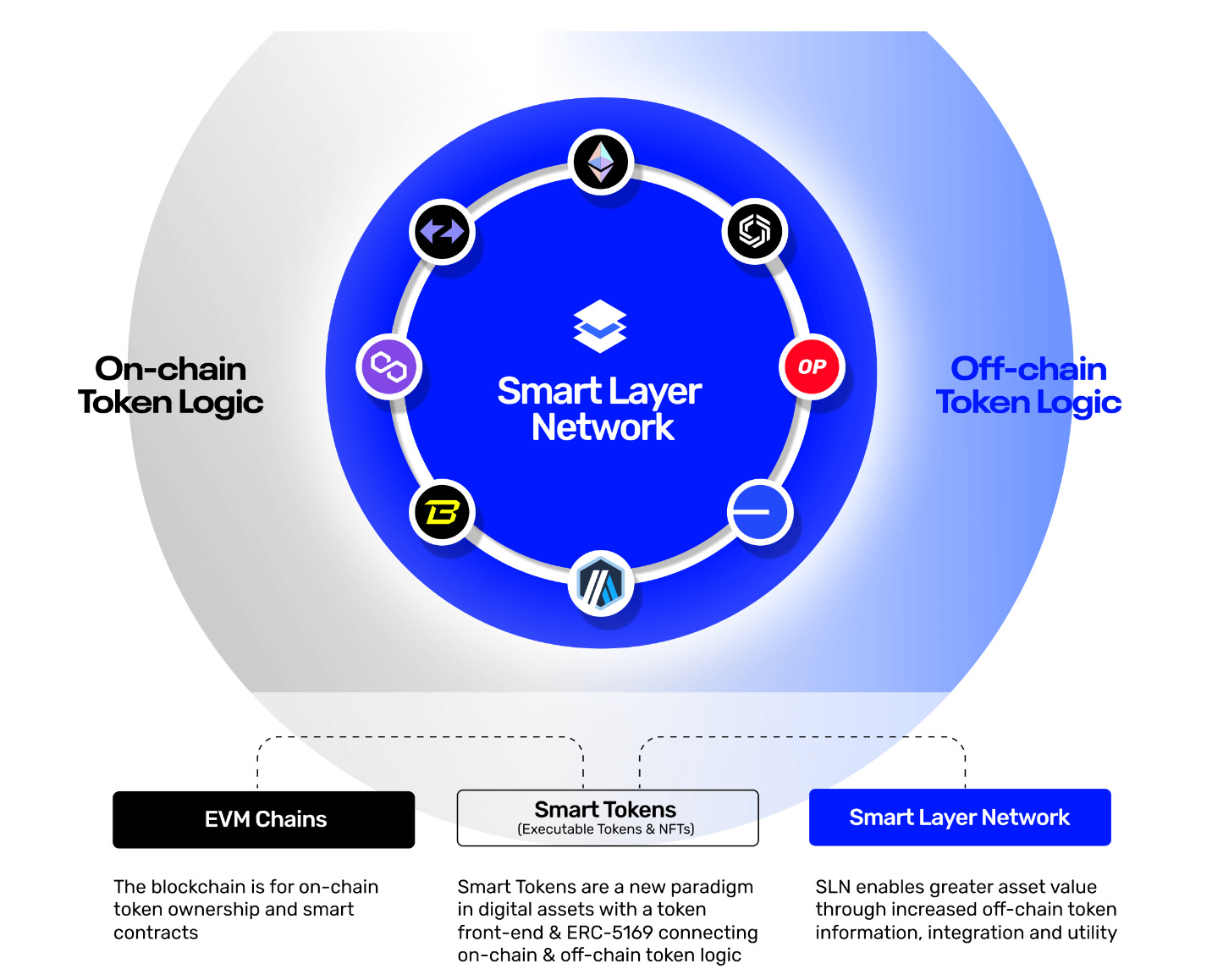
Smart Layer is a programmable blockchain service network supporting token logic execution, enabling complex, decentralized, scalable, and secure interactions with various systems and tokens. Built on TokenScript technology, Smart Layer introduced Executable Tokens—NFTs or tokens embedded with executable code, going beyond static digital assets to perform functions.
Smart Layer collaborated with the Ethereum Foundation Devcon team to develop ticket attestations using Executable Tokens. Over 20,000 Ethereum builders attending Devcon 6 Bogotá, EFDevconnect Amsterdam, and EDCON 2023 received NFT-based ticket attestations. Attendees could generate attestations via the same email address to earn a special “Smart Pass” and additional Smart Layer Points.
3. EthSign: Contract Signing
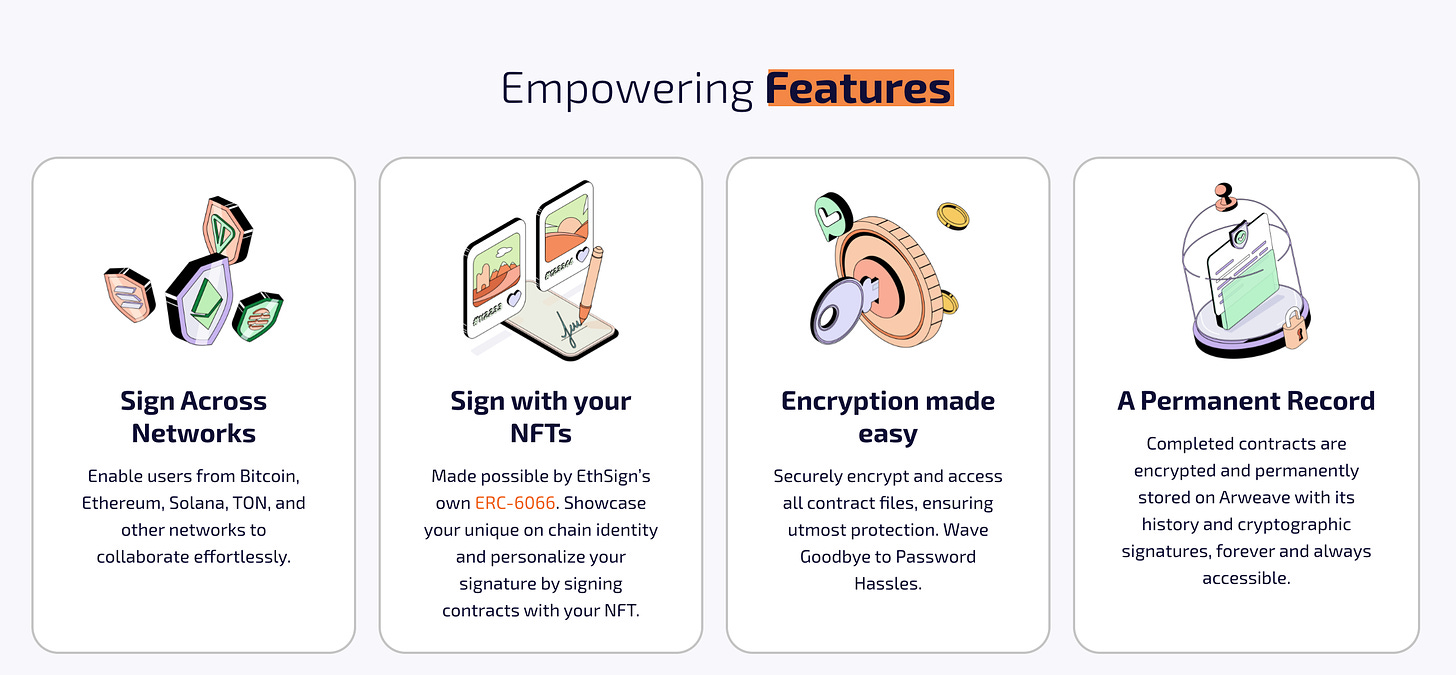
EthSign is a blockchain-based document signing protocol designed to enable users to sign, encrypt, and permanently store files in a decentralized, secure, and verifiable environment. EthSign allows users from different blockchain ecosystems—including Bitcoin, Ethereum, and others—to collaborate using their cryptographic keys for tasks like contract signing. It leverages Arweave for permanent storage without user fees.
EthSign offers diverse contract templates and operates similarly to DocuSign. Users log in via blockchain wallets or traditional accounts (email or Twitter). Using Particle Network’s authentication solution, EthSign supports Web2 identity verification. Users can create new contracts from templates or upload unsigned documents, add signature/date fields or text, specify signers, and set deadlines after which signing is no longer allowed. For privacy, documents can be encrypted, and EthSign’s contract password manager uses asymmetric encryption to securely host passwords—users don’t need to remember them.
Additionally, EthSign provides contract verification. Initially limited to checking whether a file’s original content matched its Arweave copy, it now also verifies digital signature validity and whether signatures originate from EthSign Certified addresses, with plans to support offline verification in the future.
EthSign aims to evolve from a contract-signing app into a full-chain attestation protocol called Sign Protocol, enabling users to sign anything on-chain. For example, Coinbase Verifications currently uses EAS to let users attest their KYC status on Base. If a user wants to prove they passed Coinbase verification to gain access to another project, they can use Sign Protocol’s zkAttestations: a browser extension captures data from Coinbase servers and generates a cryptographic proof confirming the user’s verified status.
4. Verax: Developer Tools
Verax is a shared on-chain attestation registry—a centralized repository for storing on-chain attestations—and provides developers with a universal, extensible toolkit to manage and leverage attestations. These attestations can confirm entity identities, rights to digital assets, or trust in specific wallets, serving applications in digital identity, trust systems, reputation protocols, and more.
One of Verax’s design goals is interoperability—helping developers issue attestations compatible with various standards. Acting as a channel, it enables different projects to store and retrieve attestations seamlessly, allowing other protocols, dApps, or users to easily use and compose them without worrying about cross-standard compatibility issues.
5. PADO Labs: Privacy Protection
PADO is a cryptography-based infrastructure enabling users to prove off-chain data truthfully while preserving privacy. For instance, gamers can prove they are veteran players in Web2 games to GameFi protocols without revealing personal details. PADO’s uniqueness lies in leveraging advanced cryptographic techniques including MPC-TLS (Multi-Party Computation over TLS) and IZK (Interactive Zero-Knowledge Proofs), allowing provers to “blindly” attest data—i.e., the prover never sees raw data, public or private, yet cryptographic methods ensure the data’s provenance.
PADO achieves its goals by guaranteeing two key security properties:
-
Authenticity: Ensures user data originates from a specific source and remains unchanged during transmission.
-
Privacy: Follows the principle of data minimization. During computation, PADO uses zero-knowledge proofs to protect privacy, ensuring no raw data—public or private—is ever exposed.
None of the above projects have launched tokens yet, and their economic models remain under consideration. Interested users can try out their products now and look forward to potential future airdrops.
Future Outlook
As one of the most important long-term narratives in Web3, RWA (Real World Assets) has drawn significant capital interest. Major DeFi protocols like MakerDAO, Synthetix, and Compound are actively expanding into this space. Boston Consulting Group estimates the RWA market could reach $16 trillion by 2030. However, bringing off-chain assets on-chain is highly complex, involving challenges around audit transparency, legal compliance, and regulatory oversight.
In this context, Attestation plays a crucial role in driving mass adoption. It enables verification of the linkage between on-chain representations and real-world assets, enhancing transparency and building confidence among investors and participants. This not only satisfies compliance and regulatory requirements but also helps build trust bridges between Web2 and Web3. Through Attestation, traditional financial institutions and enterprises can more smoothly integrate into the blockchain ecosystem, achieving seamless digital asset integration.
Join TechFlow official community to stay tuned
Telegram:https://t.me/TechFlowDaily
X (Twitter):https://x.com/TechFlowPost
X (Twitter) EN:https://x.com/BlockFlow_News
 @nake13


![In-depth Analysis of Trade[XYZ]: How Were 92 Markets and 98% HIP-3 Trading Volume Established?](https://upload.techflowpost.com/upload/images/20260716/20260716061117965147.jpeg?x-oss-process=image/resize,p_50/quality,q_80)