What Impact Will the EU's Proposed Web4 Have on the Crypto World?
TechFlow Selected TechFlow Selected
What Impact Will the EU's Proposed Web4 Have on the Crypto World?
Although Web4 and Web3 are not closely related, the cryptocurrency sectors involved in the EU's Web4-related initiatives may gain momentum during the period of proactive EU efforts.
 Navigating Web3 tides with focused insights
Author: veDAO
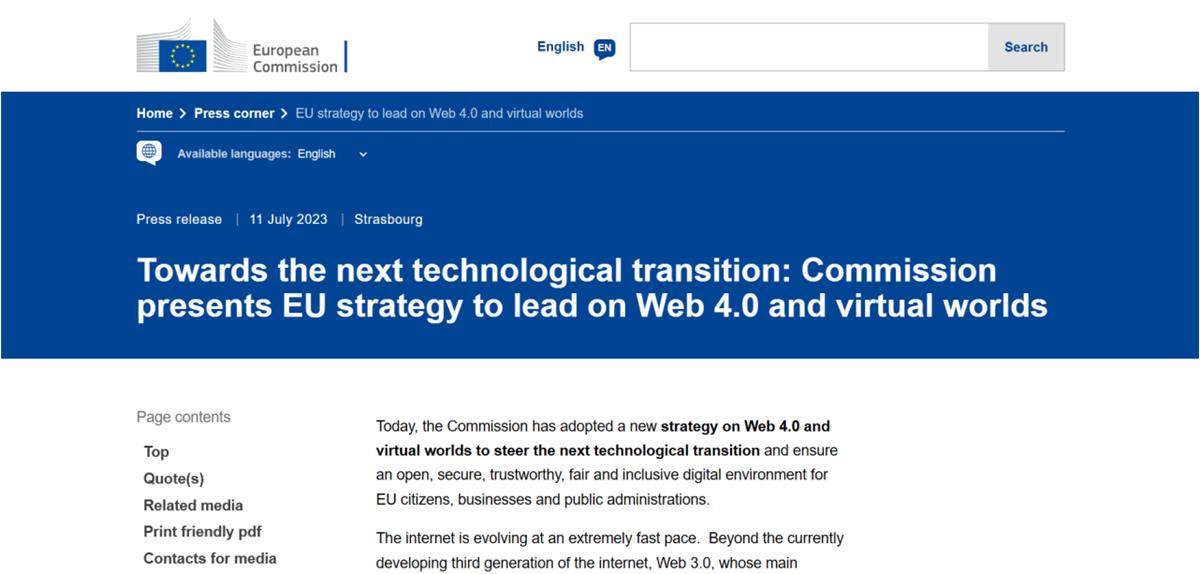
On July 11 local time, the European Commission (EC) adopted a new strategy on Web4 and virtual worlds, aiming to guide the next technological transformation and ensure open, secure, trustworthy, fair, and inclusive digital environments for EU citizens, businesses, and public administrations.
While the concept of Web3 has yet to be fully absorbed globally, a new narrative—Web4—has emerged in European policymaking. Is this traditional world finally getting ahead of the curve by opening the next mainstream narrative for the crypto space, or is Europe—a region with relatively low crypto awareness—attempting to leapfrog? In this article, veDAO Research Institute provides an analysis of the Web4 vision proposed by the EU.
What is Web4?
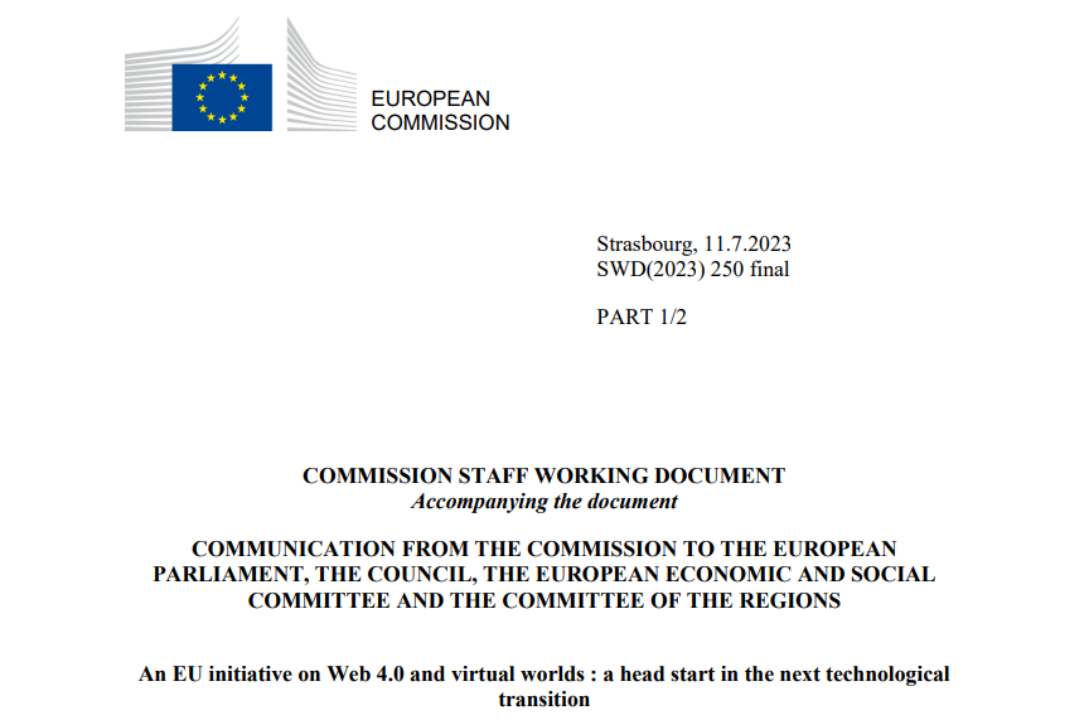
The initiative released on July 11 states that Web4 responds to and encompasses the Web3 terminology, forming part of a new vision for the internet where virtual experiences, the Internet of Things (IoT), and blockchain converge. The European Commission clarified the strategies and actions it will take to increase the EU's participation in the Web4 technology landscape.
In the EU’s document, Web3 is defined as follows: “The main features of the third-generation internet, Web3, are openness, decentralization, and full user sovereignty.” Building upon this recognition of current Web3 concepts, the Commission includes integration between digital and physical objects and environments, as well as enhanced human-machine interaction, under the umbrella term Web4. In short, we can understand Web4 as an evolution of the Web3 concept, integrating IoT, blockchain, virtual reality (VR), and augmented reality (AR).
The EU emphasizes that the Web 4.0 and Virtual Worlds Initiative rests on four pillars. The first three align with the goals of the EU’s 2030 Digital Decade: talent and skills, business environment, and public services. The fourth pillar focuses on infrastructure development—including computing power and cloud—and addresses openness and global governance of Web 4.0 and virtual worlds.
Although the European Commission lists blockchain as one of the constituent technologies of Web4, it refers specifically to "trusted" blockchain rather than the native, crypto-community-supported "trustless" blockchain. Moreover, no detailed implementation plans have been provided yet on how these technologies will be integrated to realize the new Web4 narrative.
Initiatives Related to Web4
The announcement of this Web4 strategy also revealed several new initiatives:
-
First, the announcement references an existing Horizon Europe program called the “Partnership on Virtual Worlds,” expected to launch in 2025. Its goal is to develop an “industrial and technological roadmap for virtual worlds” by helping developers, creators, and internet-using companies understand this emerging trend. It will also involve testing new solutions across all EU member states.
-
Second, a project named “CitiVerse” is envisioned—a virtual urban universe designed to manage and plan city operations and activities in alternative ways, though specific target audiences were not detailed.
-
Lastly, another idea proposed by the Commission involves creating a “European Virtual Human Twin”—a digital replica of the human body—that could help doctors study disease outbreaks and treatments.
Regarding the introduction of this new Web4 technological frontier, Thierry Breton, the European Commissioner for Internal Market, stated: “Today, Europe officially becomes a global leader in Web 4 and virtual worlds. Europe has all the conditions needed to lead the next technological shift: innovative startups, rich creative content and industrial applications, a strong role as a global standard-setter, and a favorable, predictable legal framework for innovation.”
Challenges Facing Web4 in the EU
In March, the EU published its “Outlook for the EU Economy Beyond 2030,” highlighting digitization as one of its key drivers. Web4 represents a major technological transition that will bring seamless connectivity, intelligence, and immersive experiences. After securing approval for MiCA (Markets in Crypto-Assets) in April—opening the door to cryptocurrencies and blockchain—the EU now aims to go further and compete with U.S. technological innovation.
From these developments—including the current Web4 narrative—it is clear that Europe’s regulatory framework is poised to become one of the most permissive in the world regarding cryptocurrency, showing willingness for the continent to stand out in the context of new technologies. However, discussing Web4 at the EU level may still be premature.
A survey conducted in June by Consensys (parent company of MetaMask) found that only 8% of people across the EU consider themselves familiar with the concept of Web3. Meanwhile, terms such as blockchain, cryptocurrency, and DeFi remain unfamiliar to many and are not widely understood. For a large population lacking basic knowledge of virtual currencies, there remains a significant barrier to entry when it comes to understanding either Web3 or Web4. While hubs like Berlin, London, and Lisbon are becoming centers for crypto and blockchain, other parts of the continent remain unaware of even the meaning of the word “Crypto.”
Which Crypto Sectors Could Benefit?

Having gained a broad understanding of the EU’s ambitious Web4 strategy, let us now examine which aspects could benefit the crypto market. The EU’s Web4 announcement mentions that blockchain technology can be used to manage assets in virtual worlds—such as virtual currencies or virtual real estate—and enable secure, transparent transactions within those environments. The document places considerable emphasis on “virtual worlds” and “digital cities,” indicating these are among the primary future directions. Therefore, this could represent positive news for sectors related to the metaverse.
In the EU’s policy paper, the term “Blockchain” appears 30 times, “Crypto” and related terms appear 7 times, and “NFT” is mentioned 40 times. Overall, NFTs are a focal point in the initiative. The document acknowledges that NFTs are being widely applied across various use cases and affirms the established consensus that “NFTs foster innovation in content creation and offer opportunities for artists (and creators). NFT platforms directly connect artists (and creators) with potential buyers at low cost.”
Additionally, the paper outlines ways to integrate NFTs into traditional business models: “Indeed, NFTs have already entered new business models. They can also be used for sales and event ticketing in concrete applications such as sports, fashion, gaming, and music.” As NFT integration with traditional commerce remains underdeveloped, this signal from the EU could stimulate growth in this sector.
Finally, the importance of blockchain for Web 4.0 is also highlighted in two additional areas—security and privacy protection, and cross-border payments and international trade—though without detailed elaboration. This may present potential growth opportunities for trending zk technologies and currently less-popular payment applications in the crypto market.
Conclusion: With its introduction of the Web4 concept, the EU appears eager to accelerate progress in the blockchain domain, hoping to surpass Asia and the Americas, which continue expanding in infrastructure development, and position itself as a creator and standard-setter. However, given that Web3 adoption in Europe remains limited, the trajectory of this still largely conceptual Web4 vision remains to be seen over time.
Despite the loose connection between Web4 and Web3, crypto sectors touched by EU-led Web4 development efforts may experience a surge during this period of proactive EU engagement.
Join TechFlow official community to stay tuned
Telegram:https://t.me/TechFlowDaily
X (Twitter):https://x.com/TechFlowPost
X (Twitter) EN:https://x.com/BlockFlow_News
 @TrendX_official