How will account abstraction drive mass adoption of DeFi?
TechFlow Selected TechFlow Selected
How will account abstraction drive mass adoption of DeFi?
Anyone should be able to access Web3 using their phone or computer in a simple and intuitive way.
 Navigating Web3 tides with focused insights
Written by: ValHolla
Translated by: TechFlow
“We’re still early” has become something of a meme, but it’s undeniably true. Try asking 100 people to name five applications on Ethereum. 95% won’t be able to, and some may not even know what Ethereum is.
While it seems there's a massive gap between today’s crypto market and blockchain becoming part of our daily lives, all it takes is one solid bridge to guide everyone from the old era into the new. I believe we can find that bridge in the concept of account abstraction. Today I’ll explain why, and highlight some projects building it.
If we want to attract the public, we need to improve the current user experience (UX) of decentralized blockchain services. What does this mean?
It means anyone should be able to access Web3 simply and intuitively using their phone or computer.
Ultimately, using Web3 must become easier than using Web2. However, expecting to leap directly from our current state to that point without first creating Web2-like interfaces to boost adoption is unrealistic. But you might ask, how? To answer that, I’d like to show you what some projects are doing in the space of account abstraction. Today, we’ll look at features introduced by dappOS and Instadapp.
dappOS
Currently, Web3 lacks its Windows or macOS—meaning we still rely on traditional Web2 operating systems to access all its services. dappOS is working to change that.
Windows made personal computers accessible to ordinary people by transforming complex technical components into intuitive interactions, organizing everything in a simple way.
dappOS does the same for Web3 by providing users with a central hub they can use to access various decentralized applications (dapps).
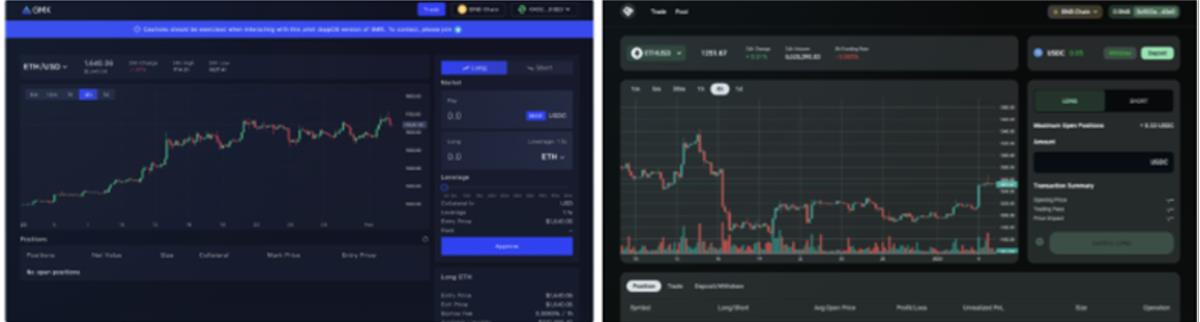
So far, they’ve established partnerships with several well-known players in the industry, including MakerDAO, Polygon, Avalanche, zkSync, and GMX. They were also successfully selected into Binance’s incubation program last year.
Their UX improvements can be summarized into two main features: cross-chain accounts and account recovery.
Effortless asset usage across chains
Anyone who has used DeFi knows each chain operates completely isolated from others. This creates an extremely high barrier to entry for those not deeply enthusiastic about Web3.
With dappOS, users will be able to use their funds across blockchains. Currently, users can access Optimism, BNB Chain, and Polygon. For example, suppose most of your funds are on Polygon, and you notice an amazing APY in a pool on Velodrome—an app popular on Optimism. But Velodrome isn’t on Polygon, and you don’t want to bridge large amounts of funds. With dappOS, you could deposit into Velodrome without any additional cross-chain steps.
Perpetual Protocol, a perpetual swap DEX on Ethereum and Optimism, was one of the first projects to integrate with dappOS. Their description of how cross-chain accounts improve UX is particularly compelling:
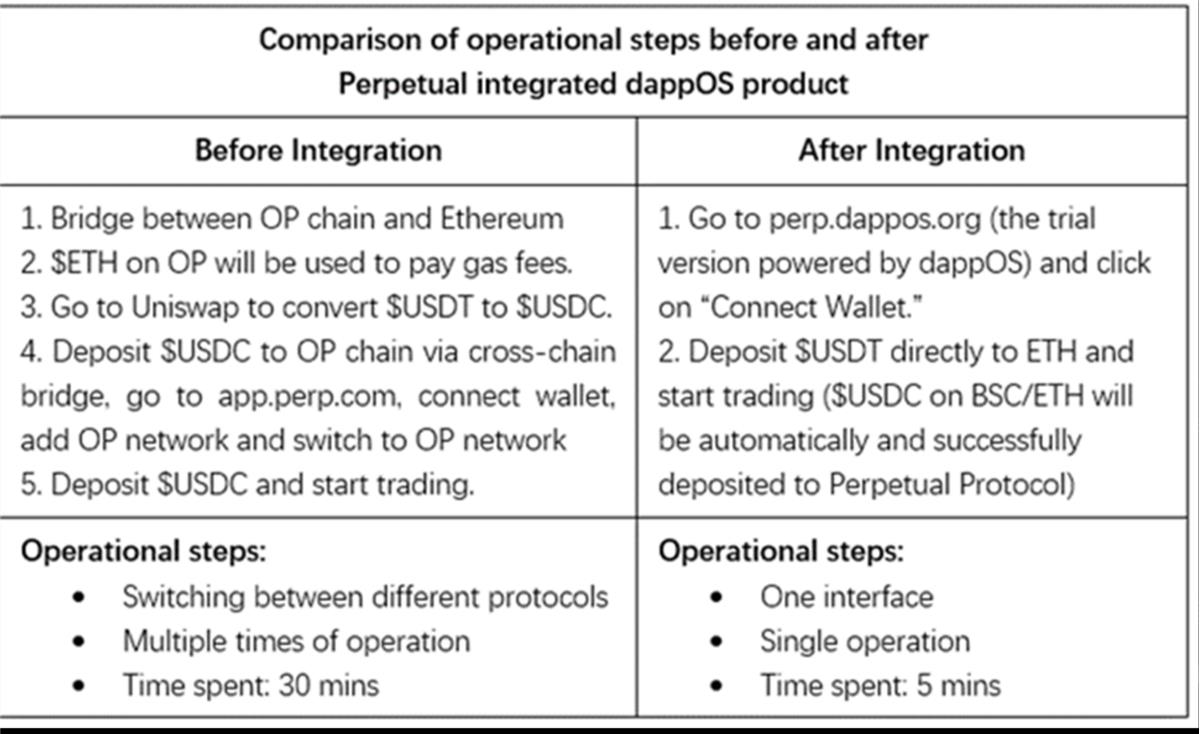
As shown above, improved UX can save up to 25 minutes per operation.
25 minutes alone may not sound like much. But considering that most people abandon websites if loading time exceeds a few seconds, this represents an exponential improvement over the status quo.
Cross-chain accounts can also enhance liquidity across various chains and applications. New protocols need significant network development and potentially bootstrap efforts to attract users. As a result, the TVL market remains dominated by early projects with first-mover advantage.
With cross-chain accounts, funds will flow more naturally toward capital-efficient protocols that improve upon many early DeFi apps, leading to a more efficient ecosystem overall.
Account recovery via email
One of the most annoying parts of setting up a new wallet is dealing with private keys or seed phrases. dappOS offers users three alternative recovery methods—we'll go through them from most to least complex:
The first method is a two-key system, consisting of a functional key and a guardian key. The functional key is stored on the user’s mobile device, PC, etc., for easy access when interacting with dapps. The guardian key acts as a backup, ideally stored on an unused device or written down. Whenever the user needs to manually input their functional key, it is verified by the guardian key. The second method allows users to store their guardian private key via centralized, trusted services such as iCloud or AWS.
The third method allows users to set up a guardian email account. An email sent from this guardian account triggers a reset of the guardian key. The email is received by dappOS nodes, which then generate a ZK proof to verify the request. Once the proof is successfully generated, the account information is reset according to the user’s instructions.
Instadapp
At Instadapp, the core idea centers around: “Users shouldn’t have to worry about which chain they’re using or what token they need to pay gas fees.” While Instadapp has long focused on improving UX, the team recently stirred attention with their latest innovation, Avocado.
Avocado
Avocado is a blockchain aggregator that consolidates numerous Web3 services into a single, unified decentralized application. Anyone with a Metamask, Trust Wallet, or Coinbase Wallet account can connect their address to Avocado and receive a new address that aggregates all their Web3 activity.
Although Avocado launched only in March, it already supports a wide range of chains: Ethereum, Optimism, Arbitrum, Polygon, Avalanche, BNB Chain, Gnosis Chain. Just nine days after launching its mainnet testnet, it became one of the first dApps to enable integration with Polygon zkEVM.
So how does it work?
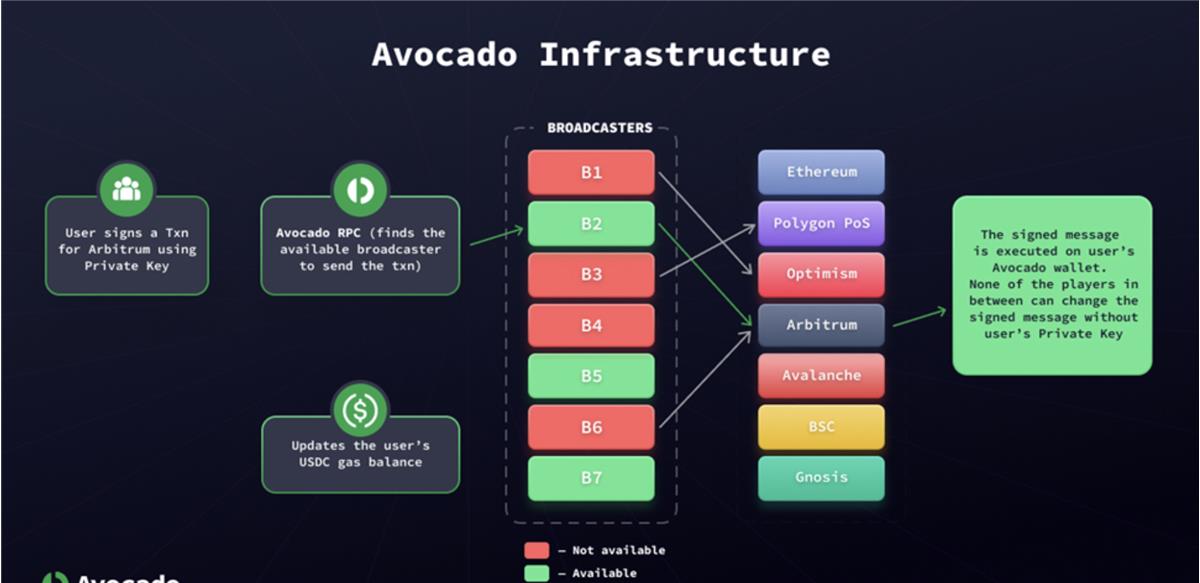
Similar to dappOS, Avocado connects to the underlying dApps on each supported chain through its own RPC and broadcasting network.
Simply put, whenever a user interacts with a dApp, they send data to the blockchain. The RPC/broadcaster acts as an intermediary facilitating this transmission.
The RPC network finds an available broadcaster and sends the user’s transaction request to the blockchain. If the encrypted information in the request matches the user’s private key, the transaction is confirmed on-chain. By maintaining its own RPC/broadcaster network, Avocado serves as a middleman between users, dApps, and the underlying blockchains.
Gas Tank
The Avocado Gas Tank is a designated portion of USDC set aside by users specifically to cover gas fees. That’s right—the only gas token you need when using Avocado is USDC, meaning you don’t need multiple native gas tokens to interact with dApps across different blockchains.
Another hassle when switching chains is ensuring you have the required gas token and enough balance for future transactions. Having a single gas token usable across all chains greatly streamlines the UX—especially since USDC is a stablecoin, making it more beginner-friendly.
dApp incentives
While Instadapp’s primary goal is simplifying Web3 for users, part of that mission involves integrating with as many dApps as possible. To kickstart this process, Avocado currently charges a 20% premium on gas fees, with half going directly to the underlying dApp. Simply put, if a trade on Uniswap costs $2, and Avocado charges $2.40, then $0.20 goes to the Uniswap protocol. The other $0.20 goes to Instadapp’s treasury. Going forward, these incentive allocations will be governed by holders of Instadapp’s native token, INST.
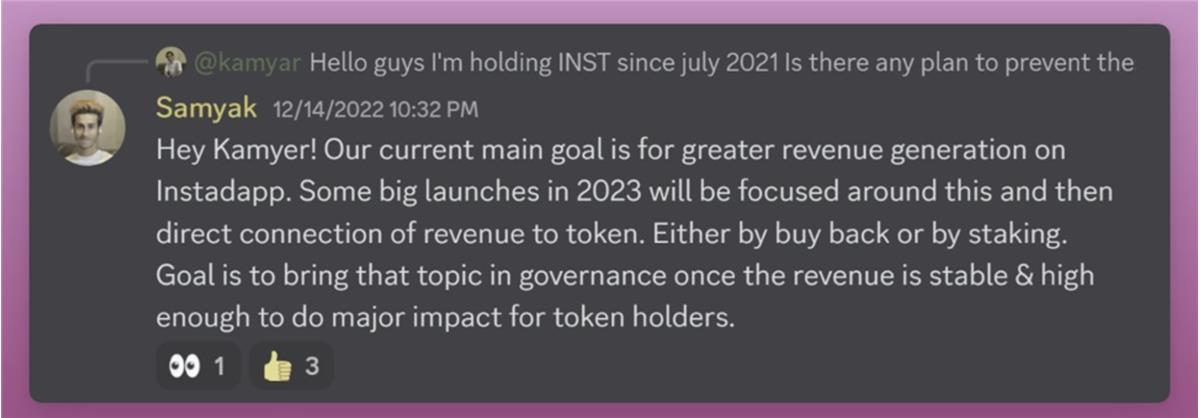
From a speculative standpoint, INST is one of the tokens to watch this year. Products like Avocado have the potential to drive mass adoption of Web3. One of Instadapp’s key goals in 2023 is to generate increasing revenue to redistribute back to users:
Conclusion
Just based on the work of these two projects, you can see how Web3 developers are tackling the industry’s growing pains—and dozens of other projects are exploring similar solutions. The key point is that while DeFi and related products can continue growing exponentially, the sustainable growth engine for the entire industry must be a clean, simple, and practically valuable approach. 2023 could become the year of mass adoption, and protocols like dappOS and Instadapp are emerging as foundational layers of Web3.
Join TechFlow official community to stay tuned
Telegram:https://t.me/TechFlowDaily
X (Twitter):https://x.com/TechFlowPost
X (Twitter) EN:https://x.com/BlockFlow_News
 Frogs Anon