Yao Qian: Web3.0, the Emerging Next-Generation Internet
TechFlow Selected TechFlow Selected
Yao Qian: Web3.0, the Emerging Next-Generation Internet
Today, the internet is at a critical juncture transitioning from Web2.0 to Web3.0. Strengthening forward-looking research and strategic foresight on Web3.0 undoubtedly holds significant importance for China's future internet infrastructure development.
 Navigating Web3 tides with focused insights
Author: Yao Qian – Director of the Technology Regulation Bureau, China Securities Regulatory Commission
Editor: Zhang Lin
The Internet represents a major revolution in human communication technology and has had an extremely profound impact on society. As current information technologies continue to innovate and evolve, the Internet is undergoing a transformation toward its next generation. This evolution may trigger a new wave of information revolution, further profoundly changing people's lives, work, and all aspects of society. On the eve of Web1.0’s emergence in 1993, the U.S. Clinton administration launched the "National Information Infrastructure" strategic initiative, vigorously building the "information superhighway" of the digital era, thereby securing global leadership in Web1.0 and Web2.0. After 30 years of development, the Internet now stands at a critical juncture transitioning from Web2.0 to Web3.0. Strengthening forward-looking research and strategic foresight into Web3.0 is undoubtedly significant for China’s future Internet infrastructure development. This article aims to analyze potential forms of Web3.0 and offer reflections by combining global and domestic Internet development practices with technological trends.
Web3.0: Internet Infrastructure Owned and Trusted by Users and Builders
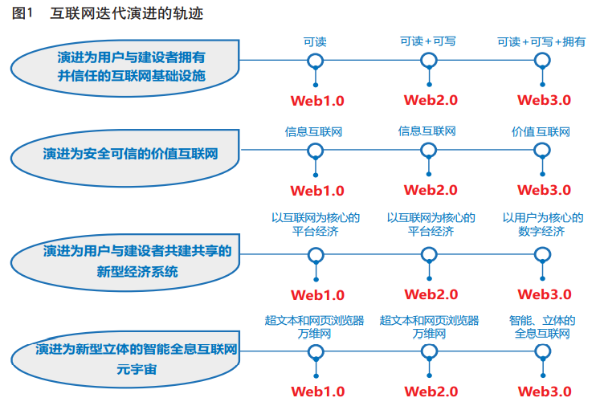
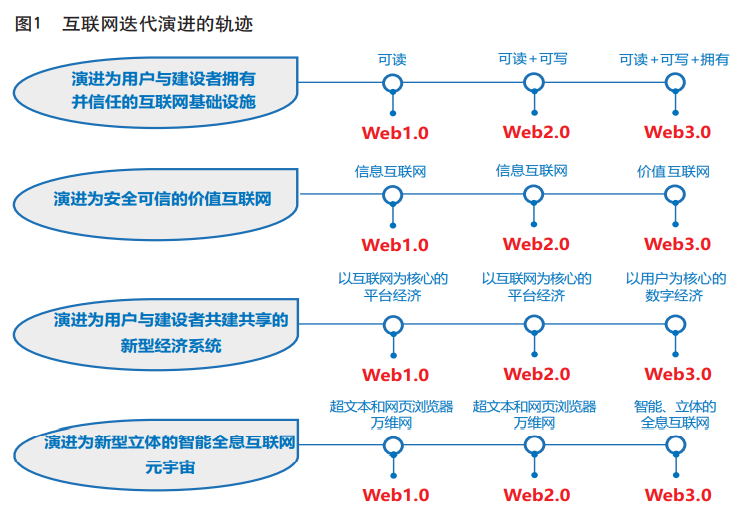
Tech entrepreneur and investor Chris Dixon describes Web3.0 as an Internet for builders and users, where digital assets serve as the bond connecting them. Messari researcher Eshita characterizes the progression from Web1.0 to Web2.0 to Web3.0 as follows: Web1.0 was “read-only” (read), Web2.0 became “read-write” (read+write), and Web3.0 evolves into “read-write-own” (read+write+own).
Web1.0 refers to the early Internet, where users could only passively browse text, images, and simple video content—they were mere consumers of content, viewing whatever platforms provided. In the Web2.0 era, users gained not only read but also write capabilities. With the rise of mobile Internet and platforms like YouTube, Facebook, and WeChat, users began creating and sharing their own content (text, images, videos) and interacting with others online. However, both Web1.0 and Web2.0 require users to rely heavily on specific Internet platforms for their online activities. Even in Web2.0, while users can produce content, platform operators still define the rules, leaving users with limited autonomy.
First, users lack autonomy over their digital identities. Users must open accounts on Internet platforms to obtain digital identities necessary for participation. Once an account is closed, access rights are lost. Each registration requires repetitive input of personal information. Different platforms maintain separate account systems with varying rules, forcing users to manage numerous accounts and passwords. These isolated systems create “silos,” hinder ecosystem development, and foster monopolistic and unfair competitive practices. Recently, Federated Identity Management (FIM) has gained popularity. While FIM reduces repeated registrations and offers users a sense of identity control, it fails to fundamentally resolve the drawbacks of platform-centric identity models—digital identities remain tied to specific platform accounts.
Second, users lack autonomy over personal data. Individuals are relatively powerless against large Internet platforms. Under the “take-it-or-leave-it” model, users must consent to data collection, often excessive. Today’s platforms deeply permeate social life, offering communication, social networking, e-commerce, news, entertainment, and more. To access these services, users inevitably relinquish control over their data. Concentrating vast amounts of user data on platforms poses severe privacy risks if leaked, as seen in Facebook’s data breach incidents. Some platforms may exploit technical advantages to subtly collect and use data without full user awareness, using technical means to circumvent legal constraints.
Third, users lack autonomy against algorithms. Algorithms lie at the heart of Internet platforms. Through “personalized experiences” based on detailed user profiling, companies gain powerful insights crucial for success in the digital economy. Yet algorithm abuse and misconduct have become increasingly prominent. Examples include big-data price discrimination—charging loyal customers more than new ones for identical goods or services; recommending only products with commercial incentives, including counterfeit or low-quality items, instead of those best suited to users; exploiting psychological vulnerabilities to excessively stimulate, persuade, or induce consumption, leading users into passive “feed-driven” addiction; keeping algorithm logic and parameters opaque to most, enabling insider exploitation; and even malicious use of algorithms to spread vulgar content or sensational fake news to boost traffic.
Web3.0 centers on the user, emphasizing ownership and autonomy. First, self-sovereign identity (SSI). Users no longer need platform-based accounts. Instead, they identify themselves via cryptographic public-private key signing and verification mechanisms. To verify identity trustworthily without centralized platforms, Web3.0 leverages distributed ledger technology to build a decentralized Public Key Infrastructure (DPKI) and a novel trusted, distributed digital identity management system. Distributed ledgers provide tamper-proof, trustworthy computation paradigms. On this trusted machine, issuers, holders, and verifiers can exchange trust end-to-end.
Second, true user data autonomy. Web3.0 empowers users not only with identity control but also breaks the natural monopoly held by central entities over data. Distributed ledger technology enables a new paradigm of user-controlled data privacy protection. Encrypted user data is stored on distributed ledgers. Users decide whom to share identity information with and for what purpose. Only data explicitly authorized via user signatures becomes legally usable. Through lifecycle-wide data rights confirmation, users’ rights to informed consent, access, refusal, portability, deletion (“right to be forgotten”), correction, and ongoing control are better protected.
Third, enhanced user autonomy vis-à-vis algorithms. Smart contracts are callable, fully functional, flexible, and controllable programs on distributed ledgers, featuring transparency, credibility, automatic execution, and enforced compliance. When deployed, their code is publicly visible. Users can inspect and verify potential algorithmic abuses, biases, or risks anytime. Immutable smart contracts execute strictly according to predefined logic, producing expected outcomes. Execution records are logged and monitored throughout, making algorithms auditable and providing strong evidence for user inquiries and appeals. Independent of any central authority, any user can initiate and deploy smart contracts. Their inherent openness and open-source nature significantly strengthen end-users’ control over algorithms.
Fourth, establishing new trust and collaboration models. In Web1.0 and Web2.0, users have insufficient trust in Internet platforms. For two decades, Edelman Public Relations Worldwide has measured public trust in institutions—including major commercial platforms. The 2020 survey found that most commercial platforms fail to act in the public interest, making it difficult for them to earn full public trust. By contrast, Web3.0 is decentralized—no single entity controls it, and multiple providers exist for any given service. Platforms interconnect via distributed protocols, allowing users to switch between service providers at minimal cost. Users and builders hold equal power; there is no dominance relationship. This is a clear advantage of Web3.0 as a distributed infrastructure.
Web3.0: A Secure and Trustworthy Value-Based Internet
In computing, without trusted mechanisms, value carried and transmitted electronically is easily copied or altered, leading to value forgery and double-spending issues. Web1.0 and Web2.0 are merely information networks. While capable of transmitting text, images, audio, and video, they lack secure, trustworthy value-transfer technologies. Thus, peer-to-peer transmission of value—such as digital cash—is impossible without relying on trusted institutional account systems for registration, transfer, clearing, and settlement. The advent of distributed ledger technology creates a highly secure and credible method for value transfer. Based on cryptography and achieved through distributed consensus, it records the entire process of value transfers (transactions) completely and immutably. Its core advantage lies in enabling direct peer-to-peer value transfer without reliance on intermediaries, evolving the Internet from Web1.0/Web2.0’s information network into a higher-order, secure, and trustworthy value internet—Web3.0.
Value registered and transferred on Web3.0 can be cryptocurrencies or digital assets.Distributed ledger technology provides unique proof of ownership for digital assets. Hash algorithms combined with timestamps ensure asset uniqueness and resistance to duplication. Distributed consensus algorithms—where one party records and many others audit—eliminate digital asset counterfeiting and double-spending without requiring trusted third parties. Digital assets can also be non-fungible—NFTs, for example, exist, are owned, and transferred in whole form.
Beyond native on-chain assets, digital assets may originate from off-chain physical assets such as paintings or real estate. Ensuring accurate value mapping between on-chain digital assets and off-chain physical counterparts is critical. Solutions include RFID tags, sensors, QR codes, GPS, and other sensing technologies to connect objects, forming the Internet of Things (IoT). Integrated with the Internet and mobile networks, this creates a unified “space-air-ground-human” information network, enabling automated data collection and reducing the likelihood of false data entering the chain.
Web3.0 enables not only user-side autonomous identity management but also autonomous resource addressing on the network side, achieving truly decentralized end-to-end access.The traditional Internet, as a global open network, relies on a centrally managed Domain Name System (DNS) for resource access.
DNS, as a foundational Internet infrastructure, has undergone expansion and optimization from IPv4 to IPv6, yet remains susceptible to manipulation. As a new decentralized value internet, Web3.0 demands a new decentralized DNS root governance system. Technically, this can be realized via distributed ledgers—resource publishers autonomously register and manage domain names, while users independently query and resolve them. This supports not only traditional Internet resources but also broader digital assets, digital entities, blockchains, etc., enabling smart contracts to operate on digital assets in more convenient and readable ways, thus enhancing interaction between digital and physical spaces in Web3.0.
For instance, the Ethereum Name Service (ENS) exemplifies a Web3.0 domain service. It is a distributed, open, and scalable naming system built on the Ethereum blockchain. ENS translates human-readable names (e.g., “alice.eth”) into identifiers computers recognize—Ethereum addresses, content hashes, metadata, etc. ENS also supports “reverse resolution,” linking metadata (like canonical names or interface descriptions) to Ethereum addresses. Like DNS, ENS uses a hierarchical structure separated by dots, with each level called a domain. Domain owners fully control subdomains. Top-level domains (e.g., “.eth” and “.test”) are governed by smart contracts known as “registrars,” which define subdomain allocation rules. Anyone can follow these rules to claim ownership of a domain and configure subdomains for themselves or others.
Web3.0: A New Economic System Co-Built and Shared by Users and Builders
Traffic reigns supreme in the Internet economy—the more users, the greater the value.The simplest monetization method is advertising. Even today, ads remain a primary revenue source for the Internet industry. Platforms leverage big data analytics to mine user characteristics, habits, needs, and preferences, enabling targeted marketing, intelligent recommendations, or selling analytical products to third parties. In Web1.0 and Web2.0, users enjoy free services and sometimes receive coupons or red packets during initial user acquisition. Yet despite being the source of Internet value, users do not benefit from its returns. User data generated within ecosystems is monopolized by platforms, denying users—key contributors—any share of the value.
Web3.0 will restructure the organizational forms and business models of the Internet economy.Web1.0 and Web2.0 revolve around centralized platforms that organize content creation and aggregation. Platforms generate network effects, reduce search costs between producers and consumers, and optimize supply-demand matching—hence termed the “platform economy.” Web3.0, leveraging distributed ledger technology, constructs an incentive-aligned, open environment known as Decentralized Autonomous Organizations (DAOs). Within such environments, numerous unknown individuals voluntarily engage in decentralized collaborative work, investing in, operating, and managing projects like traditional enterprises, collectively owning stakes and assets. Project decisions are made democratically through participant voting, and post-decision actions are automatically executed via smart contracts. A DAO is an “organization without formal structure”—no board, no corporate charter, no rigid hierarchy, no central manager. It eliminates intermediaries and establishes peer-to-peer equality. Users co-create, co-build, co-govern, and co-own—they are participants, builders, investors, owners, and beneficiaries alike.
In the Web3.0 era, developers can build arbitrary consensus-based, scalable, standardized, Turing-complete, easy-to-develop, and collaborative applications. Anyone can define custom ownership rules and transaction methods within smart contracts, fostering diverse decentralized business applications and constructing new programmable finance and programmable economies. A single smart contract might represent a business model with infinite possibilities, allowing users to jointly benefit from the growth of such programmable ventures.
As previously mentioned, Web3.0 grants users genuine data autonomy. Personal information becomes a user-controlled digital asset. Users can truly profit from data circulation and transactions, ensuring their data is no longer a free resource for Internet platforms.
Web3.0: A Three-Dimensional, Intelligent, and Holistic Internet
Hypertext and web browsers are key technologies of Web1.0 and Web2.0.World Wide Web (WWW) servers organize information into rich multimedia hypertext using Hypertext Markup Language (HTML). Browsers and servers communicate using Hypertext Transfer Protocol (HTTP) to transmit various HTML pages and data. Browsers render HTML files in a human-readable format via graphical user interfaces (GUIs). This allows users to read or browse HTML documents and navigate across computers via embedded hypertext links. The vast collection of interconnected websites and webpages constitutes the World Wide Web, enabling unprecedented cross-geographic connectivity, information searching, browsing, transmission, and sharing. Yet people seek more. With rapid advances in information technology, the next-generation Internet will be far smarter.
Today’s information Internet organizes data using standard machine languages. Although displayed in natural language on browser interfaces, the underlying layer remains machine code—the browser does not understand the actual meaning of webpage content. The next-generation Internet will not only aggregate information but also comprehend it like humans, performing autonomous learning and knowledge reasoning to deliver more accurate and reliable information, making human-Internet interactions more automated, intelligent, and human-centered. Tim Berners-Lee, inventor of the World Wide Web, proposed the concept of the Semantic Web in 1998. A semantic web—an intelligent network capable of semantic reasoning—is considered one of Web3.0’s defining features. Driven by the W3C consortium, architectural frameworks and technical standards for the Semantic Web (e.g., RDF/RDFS, OWL, SPARQL) are under active development.
Web3.0 is not just an intelligent Internet—it is a three-dimensional, holistic Internet offering unprecedented interactivity, immersion, and engagement: the much-discussed Metaverse.Imagine the Metaverse as a physical Internet where people are not mere spectators but active participants. Achieving such realism and immersion requires support from multiple advanced technologies. First, virtual reality (VR) and augmented reality (AR). To deliver realistic, immersive, multi-sensory VR experiences, Web3.0 requires advanced devices such as immersive AR/VR headsets, brain-computer interfaces, haptic gloves, haptic suits, avatars, motion capture, gesture recognition, spatial awareness, and digital twins. As in the movie *Ready Player One*, players wear VR gear and stand on movable platforms to enter a virtual world. Every movement mirrors real-life body sensations. Beyond sight and sound, tactile feedback in the virtual world can be physically transmitted via special materials. In contrast, Web1.0 and Web2.0 only convey visual and auditory signals. Second, 5G, edge computing, cloud computing, AI, and image rendering technologies. To replicate real-world interaction fidelity, Web3.0 needs high-bandwidth communication technologies so devices can connect anytime, anywhere with low latency. Image rendering and AI enhance real-time simulation accuracy, eliminating distortion. Cloud computing ensures seamless, responsive, stable, persistent, and shared large-scale interactive experiences. Third, chips. Supporting massive data computation and transmission demands immense computing power—rooted in high-performance semiconductor chips.
Web3.0 Innovation Development Strategy
Web3.0 holds great promise to significantly improve the current Internet ecosystem, effectively addressing issues prevalent in Web2.0 such as monopolies, lack of privacy protection, and algorithmic abuse. It can make the Internet more open, inclusive, and secure, advancing toward higher-order developments in trusted, value-based, intelligent, and holistic internets. As public infrastructure, Web3.0 development requires not only private-sector innovation and competitive selection through mass creativity, but also national-level top-down design and balanced regulatory frameworks for guidance and oversight.
First, build high-quality distributed infrastructure. Many in the industry refer to Web3.0 as a “Cambrian explosion of innovation.” Yet many technical elements and infrastructures remain immature—development tools, technical standards, business models, and decentralized identity management are still in early stages. Increased investment and industrial planning in chip technology, cryptography, and IoT are recommended. Based on these, construct new data infrastructure characterized by clear ownership, well-defined responsibilities, security, controllability, and efficient utilization.
Second, promote well-governed technological innovation. Establish innovation sandbox mechanisms to provide safe spaces for experimenting with programmable finance and programmable economies, reducing innovation costs and policy risks. Continuously refine regulatory priorities, tools, methods, rules, and institutional arrangements during pilot programs to balance innovation with safety. Explore a new regulatory framework centered on users, driven by builders, and focused on smart contracts. Strengthen anti-money laundering (AML) and counter-terrorism financing (CFT) measures. Enhance Web3.0 network governance to safeguard national digital sovereignty and prevent decentralized networks from becoming havens for darknets, illegal trading, or money laundering.
Third, establish universal standards to enhance interoperability. TCP/IP, HTTP, SMTP, and TLS/SSL are standard protocols of Web2.0 and form the foundation of today’s open, collaborative Internet. Similarly, Web3.0 requires universal standards to prevent fragmented distributed networks from becoming new silos. Governments should support standardization efforts and play an active role in industry, national, and international standard-setting processes.
Fourth, establish clear and fair tax regulations. Strengthen theoretical research and practical exploration of digital taxation. Closely monitor international reforms in digital taxes and actively participate in shaping global tax rules. Develop a standardized, fair, scientific, and reasonable digital tax system aligned with China’s digital economic realities.
Fifth, establish a legal framework for DAOs. DAOs are “organizations without organizational form”—a new economic collaboration mechanism in Web3.0. It is recommended that a clear legal framework for DAOs be established at the national level, granting them the same legal rights and obligations as traditional enterprises—such as filing requirements, tax payments, bank account openings, and legal contract signing—to fully expand compliant innovation space for the decentralized economy.
Currently, the concept of Web3.0 continues to evolve dynamically, with its connotations and boundaries expanding. Keeping pace promptly, discerning directions clearly, competing orderly, and innovating proactively will require joint efforts from industry, academia, and regulators.
Join TechFlow official community to stay tuned
Telegram:https://t.me/TechFlowDaily
X (Twitter):https://x.com/TechFlowPost
X (Twitter) EN:https://x.com/BlockFlow_News